
EU Packaging Rules (PPWR) for UAE Exporters: The Deadline Already Passed on 12 August 2026
Regulation (EU) 2025/40 has applied since 12 August 2026 and Brussels exempted its own companies, not yours. What UAE exporters owe now: 27 registers, PFAS limits, tonnage reporting.
- PUBLISHED
- 29 OCT 2026
- READ TIME
- 12 MIN
- AUTHOR
- AQUARIUS · DUBAI
- UNIT
- REV 2026.09
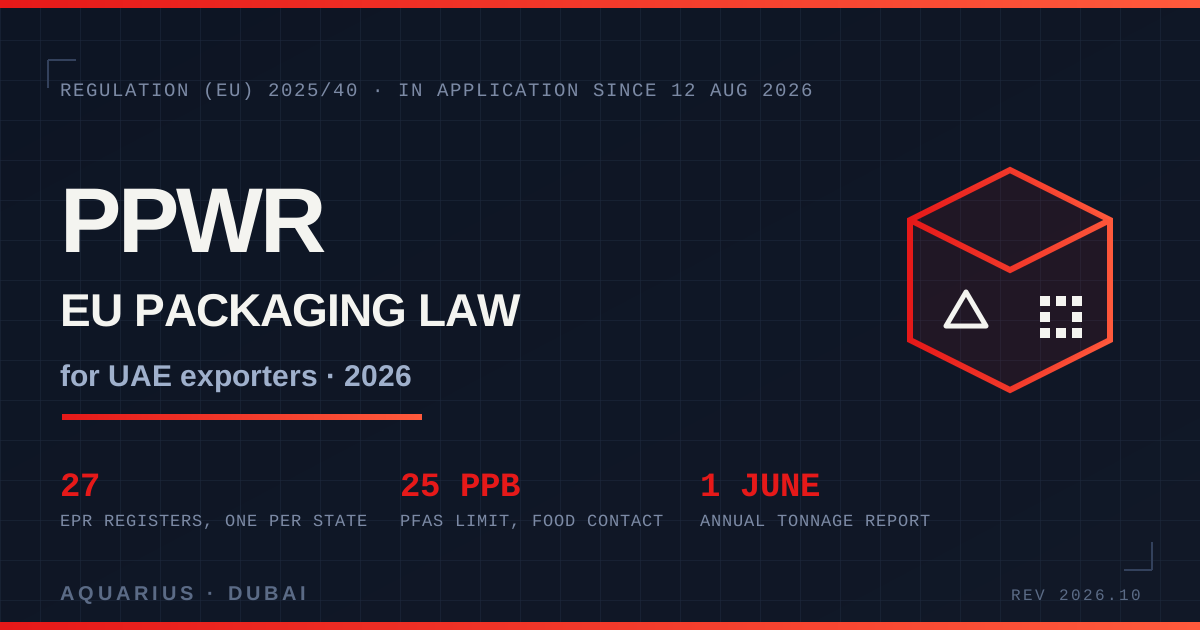
The EU Packaging and Packaging Waste Regulation — Regulation (EU) 2025/40, or PPWR — has applied since 12 August 2026. There was no transition window. If your Dubai, Sharjah or Abu Dhabi business ships packaged goods to European end users, you were required on that date to be registered as a packaging producer in every member state you sell into, with an authorised representative appointed per country under Article 45. Most UAE exporters are not. And the EU’s own simplification package, which looked like a reprieve, deliberately left third-country producers out of it.
This is the compliance item regional exporters are most likely to have missed, for a predictable reason: it looks like a packaging problem, so it lands on the operations or procurement desk. It is actually a registration and data-reporting problem, which is why it stalls. Below is what is already live, what costs what in dirhams, and the deadlines between now and 2040 that decide whether your current box design survives.
Why this matters more to the UAE than to most exporting nations
The UAE packaging industry is a USD 11.38 billion market in 2026, up from USD 10.8 billion in 2025, and forecast to reach roughly USD 14.7 billion by 2031 at a 5.23% CAGR. Paper packaging alone is USD 4.27 billion in 2026; corrugated board is USD 1.48 billion. That is a large domestic converting base producing boxes, cartons, labels and films whose specification is now partly written in Brussels.
On the export side, UAE non-oil foreign trade reached AED 1.937 trillion in the first half of 2026, up 13.1% year on year, with national non-oil exports at a first-half record of AED 452.8 billion, up 23.9%. The EU takes 8.3% of all UAE non-oil trade, worth USD 67.6 billion in 2024. Food, beverages, cosmetics, supplements, electronics accessories and e-commerce consignments all travel in regulated packaging. Every one of those categories is in scope.
The third number is the one that should concentrate minds: 27. PPWR does not create one EU packaging registration. Under Article 44 you register in the national producer register of each member state where you first make packaged products available, and under Article 45 a non-EU producer appoints an authorised representative in each of those states. Selling to buyers in six countries is six registrations, six mandates and six annual reports — not one filing in Brussels.
The simplification that was not for you
Here is the part that has quietly misled a lot of exporters, including some advised by their European counterparties.
On 10 December 2025 the European Commission published COM(2025) 982, part of the Omnibus VIII environmental simplification package. Article 2 of that proposal would suspend Article 45(3) of PPWR until 1 January 2035 — the obligation to appoint an authorised representative when a producer established in the EU sells directly to consumers in another member state. Headlines read “EU suspends packaging representative requirement”. Dubai exporters heard “this went away”.
It did not. The proposed relief covers operators established in the Union. Third-country producers were never inside it. The 12 August 2026 date stands for a UAE company regardless of what the Omnibus does — and on 5 October 2026 the European Parliament’s ENVI committee voted to narrow the suspension further, to EU micro and small companies only.
Two things follow. First, the relief is narrower than the December headlines, so even your small European distributors may not be covered. Second, and more important for a UAE business: a proposal is not law. The suspension applies only once Parliament and Council adopt it and it is published in the Official Journal. Until then the obligation is live, and for non-EU producers it stays live either way.
What is already enforceable today
Three obligations bite right now, not in 2030.
1. PFAS limits in food-contact packaging (Article 5). Since 12 August 2026, food-contact packaging may not be placed on the EU market at or above any of three thresholds: 25 ppb for any individual PFAS by targeted analysis, 250 ppb for the sum of targeted PFAS with prior degradation of precursors, and 50 ppm for total PFAS including polymeric. This hits grease-resistant paperboard, moulded fibre trays and coated films hardest — exactly the formats UAE food exporters and cloud kitchens favour. The long-standing 100 mg/kg combined limit on lead, cadmium, mercury and hexavalent chromium continues.
2. Producer registration and the Declaration of Conformity. Every packaging type needs documented conformity evidence, and packaging must carry the name, registered trade name or trade mark and a postal address of the manufacturer and, where relevant, the importer. Registration numbers then feed marketplace compliance fields — under Article 45 online marketplaces must verify producer registration before allowing sales, which is where enforcement actually lands. The precedent is not theoretical: on 18 August 2025, the EU Battery Regulation deadline, Amazon deactivated non-compliant offers the same day.
3. Annual tonnage reporting. You report quantities by weight, in kilograms, for each packaging category in Annex II Table 1 that you made available for the first time or unpacked, annually by 1 June for the prior calendar year, in each country. Below 10 tonnes per calendar year in a given state, reporting simplifies to seven material groups — glass, plastic, paper and cardboard, ferrous metal, aluminium, wood, other — plus the total.
What it costs in dirhams
Two cost layers, often confused. The first is registration and representation, which is administrative and predictable. The second is EPR scheme fees, which scale with the tonnage you actually place and are eco-modulated by material and recyclability.
| Cost line | EUR | AED (at 4.14) | Note |
|---|---|---|---|
| Registration, Germany (fastest) | 280 / yr | 1,160 / yr | LUCID register, about 1 week |
| Registration, Netherlands | 285 / yr | 1,180 / yr | — |
| Registration, France | 445 / yr | 1,840 / yr | — |
| Registration, Spain | 595 / yr | 2,460 / yr | 4–5 months without a Spanish VAT number |
| Registration, Poland | 675 / yr | 2,795 / yr | BDO register |
| Registration, Italy | 760 / yr | 3,145 / yr | — |
| Registration, Croatia (highest surveyed) | 1,285 / yr | 5,320 / yr | — |
| Article 45 authorised representative | 1,000–5,000 per country / yr | 4,140–20,700 per country / yr | Bundled at the low end, standalone mandates at the high end |
| Multi-country AR package | 5,000–15,000 / yr | 20,700–62,100 / yr | Typically 5–10 markets |
| EPR scheme fees, 50 t mixed packaging, Germany | 10,000–15,000 / yr | 41,400–62,100 / yr | At cost, modulated by material |
Converted at EUR/AED 4.1390 as of 28 October 2026 (October 2026 range 4.1048–4.1492). Add UAE VAT at 5% where a local entity invoices you for the service.
Read the table as a whole and the real finding appears: a six-country European footprint sits somewhere around AED 35,000 to AED 120,000 a year in registration, representation and scheme fees before a single design change. That is not catastrophic. What is catastrophic is lead time — Germany clears in about a week, Greece runs 9 to 17 weeks, and Spain takes four to five months if you lack a Spanish VAT number. A purchase order you want to ship in six weeks cannot wait on a Spanish registration you start today.
Most Dubai exporters get this wrong: it is a data problem, not a packaging problem
Here is the pattern we see. A company budgets for the consultant and the registration fee, then discovers it cannot answer the actual question the register asks: how many kilograms of each Annex II Table 1 packaging category did you place on the market in Spain last year?
Answering that needs a per-SKU bill of materials for packaging — primary, secondary and transport — with component weights in grams, material class, recyclability grade once grading starts, and a destination-country split of shipped units. Almost nobody has this. Component weights live in a supplier email. The box spec lives with the printer. The destination split lives in the ERP but is not joined to packaging. So the annual report becomes a three-week spreadsheet archaeology exercise, in six countries, every year, under a legal declaration.
Build it once and it is a lookup. The data model is small: a packaging component table keyed to SKU with weight, material and recyclability grade; a shipment table with destination country and units; a view that multiplies the two into kilograms per category per country per year. That is a week of engineering against systems you already run — and the same table feeds your Digital Product Passport obligations and the GS1 Digital Link carriers we cover in Sunrise 2027. One dataset, three regimes.
The deadlines that reshape your packaging, not just your paperwork
Everything above is administration. From 2028 the Regulation starts changing what you are allowed to ship.
- 12 February 2027 — EPR scheme membership indicated via a symbol in a QR code (Article 12); HORECA refill systems (Article 32); Commission guidelines on packaging restrictions (Article 25).
- 12 February 2028 — excessive packaging limits and the empty-space ratio bite (Article 24); compostable packaging compatibility standards (Article 9); reusable takeaway options (Article 33).
- 12 August 2028 — harmonised material-composition labelling becomes mandatory (Article 12), or 24 months after the implementing acts enter force, whichever is later. A QR code is optional for the composition label but mandatory for reusable packaging.
- 1 January 2029 — deposit return systems must capture 90% separate collection of the packaging listed in Article 50(1); reusable packaging labels (Article 12).
- 1 January 2030 — recyclability grading mandatory. Grade A is a recyclable mass share of 95% or more, Grade B 80% or more, Grade C 70% or more; below 70% is non-recyclable and barred from the market. Recycled-content minima start under Article 7: 30% for contact-sensitive PET, 10% for contact-sensitive non-PET plastics, 30% for single-use plastic beverage bottles, 35% for other plastic packaging. Annex V single-use format bans, refill stations (Article 28), and reuse targets of 40% for transport packaging and 10% for beverages (Article 29). Per-capita packaging waste down 5% against 2018.
- 1 January 2035 — packaging must additionally be “recycled at scale”, meaning real collected and sorted volumes, not just design intent. Per-capita waste down 10%.
- 1 January 2038 — only grades A and B remain. Grade C packaging is out.
- 1 January 2040 — recycled content rises to 50% contact-sensitive PET, 25% contact-sensitive non-PET, 65% for single-use beverage bottles and other plastic packaging. Reuse targets reach 70% transport and 40% beverages. Per-capita waste down 15%.
Note the compounding detail: recyclability grade will modulate your EPR fees, starting 18 months after the relevant delegated and implementing acts enter force. A grade C laminate does not merely survive until 2038 — it costs more every year until it is banned. That changes the payback maths on redesigning a pouch today.
The UAE side is moving in the same direction
None of this is a purely European problem you can wall off from your domestic line. The UAE banned single-use plastic bags in 2024, extended restrictions through 2025, and from 1 January 2026 prohibited the import, manufacture and trade of single-use plastic cups and lids, cutlery, plates, straws, stirrers and Styrofoam food containers, completing the rollout under Executive Council Resolution No. 124 of 2023. Bags under 50 microns are banned nationwide regardless of material. MOCCAE is piloting an EPR scheme for packaging waste.
So the choice is not EU compliance versus domestic simplicity. It is whether you build one packaging dataset that serves both, or two that disagree. Businesses already costing boxes for the local market will recognise the inputs from our custom packaging box printing cost guide; PPWR just adds material class and weight precision to a spec you already hold.
How Aquarius builds the digital half
We are not a compliance consultancy and we do not act as your authorised representative — appoint a specialist firm in each market for that, and do it before you quote your next European order. What we build is the system that makes the filing a query instead of a project: a packaging bill of materials registered against every SKU with component weights, material classes and grades; a destination-country shipment join that produces Annex II Table 1 kilograms per state per year; QR and GS1 Digital Link carriers ready for the 2027 and 2028 labelling dates; Declaration of Conformity and supplier-evidence storage that survives a market surveillance request; and dashboards that flag which SKUs fall below grade C before 2030 does it for you.
The cost of inaction is concrete rather than abstract. Penalties are set by each member state and must be effective, proportionate and dissuasive, so the exposure is 27 regimes, not one ceiling — but the enforcement that actually stops revenue is commercial: suppressed or delisted marketplace offers, customs intervention, and an EU importer who refuses the consignment because verifying your compliance is their own legal duty. Against AED 452.8 billion of non-oil exports growing at 23.9%, a pallet that cannot clear is not a fine. It is a cancelled order plus return freight.
Our services and pricing pages set out the ranges for this kind of build. One session is usually enough to tell whether you need a full packaging data layer or a reporting view on top of the ERP you already have.
Frequently asked questions
Does PPWR apply to a UAE company with no EU entity?
Yes, where you place packaging or packaged products on the EU market. If you sell directly to EU end users by distance contract — your own webshop, a marketplace, direct fulfilment — you are the producer and Article 45 requires an authorised representative in each member state where the packaging first reaches the market. If you sell B2B to an EU importer who then makes the goods available, the EU importer generally carries the registration. Confirm which model each contract actually is, in writing, because the two look identical on an invoice.
Did the EU not suspend the authorised representative requirement?
Only as a proposal, only for Article 45(3), and only for producers established in the Union. COM(2025) 982 of 10 December 2025 would suspend that paragraph until 1 January 2035, and on 5 October 2026 ENVI voted to narrow it to EU micro and small companies. It is not in the Official Journal, and non-EU producers were excluded from the relief from the start. The 12 August 2026 obligation stands for a UAE exporter.
Do I need one registration for the whole EU?
No. Registration is per member state under Article 44, with separate national registers, separate fee structures and separate reporting formats — Germany’s LUCID, Poland’s BDO and so on. A single service provider can cover several countries, but the registrations themselves remain national.
We ship under 10 tonnes of packaging a year. Are we exempt?
Not exempt — simplified. Below 10 tonnes in a calendar year you report against seven material groups rather than the full Annex II Table 1 category list, plus a total. Registration, the authorised representative, the Declaration of Conformity, PFAS limits and the 1 June reporting date all still apply.
Does my existing packaging have to change before 2030?
Food-contact packaging has to meet the PFAS limits now. Labelling changes land in 2027 and 2028. Empty-space and excessive-packaging limits apply from 12 February 2028. The recyclability grade and recycled-content rules start 1 January 2030, but since grade will modulate your EPR fees ahead of the ban, a low-grade format starts costing money well before it becomes illegal.
The short version
PPWR is not coming. It arrived on 12 August 2026. Registration is per country, the authorised representative duty for non-EU producers survived the simplification package intact, PFAS limits are enforceable today, and the 1 June tonnage report is a data question your current systems probably cannot answer. The packaging redesign deadlines run 2028 to 2040, and EPR fee modulation makes the cheap format expensive long before it is banned.
If you export packaged goods from the UAE into Europe, the first move is a packaging bill of materials with real weights and a destination split. Talk to Aquarius and we will scope that dataset against the systems you already run.