
Event and Conference App Development in Dubai (2026): Real AED Costs, DET Permits and the AED 25 Billion Market Behind Them
DWTC events generated AED 25.03 billion in 2025 across 2.18 million attendees. What a branded event or conference app really costs to build in Dubai, plus DET ePermit and PDPL badge-scan rules.
- PUBLISHED
- 08 OCT 2026
- READ TIME
- 12 MIN
- AUTHOR
- AQUARIUS · DUBAI
- UNIT
- REV 2026.09
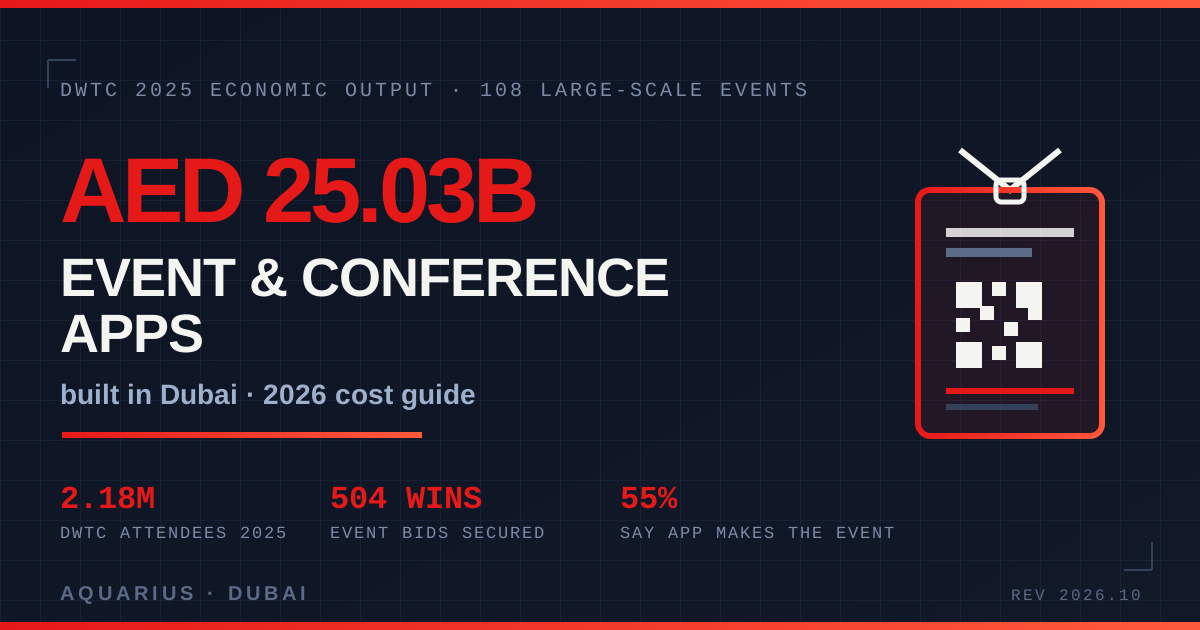
Short answer: A branded event or conference app in Dubai costs roughly AED 37,000 for a lean attendee app, AED 90,000–220,000 for the mid-tier most Dubai organisers actually need (agenda, QR check-in, lead capture, push, sponsor placements), and AED 220,000–400,000+ for a multi-event platform with AI matchmaking and analytics. The reason it is worth building rather than renting: Dubai World Trade Centre alone generated AED 25.03 billion in economic output from 108 large-scale events in 2025, and 55% of attendees say the mobile app can make or break their experience. Renting a per-event SaaS licence costs AED 3,700–73,500 a year and you hand over the attendee data every time.
Key takeaways
- The market justifies the build: DWTC events produced AED 25.03 billion of economic output in 2025, up 12% year on year, across 2.18 million attendees — 947,000 of them from overseas.
- The pipeline is already booked: Dubai Business Events secured 504 successful bids in 2025 for events running through 2029, bringing an expected 272,262 delegates — a 29% jump in delegate numbers.
- The app is no longer optional: 73% of attendees expect modern event tech and 55% say the app decides their experience. Networking, live polls and matchmaking are now baseline, not premium.
- UAE software spend is compounding at 15.7%: the UAE event management software market is USD 319.4 million in 2026, heading to USD 663.3 million by 2031.
- Two Dubai-specific gates: a DET ePermit before you sell a single ticket (3–15 working days, 60–90 days lead time for large exhibitions), and PDPL duties the moment you scan a badge.
Dubai sells more business events than it has software to run them
Start with the scale, because it is the part most organisers underestimate when they budget for technology.
- AED 25.03 billion of economic output. Dubai World Trade Centre's 2025 calendar of 108 large-scale events delivered a record AED 25.03 billion, a 12% rise year on year. Direct spending across adjacent sectors hit AED 13.48 billion — accommodation AED 3.79bn, travel and transport AED 2.98bn, retail AED 2.55bn, F&B AED 2.1bn. That activity supported over 94,000 jobs.
- 2.18 million attendees, 947,000 from abroad. International attendees stayed an average 5.6 days per event and brought 22 companions per 100 attendees. Every one of them is a user session your app has to survive on hotel Wi-Fi and roaming data.
- A booked pipeline to 2029. Dubai Business Events submitted 747 bids in 2025 and won 504 — up 15% on 2024 — worth an expected 272,262 delegates. Dubai also took the #1 ICCA ranking globally for highest attendee numbers per association conference in 2025.
- The anchor case: GITEX GLOBAL 2025 ran its 45th edition at DWTC with 6,800 exhibitors, 2,000 startups, 1,200 investors, delegations from 180+ countries and 200,000+ visitors across five days.
Here is what most Dubai organisers get wrong. They treat the app as event signage — a digital brochure commissioned six weeks out, printed once, thrown away after. The money is not in the agenda screen. It is in the record: who came, which sessions they sat through, which exhibitor stands they scanned into, what they asked for, and whether they came back next year. Rent that record from a per-event SaaS vendor and you rebuild your audience from zero every cycle. Own it and the second edition starts with a warm list, which is the only reason an app ever pays for itself.
What a Dubai event app actually has to do
Features split cleanly into three tiers. The honest answer for a Dubai organiser running two to four events a year is tier two, built once and reused.
| Tier | Core features | Build cost (AED) | Timeline |
|---|---|---|---|
| Lean attendee app | Agenda, speakers, venue map, push notifications, bilingual EN/AR | 37,000–90,000 | 4–7 weeks |
| Mid-tier (most Dubai events) | Above plus QR badge check-in, exhibitor lead capture, live polls and Q&A, personal schedules, sponsor placements, CRM sync | 90,000–220,000 | 8–14 weeks |
| Multi-event platform | Above plus AI matchmaking, organiser analytics dashboard, multi-event and multi-tenant, offline-first scanning, exhibitor self-service portal | 220,000–400,000+ | 16–24 weeks |
| Rent instead (SaaS) | Templated app, vendor-hosted, vendor owns the data | 3,700–73,500 / year enterprise 184,000+ | 2–4 weeks |
Four requirements are specific to running an event in Dubai, and they are the ones templated SaaS handles worst:
- Arabic and RTL as a first-class layout, not a toggle. Mixed EN/AR agendas, Arabic speaker names inside Latin session titles, and right-to-left navigation that does not mirror the venue map incorrectly. Retrofitting RTL after the fact routinely costs more than building it in.
- Offline-first badge scanning. DWTC halls at GITEX scale put tens of thousands of devices on the same network. A scanner that needs a live connection to validate a badge will fail at the door queue. Scanning has to write locally and sync later.
- WhatsApp over email for reminders. UAE delegates open WhatsApp; they do not open conference email. Session reminders, gate changes and no-show recovery belong on the WhatsApp Business API, with push as the backup.
- Exhibitor economics built in. Sponsors do not pay for logo placement any more. They pay for scanned, attributable leads delivered into their CRM before they fly home. 79% of organisers have now wired their event platform into a CRM or marketing automation stack.
On engagement: where community features such as in-app chat and discussion spaces exist, 47.3% of attendees actively participate, generating an average of 500+ messages per event, and personalised content paths lift app usage 25% with 15% higher satisfaction. Those are the numbers you quote back to a sponsor at renewal.
The two Dubai gates: DET ePermit and PDPL
The permit comes before the ticket link. Any organiser holding a public event in Dubai — business, entertainment, sport, charity or religious — needs approval from the Department of Economy and Tourism through the ePermits portal. You cannot promote, sell tickets or hold the event without it. Processing runs 3 to 15 working days depending on type, scale and how many other authorities must sign off; practical lead time is around 30 days for a standard corporate event and 60 to 90 days for concerts and large exhibitions. Expect to supply a valid UAE trade licence, venue NOC, event details, speaker or artist IDs, a security plan and your ticketing platform integration details. That last item is why the ticketing and app build needs to start before the permit, not after it. Ramadan editions carry extra DET conditions on timings and content.
The moment you scan a badge, you are a data controller. A badge scan captures name, employer, job title, email, phone and often passport nationality — personal data under the UAE Personal Data Protection Law. Three obligations catch event apps specifically:
- Consent has to be specific. "By attending you agree to receive communications" does not cover handing a lead record to 40 separate exhibitors. The scan screen needs to name what is shared and with whom, and log that consent per scan.
- Sponsors are processors, not owners. Every exhibitor receiving leads needs a data processing agreement. Exporting a CSV to a WhatsApp group is the single most common breach we see after a Dubai expo.
- Deletion has to be possible. A delegate can ask for their record out. If leads live only in 40 exhibitors' spreadsheets, you cannot comply. Our PDPL compliance checklist for websites and apps covers the build-side controls in detail.
Does it pay? The AED maths per event
The break-even is simpler than it looks, because an event app has three revenue lines, not one: sponsor lead packages, retained audience for the next edition, and saved registration labour at the door.
| Event size | Mid-tier app build (AED) | Sponsor lead packages that cover it | Door staff saved (AED / event) |
|---|---|---|---|
| 400 delegates, 1 edition / year | 90,000–140,000 | 8–12 at AED 12,000 | 6,000–12,000 |
| 2,000 delegates, 2 editions / year | 140,000–220,000 | 14–20 at AED 12,000 | 18,000–35,000 |
| 10,000+ visitors, multi-hall expo | 220,000–400,000 | Lead capture sold per exhibitor | 60,000–120,000 |
The ROI conversation has also changed in the organiser's favour. In 2026 only 40% of organisers report difficulty proving event ROI, down from 70% a year earlier — because the scan data finally exists. That is the number to put in front of a finance director who thinks the app is a marketing nice-to-have: without it you are selling sponsorship on footfall estimates; with it you sell attributable leads at a higher price, every edition, forever.
How Aquarius runs an event build. One codebase, reused across your editions rather than rebuilt per event. We start with the data model — delegate, session, exhibitor, scan — because that is what you keep. Then the attendee app and the scanner app ship together and get load-tested against a simulated door queue before the permit window closes. Arabic RTL is QA'd as a separate pass, not assumed. Sponsor lead delivery runs on an SLA with PDPL consent logged per scan, so your legal review is a document and not an argument. App Store and Play review timings are built backwards from your event date, with a web fallback that works if either store stalls. Published ranges are on our pricing page, and if you also need paid registration and seat inventory, read what an event ticketing platform costs in Dubai first — the two builds share a backend and cost materially less together than apart.
FAQ
How much does an event app cost in Dubai in 2026?
Roughly AED 37,000–90,000 for a lean attendee app (agenda, speakers, map, push), AED 90,000–220,000 for the mid-tier most Dubai organisers need with QR check-in, exhibitor lead capture and CRM sync, and AED 220,000–400,000+ for a multi-event platform with AI matchmaking and analytics. Renting a SaaS event app instead runs AED 3,700–73,500 a year, with enterprise contracts above AED 184,000.
Should I build my own event app or rent a platform?
Rent for a one-off event you will never repeat. Build if you run two or more editions a year, sell sponsorship on lead quality, or need the attendee database as an asset. The deciding factor is rarely cost — it is whether you keep the delegate record. SaaS vendors keep it, which means each edition restarts your audience from zero.
Do I need a permit before launching event registration in Dubai?
Yes. A DET ePermit is required before you promote an event or sell tickets in Dubai, and the application asks for your ticketing platform integration details. Approval takes 3 to 15 working days; allow around 30 days' lead time for a standard corporate event and 60 to 90 days for a concert or large exhibition.
Does PDPL apply to badge scanning and lead capture?
Yes. A badge scan collects personal data, so you need specific consent naming who the lead is shared with, a data processing agreement with every exhibitor receiving leads, and a way to honour a deletion request. Emailing or WhatsApp-ing a lead CSV to sponsors without those controls is the most common post-expo compliance failure in Dubai.
How long does it take to build an event app before a Dubai conference?
Four to seven weeks for a lean app, 8 to 14 weeks for the mid tier, and 16 to 24 weeks for a multi-event platform. Add one to two weeks for App Store and Google Play review, and start at least 12 weeks before the event so the build finishes before your DET permit and marketing push, not after.
What features do Dubai attendees actually use?
Personal schedule, venue navigation, push and WhatsApp reminders, and networking. 73% of attendees expect modern event technology and 55% say the app can make or break their experience; where in-app community features exist, 47.3% participate actively, averaging more than 500 messages per event. Agenda-only apps get opened once and deleted.