
UAE E-Invoicing ERP Integration (2027): The 30 October ASP Deadline, 51 PINT AE Fields and Real AED Costs
UAE Phase 1 businesses must appoint an accredited ASP by 30 October 2026 and go live 1 January 2027. The 51 mandatory PINT AE fields, real AED integration costs and the penalties.
- PUBLISHED
- 26 SEPT 2026
- READ TIME
- 13 MIN
- AUTHOR
- AQUARIUS · DUBAI
- UNIT
- REV 2026.09
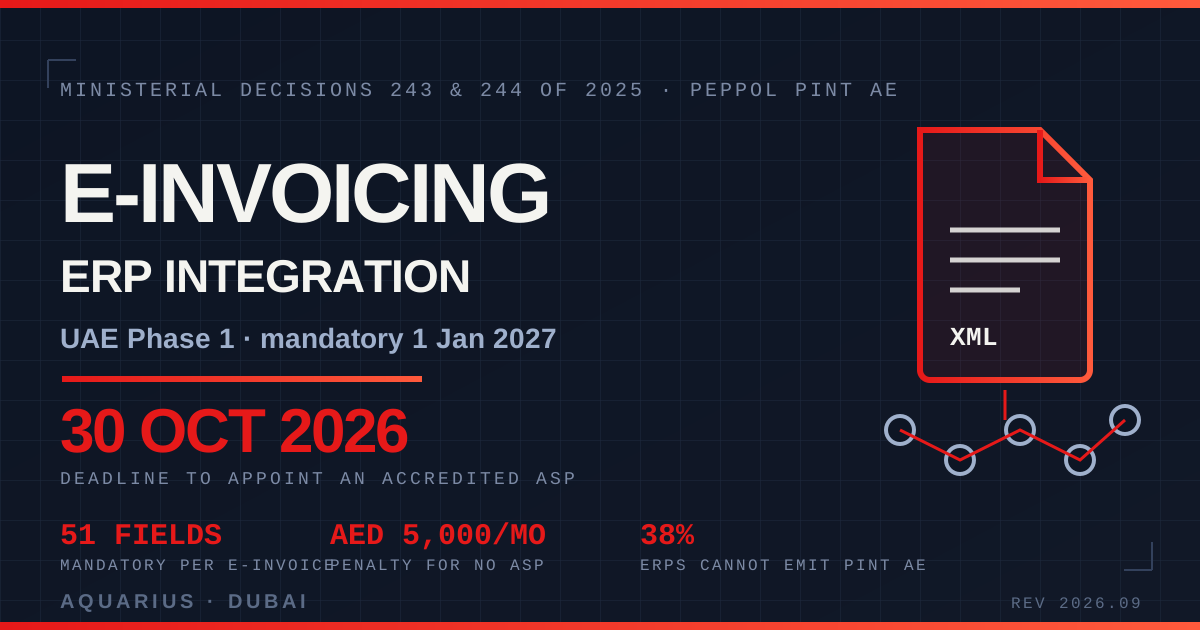
Short answer: if your UAE business turned over AED 50 million or more, you must appoint an FTA-accredited Service Provider (ASP) by 30 October 2026 and start issuing structured e-invoices from 1 January 2027. Everyone else appoints an ASP by 31 March 2027 and goes live 1 July 2027. Missing the appointment costs AED 5,000 per month, and every invoice you fail to transmit adds AED 100, capped at AED 5,000 a month. Signing the ASP contract is the easy half — the hard half is making your ERP emit 51 mandatory fields of valid PINT AE XML.
That second half is where Dubai finance teams are quietly running out of runway. An ASP is a licensed pipe. It does not invent your customer’s Tax Identification Number, it does not classify your free-zone sales, and it will reject an invoice your ERP has been printing without complaint for nine years.
Key takeaways
- 30 October 2026 is the real deadline for Phase 1 (revenue ≥ AED 50m) — ASP appointed, not merely shortlisted. Go-live is 1 January 2027.
- National readiness sits at 57.5%, and 38.0% of surveyed UAE businesses say their ERP has zero native ability to produce a compliant PINT AE XML invoice.
- The Ministry of Finance list carried 56 accredited and 8 pre-approved ASPs as of 25 September 2026. All accredited providers passed identical testing — so choose on integration fit, not on the badge.
- It is a 5-corner Peppol DCTCE model: you → your ASP → their ASP → your buyer, with tax data reported separately to the FTA. A PDF emailed to a client is no longer an invoice.
- B2B and B2G are in scope regardless of VAT registration. B2C is excluded for now.
- Budget two buckets: ASP subscription (market range AED 5,000–50,000 per month, around AED 0.75 per invoice) plus a one-off ERP integration project. Done properly, invoice processing cost falls by up to 80%.
Where the UAE actually stands, three months out
The mandate is not a rumour any more. Ministerial Decisions No. 243 and 244 of 2025 fixed the scope and timeline, the pilot opened on 1 July 2026, and the Ministry of Finance published the mandatory-field specification on 23 February 2026. The infrastructure is live. The businesses are not.
A 2026 readiness study of more than 500 UAE CFOs, tax directors and financial controllers put national readiness at 57.5% — a “developing” grade — and the detail is worse than the headline:
- 38.0% report their ERP cannot generate a compliant PINT AE XML invoice at all.
- 60.5% have not yet run an ERP gap analysis — the single task that tells you how big the project is.
- 70.4% cannot automatically process the responses that come back from the tax authority, so rejections get discovered by a human, late.
- 73.3% have no post-go-live operating model: nobody owns a failed transmission on 4 January 2027.
Read those together and the risk is obvious. Awareness is near-universal; the plumbing is half-built. The companies that will have a calm January are the ones treating this as a data project with a tax deadline, not a procurement exercise.
The four dates that decide your project plan
| Who you are | Appoint ASP by | E-invoicing mandatory from |
|---|---|---|
| Revenue ≥ AED 50,000,000 (Phase 1) | 30 October 2026 | 1 January 2027 |
| Revenue < AED 50,000,000 (Phase 2) | 31 March 2027 | 1 July 2027 |
| Government entities | 31 March 2027 | 1 October 2027 |
| Voluntary adopters | Any time (pilot opened 1 July 2026) | No fines until your phase bites |
Two things trip people up. First, the threshold is revenue, not VAT turnover and not profit — group structures with several licences need to test each taxable person separately. Second, scope follows the transaction, not your VAT status: B2B and B2G invoices are in scope whether or not you are VAT-registered. B2C stays out for now, as do government sovereign activities, international passenger air transport tickets, airline ancillary services issued as EMDs, international air cargo (excluded for 24 months) and exempt or zero-rated financial services.
How an invoice will actually travel from 1 January 2027
The UAE chose a Decentralised Continuous Transaction Control and Exchange (DCTCE) design on Peppol rails — the “5-corner model”. In order: your system issues the invoice; your sender ASP validates and signs it; the receiver ASP delivers it to your buyer; and tax data is reported to the FTA e-billing system in parallel.
Three consequences your developers care about:
- XML or nothing. The exchange format is Peppol PINT AE, which is UBL-based. A PDF is a human convenience, not the legal document, and cannot be the thing you transmit.
- Your address is your TIN. The Peppol participant identifier is scheme 0235 plus your 10-digit Tax Identification Number — the first 10 digits of your corporate tax registration number. Businesses not required to register for corporate tax still need a TIN to be addressable on the network.
- Validation happens at creation, not at filing. A missing or invalid TIN, a wrong country code or an absent tax category blocks the document before it moves. There is no “fix it in the return”.
Corrections change too: you cannot reverse a document with a negative line any more. Document type codes are explicit — 380 tax invoice, 381 tax credit note, 480 out-of-scope commercial invoice, 81 out-of-scope credit note — and an error is fixed with a credit note that references the original.
The 51 fields your ERP has never been asked for
The Ministry of Finance specification requires 51 mandatory fields for a tax e-invoice and 49 for an out-of-scope commercial invoice. Most of that data already exists somewhere in your business. The project is the “somewhere”.
The gaps in Dubai ERPs are boringly consistent:
- Customer master data holds a trading name and a mobile number, but not the registered legal name, a structured address, or the buyer TRN.
- No TIN column at all — the field the entire routing model depends on.
- Tax categories are implied by a GL code rather than stored as a code the validator understands, so zero-rated exports and standard-rated local sales look identical to an XML mapper.
- Free-zone and export transactions are untagged. The UAE profile uses a flag structure to signal features such as free trade zone treatment and margin schemes; if nothing in your data says “designated-zone supply”, nothing can set it.
- Invoices are issued from more than one place — the ERP, a billing platform, a POS, a project system, a spreadsheet in the Jebel Ali office. Each one is a separate integration, or a separate compliance hole.
That last point is the usual budget shock. Teams scope “connect the ERP” and then discover a fifth of revenue is invoiced somewhere else entirely. Run the inventory before you sign anything — the same discipline our ERP implementation cost guide for Dubai applies to any core-system change.
What e-invoicing compliance costs in AED
You will pay two invoices: a recurring one to your ASP, and a one-off one for integration. ASP pricing in the 2026 UAE market spans roughly AED 5,000 per month at micro volumes to AED 50,000 per month at large-enterprise scale, with published tiers landing near AED 6,500 / 15,000 / 30,000 per month, plus about AED 0.75 per invoice and volume discounts above 5,000 documents a month.
Integration is where the variance lives. Our scoping ranges for UAE clients:
| Integration scope | Typical build (AED) | Timeline | Best for |
|---|---|---|---|
| Single-source connector (one ERP, ASP API, transmission plus retries) | 18,000–35,000 | 2–4 weeks | One invoicing system, clean master data |
| Connector plus master-data remediation (TIN and TRN capture, tax-category mapping, validation at entry) | 35,000–75,000 | 4–8 weeks | Most Phase 1 SMEs and mid-market groups |
| Multi-source middleware (ERP + POS + billing platform, queueing, response handling, audit trail) | 75,000–180,000 | 8–14 weeks | Retail, contracting, multi-entity groups |
| Legacy or in-house system with no API surface | from 120,000 | 12 weeks+ | Bespoke accounting systems, older on-prem builds |
Set that against the upside, which is real: standardised, machine-readable invoicing is documented to cut invoice processing costs by up to 80%, most of it on inbound supplier invoices your team currently keys in by hand. A finance team of four losing a third of its month to invoice admin is the line item that pays this project back.
The penalties, in plain numbers
The administrative penalty schedule (Cabinet Decision No. 106) is cheap per event and brutal when ignored:
| Failure | Penalty |
|---|---|
| Not implementing e-invoicing or not appointing an ASP by your deadline | AED 5,000 per month of delay |
| Not issuing or transmitting an e-invoice or credit note | AED 100 per document, capped at AED 5,000 per month |
| Failing to notify a system failure | AED 1,000 per day |
| Failing to update registered data | AED 1,000 per day |
Businesses adopting voluntarily during the pilot sit outside the penalty regime until their phase becomes mandatory — a genuine argument for going early rather than late. The uncapped risk was never the fine anyway: it is a buyer’s accounts-payable system rejecting your invoice in February, so a seven-figure receivable sits unpaid while somebody re-maps a tax category.
How Aquarius runs an e-invoicing integration
We treat it as four sprints, not a software purchase.
- Week 1 — inventory and gap analysis. Every system that issues a document, mapped against the 51 mandatory fields. You get a written gap list, which is also the first thing your ASP will ask for.
- Weeks 2–3 — master data. TIN and TRN capture enforced at the point of entry, structured addresses, tax categories stored as codes, free-zone and export flags applied to historical customers.
- Weeks 3–6 — the connector. PINT AE XML generation, ASP API transmission, idempotent retries, and — the part 70.4% of the market has skipped — automated handling of acknowledgements and rejections back into the ERP, on a dashboard a controller can read.
- Before go-live — pilot volume. Real invoices through the pilot environment, credit-note and self-billing flows tested, five-year retrievable archiving confirmed.
We work alongside whichever accredited ASP you choose — the list runs to 56 providers and the right one depends on your ERP, not on marketing. Fixed scope, fixed price, and the integration code is yours. See our pricing or book a 30-minute readiness call. If you are in Phase 1 and have not started, that call is worth more this week than next month.
FAQ
Do I need an ASP if I am not VAT-registered?
Yes, if you issue B2B or B2G invoices. Scope follows the transaction type, not your VAT registration. You will also need a Tax Identification Number to be addressable on the network, even if you are not required to register for corporate tax.
Can I keep sending PDF invoices to my customers?
You can keep sending a PDF as a courtesy copy, but it is not the legal invoice. From your mandate date, the compliant document is structured PINT AE XML exchanged through accredited service providers, and records kept for the statutory five years must be retrievable by the FTA.
My ERP vendor says it is e-invoicing ready. Is that enough?
Rarely. “Ready” usually means the vendor can emit an XML file given perfect data. It does not mean your customer master holds TINs, that your tax categories are coded, or that rejections flow back into your ledger. Run the gap analysis first — 60.5% of UAE businesses still have not, which is exactly why go-live dates slip.
What if my supplier is in Phase 2 and not live until July 2027?
Your obligation is your own issuing side, so Phase 1 companies go live on 1 January 2027 regardless. Expect a mixed period where some inbound invoices arrive electronically and others do not, and plan accounts payable for both. Assessing critical suppliers early is the cheapest way to avoid surprises.
How long does an integration realistically take?
A single clean ERP connector is 2–4 weeks. Most Phase 1 businesses land at 4–8 weeks once master-data remediation is included, and multi-source environments run 8–14 weeks. Working back from 1 January 2027, a multi-source group starting after October is already compressed.
Is voluntary early adoption worth it?
For Phase 1 businesses, yes. Voluntary adopters are outside the penalty regime until their mandate date, so the pilot is a free rehearsal where a failed transmission costs nothing but time.
Still working out how invoicing fits your wider stack? Our guides to VAT-compliant invoicing for UAE stores and corporate tax accounting software in Dubai cover the layers either side of this one.