
Franchise Management Software in Dubai (2026): Royalties, the Register Myth and Real AED Costs
The UAE franchise market is worth over AED 40 billion across 600+ international brands, yet most Dubai franchisors still calculate royalties in a spreadsheet. Real costs, real deadlines.
- PUBLISHED
- 23 SEPT 2026
- READ TIME
- 11 MIN
- AUTHOR
- AQUARIUS · DUBAI
- UNIT
- REV 2026.09
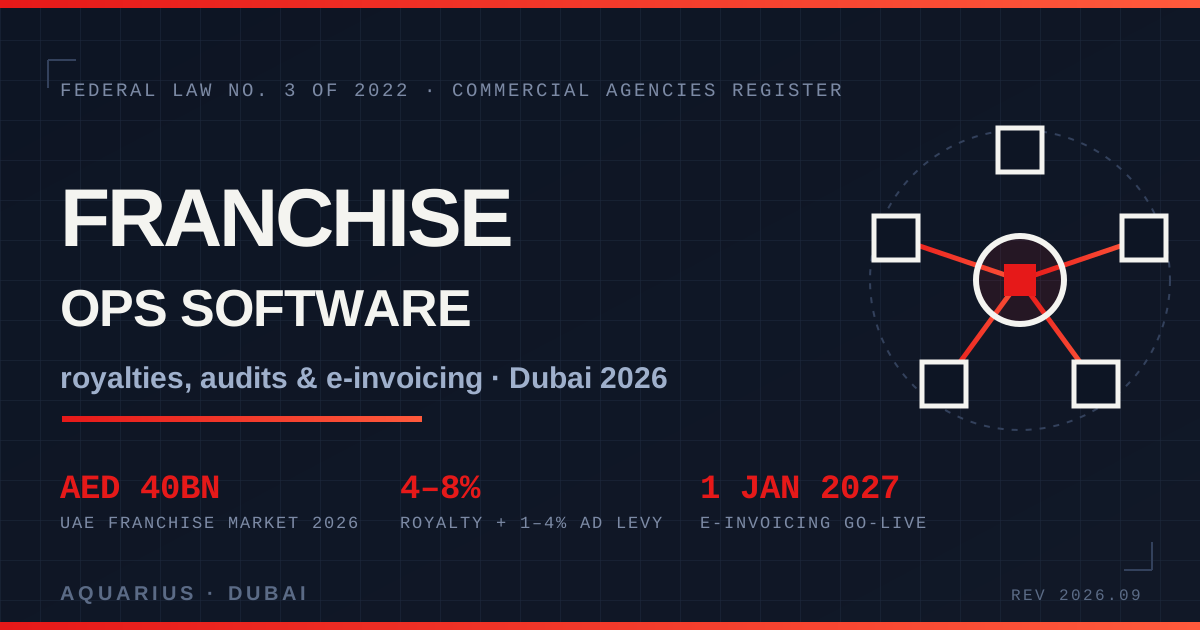
Short answer: Franchise management software in Dubai costs AED 70,000–160,000 for a royalty and reporting portal, AED 180,000–450,000 for a full operations platform, and AED 500,000–1.2M+ for a multi-country master-franchise system — against off-the-shelf platforms that charge roughly AED 735–1,835 per outlet per month. The decision is not really about software. It is about whether your royalty number can survive an FTA transfer-pricing question and a 1 January 2027 e-invoicing go-live, because in the UAE your franchise agreement is the only regulator you have.
Here is the part most Dubai franchisors have never been told: the UAE has no franchise law and no franchise register. People cite “Federal Law No. 3 of 2022” as if it were a franchise statute. It is not. It is the Commercial Agencies Law, in force since 15 June 2023, replacing Federal Law No. 18 of 1981. Franchising falls inside its definition of representation, but there is no standalone franchise registry at the Ministry of Economy — only the commercial agencies register, which carries an AED 7,500 registration fee and which only UAE nationals or entities wholly owned by UAE nationals (or qualifying public joint-stock companies) can enter at all.
Key takeaways
- The market is big and still manual. The UAE franchise market is valued at over AED 40 billion in 2026 with more than 600 international brands operating, and the Abu Dhabi Chamber puts sector revenues at roughly USD 27.2 billion growing about 15% a year.
- Your contract is the enforcement mechanism. No franchise register exists. What does exist is the commercial agencies register — and once an agency is registered, statutory protections bite hard: a minimum five-year term where the agent builds showrooms, and termination notice of one year or half the contract term, whichever is less.
- Registration cuts both ways. Selling around a registered agent exposes a principal to fines of AED 100,000 to AED 400,000 after warning, plus seizure of goods by UAE Customs.
- Two 2026–2027 deadlines change the data model. The UAE e-invoicing pilot opens 1 July 2026; businesses with revenue of AED 50 million or more go live 1 January 2027 and SMEs on 1 July 2027, all in PINT AE structured XML through an accredited service provider. The ASP appointment deadline for large businesses moved from 31 July 2026 to 30 October 2026.
The stakes: AED 40 billion, 600 brands, and one spreadsheet per network
Franchising in the UAE is no longer a side channel. The market exceeds AED 40 billion in 2026 with 600+ international brands trading across the Emirates, and Dubai carries the bulk of it — Dubai Municipality lists more than 12,000 licensed food outlets in 2026 alone, and the UAE has over 3,200 coffee shops. Add fitness studios, enrichment centres, clinics and home-services brands and you get thousands of individually owned units all trading under someone else’s trademark.
Every one of those units owes money upward. The standard Dubai structure is a 4–8% royalty on gross sales plus a 1–4% marketing levy, billed monthly, forever. Run that against a modest 20-outlet network doing AED 400,000 a month per outlet and you are invoicing roughly AED 400,000–800,000 of royalty every month on numbers that, in most Dubai networks, arrive by WhatsApp photo of a POS Z-report.
Most Dubai franchisors get this wrong: they treat the royalty calculation as accounting admin. It is not. It is the revenue engine of the entire franchisor entity, it is a related-party transaction under UAE corporate tax, and from 2027 it has to be issued as machine-readable XML. A spreadsheet that three people edit is not an adequate control for any of those three facts.
What franchise management software actually has to do in the UAE
Generic franchise platforms are built for US networks. They assume one currency, one tax regime, one language and no agency law. A Dubai network needs five modules, and only two of them are on a typical vendor’s demo.
1. Sales capture that the franchisee cannot edit
Royalty disputes start where trust starts: self-reported sales. The fix is a direct POS integration per outlet — pulling gross sales, VAT, discounts, voids and refunds nightly — so the royalty base is derived, not declared. If a brand cannot integrate a franchisee’s POS, the contract should require one it can.
2. Royalty and levy engine with VAT logic
Royalty is a taxable supply. Where the franchisor sits offshore and the Dubai franchisee pays royalties abroad, the franchisee accounts for 5% VAT under the reverse charge mechanism on imported services per Article 48 of the VAT Law — a self-assessment that has to appear correctly in the return even though no supplier charged it. Software that just multiplies sales by a percentage will get the tax treatment wrong on exactly the transactions the FTA is most interested in.
3. Operations audits and brand compliance
Mystery-shop scores, food-safety checklists, photo evidence, corrective actions with owners and deadlines. For F&B networks this is where Dubai Municipality inspection exposure lives, and it is the module that pays for itself the first time a single outlet does not cost the brand a grading downgrade.
4. Bilingual training and document control
Arabic and English parity across the operations manual, with version history and read-receipts. If you cannot prove a franchisee received the current standard, you cannot enforce it — and under the agency law you may be locked into a five-year relationship with them regardless.
5. Pipeline and unit economics
Franchise-lead CRM, territory mapping, and a per-outlet P&L view. Network expansion decisions made on royalty totals alone hide the four units that are quietly destroying brand equity.
Buy or build: the real AED comparison
The global franchise management software market was worth about USD 1.7 billion in 2024 and is forecast to reach roughly USD 4.5 billion by 2034 at around 10.2% annual growth — healthy, but almost entirely built for North America. Established platforms price per franchisee: FranConnect is commonly quoted at USD 200–500 per franchisee per month (about AED 735–1,835), with smaller plans in the USD 1,000–2,000 per month range (roughly AED 44,000–88,000 a year) before implementation.
That per-unit model is the whole decision. At 8 outlets, renting is obviously right. At 40 outlets you are paying something near AED 350,000–880,000 a year, every year, for software that still does not speak PINT AE, Arabic or reverse-charge VAT. Below are our 2026 delivery bands for custom UAE franchise systems.
| Build tier | AED cost | Timeline | Best for |
|---|---|---|---|
| Royalty & reporting portal (POS capture, royalty/levy engine, statements, VAT logic) | AED 70,000–160,000 | 6–10 weeks | Networks of 5–25 outlets ending the spreadsheet |
| Full franchise operations platform (+ audits, tasks, training, document control, lead pipeline) | AED 180,000–450,000 | 4–7 months | 25–100 outlets, one country, bilingual teams |
| Master-franchise platform (multi-entity, multi-currency, e-invoicing-ready, BI layer) | AED 500,000–1,200,000+ | 8–14 months | GCC master franchisees and UAE brands exporting |
| Annual run cost (hosting, support, integrations, tax-rule upkeep) | 15–20% of build per year | Ongoing | Everyone — budget it or the integrations rot |
For context on what the units themselves cost: a mid-market Dubai cafe franchise typically lands near AED 975,000 before opening — AED 150,000 franchise fee, AED 600,000 fit-out, AED 25,000 licence and AED 200,000 working capital — on top of a DET mainland trade licence running from about AED 12,500 for a single-activity professional licence to AED 38,000+ for a four-activity commercial one. A network that can fund ten of those can fund the system that governs all ten. Our engagement models are on the pricing page.
The 2027 deadline that quietly rewrites your invoicing
This is the BOFU number to take to your board. Under the Ministry of Finance mandate, UAE e-invoicing moves from a 1 July 2026 pilot to mandatory issuance for businesses with revenue of AED 50 million or more from 1 January 2027, and for everyone else from 1 July 2027. Invoices must be structured XML conforming to the PINT AE schema and transmitted through a ministry-accredited service provider — not emailed PDFs. Large businesses must have appointed an ASP by 30 October 2026, an extension from the original 31 July 2026 date.
For a franchisor, that lands on the highest-volume, most repetitive invoice type you issue: the monthly royalty and marketing-levy invoice to every outlet. If those are produced from a spreadsheet and a manual accounting entry, there is nothing for an ASP to connect to. The realistic sequencing is to get the royalty engine generating clean, structured, auditable invoices during 2026, then wire the ASP integration on top — not to discover in December 2026 that your billing process is a person.
The second exposure is transfer pricing. Royalties between related entities — a UAE master franchisee and its offshore parent, or a franchisor and outlets under common ownership — are related-party transactions under the 9% corporate tax regime. Where aggregate related-party transactions exceed AED 40 million, the related-party schedule must be disclosed, and any single category above AED 4 million is itemised separately. Arm’s-length pricing has to be evidenced. A royalty rate you can reconstruct from system data per outlet per month is evidence. A recollection is not.
How Aquarius builds franchise systems
We start with the royalty ledger, because it is the one number that three different authorities may ask about. That means POS integrations first, a derived royalty base the franchisee can see but not edit, VAT and reverse-charge treatment encoded per contract type rather than hardcoded, immutable statement history, and invoice output structured for PINT AE from the beginning rather than retrofitted in Q4 2026. Arabic and English parity is default, the infrastructure is UAE-hosted, and you get full source handover with your own cloud accounts — a franchisor that cannot leave its vendor has simply swapped one dependency for another.
Operations audits, training and the lead pipeline come next, because they are worth more once the money layer is trustworthy. See our web and app development services for how an engagement is structured, or read our related breakdowns on POS and inventory software in Dubai and corporate tax accounting software for UAE SMEs.
FAQ
Is there a franchise law in the UAE?
No standalone franchise statute and no franchise register. Franchising is governed by general contract law, the Commercial Transactions Law, IP legislation, and — if the arrangement is registered — the Commercial Agencies Law, Federal Law No. 3 of 2022, in force since 15 June 2023. Registration in the commercial agencies register is open only to UAE nationals, wholly UAE-owned entities and qualifying public joint-stock companies.
What does franchise management software cost in Dubai?
Off-the-shelf platforms commonly run USD 200–500 per franchisee per month (about AED 735–1,835). A custom build is AED 70,000–160,000 for a royalty and reporting portal, AED 180,000–450,000 for a full operations platform, and AED 500,000–1.2M+ for a multi-country master-franchise system, plus 15–20% of build cost a year to run.
At how many outlets does building beat subscribing?
Roughly where per-unit fees pass AED 200,000–300,000 a year — typically the 20–40 outlet range at Dubai royalty volumes — or earlier if you need Arabic, PINT AE e-invoicing or reverse-charge VAT logic that the vendor does not offer at any price.
What royalty rate is standard in Dubai?
Typically 4–8% of gross sales plus a 1–4% marketing levy, charged monthly for the life of the agreement. These are operating costs, not launch costs, and they belong in the outlet P&L model from day one.
Does e-invoicing apply to royalty invoices?
Yes. Royalty and marketing-levy invoices are B2B supplies like any other. Businesses at or above AED 50 million revenue are in scope from 1 January 2027, others from 1 July 2027, with structured PINT AE XML transmitted via an accredited service provider. Large businesses must have an ASP appointed by 30 October 2026.
The bottom line
An AED 40 billion UAE franchise market growing near 15% a year is still being administered, in most networks, by a shared spreadsheet and a WhatsApp group. That was survivable while the royalty invoice was a PDF nobody audited. It stops being survivable when the same invoice has to be structured XML through an accredited provider from 1 January 2027, and when the same royalty rate has to stand up as an arm’s-length related-party transaction under 9% corporate tax. Fix the royalty ledger in 2026 and everything else — audits, training, expansion — gets easier to bolt on. Talk to Aquarius and we will map your network, your contracts and your 2027 exposure to an architecture and an AED number in one session.