
Corporate Tax Accounting Software for Dubai SMEs (2026): 9% CT, E-Invoicing & What to Build
The UAE 9% corporate tax and the 2027 e-invoicing mandate change what your books must do. Here is what CT-ready accounting software needs in 2026 - and the real AED cost to buy or build it.
- PUBLISHED
- 10 SEPT 2026
- READ TIME
- 09 MIN
- AUTHOR
- AQUARIUS · DUBAI
- UNIT
- REV 2026.09
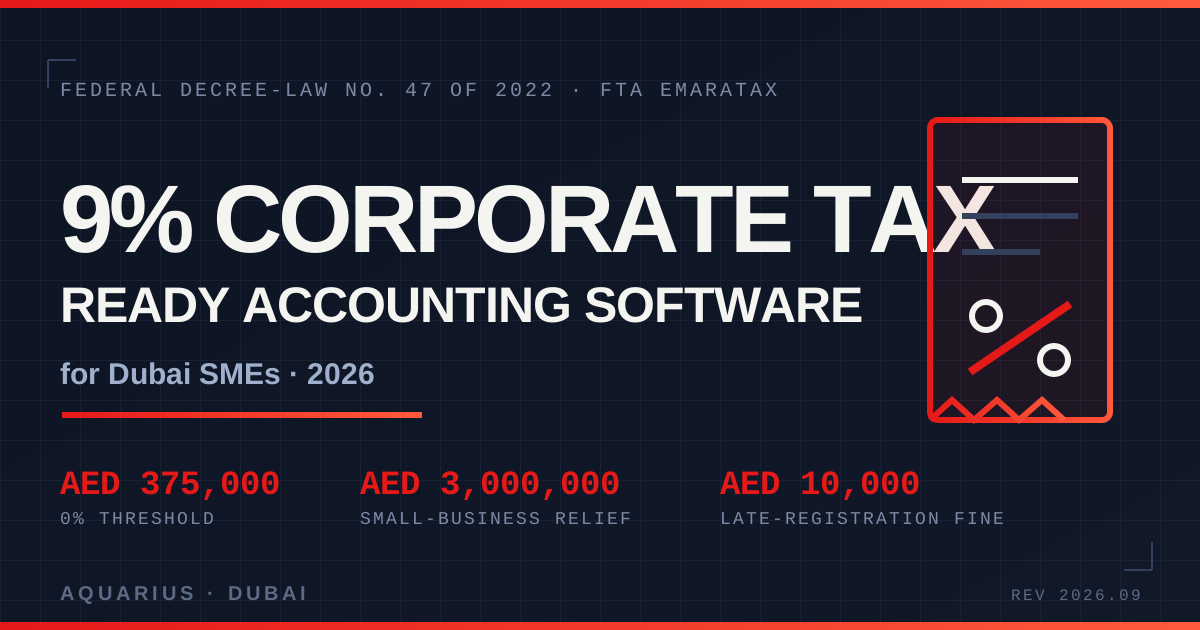
Short answer: Since the UAE introduced 9% corporate tax (Federal Decree-Law No. 47 of 2022) on taxable income above AED 375,000, every Dubai business needs books that can produce an FTA-ready corporate tax return — not just a VAT total. Even the smallest firms must register for a Tax Registration Number and file, and missing registration carries a flat AED 10,000 penalty. On top of that, the FTA's e-invoicing mandate (Ministerial Decision No. 243 of 2025) forces structured Peppol XML invoices from 1 July 2027 for most SMEs. Off-the-shelf CT-ready accounting software starts around AED 40-120 per month; a custom or deeply-integrated finance platform for a Dubai business typically runs AED 40,000 for a focused build to AED 250,000+. If your accounting is still a spreadsheet plus a bank statement, you are building your first corporate tax return the hard way.
Key takeaways
- Registration and filing are universal. The 0% band up to AED 375,000 does not exempt you from registering for a TRN and filing a return — non-registration is a flat AED 10,000 fine.
- Small Business Relief was extended to 2029. If revenue stays at or below AED 3 million you can elect to be treated as having no taxable income — but you still register, still file, and still keep records.
- E-invoicing is coming fast. Structured Peppol/PINT AE XML invoices via an accredited service provider are mandatory from 1 January 2027 (large firms) and 1 July 2027 (everyone else).
- Your software is now your compliance layer. Books that cannot map to taxable income, keep 7-year records, and emit structured invoices are a liability, not a convenience.
Why Dubai SMEs suddenly need real accounting software (awareness)
For decades the UAE's pitch was simple: no corporate income tax. That era ended for financial years starting on or after 1 June 2023, when Federal Decree-Law No. 47 of 2022 brought in a 9% federal corporate tax on business profits above AED 375,000, with a 0% rate on the first AED 375,000 to protect small businesses and startups. It is still one of the lowest headline rates in the world — but it is not zero, and the compliance obligations land on every business regardless of profit.
That is the part most owners underestimate. The 0% band is a rate, not an exemption: you must still hold an active Tax Registration Number, file a corporate tax return, and keep supporting records for seven years. The Federal Tax Authority charges a flat AED 10,000 for late registration — the same fine whether you are a two-person consultancy or a 200-person trading firm. A spreadsheet that was fine for tracking cash simply cannot produce the accrual-basis, IFRS-aligned numbers a return demands.
There is genuine relief for the smallest firms. Under Small Business Relief, a resident business whose revenue does not exceed AED 3 million in the current and all prior tax periods (from 1 June 2023) can elect to be treated as having no taxable income — and the Ministry of Finance has extended this relief to tax periods ending on or before 31 December 2029, up from the original 2026 sunset. But relief is not automatic and it is not a pass on paperwork: you register, you file the simplified return, and you keep the records that prove you stayed under AED 3 million. Software that tracks revenue against that threshold in real time is the difference between claiming relief cleanly and losing it to a bookkeeping gap.
What "corporate-tax-ready" actually means in your software (consideration)
Plenty of tools claim to be "UAE compliant." Only a handful genuinely do the things that keep a Dubai SME safe under the 2026 rules. A build or a subscription that skips any of these is a false economy:
- A clean path from books to taxable income. The system must keep accrual-basis accounts that map to the corporate tax return — separating exempt income, deductible vs non-deductible expenses (entertainment, fines, owner drawings), and adjustments — not just a profit-and-loss for the bank.
- Revenue-threshold tracking. Live dashboards showing turnover against the AED 375,000 taxable-income line and the AED 3 million Small Business Relief ceiling, so you know your position before the year closes, not after.
- FTA-compliant tax invoices and VAT. Correct 5% VAT per line, supplier and recipient TRNs, sequential numbering — the same invoice discipline that feeds both your VAT and CT positions.
- E-invoicing readiness. The ability to emit structured PINT AE XML invoices and connect to an accredited service provider (ASP) on the Peppol network — the format the FTA mandate requires, which a PDF emphatically is not.
- Seven-year record retention and an audit trail. Immutable transaction history, document attachments, and export-ready reports so an FTA query is a download, not a fire drill.
The e-invoicing timeline is the deadline most Dubai SMEs have not diarised yet. Under Ministerial Decision No. 243 of 2025, structured invoicing rolls out in two waves — and the penalties for missing an ASP appointment are already defined under Cabinet Decision No. 106 of 2025 at AED 5,000 per month:
| Business | Appoint an accredited service provider by | Mandatory e-invoicing from |
|---|---|---|
| Revenue AED 50 million or more | 30 October 2026 | 1 January 2027 |
| All other businesses (most SMEs) | 31 March 2027 | 1 July 2027 |
The practical read: if your accounting or ERP system cannot already speak structured XML and connect to a Peppol ASP, that integration is on your 2026-2027 roadmap whether you plan it or scramble for it. Deciding between subscribing and building? Our custom software vs off-the-shelf guide and the UAE e-invoicing and tax-invoice guide walk the trade-offs in detail.
What CT-ready accounting software costs in Dubai (2026)
There are two honest paths, and the right one depends on how standard your finances are.
Buy: off-the-shelf, FTA-aware SaaS
For a typical services or trading SME with clean, standard bookkeeping, subscription accounting software is the sensible floor. FTA-aware cloud tools (the Zoho Books / Odoo / QuickBooks-class products) generally run from about AED 40 to AED 120 per month per organisation at the SME tier, more as you add users, inventory and payroll. They handle VAT, tax invoices and CT-friendly reports out of the box, and the credible ones are building Peppol e-invoicing connectors ahead of 2027. This is the cheapest route to compliant — and for many Dubai SMEs it is the right answer.
Build: custom or integrated finance software
Off-the-shelf stops making sense when your operation is the product — a marketplace splitting payouts and VAT per vendor, a logistics firm reconciling COD, a clinic tying billing to patient records, or any business whose invoicing logic no template captures. A custom finance module or a bespoke integration layer for a Dubai business typically runs AED 40,000 for a focused build to AED 250,000+ for a mid-to-enterprise system with e-invoicing, multi-entity consolidation and deep ERP integration — in line with the broader custom-software ranges we see across UAE projects. Budget the usual 15-20% per year for maintenance, because tax rules keep moving.
How Aquarius builds compliant finance software (decision)
We start with the cheapest thing that works. If a Dubai SME's books are standard, we will set up and integrate FTA-aware SaaS, wire in VAT and CT-ready reporting, and get you Peppol-ready — no six-figure build where a subscription does the job. When your operation genuinely needs custom logic, we build the finance layer around your workflow: accrual accounting that maps to the corporate tax return, live turnover tracking against the AED 375,000 and AED 3 million lines, structured PINT AE XML invoicing with an accredited-provider connector, and seven-year audit-ready records — with PDPL-safe handling of the financial data throughout.
The cost of getting this wrong is concrete, not theoretical: a flat AED 10,000 for missing registration, AED 5,000 per month for e-invoicing non-readiness, plus late-filing and record-keeping fines that stack. Against that, compliant software is inexpensive — and it doubles as the reporting backbone that tells you what your business actually earns. Pair it with the systems around it — see our guides to WPS-compliant HR & payroll software and ERP implementation for Dubai SMEs — and your finance stack stops being a compliance risk and starts being a source of truth. See how we build finance and back-office software, check our pricing, or book a free readiness consult.
FAQ
Does a small Dubai business really have to register for corporate tax if it earns under AED 375,000?
Yes. The AED 375,000 threshold is a 0% tax rate, not an exemption from the system. You must still register for a Tax Registration Number and file a corporate tax return. Failing to register on time is a flat AED 10,000 penalty regardless of your profit.
What is Small Business Relief and is it still available in 2026?
Small Business Relief lets a resident business with revenue of AED 3 million or less (in the current and all prior tax periods) elect to be treated as having no taxable income. The Ministry of Finance extended it to tax periods ending on or before 31 December 2029. You still register, file a simplified return and keep records — the relief removes the tax, not the paperwork.
When does UAE e-invoicing become mandatory for my business?
Under Ministerial Decision No. 243 of 2025, businesses with revenue of AED 50 million or more must appoint an accredited service provider by 30 October 2026 and issue structured e-invoices from 1 January 2027. All other businesses appoint a provider by 31 March 2027 and go live from 1 July 2027. Invoices must be structured PINT AE XML sent over the Peppol network — a PDF does not qualify.
Can I just use Zoho Books or Odoo, or do I need custom software?
For most SMEs with standard bookkeeping, FTA-aware SaaS from roughly AED 40-120 per month is the right, cheapest answer. You need custom or integrated software when your invoicing and revenue logic is unusual — marketplaces, per-vendor VAT, COD reconciliation, or billing tied to your own operational system.
How much does custom corporate-tax-ready accounting software cost to build in Dubai?
A focused custom finance build typically starts around AED 40,000 and rises to AED 250,000+ for a mid-to-enterprise platform with e-invoicing, multi-entity consolidation and ERP integration. Budget 15-20% of the build cost per year for maintenance as tax rules evolve.
The bottom line
The UAE is still a low-tax place to do business — but "low tax" is not "no admin." The 9% corporate tax, universal registration, the AED 3 million relief threshold and the 2027 e-invoicing mandate together mean your accounting software is now the system that keeps you compliant, not just organised. Buy the SaaS if your books are standard; build when your operation demands it. Either way, do it before a deadline does it for you. Tell us how you invoice today and we will map your CT-ready path →