
Fuel Delivery App Development in Dubai (2026): Real AED Costs, Licences and the Dispatch Engine That Decides If You Win
Diesel jumped 13.2% to AED 4.30 in September 2026 and Dubai now licenses 16,917 transport firms. Real build costs, DET/DCD/RTA approvals and the capacity engine incumbents got wrong.
- PUBLISHED
- 29 SEPT 2026
- READ TIME
- 12 MIN
- AUTHOR
- AQUARIUS · DUBAI
- UNIT
- REV 2026.09
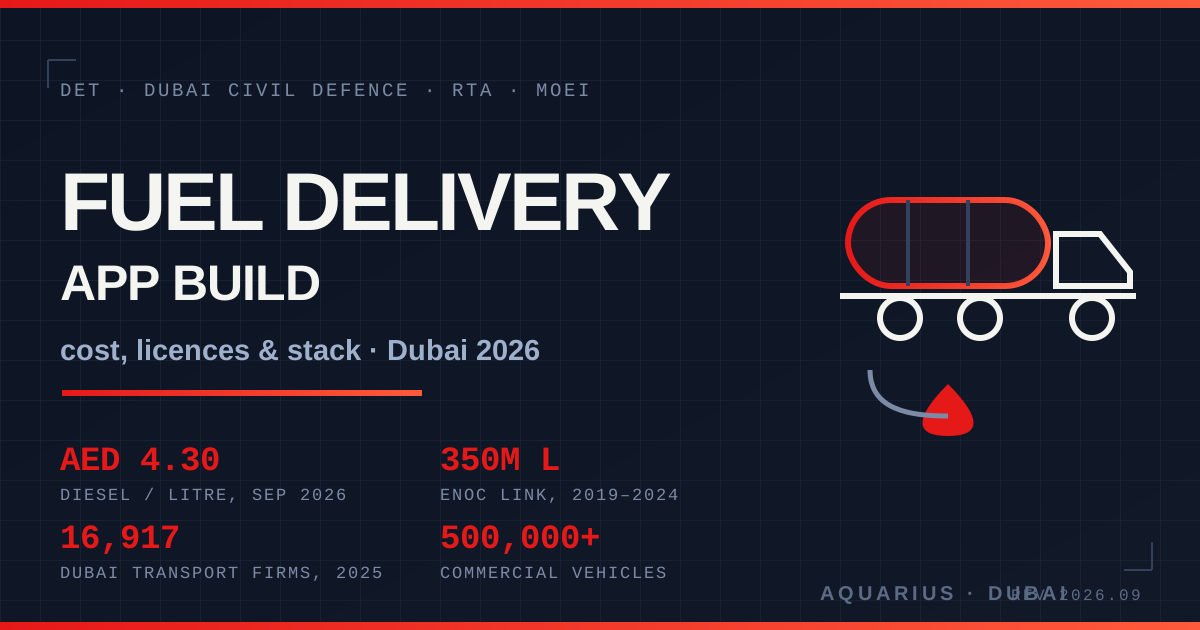
Short answer: a production fuel delivery app in Dubai — customer app, driver app, dispatch console and payment layer — costs roughly AED 140,000 to AED 420,000 to build and takes 14 to 26 weeks, with a fleet-only B2B version starting near AED 85,000. The software is the easy half. The half that kills projects is licensing: a Department of Economy and Tourism trade licence plus approvals from Dubai Civil Defence, the RTA and the Ministry of Energy and Infrastructure, ADR-standard tankers, and hazmat-certified drivers. Build the compliance model into the data schema on day one or you rebuild the app after your first inspection.
Key takeaways
- Diesel hit AED 4.30 per litre on 1 September 2026 — a 13.2% jump in a single month, from AED 3.80. Petrol rose AED 0.20: Super 98 at AED 3.80, Special 95 at AED 3.69, E-Plus 91 at AED 3.61. Fuel just became a board-level line item for every Dubai fleet.
- ENOC Link delivered 349,790,732 litres of petrol and diesel to business customers between 2019 and 2024, serving 268 businesses with 306.4% growth by 2024, and targets 60% of gasoline users inside its customer portfolio by 2026.
- Dubai’s licensed commercial transport companies grew from 12,100 in 2024 to 16,917 in 2025, with registered vehicles in the sector passing 500,000 (up 25% year-on-year) and annual revenues above AED 8.4 billion.
- 3.5 million vehicles use Dubai’s roads during the day, with registrations up 10% over two years.
- The UAE fuel station market is worth USD 17.40 billion in 2026, heading to USD 21.32 billion by 2031 at a 4.15% CAGR — and the UAE fleet management software market is growing far faster, from USD 245 million in 2025 to USD 580 million by 2032 at 13.1% a year.
- The incumbents have a capacity problem. In January 2026 Dubai customers told The National that CAFU booking slots had slipped from 15 minutes to three or four days, with Super petrol unavailable on repeat tests. That gap is the commercial opening.
Why Dubai fuel delivery demand is accelerating in 2026
On-demand fuel delivery looked like a convenience play when CAFU launched in Dubai in 2018. In 2026 it is an operating-cost play, and the numbers moved sharply this year.
The UAE Fuel Price Committee raised rates from 1 September 2026. Petrol went up AED 0.20 a litre — a 5.6% to 5.9% rise depending on grade — but diesel, the fuel that actually moves Dubai’s economy, jumped from AED 3.80 to AED 4.30 per litre: 13.2% in one month. For a logistics operator running 60 light commercial vehicles, that single revision adds tens of thousands of dirhams a year before a wheel turns.
At the same time, the fleet base is expanding fast. RTA reported that licensed commercial transport companies in Dubai rose from 12,100 in 2024 to 16,917 in 2025 — more than 40% growth in licensed operators — while registered vehicles in the sector passed 500,000, up 25% year-on-year, generating annual revenues of more than AED 8.4 billion. Dubai’s rental fleet alone grew from 49,725 to 71,040 vehicles in a year. Across the emirate, 3.5 million vehicles are on the roads during daytime hours, with registrations up 10% over two years.
Put those two curves together and you get the demand signal: more vehicles, dearer fuel, and a hard ceiling on how much unproductive time an operator can absorb sending drivers to forecourts. That is why the B2B side of this market is the one with proof. ENOC Link supplied 349,790,732 litres of MOGAS and diesel to business customers between 2019 and 2024, reaching 268 businesses with recorded growth of 306.4% by 2024, and has stated a target of 60% of gasoline users within its customer portfolio by 2026.
The gap most founders miss
Here is the thing most Dubai business plans in this category get wrong: they pitch a consumer app competing with CAFU on convenience. The evidence says the pain is on the supply side, not the demand side.
In January 2026, Dubai users told The National that CAFU slots that once took 15 minutes to book now took three to four days. Independent testing found Super petrol unavailable on multiple attempts, several Elite Care services not working in parts of Dubai, and none of the tested services available at several Abu Dhabi locations. Customers also flagged that the introduction of a delivery fee coincided with slots getting scarcer.
Those are not marketing failures. They are capacity allocation, routing and inventory-visibility failures — exactly the problems software solves. The winning build in 2026 is not a prettier consumer app. It is a dispatch and capacity engine that can promise a delivery window and hit it.
What you are actually licensed to do — before you write code
Fuel is a hazardous material. A fuel delivery app in Dubai is not a marketplace with a payment gateway bolted on; it is a regulated logistics operation with an app on top. The approvals you will touch:
- Department of Economy and Tourism (DET) — issues the mainland trade licence with the correct fuel transport and distribution activity.
- Dubai Civil Defence (DCD) — fire safety and fuel storage/handling approvals, inspections, and emergency response training sign-off.
- RTA — vehicle permits and driver licensing for the tanker fleet.
- Ministry of Energy and Infrastructure (MOEI) — fuel product approvals.
- EHS / Trakhees — environmental compliance where you operate inside free zones or Trakhees-governed areas.
On the fleet side, approved tankers require ADR-standard construction, GPS tracking, fire suppression, anti-leakage valves, emergency shut-off systems and visible hazard labelling. Drivers and handlers need hazardous material transport certification plus specialised training in spill management and emergency response.
Every one of those items is a software requirement, not just a paperwork requirement. Certificate expiry dates, tanker inspection cycles, driver hazmat credentials, calibration records for flow meters, per-delivery incident logs — if your schema cannot answer “prove this litre was delivered by a certified driver from a compliant tanker at 14:32”, your app is not audit-ready. Design the compliance entities first. We take the same position on regulated-sector builds in our Dubai logistics and fleet tracking software guide.
The build: modules, stack and what each part costs
A complete platform is four applications sharing one backend, not one app.
| Module | What it must do | Typical AED range | Timeline |
|---|---|---|---|
| Customer app (iOS + Android) | Vehicle profiles, fuel grade selection, geofenced location capture, live slot availability, ETA tracking, wallet and invoices | 45,000 – 110,000 | 5–9 weeks |
| Driver / tanker app | Route sequence, offline-first job capture, flow-meter reading entry, photo and OTP proof of delivery, hazmat checklist gate, panic button | 35,000 – 80,000 | 4–7 weeks |
| Dispatch and capacity console | Slot inventory by grade and zone, tanker load tracking, route optimisation, exception handling, live map | 40,000 – 120,000 | 5–10 weeks |
| B2B fleet portal | Multi-vehicle accounts, cost centres, per-driver fuel limits, consumption analytics, VAT-compliant consolidated invoicing | 30,000 – 85,000 | 4–7 weeks |
| Payments and wallet layer | Card, Apple Pay, corporate credit terms, instant A2A transfers, refunds on partial fills | 15,000 – 40,000 | 2–4 weeks |
| Telematics and IoT integration | Tanker GPS, flow-meter and tank-level sensors, geofence alerts, fuel-theft detection | 25,000 – 70,000 | 3–6 weeks |
| Compliance and audit layer | Certificate registry with expiry alerts, inspection logs, incident reports, exportable regulator evidence packs | 18,000 – 45,000 | 2–4 weeks |
Our standard stack for this category is React Native for both mobile apps, Node with PostgreSQL and PostGIS for geospatial dispatch, Next.js for the consoles, and an MQTT ingest path for telematics. PostGIS matters more than founders expect: slot availability by zone, geofence validation at the point of delivery, and route sequencing are all spatial queries, and bolting them onto a non-spatial database is the single most common cause of a rebuild at month nine.
Three routes to market, compared
| Route | Up-front AED | Time to live | Trade-off |
|---|---|---|---|
| Integrate with an existing supplier (resell delivery, own the software layer) | 60,000 – 140,000 | 6–10 weeks | No tanker capex or DCD file, but your margin and your delivery promise both depend on someone else’s slots |
| White-label platform + your own fleet | 80,000 – 180,000 + licences | 8–14 weeks | Fast, but generic dispatch logic and no control over the capacity engine that is the actual differentiator |
| Custom build, full ownership | 140,000 – 420,000 + licences | 14–26 weeks | Highest up-front cost; the only route where routing, slot inventory and compliance are genuinely yours |
Budget separately for operations: ADR-compliant tankers, DCD and MOEI approvals, hazmat driver certification, insurance and the depot arrangement are operating costs outside any software quote. Ask any agency that omits them what else they are omitting.
The economics: what the software has to earn back
Fuel delivery does not sell on novelty. It sells on two numbers a fleet manager can verify, so build the app to produce both.
Reclaimed driver hours. Take a 40-vehicle Dubai fleet where each vehicle refuels twice a week and each forecourt trip costs 35 minutes of detour, queue and payment. That is 2,800 minutes — roughly 47 hours a week, about 2,400 hours a year of paid time spent not working. At a loaded cost of AED 45 an hour, that is on the order of AED 108,000 a year in recovered productive time. (Illustrative: substitute your own refuel frequency, detour time and hourly cost.)
Controlled consumption. The same fleet burning 8,000 litres of diesel a month pays AED 34,400 monthly — AED 412,800 a year — at the September 2026 rate of AED 4.30 per litre, up from AED 364,800 at August’s AED 3.80. That AED 48,000 increase arrived in one month, with no change in operations. Per-vehicle limits, flow-meter reconciliation and fuel-theft alerts are how an app claims a slice of that number back, and why UAE fleet management software is growing at 13.1% a year toward USD 580 million by 2032 while the fuel retail market it sits on top of grows at 4.15%.
Those two figures are your entire B2B pitch. If your product cannot report them per cost centre, per month, in a VAT-compliant invoice a Dubai finance team can file, you are selling convenience into a market that has stopped paying for convenience alone.
How Aquarius approaches it
We start with the dispatch model, not the screens. In this category the product is a promise — fuel, this grade, this window — and every founder who skipped capacity modelling ends up where the incumbents are: slots stretching from fifteen minutes to four days while support absorbs the damage. So we model slot inventory, tanker load cycles and zone coverage before design, then derive the apps from it.
Second, compliance goes in the schema, not a spreadsheet. Certificates, inspections, hazmat credentials and per-delivery evidence are first-class records with expiry alerts, because a regulated operation that keeps its proof in someone’s Downloads folder is one inspection from a stop-work order.
Engagements are fixed-scope against a written spec, and we hand over full source, repositories and credentials — no lock-in. If you would rather start with a phased MVP, the B2B fleet portal plus driver app is the cheapest route to real revenue, because businesses sign contracts while consumers compare prices. See our pricing and full services list. Building the electric equivalent? The same capacity logic drives our EV charging and CPMS development guide.
Frequently asked questions
How much does a fuel delivery app cost in Dubai?
A custom platform with customer app, driver app, dispatch console and payments runs AED 140,000 to AED 420,000 over 14 to 26 weeks. A B2B-only build — fleet portal plus driver app, no consumer marketplace — starts around AED 85,000 and can launch in 8 to 10 weeks. Tankers, licences, DCD approvals and hazmat certification are operating costs on top of software.
Do I need my own tankers and licences, or can I just build the app?
You can build a software layer that resells another licensed supplier’s delivery capacity, which avoids the DCD file and tanker capex entirely — typically AED 60,000 to AED 140,000 for the platform. The trade-off is that your delivery promise is only as good as their slot availability, which is precisely where Dubai customers reported problems in January 2026. If you dispatch fuel yourself, you need the DET licence plus DCD, RTA and MOEI approvals.
Which approvals apply to mobile fuel delivery in Dubai?
Mainland operators need a DET trade licence with the right fuel transport activity, Dubai Civil Defence approval for fire safety and fuel handling, RTA vehicle permits and driver licensing, and Ministry of Energy and Infrastructure approval for fuel products. Free-zone or Trakhees-area operations add EHS environmental compliance. Tankers must meet ADR standards with GPS, fire suppression, anti-leakage valves and emergency shut-off; drivers need hazmat certification.
Is the consumer or the B2B market the better opportunity?
B2B, on the current evidence. ENOC Link moved 349.8 million litres to 268 business customers between 2019 and 2024 with 306.4% growth, and Dubai’s commercial transport sector now counts 16,917 licensed companies and over 500,000 registered vehicles generating AED 8.4 billion a year. Fleets sign contracts, forecast volumes and tolerate scheduled windows. Consumers want instant slots and churn on a delivery fee.
How long does the telematics and IoT side take?
Plan 3 to 6 weeks and AED 25,000 to AED 70,000 for tanker GPS, flow-meter and tank-level ingest, geofence alerts and fuel-theft detection, assuming the hardware vendor has a documented API or MQTT feed. Undocumented or proprietary meters are the usual schedule risk — confirm the integration path in writing before you buy the hardware.
The practical next step
Diesel rose 13.2% in a single month, Dubai added nearly 5,000 licensed transport companies in a year, and the market leader is publicly working through slot-availability complaints. Fuel delivery in Dubai is no longer an unproven idea — it is a proven demand curve with an execution gap in the middle of it.
The teams that win it will not be the ones with the slickest onboarding screen. They will be the ones whose dispatch engine keeps its promises and whose compliance evidence survives an inspection. If you want a straight read on which of the three routes fits your capital and licence position, book a scoping call. We will map the modules, the approvals and the AED range in writing before anyone writes code.