
Funding a Website, App or Software Build in Dubai (2026): Grants, Guarantees and the Real AED Cost of Money
How Dubai SMEs actually pay for a digital build in 2026: the EDB AED 30bn mandate and 50% guarantees, MBRIF and Dubai SME interest-free tracks, 8-18% bank rates and invoice finance from 0.8% a month.
- PUBLISHED
- 02 OCT 2026
- READ TIME
- 12 MIN
- AUTHOR
- AQUARIUS · DUBAI
- UNIT
- REV 2026.09
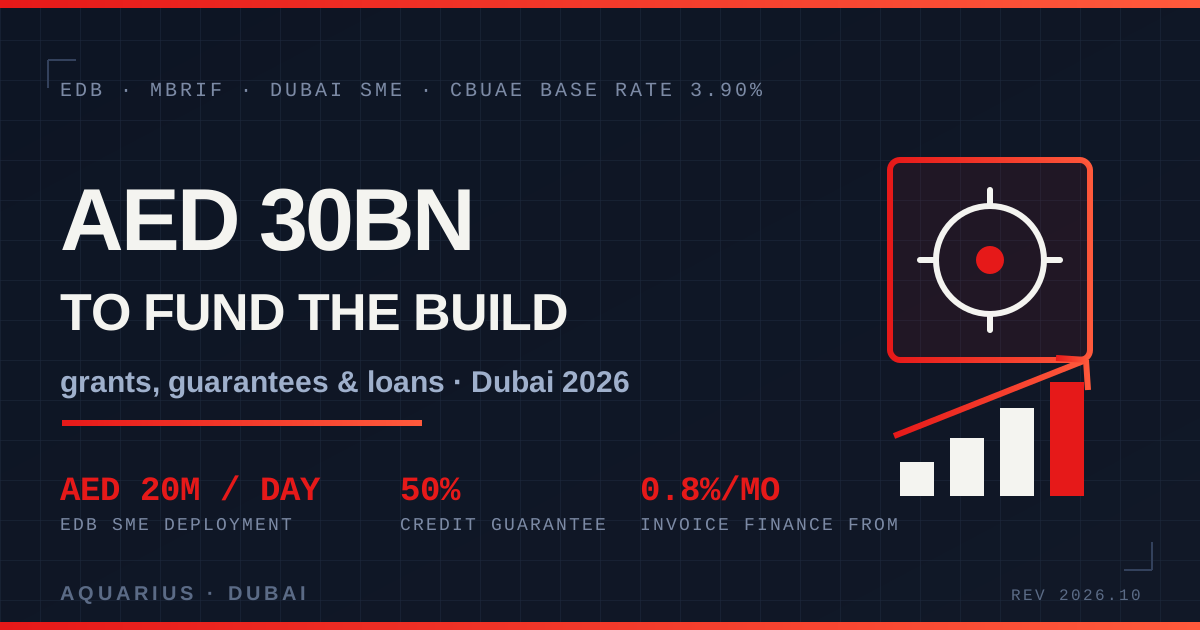
Short answer: A Dubai SME almost never needs venture capital to pay for a website, app or internal system. The realistic routes are staged milestone payments out of cash flow, a bank facility priced off EIBOR (unsecured SME lending runs 8–18% a year effective), government development finance through Emirates Development Bank, which carries a mandate to deploy AED 30 billion to 13,500 companies across five priority sectors including advanced technology, or invoice finance from 0.8% a month against receivables you have already earned. Equity is the most expensive money on the list and the least appropriate for a build with a fixed scope.
Most Dubai businesses get this backwards. They treat a AED 150,000 platform as a capital-raise problem and burn three months pitching, when the same build is routinely funded by a four-milestone payment schedule plus a short working-capital facility costing under AED 10,000 in interest.
The spend is accelerating, and the capital is concentrating
Two numbers set the stakes for 2026. Gartner forecasts MENA IT spending at US$169 billion this year, up 8.9% on 2025, with software growing fastest among the traditional segments at 13.9% to US$20.4 billion as organisations push generative AI into production. Data centre systems are the outlier at +37.3%. Translation: your competitors' technology budgets are rising by double digits, and the cost of standing still compounds every year.
The second number is the warning. UAE startups raised US$895 million in H1 2026, up 53% year on year and equal to 66% of all MENA venture capital — but the UAE's own deal count fell 37%, per MAGNiTT. Across MENA, funding dropped 22% to US$1.35 billion across 214 deals while deal activity contracted almost twice as fast at -41%. The ten largest deals absorbed 58% of all capital; mean deal size hit US$7.9 million while the median stayed at US$2.0 million. More money, far fewer cheques. If your plan to fund a AED 200,000 build is “raise a round”, you are queueing at the narrowest door in the market.
The capital exists. It is just not where most Dubai SMEs look first — and the cheapest money in the stack is the money you never dilute for.
This matters because Dubai is an SME economy. SMEs make up roughly 95% of all businesses in Dubai, and a Dubai SME and Dubai Statistics Centre study put their share of emirate GDP at 47% and of the workforce at 52.4%. The economy itself reached AED 232 billion in Q1 2026, growing 2.4%, on the way to a near-trillion-dirham annual GDP. UAE development finance is aimed squarely at that bracket, not at unicorn hunting.
The six routes that actually fund a Dubai build
1. Staged milestone payments (the default, and usually the right one)
A fixed-scope build is not a capital asset you must buy upfront. Any serious Dubai studio splits delivery into three to five milestones — discovery and design, core build, integrations, launch — invoiced as each is accepted. On a AED 150,000 project that converts one large cheque into roughly AED 30,000–50,000 per month across a quarter, which most trading SMEs absorb without borrowing at all. Pair it with a scope freeze and you have removed the cash-flow problem and the overrun problem in one contract.
2. Emirates Development Bank: the biggest pot, and tech is a named priority
EDB is the federal development bank, and its mandate is explicit: AED 30 billion in financing to 13,500 companies across five priority sectors — manufacturing, advanced technology, healthcare, renewables and food security. This is not theoretical money. EDB reports deploying an average of AED 20 million (US$5.5 million) every day to keep UAE MSMEs trading.
The mechanism most SMEs should care about is the credit guarantee scheme. Rather than lending directly, EDB partners with commercial banks and guarantees up to 50% of the facility, capped at AED 10 million — which is what turns a “no” from a credit committee into a “yes” for a company with thin collateral. EDB has channelled AED 1.58 billion through the guarantee scheme to date, which it links to around 4,000 jobs created, and has extended it through bank partners including ADIB. Separately, EDB launched an AED 1 billion Emirates Growth Fund for UAE SMEs.
3. Innovation guarantees and Emirati-ownership tracks
The Mohammed bin Rashid Innovation Fund (MBRIF) is an AED 2 billion initiative whose guarantee scheme exists precisely to give innovative growth-stage companies affordable debt without diluting equity — government-backed credit guarantees instead of a term sheet. Reported facility sizes run to around AED 2 million. Eligibility is the part people miss: the innovation must be post-ideation — a developed, generally commercialised product or service with a credible path to breakeven. A pitch deck is not an application.
In the emirate itself, Dubai SME — formally the Mohammed Bin Rashid Establishment for SME Development, under the Department of Economy and Tourism — runs interest-free lending tracks for Emirati-owned businesses, commonly reported at up to AED 1 million and in some cases AED 1–3 million, with terms stretching five to seven years and grace periods up to 24 months. Dubai SME has also allocated AED 20 million as capital guarantee through a partnership with the peer-to-peer platform Beehive, under which Dubai SMEs that are 50% or more Emirati-owned and managed can access financing of up to AED 420,000 backed by a 50% capital guarantee. Interest-free money with a two-year grace period is the cheapest capital in this article — if you qualify, start here.
4. Bank lending: know what money costs this quarter
Pricing moved in September. The CBUAE raised its base rate 25 basis points to 3.90%, effective 17 September 2026, mirroring the US Federal Reserve, and kept short-term borrowing under its standing credit facilities at 50 basis points above base — so 4.40%. Commercial SME lending is priced off EIBOR plus a margin: a profitable, collateralised SME may see something near EIBOR + 3%, roughly 6–8% APR, while unsecured SME facilities typically land at 8–18% a year effective depending on trading history and cash-flow consistency. Because the dirham is pegged, every Fed move reprices your facility — fix the tenor if your build runs across decision dates.
5. Invoice and receivables finance: the fastest match for a build
The most under-used route for a project with a hard start date. Beehive, regulated by the DFSA and operating since 2014, advances up to 80% of receivables on invoices due in 30 to 120 days, with funds available within 24 hours and rates from 0.8% a month; facility sizes run AED 100,000 to AED 5 million. Funding Souq operates in a similar band, typically AED 200,000 to AED 2 million. Speed is the real differentiator: fintech lenders turn decisions around in three to five days against two to eight weeks at a traditional bank. If you are a B2B company in Dubai with 60-day payment terms, your platform is already funded — it is sitting in your debtors ledger.
6. Equity, last and least suitable
The Dubai Future District Fund is an evergreen venture fund-of-funds anchored by DIFC and the Dubai Future Foundation with AED 1 billion in committed capital, aligned to the D33 agenda across PropTech, HealthTech, LogisticsTech, DeepTech, circular economy and Web3; it has completed 25+ investments — 12 VC funds and 16 direct. Excellent capital for a scaling technology venture. The wrong instrument for a AED 120,000 e-commerce rebuild: you would be selling a permanent share of your company to buy a depreciating asset with a known price.
| Route | Typical size (AED) | Cost of money | Speed | Best for |
|---|---|---|---|---|
| Staged milestone payments | Any, spread over 2–6 months | Nil | Immediate | Almost every fixed-scope build |
| Dubai SME / MBRIF tracks | 420,000–3,000,000 | Interest-free or guaranteed | Weeks to months | Emirati-owned SMEs, commercialised innovation |
| EDB-guaranteed bank facility | Up to 10,000,000 guaranteed at 50% | Bank margin, improved by the guarantee | Weeks | Advanced-technology and priority-sector SMEs |
| Unsecured bank term loan | 100,000–3,000,000 | 8–18% p.a. effective | 2–8 weeks | Two-plus years of clean statements |
| Invoice / receivables finance | 100,000–5,000,000 | From 0.8% per month | 24 hours to 5 days | B2B firms with 30–120 day terms |
| Venture equity | 2,000,000+ (US$2.0m median round) | Permanent dilution | 3–9 months | Scaling products, not internal systems |
What the build costs, and what financing really adds
Price the asset before you price the money. In Dubai in 2026, a credible bilingual SME website lands at AED 18,000–45,000; a transactional e-commerce store with a UAE payment gateway, Tabby or Tamara and VAT-correct invoicing at AED 45,000–140,000; a two-platform mobile app at AED 90,000–280,000; and a custom internal platform — ERP-adjacent, integrated, role-based — at AED 180,000–450,000. Our Dubai website and app cost breakdown and Dubai SME corporate tax software guide go line by line.
Now the financing arithmetic, which is smaller than most owners fear. Borrow AED 150,000 on a 12-month amortising facility at 12% a year and you pay about AED 13,330 a month and roughly AED 9,900 in total interest — about 6.6% on top of the build. On invoice finance at 0.8% a month for a 90-day advance, the same AED 150,000 costs around AED 3,600. Set that against a platform that lifts conversion or removes a salary's worth of manual admin and the interest is a rounding error. The expensive decision is not borrowing — it is twelve months of not shipping while you hunt for free money.
Three local line items for the model:
- VAT: 5% is charged on the agency invoice and is recoverable input tax if you are TRN-registered and the spend supports taxable supplies. Loan interest is an exempt financial service, so your financing cost carries no VAT.
- Corporate tax: 9% applies above AED 375,000 of taxable income. Financing costs are generally deductible, subject to the general interest deduction limitation rule — capped at 30% of adjusted EBITDA with a de minimis of AED 12 million in net interest, which almost no SME breaches.
- Run cost: hosting, maintenance, security patching and content. Budget 15–20% of build cost per year and fund it from operating cash, never from the project loan.
One conversion number worth holding on to: with MENA software spending growing 13.9% in 2026 and UAE venture deal counts down 37%, the companies taking share this year are debt-funding or self-funding their technology and shipping now, while competitors wait on an equity market writing fewer, bigger cheques to other people.
How Aquarius structures a fundable build
We quote fixed-price, milestone-based scopes specifically so they can be financed: a written deliverable per milestone, an acceptance test per milestone, and an invoice schedule a bank or an invoice-finance platform will actually look at. You own the repository, the domain and the hosting account from day one — which matters, because a lender will ask what the asset is and who holds it. If a government track fits your licence, we shape the scope and documentation around it rather than pretend the paperwork does not exist.
See Aquarius pricing for indicative AED bands, or send your scope and trading profile and we will come back with a fixed price, a milestone schedule and the funding route that fits it.
FAQ
Can I get a government grant in Dubai to pay for a website?
Rarely as a straight grant. UAE government support for technology spending is mostly structured as subsidised or interest-free lending and credit guarantees — EDB's 50% guarantee capped at AED 10 million, MBRIF's non-dilutive guarantee scheme, and Dubai SME's interest-free tracks for Emirati-owned businesses. A generic brochure site rarely qualifies on its own; a platform with a defensible innovation or a priority-sector case stands a far better chance.
Do I need to be an Emirati to access Dubai SME funding?
For Dubai SME's own lending tracks, yes in practice — the Beehive-guaranteed facility, for example, requires the business to be 50% or more owned and managed by an Emirati. EDB's guarantee scheme, MBRIF, bank lending and invoice finance are open to UAE-licensed companies regardless of shareholder nationality.
What interest rate should a Dubai SME expect in late 2026?
With the CBUAE base rate at 3.90% since 17 September 2026, expect roughly EIBOR + 3% (around 6–8% APR) if you are profitable and can offer collateral, and 8–18% effective for unsecured SME facilities. Invoice finance is quoted monthly — from 0.8% — so compare it on the actual number of days you borrow, not annualised.
Is it smarter to raise equity instead of borrowing for a build?
Not for a defined-scope project. The UAE median round in H1 2026 was US$2.0 million and the top ten deals took 58% of all capital — raising is slow, selective and permanently dilutive. Debt or staged payments cost single-digit percentages of the build; equity costs a share of every future dirham.
How fast can funding actually arrive?
Invoice finance can fund in 24 hours to five days. Bank term facilities take two to eight weeks. Government tracks take longer because of eligibility verification. Plan the funding route in parallel with discovery, not after sign-off, and the money lands before milestone two falls due.
Ready to scope it? Talk to Aquarius — we will send a fixed-price scope, a milestone invoice schedule, and an honest view of which Dubai funding route your company qualifies for.