
Garage & Workshop Management Software in Dubai (2026): Job Cards, VAT Invoices and the E-Invoicing Deadline
Only 34% of Dubai garages run a digital system — while 4.56 million UAE vehicles need servicing and e-invoicing turns mandatory by July 2027. What to build, and what it costs in AED.
- PUBLISHED
- 13 SEPT 2026
- READ TIME
- 09 MIN
- AUTHOR
- AQUARIUS · DUBAI
- UNIT
- REV 2026.09
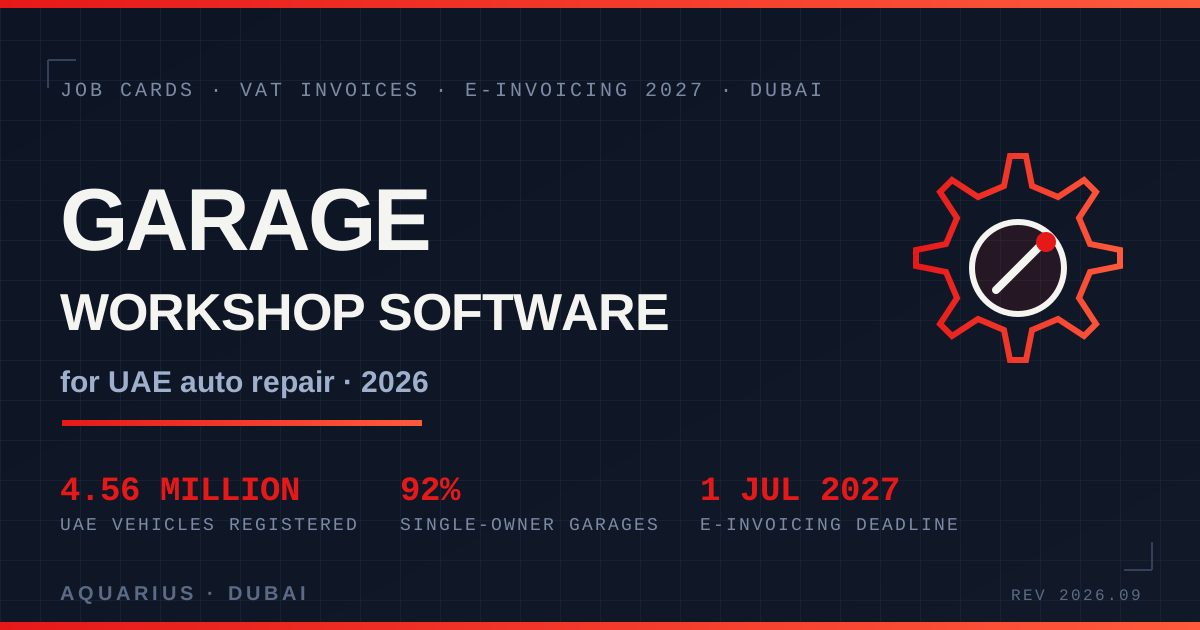
Short answer: Garage management software in Dubai is no longer a spreadsheet replacement — it is the system that produces a legally valid 5% VAT tax invoice, keeps a defensible job-card trail per vehicle, and will have to emit structured e-invoices once the UAE Electronic Invoicing System becomes mandatory for in-scope VAT-registered businesses by 1 July 2027. Off-the-shelf UAE garage SaaS runs roughly AED 370 to AED 1,100 per month; a custom workshop platform built around your own process costs AED 18,000 to AED 90,000, and AED 90,000 to AED 250,000+ for multi-branch or fleet-contract operations. Updated September 2026.
Key takeaways
- The vehicle parc is growing far faster than the workshops serving it. Active registered vehicles in the UAE hit 4.56 million by June 2025, up from 4.17 million a year earlier — a 9.35% jump, roughly 390,000 extra vehicles in 12 months, per Salik and RTA data published in August 2025.
- Dubai is the centre of gravity. Around 3.5 million vehicles are on Dubai's roads during daytime hours, and registrations rose 10% in two years against a global average of 2–4%.
- The aftermarket money is real. The UAE automotive aftermarket was worth about USD 7.3 billion in 2024 and is forecast to reach USD 10.5 billion by 2033 (CAGR ~3.8%), with preventive maintenance alone taking roughly 30% of service revenue.
- Most garages are still analogue. An industry estimate puts 92% of Dubai garages as single-owner workshops and only 34% running a website or digital system. That gap is the entire opportunity.
- A regulatory clock is running. Ministerial Decisions 243 and 244 of 2025 set the UAE e-invoicing path: voluntary from 1 July 2026, mandatory for businesses above the FTA revenue threshold (AED 50 million) from 1 January 2027, and for the remaining in-scope businesses from 1 July 2027.
TOFU: 390,000 more cars a year, and a workbench still running on carbon paper
Dubai's service demand is not a forecast — it already arrived. The UAE crossed 4.56 million active registered vehicles by June 2025, adding about 390,000 vehicles in twelve months, a 9.35% year-on-year rise. Dubai alone accounted for 484,223 of the 801,857 vehicles registered nationally in 2024 — more than half the country's registrations in one emirate. During the working day, roughly 3.5 million vehicles are moving on Dubai roads.
Commercial fleets are growing even faster. Licensed commercial transport companies in Dubai rose from 12,100 in 2024 to 16,917 in 2025, and registered vehicles in that sector passed 500,000, up 25% year on year. Fleet work is the highest-value contract a workshop can hold — and it is also the work that demands structured invoicing, per-vehicle service history and SLA reporting that a WhatsApp thread cannot produce.
Meanwhile the supply side is fragmented and under-digitised. Industry estimates put 92% of Dubai garages in single-owner hands, with about 23 new garages opening in Dubai each year and only 34% operating any website or digital system. In a market where the UAE aftermarket is heading from USD 7.3 billion (2024) toward USD 10.5 billion by 2033, and where preventive maintenance is about 30% of service revenue, the differentiator is no longer the lift or the diagnostic scanner. Every competent garage has those. The differentiator is whether you can tell a customer — in ten seconds, by phone or WhatsApp — exactly what you did to their car eighteen months ago, what you quoted, what they approved, and what is due now.
MOFU: the eight modules that actually matter in a UAE workshop system
Here is what most Dubai garage owners get wrong: they buy "garage software" for the invoice and never use the other 80%, so the system becomes a slower calculator. The invoice is the output. The value sits upstream, in the job card and the approval trail.
1. The digital job card
One record keyed to the chassis/VIN and plate: complaint, technician assigned, hours booked, parts consumed, photos in and out, customer approval timestamp. In UAE practice this is also your dispute shield — when a customer claims a scratch or denies approving an upsell, the timestamped photo set and the approval record settle it before it reaches a consumer complaint.
2. Estimate to approval, on the channel customers actually use
Estimates sent as a link the customer approves with one tap, not a verbal yes on a noisy shop floor. UAE consumers live on WhatsApp: WhatsApp messages see 90%+ open rates against roughly 20% for email, and 88% of businesses using WhatsApp report more repeat bookings. A WhatsApp Business API integration turns approvals, status updates and "your car is ready" into automated, logged events.
3. Digital vehicle inspection (DVI)
A structured multi-point check with red/amber/green statuses, photos and short videos attached, sent to the customer before you quote. It is the single highest-return module in modern workshop software: it converts "trust me, the pads are gone" into visible evidence, which lifts approval rates on legitimate additional work instead of turning every upsell into an argument.
4. Parts inventory tied to the job card
Stock levels that decrement when a part is fitted, reorder points on fast-moving consumables, supplier price history, and margin visible per job. Workshops that run parts on a separate sheet consistently discover at year-end that their labour was profitable and their parts were not. The same discipline applies as in any POS and inventory system.
5. VAT invoicing that survives an FTA audit
A UAE tax invoice is not a styled PDF. It needs the supplier TRN, the recipient TRN for B2B, a sequential invoice number, line-level 5% VAT and the AED totals. Get the structure right now and the e-invoicing transition becomes a format change rather than a rebuild — the same argument set out in our guide to VAT-compliant invoicing and the UAE e-invoicing mandate.
6. Service reminders and retention automation
Independent garages typically retain 40–60% of customers year to year with no active retention effort; with automated reminders, a customer portal and structured aftercare that climbs to 65–80%. On no-shows, automated reminders cut missed appointments by 30–50%, and WhatsApp reminders specifically have been measured at a 52% reduction. For a garage running 12 bays, a 40% cut in no-shows is several thousand dirhams of recovered bay time every month.
7. Booking and bay scheduling that respects the RTA calendar
Since 2 June 2025, an appointment is mandatory at 27 of Dubai's 28 vehicle testing centres, eight are appointment-only, and walk-ins incur an extra AED 100 at 19 of them. Any garage that prepares cars for registration renewal now has to schedule around a booked testing slot, not a queue. A calendar that models bays, technicians and the testing appointment together stops you promising a same-day handover you cannot deliver.
8. Fleet and B2B contract handling
Multi-vehicle accounts need per-vehicle history, monthly consolidated invoicing, approval limits per driver, and SLA reporting. This is where garages win the six-figure annual contracts — and where the e-invoicing rules bite first, because the mandate targets B2B and B2G transactions while B2C sits outside the initial scope. Workflow-wise it mirrors field service management software: dispatch, evidence capture, billing.
The e-invoicing deadline nobody in the workshop has diarised
Ministerial Decisions 243 and 244 of 2025 introduced the UAE Electronic Invoicing System, and the timeline is now specific. Voluntary participation and pilots open from 1 July 2026. Businesses with annual revenue of AED 50 million or more must appoint an Accredited Service Provider (ASP) by 30 October 2026 and issue e-invoices from 1 January 2027. Every other in-scope VAT-registered business must appoint an ASP by 31 March 2027 and comply from 1 July 2027. The initial scope is B2B and B2G.
Most independent Dubai garages sit in the second wave. That feels distant until you count backwards: to issue a structured e-invoice you need clean master data — TRNs on every business customer, a sequential numbering scheme that does not reset arbitrarily, line-level tax treatment, and a system that can hand an ASP a machine-readable document. A garage still writing job cards on a duplicate pad in mid-2026 is not eighteen months from compliance; it is eighteen months from a data-cleanup project it has not started.
BOFU: what it costs, and what paper is already costing you
Software is the cheapest line item in a Dubai garage. Opening one runs roughly AED 236,000 to AED 437,000+ all-in — AED 12,000–35,000 for trade licence and setup, AED 60,000–180,000+ in tools and equipment, AED 40,000–120,000+ in rent deposits and first payments. Against that, the system controlling every dirham flowing through those bays is typically 1–3% of setup capital.
| Option | Cost (AED) | What you get | Best for |
|---|---|---|---|
| Off-the-shelf UAE garage SaaS | ~370 – 1,100 / month | Job cards, VAT invoices, basic inventory, customer records, Arabic/English UI, vendor-managed updates. | 1–2 bay workshops with standard workflows |
| Custom workshop core | 18,000 – 35,000 one-off | Digital job card, estimate approvals, VAT invoicing, customer history, WhatsApp notifications — your process, not the vendor's. | Single-branch garages escaping paper |
| Full workshop platform | 35,000 – 90,000 one-off | Everything above plus DVI with media capture, parts inventory and margin reporting, bay/technician scheduling, online booking, customer portal, dashboards. | 4–12 bay operations, service-heavy |
| Multi-branch / fleet platform | 90,000 – 250,000+ | Multi-location stock and staff, fleet contracts with consolidated billing, SLA reporting, accounting and ASP e-invoicing integration, technician mobile app, API to insurers or dealerships. | Groups, fleet contractors, franchise networks |
Run the arithmetic on the leak rather than the licence. A 6-bay Dubai garage billing an average of AED 900 per job at 70% utilisation turns over roughly AED 90,000 a month. Cutting no-shows by the measured 30–50% and lifting annual retention from 50% toward 70% does not need to be perfect to matter: recovering four lost bay-days a month is about AED 25,000 a year, and a single retained fleet account usually exceeds the entire build cost. Paper does not save you money. It hides where the money went.
How Aquarius does it. We start with your job card — the actual one, photographed off your desk — and build the system around the way your technicians already work, in English and Arabic, with WhatsApp notifications wired in from the first sprint. VAT invoice structure is built to the FTA field set on day one, so the e-invoicing switch in 2027 is a connector rather than a rewrite. You get the source code, your own hosting and your customer data, with no per-bay licence trap. See transparent pricing, browse what we build, or send us one week of job cards and we will tell you in a single call whether SaaS or a custom build is the cheaper answer at your volume.
FAQ
How much does garage management software cost in Dubai in 2026?
Off-the-shelf UAE garage SaaS is roughly AED 370–1,100 per month depending on users and modules. A custom workshop core built to your process is AED 18,000–35,000 one-off, a full platform with digital vehicle inspection, inventory and scheduling is AED 35,000–90,000, and multi-branch or fleet-contract platforms run AED 90,000–250,000+.
Does my garage have to use e-invoicing in the UAE?
If you are VAT-registered and in scope, yes — on a phased timeline. Ministerial Decisions 243 and 244 of 2025 set voluntary adoption from 1 July 2026, mandatory e-invoicing for businesses with revenue of AED 50 million or more from 1 January 2027 (with an ASP appointed by 30 October 2026), and for the remaining in-scope businesses from 1 July 2027 (ASP appointed by 31 March 2027). The initial focus is B2B and B2G transactions.
Should a small Dubai garage buy SaaS or build custom?
Buy SaaS if you run one or two bays with standard workflows and can adapt to the vendor's process — it is live this week and costs under AED 1,100 a month. Build custom when your process is the competitive advantage (fleet contracts, insurance work, specialist marques), when you need integrations the vendor will not build, or when per-user licence fees across several branches exceed the one-off build inside two to three years.
What must a UAE garage tax invoice contain?
A valid tax invoice needs the supplier's name, address and TRN, the recipient's details including TRN for B2B supplies, a sequential invoice number, the date of issue and supply, a description of the goods and services, the amount payable in AED, and the 5% VAT amount. Simplified tax invoices apply below the FTA threshold, but a business customer needs a full tax invoice to recover input VAT — so B2B fleet work should default to the full format.
Can workshop software reduce no-shows and bring customers back?
Yes, measurably. Automated appointment reminders cut missed appointments by 30–50%, and WhatsApp reminders specifically have been measured at a 52% reduction. Independent garages typically retain 40–60% of customers annually without any retention system; with automated reminders, a customer portal and aftercare follow-up that rises to 65–80%.
Does garage software need to handle RTA vehicle testing appointments?
It should at least model them in your schedule. Since 2 June 2025 an appointment is mandatory at 27 of Dubai's 28 testing centres, eight are appointment-only, and 19 charge an extra AED 100 for walk-ins. If you prepare cars for registration renewal, your bay schedule has to be planned around a booked testing slot rather than a queue you can join at will.
How long does it take to build a custom workshop system?
Four to six weeks for a job-card and invoicing core, eight to twelve weeks for a full platform with DVI, inventory and scheduling, and three to five months for a multi-branch or fleet build with accounting and ASP integration. Arabic content and migrating historical vehicle records are the two items that most often stretch the timeline — start both in week one.
Dubai does not have a shortage of garages. It has a shortage of garages that can prove what they did, invoice it the way the FTA wants it, and get the customer back in six months without a phone call nobody has time to make. Fix those three things and the 2027 deadline stops being a threat and starts being the reason your competitor loses the fleet contract you win. Talk to Aquarius about your workshop.