
VAT-Compliant Ecommerce Invoicing in the UAE: TRN, Tax Invoices & the 2027 E-Invoicing Mandate
How Dubai online stores issue FTA-compliant tax invoices in 2026 — TRN rules, the AED 10,000 full-invoice threshold, simplified vs standard, and the e-invoicing mandate (voluntary July 2026, mandatory January 2027).
- PUBLISHED
- 08 SEPT 2026
- READ TIME
- 08 MIN
- AUTHOR
- AQUARIUS · DUBAI
- UNIT
- REV 2026.09
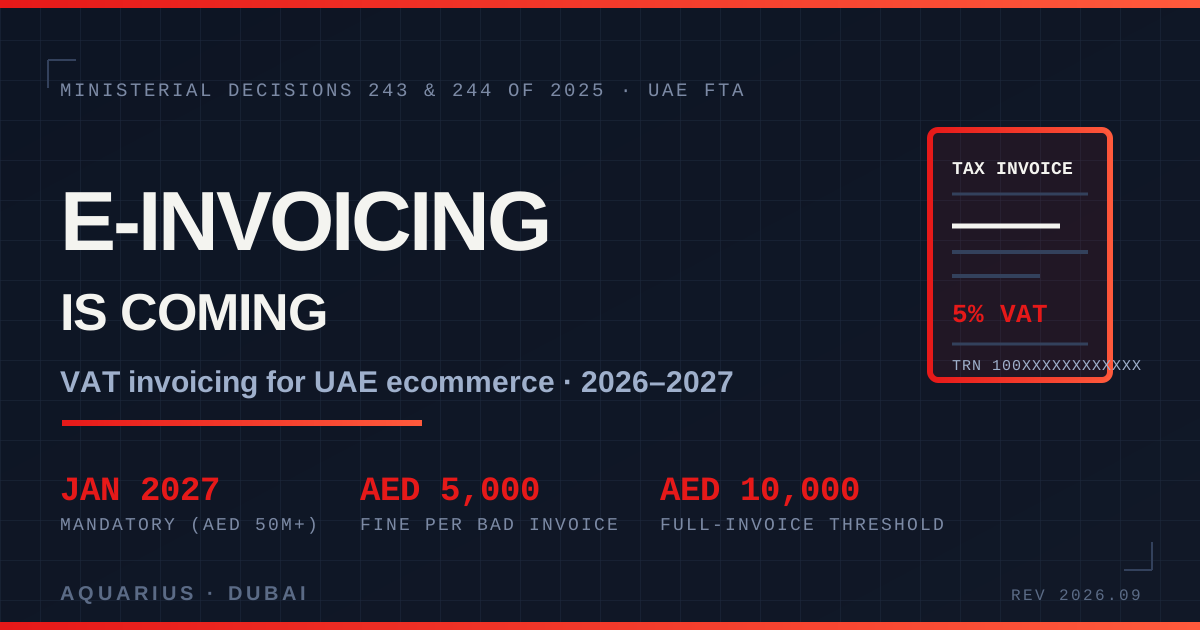
Short answer: every UAE online store must show its 15-digit Tax Registration Number (TRN) and 5% VAT on each sale. For B2B sales over AED 10,000 you must issue a full tax invoice with the buyer's name, address and TRN; below that you can use a simplified invoice. Failing to issue a valid tax invoice carries a AED 5,000 fine per document. And under Ministerial Decisions No. 243 and 244 of 2025, the UAE is moving to a structured e-invoicing system — voluntary from 1 July 2026 and mandatory from 1 January 2027 for businesses turning over AED 50 million or more. Your checkout and invoicing module need to be built for this now.
Why invoicing is now a build problem, not an accounting afterthought (the UAE numbers)
Invoicing used to be the finance team's problem. For a Dubai ecommerce brand in 2026, it is an engineering requirement baked into checkout — and the stakes are growing with the market:
- ~US$12.3 billion — the estimated size of the UAE ecommerce market in 2026, forecast to reach US$21.0 billion by 2031 (an 11.3% CAGR), per Mordor Intelligence. More transactions means more invoices that have to be right.
- 11.04 million — online shoppers in the UAE, with smartphones driving 78.67% of 2025 transaction volume. Every mobile checkout still has to produce a compliant tax invoice.
- AED 5,000 — the Federal Tax Authority's administrative penalty for each tax invoice or tax credit note a registered business fails to issue correctly. At scale, a checkout bug that drops TRNs is not a small mistake.
Most Dubai store owners think "we charge 5% VAT, so we're compliant." Charging the tax is the easy half. Issuing a correctly structured tax invoice — and being ready for e-invoicing in 2027 — is where stores actually get caught out.
What an FTA-compliant tax invoice must contain
If your business is VAT-registered (mandatory above AED 375,000 in annual taxable supplies), every sale needs a tax invoice. There are two kinds, and which one you issue depends on the buyer and the amount.
Full (standard) tax invoice
Required for B2B sales where the consideration exceeds AED 10,000. It must include:
- The words "Tax Invoice" clearly displayed.
- The supplier's name, address and TRN.
- The recipient's name, address and TRN (where the buyer is VAT-registered).
- A sequential invoice number and the date of issue.
- Description, unit price, quantity and any discount per line.
- The net amount, VAT rate and VAT amount per line, and the gross total.
Simplified tax invoice
Allowed for B2C sales, for unregistered buyers, or for supplies under AED 10,000. It drops the buyer's name, address and TRN — the minimum is the supplier's TRN, the total including VAT, and the VAT amount. The catch: a simplified invoice cannot support input-VAT recovery. If a VAT-registered customer wants to reclaim the tax you charged, they need a full invoice. A store that only ever emits simplified invoices quietly loses B2B buyers who can't expense the purchase. Related reading: VAT on SaaS and digital products in the UAE.
| Situation | Invoice type | Buyer TRN required? |
|---|---|---|
| B2C sale (any amount) | Simplified | No |
| B2B sale ≤ AED 10,000 | Simplified or full | Optional |
| B2B sale > AED 10,000 | Full tax invoice | Yes (if registered) |
| Buyer wants to reclaim VAT | Full tax invoice | Yes |
In practice this means your checkout needs a "Buying for a business?" toggle that captures a TRN and switches the invoice template accordingly — not a one-size-fits-all PDF.
The 2027 e-invoicing mandate: what is actually changing
This is the part most Dubai stores have not prepared for. Through Ministerial Decisions No. 243 and 244 of 2025, the UAE introduced an Electronic Invoicing System (EIS) that replaces emailed PDFs with structured, machine-readable invoices exchanged through accredited providers. The timeline:
- 1 July 2026 — voluntary go-live. Any VAT-registered business can opt in and start exchanging e-invoices.
- 1 January 2027 — mandatory, Phase 1. Businesses with annual revenue of AED 50 million or more must comply.
- 1 July 2027 — Phase 2. Smaller businesses are brought in, with government entities following around 1 October 2027.
The mechanics matter for how you build. The EIS uses the international OpenPeppol framework on a decentralised "five-corner" model, and businesses must appoint an Accredited Service Provider (ASP) to transmit invoices to the counterparty and report them to the FTA. Scope is B2B and B2G; B2C is excluded for now. The ASP appointment deadline for large businesses has been set around 30 October 2026 — meaning the practical work starts well before the 2027 go-live.
For an ecommerce platform, the upshot is clear: your invoicing module should be designed so that moving from "generate a PDF" to "emit a structured e-invoice via an ASP API" is a configuration change, not a rebuild. If you are also handling personal data at checkout, pair this with our UAE PDPL compliance checklist — the two obligations land on the same checkout flow.
What it costs to build invoicing in properly (AED ranges)
Retrofitting compliant invoicing after launch always costs more than building it in. Indicative Dubai ranges when we add or rebuild an invoicing module:
| Invoicing capability | What it involves | Typical cost (AED) |
|---|---|---|
| Compliant tax-invoice engine | Full + simplified templates, TRN capture, sequential numbering, per-line VAT | 6,000 – 15,000 |
| Bilingual invoices (EN/AR) | Arabic/RTL invoice layout and number formatting | 3,000 – 8,000 |
| Accounting/ERP sync | Push invoices to Zoho Books, Xero, Odoo or a custom ledger | 8,000 – 25,000 |
| E-invoicing (ASP) readiness | OpenPeppol-ready data model + ASP API integration hooks | 15,000 – 45,000+ |
Against a AED 5,000-per-invoice penalty and the hard January 2027 deadline for larger sellers, building this correctly is cheap insurance. A new build should have compliant invoicing baked in from day one — see our transparent AED pricing. Related reading: insurance comparison website development.
How Aquarius builds invoicing-ready ecommerce
We treat the tax invoice as a first-class part of checkout, not a receipt bolted on afterward. Every store we ship gets a TRN-aware invoice engine that switches between simplified and full tax invoices automatically, sequential numbering that survives refunds and credit notes, bilingual EN/AR output, and a data model structured so the move to e-invoicing in 2027 is an integration, not a teardown. The cost of getting invoicing right is a rounding error next to a single FTA finding across thousands of orders. See how we build ecommerce, or book a free invoicing review of your current store.
Frequently asked questions
Does my Dubai online store need to show VAT on prices?
If your business is VAT-registered (mandatory once taxable supplies exceed AED 375,000 a year), yes — you charge 5% VAT and must issue a tax invoice for each sale that shows your TRN and the VAT amount. Displayed prices to consumers should be VAT-inclusive.
What is the difference between a simplified and a full tax invoice?
A full tax invoice includes the buyer's name, address and TRN and is required for B2B sales over AED 10,000. A simplified invoice omits the buyer's details and is fine for B2C sales or amounts under AED 10,000 — but it cannot be used by a VAT-registered buyer to reclaim input VAT.
When does UAE e-invoicing become mandatory?
Under Ministerial Decisions No. 243 and 244 of 2025, e-invoicing is voluntary from 1 July 2026 and mandatory from 1 January 2027 for businesses with revenue of AED 50 million or more. Smaller businesses follow in a second phase from July 2027. B2C transactions are currently excluded.
What happens if I don't issue a proper tax invoice?
The FTA can impose an administrative penalty of AED 5,000 for each tax invoice or tax credit note a registered business fails to issue correctly — so a systemic checkout error across many orders compounds quickly.
Do I need an Accredited Service Provider (ASP) now?
Only once e-invoicing applies to you, but larger businesses face an ASP appointment deadline around 30 October 2026 ahead of the January 2027 go-live. The sensible move is to build your invoicing data model to OpenPeppol-ready standards now, so appointing an ASP later is a plug-in step rather than a rebuild.