
How to Rank on Google Maps in Dubai (2026): The Local Pack Playbook
Dubai has 292,486 active Chamber-registered companies and three Maps slots. The 2026 ranking factors, the trade-licence trap that suspends profiles, and what local SEO costs in AED.
- PUBLISHED
- 13 SEPT 2026
- READ TIME
- 10 MIN
- AUTHOR
- AQUARIUS · DUBAI
- UNIT
- REV 2026.09
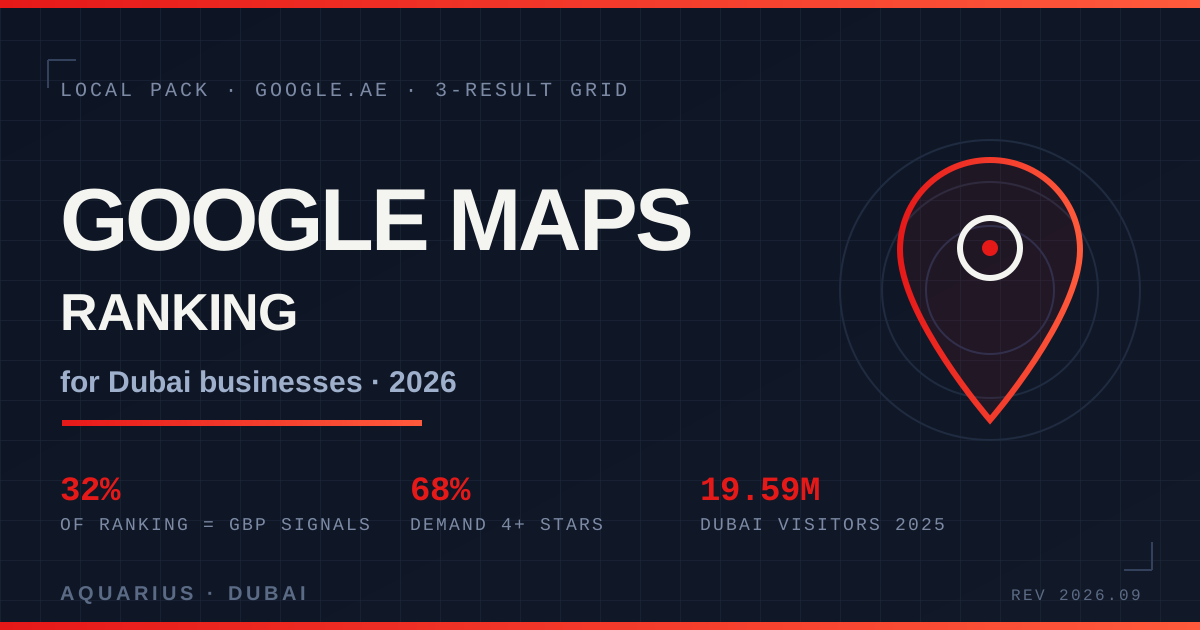
Short answer: To rank in the Google Maps local pack in Dubai you need three things Google can verify: a verified Google Business Profile whose name and address match your trade licence exactly, a steady flow of recent reviews, and location-specific content on your own site that backs up what the profile claims. Google ranks on relevance, distance and prominence — you cannot move your office, so you compete on the other two. In 2026, Google Business Profile signals account for roughly 32% of local pack ranking weight and review signals another 20%, which is why a AED 200,000 website loses to a shop with 400 fresh reviews.
Key takeaways
- Dubai is the densest local SERP in the region. Dubai Chamber of Commerce ended 2025 with 292,486 active member companies after 71,830 new companies joined during the year. Three Maps slots, a quarter of a million competitors.
- Your profile is the product page. Whitespark's 2026 Local Search Ranking Factors study puts GBP signals at 32%, review signals at 20% and on-page signals at 15% — and eight of the top ten local pack factors come straight from the profile itself.
- Old reviews now count against you. BrightLocal's 2026 consumer survey found 74% of consumers look for reviews written in the last three months, 68% will not use a business under 4 stars (up from 55%), and 31% only use businesses rated 4.5 or higher (up from 17%).
- The most common Dubai failure is self-inflicted. Keyword-stuffed business names and an address that does not match the trade licence are the two biggest causes of suspension in this market — and a suspended profile ranks nowhere while you appeal.
- Maps is becoming an AI surface. Google discontinued the Q&A API on 3 November 2025 and launched Gemini-powered Ask Maps in March 2026. The profile content you write today is the training data for the answer a tourist gets tomorrow.
TOFU: 19.59 million visitors, 99% connectivity, three slots
Dubai recorded 19.59 million international overnight visitors in 2025, a 5% rise on the 18.72 million of 2024 and a third consecutive record year, with hotel occupancy at 80.7%, according to the Dubai Department of Economy and Tourism. Almost none of those people know your brand name. They know the phrase "near me", and they type it into Maps from the back of a taxi.
They can do that everywhere. DataReportal's Digital 2026 report put UAE internet penetration at 99.0% with 11.3 million users at the end of 2025, against 23.0 million active cellular connections — 202% of the population. This is one of the most mobile-saturated markets on earth, which means the local pack is not a desktop nicety here. It is the default storefront.
Now the supply side. The Dubai Chamber of Commerce closed 2025 with 292,486 active member companies, having added 71,830 new members during the year — 53,838 of them in the first nine months alone, up 4% year on year. Every one of those licences can create a Google Business Profile in ten minutes. The local pack still shows three.
That is the whole strategic picture: unlimited competitors, fixed shelf space, and a customer base that decides in the four seconds it takes to read a star rating. Google's own long-running research on this behaviour is blunt — 76% of people who search for something nearby on a smartphone visit a business within 24 hours, and 28% of those searches end in a purchase. Local intent is not top-of-funnel traffic. It is someone with a car and a card.
MOFU: what actually moves you into the three-pack
Google has been consistent about the mechanics: local results are ranked on relevance (does the profile match the query), distance (how far the business is from the searcher or the searched location) and prominence (how well known and well referenced the business is). You cannot change distance. So the work is relevance and prominence, and the 2026 weightings tell you where to spend.
| Signal group | Share of local pack weight (Whitespark 2026) | What that means in practice for a Dubai business |
|---|---|---|
| Google Business Profile signals | ~32% | Primary category, additional categories, correct trade-licence name, exact address, opening hours including Friday and Ramadan timings, attributes, services list, photos, posts. |
| Review signals | ~20% | Review velocity and recency, rating, whether reviews mention your service and your area, and whether you reply. Volume alone no longer carries a profile. |
| On-page signals | ~15% | NAP on the site matching the profile, location pages per branch, LocalBusiness schema, Arabic and English versions, page speed on mobile. |
| Links, citations, behaviour | Remainder | UAE directory citations, local press, chamber and association listings, and what users do after they see you — calls, direction requests, clicks. |
1. The primary category decides which races you are even in
The single highest-leverage field on the whole profile is the primary category, because it determines the query set you are eligible for. A Dubai company listed as "Business Management Consultant" will not surface for "web design company", no matter how good the site is. Set the primary category to the exact service you want the phone to ring about, then add the secondary categories that describe real services you deliver — profiles that use several well-chosen additional categories consistently out-rank single-category profiles in category studies.
2. The Dubai trap: your business name must be your trade licence name
This is where most Dubai businesses get it wrong, and it is wrong in a way that feels clever. Half this market names its profile "Best Web Design Company Dubai | Affordable SEO Services". Google's naming policy allows your real-world business name only — no keywords, no taglines, no city bolted on unless it is legally part of the name. Keyword-stuffed names are the single most reported cause of suspensions and competitor edit-requests, and a suspended profile does not drop a few places, it disappears from Maps entirely while you appeal.
The second half of the trap is the address. In the UAE your GBP address and name should match your trade licence exactly — the licence is the document Google's reviewers and the reinstatement team will ask for. Mismatches between the licensed address and the profile address are a recurring suspension cause here, and so are PO Box addresses, which are not a valid street address for verification. If you operate from a flexi-desk or a free-zone business centre, expect video verification, which Google typically reviews within 3 to 5 business days: you will be asked to walk from the street signage to the unit, show the signage, the licence and the equipment you actually work with.
3. Reviews: recency beats volume in 2026
The consumer bar has risen sharply. BrightLocal's Local Consumer Review Survey 2026 found that 97% of consumers read reviews when choosing a local business, that 41% now always read them (up from 29% the year before), and that 74% specifically look for reviews written in the last three months. Rating expectations moved with it: 68% require at least 4 stars, up from 55%, and 31% will only use a business rated 4.5 or above, up from 17%.
Read those two numbers together and the operational conclusion is uncomfortable for a lot of Dubai SMEs: a 4.7-star profile with 300 reviews, none from this quarter, is now weaker than a 4.6-star profile collecting eight a month. Build review requests into the point of delivery — the invoice, the handover message, the WhatsApp confirmation — and reply to every one, positive or not. Never buy reviews and never run a review kiosk or incentivised campaign; Google tightened enforcement on solicited and incentivised reviews again in 2026, and the penalty lands on your profile, not the vendor's.
4. Freshness is now a ranking behaviour, not a vanity metric
Profiles that go quiet stop being surfaced as confidently. Treat the profile like a channel with a publishing schedule: photos every couple of weeks (geo-tagged from the actual location, not stock), a Post for every offer, event or seasonal change, updated hours for Ramadan and Eid, and the products or services list kept current with real AED prices where you are comfortable publishing them. Dubai has two hard seasonality events a year that competitors forget to update for — if your hours are wrong during Ramadan, the profile leaks trust and calls at the exact moment search volume spikes.
MOFU: how to measure it without fooling yourself
Rank tracking on a single postcode is misleading in Dubai, because local results shift block by block. A business in Business Bay can sit at position 1 for a searcher in Business Bay and position 18 for a searcher in Al Quoz, and your rank tracker will confidently report whichever one it happened to sample. Use a geo-grid measurement — a matrix of simulated search points across the emirate — so you see your real catchment radius rather than a number.
Then watch the two Google Business Profile metrics that correlate with money: direction requests and calls. Impressions go up when Google shows you more; those two only go up when you were the choice. If discovery searches rise while calls stay flat, your problem is not ranking. It is your photos, your rating or your hours.
The AI shift: Maps is becoming an answer engine
The Q&A panel that businesses have been farming for years is being retired. Google discontinued the Q&A API on 3 November 2025, and in March 2026 introduced Ask Maps, a Gemini-powered conversational layer that answers complex questions directly inside Maps — it launched in the US and India first on Android and iOS, with desktop and further markets to follow, and is withheld for regulated and spam-prone categories. UAE businesses have a short, useful window here: the answers Ask Maps eventually gives about you will be assembled from your profile attributes, services list, posts, photos and review text. Write them now, in plain factual sentences, in both English and Arabic. Same principle as our guide to getting cited by AI search — structured, specific, verifiable content is what gets quoted.
BOFU: what local SEO costs in Dubai, and what it returns
Local SEO is a retainer, not a project, because reviews and freshness are recurring work. Dubai market rates cluster in four bands — the detail behind these numbers is in our 2026 Dubai SEO cost breakdown.
| Scope | Typical Dubai monthly rate (AED) | What it should include |
|---|---|---|
| Single-location local SEO | 1,500 – 5,000 | Profile optimisation and maintenance, weekly posts and photos, review generation workflow, citation cleanup, geo-grid tracking, monthly reporting. |
| Local + full SEO for a growing SME | 3,000 – 8,000 | The above plus technical SEO, 4–12 content pieces a month, bilingual location pages and link acquisition. |
| Multi-branch or multi-emirate | 3,000 – 10,000 | One profile per branch, per-branch location pages and schema, branch-level review routing, duplicate suppression. |
| Anything at AED 999 | Avoid | Automated directory blasts and template posts. In a 292,000-company market this does not move a pin. |
The return case is the part finance asks about. Cross-industry analysis of 119 companies puts SEO returns at roughly AED 7.48 for every AED 1 invested, with a typical break-even around month nine — and local pack traffic sits at the sharpest end of that, because it arrives with intent and proximity already solved. Set against a AED 3,000 monthly retainer, a single recovered high-value client usually pays for the quarter.
The cost of inaction is simpler to calculate. If you are invisible in Maps for your main service term while three competitors are not, you are not losing a percentage of traffic. You are losing the entire share of searchers who never scroll past the pack — and that pack out-clicks the organic blue links beneath it for local queries.
How Aquarius does it
We treat the profile and the website as one system, because Google does. That means the trade-licence audit first (name, address, category), then verification handled properly including the video walkthrough, then bilingual location pages with LocalBusiness schema that mirror the profile exactly, then a review workflow your team can actually run without being nagged. Reporting is geo-grid plus calls and direction requests — not a screenshot of a ranking taken from our own office. If a profile is suspended when we take it on, reinstatement is the first deliverable, because nothing else matters until it is live.
FAQ
How long does it take to rank on Google Maps in Dubai?
For a new, correctly verified profile in a normal-competition category, expect early movement in 4–8 weeks and a stable local pack position in 3–6 months. Highly contested Dubai categories such as real estate, clinics, salons and web design take longer because the incumbents already have hundreds of reviews and years of behavioural data.
Can I rank in Google Maps without a physical office in Dubai?
Only as a service-area business. You can hide the address and define the areas you serve, but you still need a verifiable real address for Google's records and you will generally rank less strongly than a competitor with a staffed address in the searcher's neighbourhood. Virtual offices and PO Boxes do not qualify for verification.
Why did my Google Business Profile get suspended?
In this market, the usual causes are a keyword-stuffed business name, an address that does not match the trade licence, a PO Box or virtual address, multiple profiles at the same location, or a category change that triggers re-review. Fix the underlying detail first, then appeal with clear documentary proof — the trade licence, tenancy contract and a utility bill — rather than a long explanation.
Do I need an Arabic version of my profile and pages?
For consumer-facing businesses, yes. A large share of UAE residents search in Arabic, and the profile description, services and location pages in Arabic widen the query set you are relevant for. Machine-translated Arabic is worse than none; have it written natively — the same rule we apply to Dubai SEO generally.
Are Google Posts worth the effort?
Yes, but as a freshness and conversion signal rather than a direct ranking lever. Posts keep the profile active, occupy space on the profile panel with your offer, and give Google recent text about what you actually sell. One genuine post a week beats four recycled ones in a burst.
Want the three-pack spot for your category?
We audit Dubai profiles against the trade licence, the category taxonomy and a geo-grid of your real catchment, then fix what is losing you the pack. Send us your business name and main service term and we will tell you exactly where you currently rank across the emirate and what it will take to move. Talk to Aquarius, or see what our retainers include.