
Online Reputation and Review Management in Dubai (2026): Real AED Costs and the April Google Crackdown
Google blocked 292 million reviews in 2025 and banned review gating in April 2026. Real AED costs to run reputation management in Dubai, plus the fines for fake and defamatory reviews.
- PUBLISHED
- 11 OCT 2026
- READ TIME
- 11 MIN
- AUTHOR
- AQUARIUS · DUBAI
- UNIT
- REV 2026.09
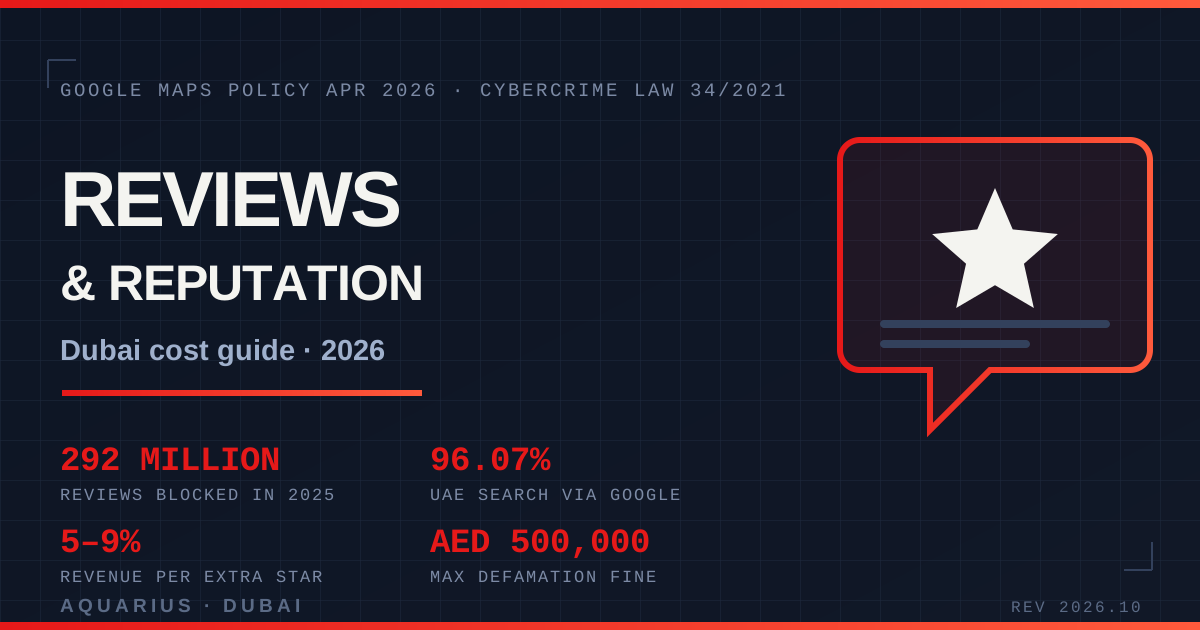
Short answer: managed reputation and review work in Dubai runs AED 1,800–9,000 per month for an SME retainer and AED 5,000–75,000 per month at executive or crisis level, while building your own review engine — request automation, bilingual templates, schema and a multi-location dashboard — costs AED 12,000–220,000 once. The reason to care this quarter: Google blocked or removed 292 million policy-violating reviews in 2025 and, on 17 April 2026, explicitly banned the tactic almost every Dubai business still uses — review gating, staff review quotas and asking customers to name an employee.
Key takeaways
- Google is the whole funnel in the UAE. StatCounter puts Google at 96.07% of UAE search (March 2026) and 98.08% on mobile (August 2026). Your star rating is your shopfront.
- “Only ask the happy customers” is now a policy violation. Google’s April 2026 Rating Manipulation update names review gating, staff quotas, incentives and on-premise pressure as prohibited. Penalties escalate from silent removal to a public warning banner on your profile.
- One star is worth 5–9% of revenue. The most-replicated finding in review research. For a Dubai business turning over AED 3 million a year, that is AED 150,000–270,000 sitting in your rating.
- The legal line runs both ways. Under Article 43 of Federal Decree-Law No. 34 of 2021, online insult carries detention and fines of AED 250,000–500,000. Cabinet Resolution No. 42 of 2025 adds administrative fines of AED 10,000–100,000 for false and falsely attributed material. Buying fake praise is as exposed as receiving fake blame.
- AI answers run on your review profile. BrightLocal’s 2026 study of 200,085 localised searches and 1.9 million AI citations found Google Maps mentioned a tracked business in 66% of searches versus 38% for AI Overviews, 33% for ChatGPT and 32% for AI Mode. SOCi’s 2026 index puts Google Maps at 32.5% of all citations in local AI answers.
Why reviews stopped being a vanity metric in Dubai
Three numbers set the stakes, and all three are Dubai-specific.
First, concentration. The UAE runs at roughly 99% internet penetration with about 11.3 million internet users, and StatCounter has Google taking 96.07% of UAE search as of March 2026, rising to 98.08% on mobile by August 2026. There is no Bing or Yandex cushion here. One review surface — the Google Business Profile — sits between you and almost every local buying decision in the city.
Second, transience. Dubai welcomed 6.97 million international overnight visitors between January and August 2026, including 869,000 in August alone. A visitor who lands on Thursday has no neighbour to ask, no past experience and no brand memory. They have a phone, a map and a star rating. That audience is the purest version of the review economy, and in Dubai it arrives every single week.
Third, volume. Google published more than 1 billion helpful reviews across Maps in 2025. The default state of a Dubai category page is now “everyone has reviews”. Thin profiles do not read as neutral any more; they read as closed.
Practitioner surveys consistently rank review signals — count, rating, velocity and keyword content — among the top three local-pack factors, worth roughly 20% of local ranking weight. It is the only major ranking factor your customers control on your behalf.
What Google actually changed in April 2026
Google published its Maps trust and safety numbers for 2025 on 16 April 2026, and they are larger than most Dubai owners realise:
- 292 million policy-violating reviews blocked or removed, up from 240 million the year before — a 21% increase.
- 13 million fake Business Profiles removed.
- 79 million inaccurate or unverified profile edits blocked.
- Posting restrictions placed on more than 782,000 policy-violating accounts.
The same announcement introduced something Dubai businesses have quietly needed for years: detection for review extortion — the “pay me and the one-star goes away” message that lands on restaurants, clinics and car workshops. Google now says it can stop suspicious posts before publication and alert verified owners during a spam spike.
Then, on 17 April 2026, Google extended the Rating Manipulation policy with explicit prohibitions. The newly named practices include:
- Directing staff to meet review quotas.
- Asking customers to mention an employee by name.
- Review gating — surveying first and only sending the Google link to people who answered positively.
- Offering discounts, cash, free services or prize-draw entries in exchange for a review.
- Pressuring customers to leave a review while they are still on the premises.
Read that list against what is currently installed in most Dubai outlets: a tablet at the till, a “rate us” funnel that branches on a smiley face, and a WhatsApp offer of 10% off for five stars. Those are not grey-area tactics any more. Enforcement escalates from removing the affected reviews, to blocking the profile from receiving new ones, to temporarily unpublishing the reviews you already have, to a public banner telling searchers that fake reviews were removed from this profile. That banner is the real penalty: it converts a marketing shortcut into a permanent trust problem on the exact surface that decides your bookings.
What replaces gating: ask everybody, every time, through an automated and auditable channel — and fix the operational problems the negative reviews expose. That is slower, and it is the only version that survives an AI-powered spam sweep.
The UAE legal line — in both directions
Dubai adds a layer that most international reputation playbooks ignore entirely: online speech is criminally regulated here, and that cuts against the business as often as it protects it.
Under Article 43 of Federal Decree-Law No. 34 of 2021 on Countering Rumours and Cybercrimes, using an information network to insult a person or attribute to them something that exposes them to contempt or punishment carries detention and/or a fine of AED 250,000 to AED 500,000, with aggravated treatment where a public official is targeted. Cabinet Resolution No. 42 of 2025 layers administrative fines of AED 10,000 to AED 100,000 for false news and falsely attributed material. A 2026 case reported in the UAE press ended with a AED 30,000 criminal fine plus AED 51,000 in civil compensation, removal of the content and confiscation of the device.
The practical reading for a Dubai business:
- A genuine bad review is legal. Criticism of price, speed, food, fit-out or service quality is consumer feedback, not defamation. Demanding its removal, threatening the customer or filing over it is the most expensive possible response — it converts one unhappy diner into a news story.
- A review that attacks a person is different. Where content accuses a named individual of fraud, theft or immorality without basis, a criminal complaint and a civil claim are both available. Capture evidence properly: full-page screenshots with URL and timestamp, the reviewer handle, and the Google review ID.
- Manufacturing reviews is the bigger risk. Buying five-star reviews, or paying a “reputation” vendor who buys them for you, is a misleading commercial practice on top of a Google policy breach. The AED 3,000 you save on review generation is not worth the banner, the suspension, or the commercial-fraud exposure.
What a Dubai review engine is actually made of
Reputation is not a monthly report. It is five pieces of plumbing, and most Dubai businesses have one or two of them.
- Profile hygiene. A verified Google Business Profile per physical location, bilingual name and category, correct Arabic transliteration, service areas, hours including Ramadan timings, and photos refreshed monthly. Our Google Maps ranking guide for Dubai covers the ranking side in detail.
- Request automation, not gating. A trigger on job completion, invoice paid or checkout, firing one bilingual WhatsApp or SMS request with a direct review link — to every customer. WhatsApp utility templates run AED 0.08–0.12 per message in the UAE; SMS costs more. Consent and sender-ID rules apply: see our UAE messaging cost and TDRA rules breakdown before you switch anything on.
- Response discipline. Every review answered in Arabic or English to match, within 24 hours, by a named person with authority to fix things. Response text is indexed, and the next buyer reads it far more carefully than the review itself.
- On-site proof. Reviews pulled onto your own site with valid structured data, so your pages carry the social proof rather than renting it to Google. Note that Google does not show rich-result stars for self-serving reviews of your own business — the win here is conversion rate, not a star snippet.
- One dashboard with alerts. Google, Talabat, Noon, Amazon.ae, Trustpilot, Glassdoor and the app stores in a single view, with a rating-drop alert and a review-velocity target per branch. Without this, a Dubai Marina branch can shed half a star over six weeks and nobody at head office notices.
| Workstream | What it covers | Dubai 2026 (AED) |
|---|---|---|
| Profile audit and clean-up | Up to 3 locations, categories, bilingual data, photos, Q&A seeding | 3,500–9,000 one-off |
| Review request automation | Triggers, bilingual WhatsApp/SMS templates, QR assets, opt-out handling | 12,000–30,000 build |
| On-site reviews and schema | Aggregation widget, review landing pages, structured data, Arabic RTL | 8,000–22,000 build |
| Multi-location dashboard | API ingestion, branch scorecards, alerts, AR/EN sentiment tagging | 35,000–90,000 build |
| Full reputation platform | Multi-source ingestion, roles, SLA tracking, response workflows, reporting | 90,000–220,000 build |
| Managed retainer (SME) | Monitoring, responses, monthly velocity targets, reporting | 1,800–9,000 per month |
| Executive or crisis ORM | Negative-SERP work, PR coordination, personal profiles, legal liaison | 5,000–75,000 per month |
| Per-request messaging cost | WhatsApp utility template, UAE routing | 0.08–0.12 per request |
Those retainer bands are what Dubai agencies publicly quote in 2026: entry tiers from AED 1,800–2,500 per month, growth tiers around AED 3,000–5,000, elite tiers from AED 9,000, and crisis or executive mandates running to AED 50,000–75,000 and above. The build numbers are ours — see our pricing for how they package.
The numbers that actually move the needle
Four benchmarks are worth planning against, and none of them require buying anything.
Volume gets you into the pack. Businesses with 50 or more Google reviews are dramatically more likely to appear in the local pack than those under 10 — one widely cited analysis puts the gap at 266%. In practice, Dubai local winners cluster around 80–90 reviews per location, and 25–40 is roughly the floor for consistent local-pack appearance in a competitive area like Business Bay or JLT.
4.5 beats 5.0. The gap between 3.8 and 4.5 stars is worth around a 25% difference in clicks, but a flat 5.0 is trusted less than a 4.5 — buyers read perfection as purchased. A handful of three-star reviews with good responses underneath is a stronger asset than a spotless profile.
Velocity matters more than the lifetime total. Twenty reviews spread over the last ninety days outranks two hundred that stopped arriving in 2023. Set a per-branch monthly target and treat a miss like a missed sales number.
One star equals 5–9% of revenue. This is the single most replicated result in the review literature. Run it on your own P&L before you argue with the retainer: a Dubai business at AED 3 million turnover is looking at AED 150,000–270,000 a year for one star of movement, against a managed retainer of AED 36,000–108,000 a year.
Reviews are now the input to AI answers
Here is why this stopped being a 2019 problem. AI assistants do not read your brochure copy to recommend a dentist in Jumeirah. They read structured local data and reviews.
BrightLocal’s 2026 local AI visibility study ran 200,085 localised searches across ChatGPT, Google AI Mode and AI Overviews over 1,300 locations, and examined 1.9 million citations. Google Maps mentioned a tracked business in 66% of searches; AI Overviews managed 38%, ChatGPT 33% and AI Mode 32%. The platforms also disagree violently with each other — repeat searches returned only 20–33% overlap in recommended businesses, and ChatGPT overlapped just 19–20% with either Google surface.
SOCi’s 2026 index of local AI answers found the citation mix was Google Maps 32.5%, niche and directory sites 26.3%, brand websites 23.1%, Yelp 10.5% and Facebook 7.6%. In other words, roughly a third of what an AI assistant says about your Dubai business is read straight off the profile you have been ignoring — and another quarter comes from directories still carrying your old phone number. If you want to measure what this is already sending you, our GA4 guide to tracking AI search traffic shows the segments to build.
How Aquarius runs it
We build the engine, then either hand it over or run it. In sequence: audit every profile and directory listing for the whole brand, including the Arabic entries nobody owns; wire review requests into the systems that already know a job finished — POS, CRM, booking engine, invoicing; ship bilingual templates that comply with the April 2026 policy and TDRA consent rules; pull reviews onto your own site with proper structured data; stand up one dashboard with branch-level velocity targets and rating-drop alerts; and set a 24-hour response SLA with templates your branch managers can actually use. No gating, no incentives, no bought reviews — those are the three things that put a warning banner on the asset we are trying to grow. If search visibility is the wider problem, our Dubai SEO cost guide sets out the full budget picture.
FAQ
Can I ask customers for reviews in Dubai without breaking Google’s rules?
Yes. Asking is explicitly allowed; selecting who you ask is not. Send the same request, through the same channel, to every customer after a completed transaction, with no incentive attached and no pre-screening survey deciding who gets the link. Keep the send log — it is your evidence if a competitor reports you.
How do I remove a fake review from my Google profile?
Report it through the Business Profile interface against a specific policy — conflict of interest, off-topic, spam, impersonation — not simply “this is untrue”. Include evidence that the reviewer was never a customer, and escalate via Google Business Profile support if the first pass fails. Where the content accuses a named individual of a crime, a legal route also exists under Article 43 of Federal Decree-Law No. 34 of 2021, but reserve that for genuine defamation.
What is a good Google rating for a Dubai business?
Between 4.4 and 4.8, with reviews still arriving every month. Below 4.2 you lose clicks to the competitor above you; at a flat 5.0 with low volume, buyers and Google’s spam systems both get suspicious.
Should review requests go out in Arabic or English?
Both — matched to the language the customer used with you, with the response in the same language as the review. A profile with credible Arabic reviews and Arabic responses reads as a local business to both buyers and AI assistants, and Arabic review text is a ranking input for Arabic-language local searches.
Is reputation software worth building instead of subscribing?
Under about five locations, subscribe and spend the money on response discipline. Past five locations, or where reviews must flow into a POS, CRM or franchise scorecard, the build pays for itself quickly — per-location SaaS seats compound, and the integrations are where the operational value sits.
Where to start: pull your own profiles and count what arrived in the last ninety days. If the answer is under ten per location, your rating is a historical document, not a sales asset. Talk to Aquarius and we will audit the profiles, show you the velocity gap against the three competitors above you, and quote the engine that closes it.