
Google Play's April 2027 foldable rules: 90% of UAE apps are not ready
From April 2027 Google Play blocks updates for apps that miss Tier 3 adaptive quality and foldable screenshots. We measured 232 UAE listings: 209 would fail. Android is 80.79% of UAE handsets.
- PUBLISHED
- 21 NOV 2026
- READ TIME
- 11 MIN
- AUTHOR
- AQUARIUS · DUBAI
- UNIT
- REV 2026.09
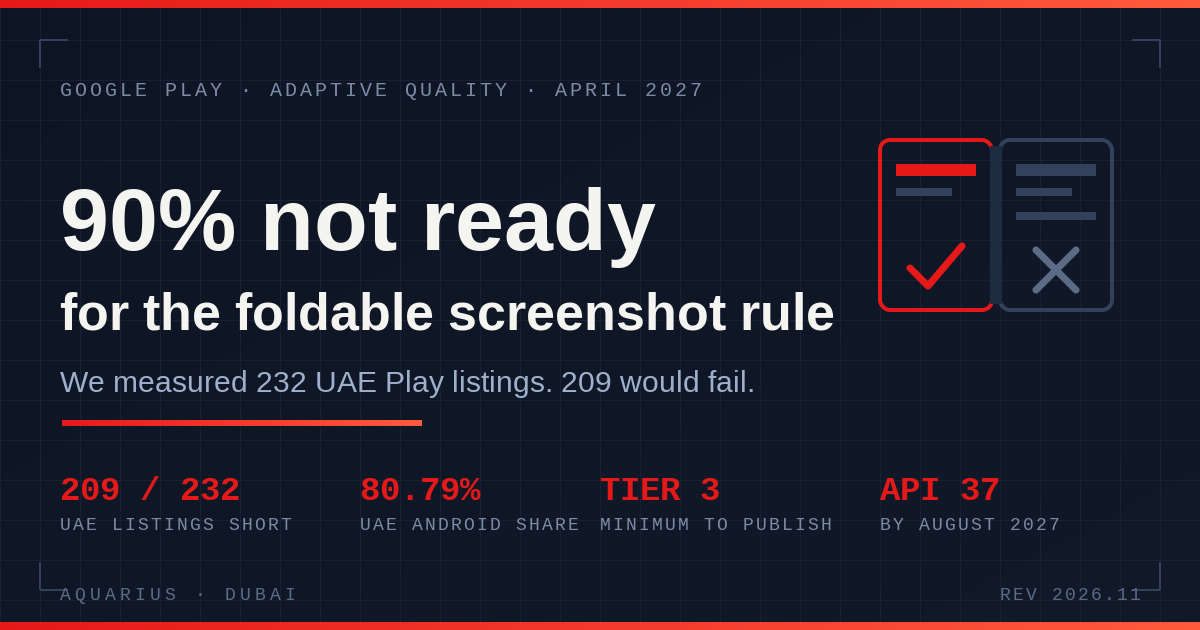
From April 2027, Google Play will refuse to publish or update an Android app that does not meet at least Tier 3 of its new adaptive quality standards, and every new submission will need three dedicated foldable screenshots on top of the standard two phone shots. Google announced the rules on 18 November 2026. In the UAE, where Android holds 80.79% of mobile traffic, this is not a tablet side-quest — it is a publishing-eligibility deadline for four out of five of your users.
We measured it rather than guessed. Across 232 live Google Play listings aimed at UAE audiences, 209 — just over 90% — carry no foldable screenshots at all. 217 of them are portrait-only: every single screenshot taller than it is wide. On today's Play Console that is fine. In April 2027 it is a blocked update.
The three dates that matter
Google published two posts on 18 November 2026 — one for apps, one for games — and the timelines differ. For apps, the wording is blunt: apps that do not meet the quality bar “will no longer be able to publish or update on Google Play, and may have reduced visibility on the store.” Existing, un-updated apps stay downloadable, which is cold comfort if you ever intend to ship a bug fix.
| When | Apps | Games |
|---|---|---|
| Now (Nov 2026) | Foldable screenshots can be uploaded in Play Console. Tier 2 / Tier 1 apps can apply for badging and enhanced merchandising. | Same upload path available. |
| April 2027 | Tier 3 adaptive quality required. 3 foldable screenshots required at submission. Non-compliant apps cannot publish or update. | Screenshots required. Tier not yet enforced. |
| August 2027 | New and updated apps must target API level 37 (Android 17). | Tier 3 equivalent (“Ready”) required. |
Google counts over 580 million large-screen devices in users' hands today — foldables, tablets, Chromebooks, the new Googlebook class of laptops, and Android XR headsets. Worth noting: Google's own Compose documentation still carries the older “more than 300 million” figure. The two numbers coexist in Google's own docs right now, so treat 580 million as the current line and expect the older one to be retired.
Why Dubai teams read this wrong
The instinctive objection in every Dubai boardroom is that nobody here uses tablets. The data half-agrees: tablets are only 0.83% of UAE web traffic (StatCounter, October 2026), against 68.03% mobile and 31.14% desktop. So the temptation is to file this under “not our market”.
That misreads the rule. April 2027 is not a traffic threshold — it is a gate on the submission pipeline. The question is not how many Emiratis use a Galaxy Z Fold. It is whether your next release gets accepted on a store that serves 80.79% of UAE handsets (Android) versus 19.18% for iOS. A Play block is an 80% outage, not a 1% one.
And the foldable installed base here is less theoretical than it looks. The UAE's top mobile vendor is Samsung at 20.86%, ahead of Apple's 19.18%. Honor sits at 5.59% and Motorola at 3.98%. All three ship foldables into this market. Samsung alone outranks Apple on UAE handsets, and Samsung is the single vendor most responsible for the device class the rule is written around.
What we found in 232 UAE Play listings
To size the gap locally we scraped the Play Store listings of 232 apps that target UAE users — banking, delivery, government, retail, clinics, schools, taxi, insurance — pulled every screenshot at original resolution, and measured the real pixel aspect ratio of each one rather than trusting the thumbnail container. Findings are aggregated by sector; we do not name individual apps.
- 896 screenshots were 9:16 phone portrait. That is the required baseline and almost everyone has it.
- Only 25 of 232 apps (10.8%) had even one screenshot at an inner-display ratio (1:1, 4:3 or 3:4).
- Only 12 apps (5.2%) had a folded outer-screen shot (16:10 or 10:16).
- Just 23 apps (9.9%) would clear the three-foldable-screenshot bar as it stands.
- 217 apps (93.5%) are portrait-only. Not one landscape asset. Only 7 apps carried a 16:9 phone landscape shot — which is now optional anyway.
Read that as a competitive opening rather than a crisis. Nine in ten of your UAE competitors have the same April 2027 problem, and the apps that fix it early collect the badging and enhanced merchandising that Google is already handing out.
What Tier 3 actually asks for
Tier 3 (“Adaptive ready”) is the floor, and it is narrower than people fear. Three requirements carry most of the weight:
- Fill the display area. No letterboxing, no compatibility mode, no content overflowing the window.
- Preserve state. Scroll position, text input and media playback must survive rotation, folding, unfolding and resizing.
- Support multi-window. Behave correctly when your app shares the screen.
The published Tier 3 checklist is 9 guidelines and 13 tests across 5 categories — configuration changes, configuration combinations, multi-window, multi-resume, and input (keyboard, mouse/trackpad, stylus). Core app quality, especially the user-experience section, is a prerequisite. Tier 2 adds responsive multi-pane layouts and proper external keyboard, mouse, trackpad and stylus handling. Tier 1 adds tabletop and book postures, camera continuity, interactive picture-in-picture and multi-instance.
The escape hatches that no longer work
Two lines of manifest XML have been quietly load-bearing in a lot of Dubai codebases:
android:screenOrientationlocksandroid:resizeableActivity="false"
Large-screen devices running Android 12 (API 31) and above already ignore both. They are not a compliance strategy; they are a comment. And targeting API 37 in August 2027 removes the remaining developer opt-outs entirely. Right now, a non-adaptive app can already show users a warning on its Play details page reading “May not be optimized for your device.”
The screenshot spec, precisely
For apps: two phone screenshots (9:16 portrait required, 16:9 landscape now optional) plus three foldable screenshots — at least one 1:1 inner display, at least one 4:3 inner display, and at least one folded outer screen at 10:16 portrait, with 16:10 landscape optional. Games need three foldable plus one phone shot. You do not need to buy hardware: Google states that captures from the Foldable (1:1) and Foldable (4:3) emulator profiles are fully compliant.
Test targets published in the matrix, in dp: foldable 1:1 inner at 802×802, foldable 4:3 inner at 1024×768, 8-inch tablet at 1024×640, 10.5-inch tablet at 1280×800, 13-inch Chromebook at 1600×900. The threshold for large-screen behaviour is smallest-width 600 dp on Android 12 or later.
The API 37 problem is bigger than the screenshots
Screenshots are a day of work. The August 2027 requirement to target API level 37 is the one that moves budgets — and UAE device data says the runway is short. In October 2026, Android 17 accounted for just 2.14% of UAE Android traffic. Android 16 leads at 40.39%, with 15.0 at 18.53%, 13.0 at 12.67% and 14.0 at 10.4%. You will be compiling against a platform version that almost none of your UAE users are running yet, which means behaviour changes land in testing rather than in production feedback.
What this costs in Dubai, and how we scope it
Rough ranges from the adaptive readiness work we quote in the UAE. Every number assumes an existing production app, not a rebuild.
| Scope | Typical AED | Timeline |
|---|---|---|
| Adaptive audit — run the 13 Tier 3 tests on both foldable emulator profiles, manifest flag review, written gap list | AED 4,000 – 8,000 | 3 – 5 days |
| Store listing compliance — five correct screenshot ratios captured, branded and uploaded | AED 2,500 – 5,000 | 2 – 4 days |
| Tier 3 remediation — remove orientation and resizability locks, fix state preservation across configuration changes, multi-window pass | AED 18,000 – 45,000 | 3 – 6 weeks |
| Tier 2 uplift — responsive multi-pane layouts, keyboard, mouse, trackpad and stylus support | AED 35,000 – 90,000 | 6 – 10 weeks |
| API 37 target migration with regression pass | AED 12,000 – 30,000 | 2 – 4 weeks |
Set that against the cost of inaction. A blocked update on a market where Android is 80.79% of handsets means you cannot ship a security patch, a payment-gateway fix or a Ramadan campaign to four in five of your users — and Google has reserved the right to reduce your store visibility on top of that. The remediation band above is normally less than a month of paid acquisition for a mid-size Dubai app.
How Aquarius handles it
We start with the audit, because most apps are closer to Tier 3 than they assume — state preservation across configuration changes is usually the only real engineering item, and the manifest flags are a delete. You get the gap list in writing before any build work is quoted, so the remediation number is based on your code and not an average. If the audit shows you already pass, we say so and charge for the audit only.
If you are earlier in the cycle, our guide to publishing an app on the App Store and Google Play from Dubai covers the submission basics, and Android developer verification for sideloaded APKs covers the other 2027 Play deadline that catches UAE teams. Build scopes and rates are on our pricing page.
FAQ
What exactly is the April 2027 Google Play deadline?
From April 2027, apps must meet at least Tier 3 of Google Play's adaptive quality standards and include three foldable screenshots with each submission. Apps that do not comply cannot publish or update, and may lose store visibility. Google has only published the month, not a day-of-month date.
Do I need to buy a foldable to comply?
No. Google states that screenshots captured on the Foldable (1:1) and Foldable (4:3) emulator profiles are fully compliant, and the Tier 3 test matrix is defined in dp so it can be run entirely in Android Studio.
Does android:resizeableActivity="false" still protect my app?
No. Large-screen devices on Android 12 (API 31) and above already ignore both android:resizeableActivity="false" and android:screenOrientation locks, and targeting API 37 in August 2027 removes the opt-outs outright.
My app is already live. Will it be removed?
No. Google's wording is that existing un-updated apps remain downloadable. The block applies to publishing and updating, which in practice means you are frozen on your current build until you comply.
Are the rules the same for games?
No. Games need foldable screenshots by April 2027 but their Tier 3 equivalent is not required until August 2027, they need three foldable plus one phone screenshot, and the games announcement carries no API 37 requirement.
Nine in ten UAE-facing Play listings are not ready. The ones that fix it in the next two quarters get badging and merchandising while their competitors are still arguing about tablet traffic. Book an adaptive readiness audit and we will tell you in a week whether you are a delete-two-lines job or a six-week one.