
Grocery Delivery App Development in Dubai (2026): Q-Commerce, Dark Stores & Real AED Costs
What it really costs to build a grocery delivery app in Dubai in 2026 — the q-commerce economics, the four apps you actually need, dark-store logistics, and honest AED ranges.
- PUBLISHED
- 10 SEPT 2026
- READ TIME
- 10 MIN
- AUTHOR
- AQUARIUS · DUBAI
- UNIT
- REV 2026.09
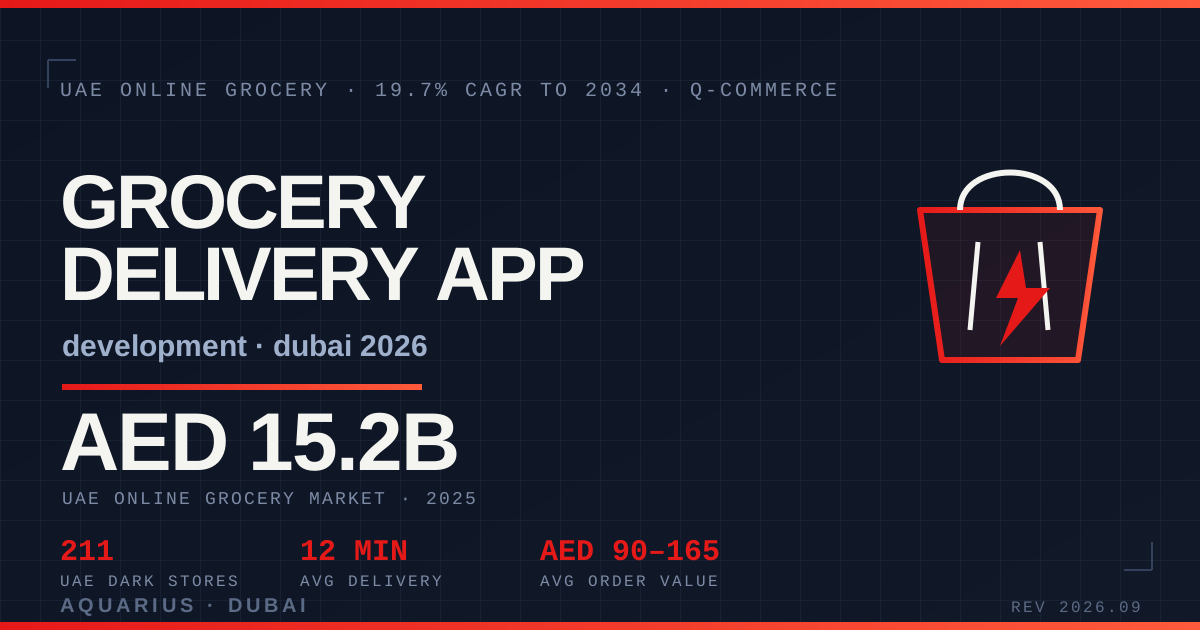
Short answer: a grocery delivery app in Dubai costs roughly AED 90,000–180,000 for a lean MVP (customer app, driver app, one store or dark store), AED 180,000–450,000 for a multi-store platform with dark-store inventory, dispatch and loyalty, and AED 450,000–1,200,000+ for an AI-driven quick-commerce operation. The market is worth building for: UAE online grocery hit USD 4.13 billion (≈ AED 15.2B) in 2025 and is forecast to reach ~USD 22 billion by 2034 at a 19.7% CAGR. But the app is the easy part — in Dubai's q-commerce, an AED 15–25 delivery cost against an AED 90–165 order means unit economics, not features, decide whether you survive.
The Dubai grocery-delivery opportunity, in real numbers
The demand is not in question. The UAE online grocery market reached USD 4,129 million (about AED 15.2 billion) in 2025 and is projected to grow to roughly USD 22 billion by 2034 — a 19.7% CAGR, one of the fastest retail curves in the region. Inside that sits quick commerce (q-commerce): ultra-fast 10–30 minute delivery, where grocery and essentials make up around 45% of orders because people re-order them constantly.
The infrastructure is already dense. There are now 211 dark stores mapped across the UAE, operated mainly by Talabat Mart and Noon Minutes across 10 cities. In January 2026 Noon activated 20 more dark stores in Dubai and Abu Dhabi, pushing real-time inventory coverage to 85% of urban households and cutting the average delivery window to 12 minutes. And consolidation is real: in 2025 Talabat fully acquired InstaShop, folding roughly USD 630 million of grocery sales into one operator. The top five players — Talabat, Noon, Careem, Amazon and Deliveroo — already control 65–70% of revenue.
Most Dubai founders get this backwards: they obsess over the app and ignore the store. In grocery delivery the app is 30% of the problem — the dark store, the inventory feed and the delivery cost per order are the other 70%, and they are where the money is won or lost.
The four apps you're actually building
"A grocery app" is really a system of four connected products, and pricing that treats it as one app is a red flag. A serious build ships:
- Customer app (iOS + Android) — catalog, search, real-time stock, cart, secure payment, live order tracking, re-order and substitutions.
- Picker / store app — the staff device inside the dark store or supermarket that receives orders, guides picking, flags out-of-stock items and confirms hand-off.
- Driver app — batched order assignment, route to store then customer, proof-of-delivery, cash-on-delivery reconciliation and earnings.
- Admin dashboard — catalog and pricing, branch/dark-store inventory, delivery zones, promotions, analytics and settlement.
The backend typically eats 25–35% of the budget — real-time inventory, order routing and dispatch logic are far more expensive than the screens users see. Skimp here and you ship an app that sells items you cannot deliver.
Q-commerce unit economics: the number that decides everything
This is the part Dubai operators discover too late. Quick commerce carries a delivery cost of AED 15–25 per order against a typical average order value (AOV) of AED 90–165. Traditional e-commerce, by contrast, spends only AED 8–12 per delivery on AOVs of AED 300–550. So q-commerce burns a far larger share of each basket on logistics — which is why a dark store is now expected to hit 150–200 orders a day just to be viable.
| Metric | Quick commerce (grocery) | Traditional e-commerce |
|---|---|---|
| Average order value (AED) | 90 – 165 | 300 – 550 |
| Delivery cost per order (AED) | 15 – 25 | 8 – 12 |
| Delivery cost as % of order | ~10 – 25% | ~2 – 4% |
| Break-even density | 150 – 200 orders/day per dark store | n/a |
The lever is basket size and batching. Raise AOV with bundles, free-delivery thresholds and a subscription (Talabat Pro sells at ~AED 19/month for a reason), and batch multiple orders per trip, and the delivery cost per order falls. Build these into the product from day one — they are not features, they are the business model.
Build vs buy: white-label, custom, or aggregator?
Not everyone should build. Match the model to your actual position:
| Model | Best for | Trade-off |
|---|---|---|
| List on Talabat / Noon / InstaShop | Testing demand, discovery, no tech risk | Commissions and you never own the customer |
| White-label / template app | A single supermarket going online fast | Limited dark-store logic, hard to differentiate |
| Custom platform | Multi-store chains, dark-store operators, new q-commerce brands | Higher build cost, but you own the economics and data |
A useful rule: if delivery logistics and inventory are your competitive advantage, build custom. If you just need to be findable, start on the aggregators — the same logic we lay out for restaurants in cutting Talabat commission with a branded app. Running vendors and payouts too? That's closer to a multi-vendor marketplace build.
What a grocery app costs to build in Dubai (2026 AED)
| Tier | Typical AED range | What you get |
|---|---|---|
| MVP | 90,000 – 180,000 | Customer + driver app, one store/dark store, catalog, payments, live tracking, admin basics |
| Growth platform | 180,000 – 450,000 | Multi-store, picker app, dark-store inventory, dispatch/route logic, loyalty, EN/AR, promotions |
| Enterprise q-commerce | 450,000 – 1,200,000+ | AI substitutions & demand forecasting, multi-dark-store routing, batching, super-app integrations |
Two things move the number most: real-time inventory across multiple stores and your own delivery/dispatch fleet (batching, live routing and proof-of-delivery are serious engineering). Add 15–20% of build cost per year for maintenance — OS updates, gateway changes and app-store compliance are not optional, and payments must be PDPL-safe with proper consent and data handling on customer records. Local rails matter too: Network International, Telr, PayTabs or Tap for cards and Apple/Google Pay, plus cash-on-delivery, still a real share of UAE orders.
How Aquarius builds it
We build grocery and q-commerce platforms for Dubai operators as a fixed-scope AED quote — the four apps, dark-store inventory, dispatch and loyalty — with the unit-economics model baked into the plan so the app is designed to be profitable, not just functional. Because we are AI-native, we compress MVP timelines (typically 3–5 months) and wire in smart substitutions and demand forecasting without the enterprise price tag. The cost of getting this wrong is brutal: with delivery eating 10–25% of every basket, an app that ignores batching and AOV can lose money on every order it fulfils — profitably scaling is a design decision made before the first sprint. Related reading: on-demand laundry app development.
Want the real number for your grocery build? See our pricing, explore what we build, or tell us your model and we'll send a fixed AED quote. New to Dubai app budgets? Start with our 2026 cost guide.
FAQ
How much does it cost to build a grocery delivery app in Dubai in 2026?
Roughly AED 90,000–180,000 for an MVP (customer and driver apps, one store), AED 180,000–450,000 for a multi-store platform with dark-store inventory, dispatch and loyalty, and AED 450,000–1,200,000+ for an AI-driven quick-commerce operation. Budget 15–20% of the build cost per year for maintenance.
How many apps do I actually need?
Four connected products: a customer app, a picker/store app, a driver app, and an admin dashboard. The backend that ties them together — real-time inventory, order routing and dispatch — is typically 25–35% of the budget and the part that most determines whether the app works in the real world.
What is a dark store and do I need one?
A dark store is a small warehouse dedicated to fulfilling online orders, placed near demand to enable 10–15 minute delivery. There are around 211 across the UAE. You need one only if you are competing on speed; a dark store is expected to hit 150–200 orders a day to be viable, so validate demand before committing to the real estate.
Why is grocery delivery so hard to make profitable in the UAE?
Because delivery costs AED 15–25 per order against an average basket of only AED 90–165 — so logistics can consume 10–25% of every order, versus 2–4% for regular e-commerce. Profit comes from raising basket size (bundles, free-delivery thresholds, subscriptions) and batching multiple orders per trip, which is why those levers must be built into the product from day one.
Should I just list on Talabat and Noon instead?
For discovery and testing demand, yes — the top five platforms control 65–70% of the market and that is where customers already shop. Build your own app when logistics, data and margin ownership become your advantage; use the aggregators while you are still proving the model.