
On-Demand Laundry & Dry-Cleaning App Development in Dubai (2026): Build Cost, Pickup Logistics & Subscription ROI
Dubai households spend AED 400–1,200/month on laundry and on-demand laundry is growing ~37% a year. Real 2026 build costs, UAE market stats and subscription unit-economics for a pickup-and-delivery laundry app.
- PUBLISHED
- 11 SEPT 2026
- READ TIME
- 10 MIN
- AUTHOR
- AQUARIUS · DUBAI
- UNIT
- REV 2026.09
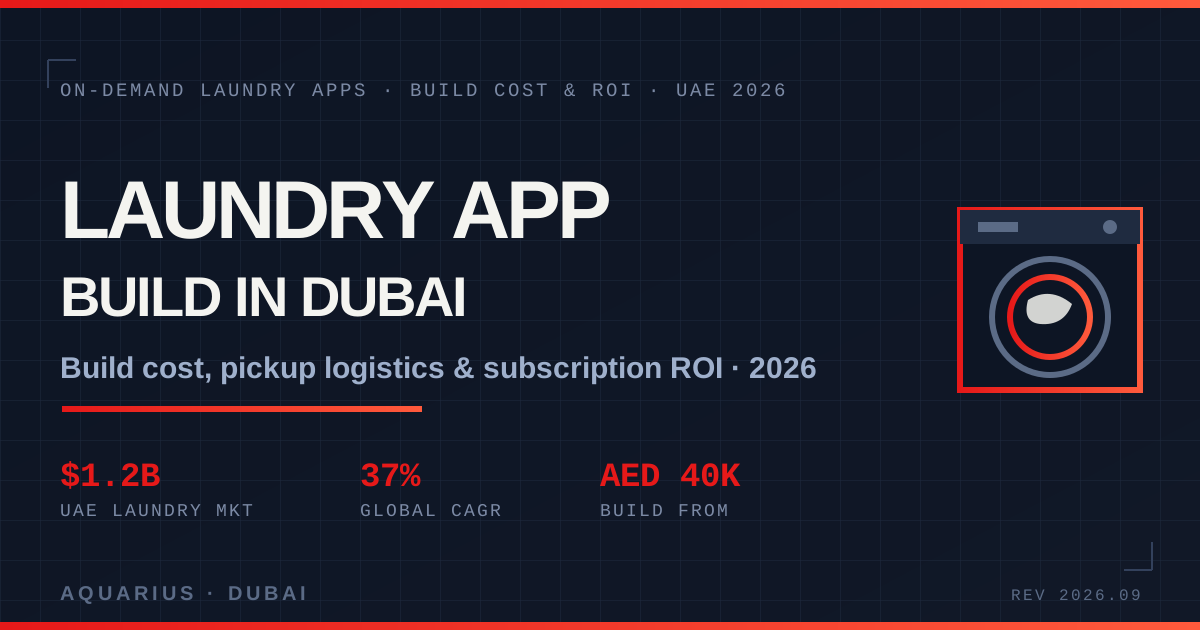
Short answer: A production-ready on-demand laundry and dry-cleaning app for Dubai — customer app, driver app and an operations dashboard — costs roughly AED 40,000 for a single-zone MVP and AED 200,000–400,000+ for a full AI-routed platform. The economics work because Dubai households already spend AED 400–1,200 a month on laundry, and a subscription model can cut your per-item cost up to 30% while turning one-off washes into recurring revenue. The build is the easy part; the pickup-and-delivery logistics and retention loop are where laundry apps win or die.
Key takeaways
- UAE laundry market is worth over USD 1.2 billion; the dry-cleaning & laundry services segment alone runs ~USD 263M (2025) heading to ~USD 343M by 2032.
- The global on-demand laundry market (~USD 105B in 2024) is compounding at roughly 37% a year — Dubai's density and expat base make it a prime market.
- Build cost: MVP from AED 40,000; growth build AED 90,000–200,000; full platform with AI routing AED 200,000–400,000+.
- Winners run on subscriptions and route density, not per-order pricing. Washmen alone processes 50,000+ orders a month on that model.
- For Dubai you need Arabic (RTL), UAE PDPL-compliant data handling and, ideally, UAE Pass login — not optional extras.
The Dubai laundry opportunity (TOFU): a big, boring, recurring market
Laundry is the rare app category where demand is guaranteed, frequent and price-inelastic — everyone generates dirty clothes every week. In the UAE that demand is unusually concentrated. Dubai has around 3.5 million residents, a majority-expat population living in high-density towers (JLT, Downtown, Dubai Marina, Business Bay) where in-home laundry is often impractical, and a service culture where paying someone to handle chores is normal.
The numbers back it up:
- The broader UAE laundry market is valued at over USD 1.2 billion, and the specialised dry-cleaning & laundry services segment sits near USD 263 million in 2025, forecast to reach ~USD 343 million (≈AED 1.26 billion) by 2032.
- An average Dubai household spends AED 400–1,200 per month on laundry and dry-cleaning — a stable, repeatable wallet you can capture with a subscription.
- Globally, the on-demand laundry market was about USD 105 billion in 2024 and is expanding roughly 37% year on year as pickup-and-delivery replaces the walk-in shop.
Established players prove the model at scale: Washmen processes more than 50,000 orders a month, and JustLife, Laundryheap, WashOn, JustClean and legacy chains like 5àsec all compete on convenience. That's validation, not a closed door — most operate city-wide and generically, leaving room for neighbourhood-dense, niche (hospitality, gyms, clinics, residential-tower) or premium-garment-care operators to win on speed and service.
What a Dubai-ready laundry app actually needs (MOFU)
A laundry app is really three connected products: a customer app (schedule pickup, pick services, pay, track), a driver/rider app (route, pickup, drop-off, proof-of-delivery) and an operations dashboard (orders, plant workflow, pricing, drivers, subscriptions). Get the pickup logistics right and the app feels magic; get it wrong and one late collection loses a customer for good.
Non-negotiables for the UAE market specifically:
- Arabic + English with full RTL layout. Not a translation afterthought — a first-class bilingual experience.
- UAE PDPL-compliant data handling. Addresses, payment tokens and order history are personal data; consent, retention limits and secure storage are legal requirements, not nice-to-haves. (See our UAE PDPL compliance checklist.)
- Local payments: cards plus Apple Pay/Google Pay, and ideally UAE Pass login to cut signup friction.
- Slot-based scheduling with live driver tracking and automated SMS/WhatsApp updates — the single biggest driver of repeat use.
- Subscription plans (e.g. X kg/week or unlimited wash-and-fold) — this is the retention engine and can reduce your effective per-item cost by up to 30% through predictable volume and route density.
Build cost by tier (2026, Dubai)
| Tier | What you get | Cost (AED) |
|---|---|---|
| MVP / single zone | Customer app + basic driver app + admin, one service area, card payments, manual routing | 40,000 – 90,000 |
| Growth | Multi-zone, subscriptions, live tracking, WhatsApp notifications, loyalty, analytics | 90,000 – 200,000 |
| Full platform | AI route optimisation, franchise/multi-branch, plant/barcode workflow, UAE Pass, BI dashboards | 200,000 – 400,000+ |
For reference, industry build estimates for UAE on-demand laundry startups cluster between AED 238,000 and AED 695,000 for full platforms, while an AI-enabled laundry app runs about USD 21,000–27,000 (≈AED 77,000–99,000). Ultra-budget "from AED 15,000" offers exist — they buy a template, not the routing, subscriptions or compliance that make the business work.
Pricing, payback and how Aquarius builds it (BOFU)
Here's the unit economics that decide whether to build. Say you launch in three dense Dubai zones and reach 800 orders a month at an average basket of AED 90 — that's AED 72,000/month, or roughly AED 864,000 a year in GMV. On a healthy laundry contribution margin (typically 25–40% after wash cost, driver and payment fees), you're clearing AED 215,000–345,000 a year. Against a growth build of AED 90,000–200,000, the app pays for itself in 4–9 months — and every subscription customer added after that is near-pure recurring margin.
The cost of not building is the quiet killer: without slot scheduling and reminders, on-demand services routinely lose a large share of would-be repeat customers to missed collections and clunky booking — the same one-and-done problem that plagues every service app. A subscriber who churns after month one is worth a fraction of one who stays a year.
How we approach it at Aquarius: we start with a tight single-zone MVP so you prove pickup logistics and pricing in one neighbourhood before spending on AI routing; we build Arabic/RTL and PDPL handling in from day one (retrofitting compliance later costs more); and we instrument subscriptions and retention from launch so you're optimising lifetime value, not just chasing new installs. See what we build and how we price, or if you'd rather model your own numbers first, related reading: our grocery delivery app cost breakdown covers the same driver-logistics maths.
FAQ
How much does a laundry pickup-and-delivery app cost in Dubai?
A single-zone MVP starts around AED 40,000. A growth build with subscriptions and live tracking runs AED 90,000–200,000, and a full AI-routed, multi-branch platform is AED 200,000–400,000+. The gap is mostly routing intelligence, compliance and back-office plant workflow.
How long does it take to build?
A focused MVP (customer app, driver app, admin, one zone) is typically 10–16 weeks. Multi-zone, subscriptions and AI routing add roughly 2–4 months depending on integrations.
Do I need Arabic and UAE PDPL compliance?
Yes to both. Arabic/RTL is expected by a large share of UAE users, and PDPL governs how you collect and store customer addresses, payment data and order history. Both should be designed in from the start, not bolted on.
Should I charge per order or by subscription?
Lead with subscriptions. Predictable weekly volume lets you batch pickups, raise route density and cut per-item cost up to 30% — and it converts fickle one-off users into recurring, higher-lifetime-value customers.
Bottom line: Dubai's laundry demand is large, recurring and under-served by generic city-wide apps. Build a lean, compliant, subscription-first pickup-and-delivery app for AED 40,000–200,000, nail the logistics in one zone, and let route density and retention do the compounding. Talk to Aquarius about scoping your build.