
Debt or Equity? IAS 32 Classification for Dubai Convertible Notes, SAFEs and Shareholder Loans (2026)
Almost every UAE convertible note and SAFE is a liability under IAS 32, not equity. The fixed-for-fixed test, the Article 30 and 31 interest sequence, and the 11 fields no cap table stores.
- PUBLISHED
- 15 NOV 2026
- READ TIME
- 14 MIN
- AUTHOR
- AQUARIUS · DUBAI
- UNIT
- REV 2026.09
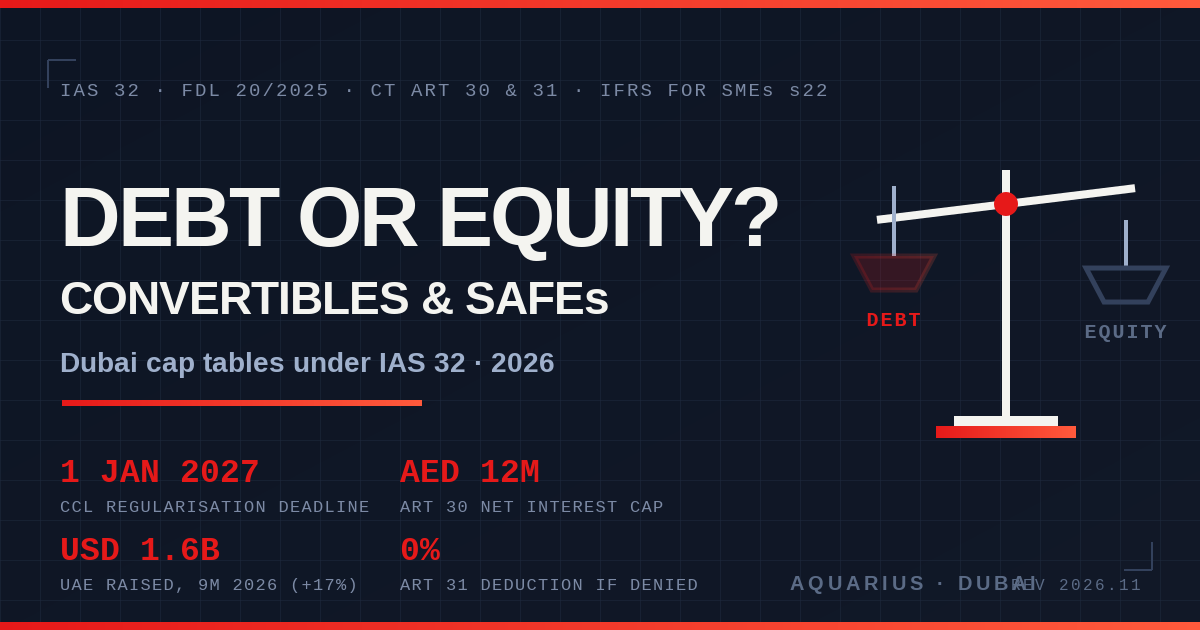
Short answer: under IAS 32 a convertible note or SAFE issued by a Dubai company is a financial liability, not equity, whenever it can settle into a variable number of shares or can be forced into cash — which is how almost every UAE seed instrument is drafted. The label on the term sheet does not decide it; paragraph 11 and the fixed-for-fixed condition in paragraph 16(b)(ii) do. Get it wrong and three things break at once: your balance sheet shows equity that is actually debt, the accretion becomes interest expenditure that Articles 30 and 31 of the Corporate Tax Law can cap or deny outright, and the fix later is a prior-period restatement rather than a reclassification.
This stopped being a theoretical problem in the UAE about a year ago. Federal Decree-Law No. 20 of 2025, which took effect on 15 October 2025, finally let onshore companies — including mainland LLCs — issue multiple share classes, preference rights and convertible instruments directly. Existing companies have until 1 January 2027 to regularise their memoranda and articles against the amended law. So 2026 is the first financial year in which a Dubai mainland company can legally hold the instruments that IAS 32 was written to classify, and the first in which the classification lands inside a 9% corporate tax return.
Why this matters now: the money arrived, the rulebook changed, the data layer did not
UAE startups raised USD 1.6 billion (roughly AED 5.9 billion) in the first nine months of 2026, up 17% year on year. In H1 2026 alone funding rose 53% to USD 895 million — 66% of all capital raised across MENA — while the UAE deal count fell 37%. In Q1 2026 funding hit a record USD 419 million, up 47% year on year, even as deal activity dropped 45% to a three-year Q1 low. Fewer, larger, more structured rounds. Structured rounds mean convertibles, discounts, valuation caps, liquidation preferences and ratchets — precisely the features that fail the IAS 32 equity test.
Meanwhile the price of debt in the UAE is observable and high. The CBUAE base rate stood at 3.90% as of 28 October 2026, and 3-month EIBOR fixed at 4.339930% on 11 November 2026. That matters twice over: it is the benchmark an auditor uses to discount the liability component of a compound instrument, and it is the yardstick the FTA uses to ask whether a shareholder loan at 12% is arm's length.
Most Dubai founders get this exactly backwards. They assume a convertible note is “almost equity” because it is intended to convert. IAS 32 does not care about intention. It cares about whether the issuer can be compelled to deliver cash, and whether the number of shares delivered is fixed.
The two tests that decide debt or equity
IAS 32 asks two questions, in order, and either one failing makes the instrument a liability.
Test 1: Is there a contractual obligation to deliver cash?
Paragraph 11 defines a financial liability as a contractual obligation to deliver cash or another financial asset. If the holder can put the instrument back — redemption on a maturity date, a change-of-control cash-out, a “no qualified financing by month 24” repayment trigger — the issuer does not control the outcome, and it is debt. Paragraph 18(a) applies the same logic to preference shares: a mandatorily redeemable preference share is a liability in substance regardless of being called a share, and its dividend is presented as interest expense in profit or loss.
Test 2: Does the conversion feature satisfy fixed-for-fixed?
Even with no cash obligation, a conversion right only sits in equity if it delivers a fixed number of shares for a fixed amount (paragraph 16(b)(ii)). A note that converts at a 20% discount to the next round price, or at the lower of a valuation cap and the round price, delivers a variable number of shares. It fails. A contract that may oblige the issuer to deliver a variable number of its own equity instruments is a financial liability under paragraph 11.
That is why a standard post-money SAFE is a liability under IFRS: it delivers a variable number of shares for a fixed value and can require cash on a change of control. The conversion feature becomes an embedded derivative measured at fair value through profit or loss — so every improvement in your own valuation produces a loss in your income statement. Founders find this genuinely counter-intuitive the first time an auditor shows them.
The IASB is actively tightening this area. Under its Financial Instruments with Characteristics of Equity (FICE) project the Board tentatively decided to proceed with amendments to IAS 32 clarifying the fixed-for-fixed condition — covering fixed consideration, group-entity currency, adjustments that compensate future equity holders, time-only adjustments and share-for-share exchanges — plus expanded IFRS 7 disclosure about the liabilities and equity instruments an entity issues. Balloting on the package was targeted for the end of 2026. Classification judgements you make in your FY2026 accounts will be read back against those clarifications.
The instrument-by-instrument verdict for a Dubai cap table
| Instrument as commonly drafted in the UAE | IAS 32 outcome | Why | Corporate tax consequence |
|---|---|---|---|
| Post-money SAFE (discount and/or valuation cap) | Financial liability, usually with an embedded derivative at FVTPL | Variable share count; cash on change of control. Fails para 11 and 16(b)(ii). | Fair-value movements and accretion hit accounting income, the Article 20 starting point. Interest-like amounts are tested under Articles 31 then 30. |
| Convertible note, fixed conversion price, no redemption right | Compound instrument — split into liability and equity components | Fixed-for-fixed is met, but the principal is still repayable. Para 28–32 split accounting. | Only the liability component accretes interest. The equity component never touches P&L. |
| Convertible note, discount to next round | Wholly a liability, no equity component | Variable share count kills the equity leg entirely. | The full accretion is interest expenditure, exposed to the Article 30 cap. |
| Mandatorily redeemable preference share | Financial liability (para 18(a)) | Issuer cannot avoid delivering cash. | The “dividend” is interest expense in P&L — and is tested for deductibility, not treated as a distribution. |
| Preference share, discretionary dividend, no redemption | Equity | No contractual obligation to pay anything. | Distributions are non-deductible, but no interest cap and no Article 31 exposure. |
| Shareholder loan, repayable on demand, interest-bearing | Current financial liability | On-demand means current, however long it has actually sat there. | Interest must be arm's length under transfer pricing, then survive Article 31, then Article 30. |
| Shareholder funding, no obligation to repay, no interest | Equity contribution | No contractual obligation to deliver cash. | No deduction, no cap, no arm's-length test. Often the cleanest answer. |
Same instrument, two balance sheets: the IFRS for SMEs trap
Article 20 of the Corporate Tax Law accepts financial statements prepared under either full IFRS or IFRS for SMEs (available to entities with revenue up to AED 50 million). Those two frameworks do not agree here. The third edition of IFRS for SMEs, issued in February 2025 and effective for annual periods beginning on or after 1 January 2027, keeps mandatory split accounting in Section 22.13: a compound instrument is divided into liability and equity components at the date of issue, with the liability measured as the fair value of a similar instrument without the conversion right, and the allocation never revised afterwards.
So a discount-to-next-round convertible note is wholly a liability with an FVTPL derivative under full IFRS, but gets split with an equity component under IFRS for SMEs. Same AED 5 million round, two different equity balances, two different interest charges, two different taxable incomes. Your framework choice is a tax position, and it needs to be documented as one.
The tax layer nobody models: interest tested three times
Once an instrument is a liability, the amounts accreting on it are interest expenditure — and UAE corporate tax tests interest in sequence, not in parallel.
- Arm's length. If the funder is a related party, the rate itself must be arm's length. With 3-month EIBOR fixed at 4.339930% and the CBUAE base rate at 3.90%, a 14% founder loan needs a credit story, not a sentence.
- Article 31, the specific rule. No deduction is allowed for interest on a loan obtained directly or indirectly from a related party where the proceeds funded a dividend or profit distribution to a related party, a redemption, repurchase, reduction or return of share capital to a related party, a capital contribution to a related party, or the acquisition of an ownership interest in a person who is or becomes a related party. The relief is a main-purpose test — you must show the main purpose was not a corporate tax advantage — and Article 31(3) deems no advantage to arise where the related party is taxed on that interest at not less than 9%. This one bites hardest on exactly the transaction UAE groups do most: a shareholder loan used to buy out a cousin's stake, or to push cash upstream.
- Article 30, the general rule. Whatever survives is then capped. Net interest expenditure is deductible up to the greater of 30% of tax-adjusted EBITDA or AED 12 million — the AED 12 million de minimis under Ministerial Decision No. 126 of 2023 means the EBITDA test only engages above that level. Disallowed amounts carry forward ten tax periods. Banks, insurers and natural persons conducting business are outside the rule.
Read the sequence against the balance sheet. A convertible note recognised as equity by mistake produces no interest expenditure at all, so none of these three tests ever runs, and the return is filed on an accounting income figure that is simply wrong. Correct it later and you are not reclassifying — classification under IAS 32 is determined at issue and not revisited — you are restating a prior period under IAS 8, reopening comparatives, the deferred tax in your IAS 12 provision, and the share count behind your IAS 33 diluted EPS.
The eleven fields no Dubai cap-table tool stores
This is the practical heart of it. Cap-table products built for Delaware and common-law jurisdictions store ownership. They do not store classification evidence. We see the same eleven gaps on nearly every Dubai engagement, and each one is a field, not a policy:
- Redemption trigger register — every event that can force cash out, with its date and condition, not a PDF of the SHA.
- Conversion share-count formula — stored as a formula with its inputs (cap, discount, round price), so fixed-for-fixed can be re-tested, not as a single number.
- Classification decision and date — liability, equity or compound, with the paragraph relied on and who approved it.
- Split-accounting allocation at issue — the liability and equity amounts and the discount rate used, frozen, because Section 22.13 forbids revising it.
- Effective interest rate per instrument — what actually drives accretion, separate from the coupon.
- Related-party flag on the funder — the switch that turns Article 31 on, and it changes when shareholdings change.
- Use-of-proceeds tag — the single field that decides Article 31. Nobody records what a shareholder loan paid for.
- Counterparty tax rate evidence — for the Article 31(3) 9% safe harbour.
- Currency of the conversion price — a conversion priced in USD against AED functional currency can break fixed-for-fixed by itself.
- Reporting framework elected — full IFRS or IFRS for SMEs, per period, because the answers differ.
- CCL share-class record — which class, with the rights attached, matched to the commercial register entry at the Economic Department.
That last one has a deadline attached. The amended CCL lets share capital be divided into classes with different value, voting, redemption, distribution-priority and liquidation rights, and those classes must be recorded in the commercial register maintained by the Economic Department in each Emirate. The Cabinet is still to prescribe the permissible categories and the conditions attached to each — as at late 2026 the implementing Cabinet Decision for LLC share classes had not issued — while the 1 January 2027 regularisation deadline for existing companies' constitutional documents stands. Anyone who issued a convertible onshore in 2026 is holding an instrument whose class rules are still being written.
Where to hold the instruments is a separate question from how to classify them — we covered the jurisdiction mechanics in our guide to ESOP and cap-table management in DIFC and ADGM. Classification applies identically in all three; only the registry friction differs.
What it costs to build the register properly
| Option | 2026 Dubai cost | What you get — and what you still own |
|---|---|---|
| Spreadsheet plus year-end audit adjustments | AED 0 up front; typically AED 25,000–60,000 of extra audit and advisory time per year | Classification gets decided by whoever is in the room at audit, nine months after the cash came in. Restatement risk sits with you. |
| Off-the-shelf cap-table SaaS | AED 9,000–45,000 per year | Ownership, waterfalls and option pools. No IAS 32 classification evidence, no use-of-proceeds tag, no Article 30/31 layer, no commercial-register mapping. |
| Instrument register integrated with your ERP and close process | AED 55,000–185,000 one-off | The eleven fields above, split-accounting and effective-interest schedules, an Article 31 use-of-proceeds trail and an Article 30 cap model that reconciles to the return. You own the logic. |
| Add an Article 30 and 31 modelling layer to an existing finance system | AED 30,000–75,000 one-off | Narrower build for groups that already hold clean instrument data and only need the tax sequence automated. |
Set that against the cost of inaction. Article 56 of the Corporate Tax Law requires records to be kept for seven years, explicitly including documents that evidence any election, assessment, determination or calculation and the basis or method used — which is a precise description of an IAS 32 classification memo. FTA Decision No. 4 of 2026 adds that records must be complete, legible, in order and accessible to the Authority, including access to the system storing them. Cabinet Decision No. 129 of 2025 sets record-keeping penalties at AED 1,000 per violation, rising to AED 20,000 for a repeated violation within 24 months, with effect from 14 April 2026. A classification kept only in an advisor's email thread is not a producible record.
And the larger number is the deduction itself. On a group running AED 40 million of related-party debt at 5%, that is AED 2 million of annual interest; denied under Article 31 it costs AED 180,000 a year in lost shield at 9%, repeating for as long as the structure stands. One use-of-proceeds field, captured at drawdown, is what defends it.
How Aquarius builds it
We build the instrument register as a first-class object inside the systems you already run, not as another silo. Each instrument carries its terms as data, its classification decision with the paragraph relied on, its split-accounting allocation frozen at issue, and its effective-interest schedule feeding the close. The Article 31 use-of-proceeds tag is mandatory at drawdown, because capturing it twelve months later is guesswork. The Article 30 cap is modelled against actual tax-adjusted EBITDA so you see the disallowed carry-forward before the return, not after. Share classes map to the commercial-register entry so the 1 January 2027 regularisation is a report, not a project. Delivery runs four to ten weeks; see pricing for how we scope, or the full services list.
FAQ
Is a convertible note debt or equity on a UAE balance sheet?
Almost always debt. Under IAS 32 it is a liability if the holder can force cash repayment, or if conversion delivers a variable number of shares — which any discount to the next round, or any valuation cap, does. Only a note with a genuinely fixed conversion ratio and no redemption right gets split into liability and equity components under paragraphs 28–32.
Can a Dubai mainland LLC now issue preference shares and convertibles?
Yes in principle. Federal Decree-Law No. 20 of 2025, effective 15 October 2025, permits onshore companies including LLCs to issue multiple share classes with differing value, voting, redemption and distribution rights, recorded in the commercial register at the relevant Economic Department. The Cabinet Decision prescribing the permissible categories and conditions had not issued as at late 2026, so take the specifics to counsel before you draft.
Is interest on a shareholder loan deductible against UAE corporate tax?
Only after three tests. The rate must be arm's length; the loan must survive Article 31, which denies interest on related-party loans used to fund distributions, capital reductions, capital contributions to related parties or acquisitions of related-party interests unless the main purpose was not a tax advantage (or the lender is taxed on it at 9% or more); and the remainder is capped by Article 30 at the greater of 30% of tax-adjusted EBITDA or AED 12 million, with disallowed amounts carried forward ten tax periods.
What happens if we classified a SAFE as equity and the auditor disagrees?
You restate. IAS 32 classification is set at the date of issue and is not revisited for changes in circumstances, so there is no prospective fix. The correction runs through IAS 8 as a prior-period error: restated comparatives, a re-measured liability with cumulative accretion, revised deferred tax, revised diluted EPS, and an amended corporate tax return if the accounting income that fed it has moved.
Does the IFRS for SMEs framework give a different answer?
Yes, and that is the point most groups miss. Section 22.13 of IFRS for SMEs requires split accounting for compound instruments and never revises the allocation, so an instrument that is wholly a liability under full IFRS can carry an equity component under IFRS for SMEs. Article 20 of the Corporate Tax Law accepts either framework for entities up to AED 50 million of revenue, so the election changes your taxable income. The third edition of IFRS for SMEs is effective for periods beginning on or after 1 January 2027.
Do we need all of this if we only raised AED 2 million?
You need the classification and the eleven fields, because those drive your statements regardless of size. You probably do not need a built system yet — a disciplined register and a documented classification memo will carry a single instrument. Build when the second instrument lands, or when a funder becomes a related party, because that is when the Article 31 question starts and the manual trail stops being reconstructable.
The one thing to do this week
Pull every funding instrument your company has issued since 2024 — notes, SAFEs, preference shares, shareholder loans, founder advances — and for each one write down two things: can the holder force us to pay cash, and is the share count on conversion fixed. If either answer is “no” or “it depends”, you have a liability on a balance sheet that probably shows equity, and you have 47 days until the 1 January 2027 CCL regularisation deadline to get the paperwork and the ledger telling the same story.
If you want that done properly, with the register and the Article 30/31 layer built into the systems you already run, talk to Aquarius. We scope in a week and we do not start with a spreadsheet.
This article is general information on accounting and tax systems, not accounting, tax or legal advice. Figures are current as at November 2026; confirm your own position with your auditor, tax adviser and UAE counsel.