
ESOP and Cap Table Software for Dubai Startups in 2026
Mainland LLCs cannot practically run an option plan: 50-partner cap, Article 80 pre-emption, a notary for every transfer. What works in DIFC and ADGM, and real 2026 costs.
- PUBLISHED
- 08 NOV 2026
- READ TIME
- 12 MIN
- AUTHOR
- AQUARIUS · DUBAI
- UNIT
- REV 2026.09
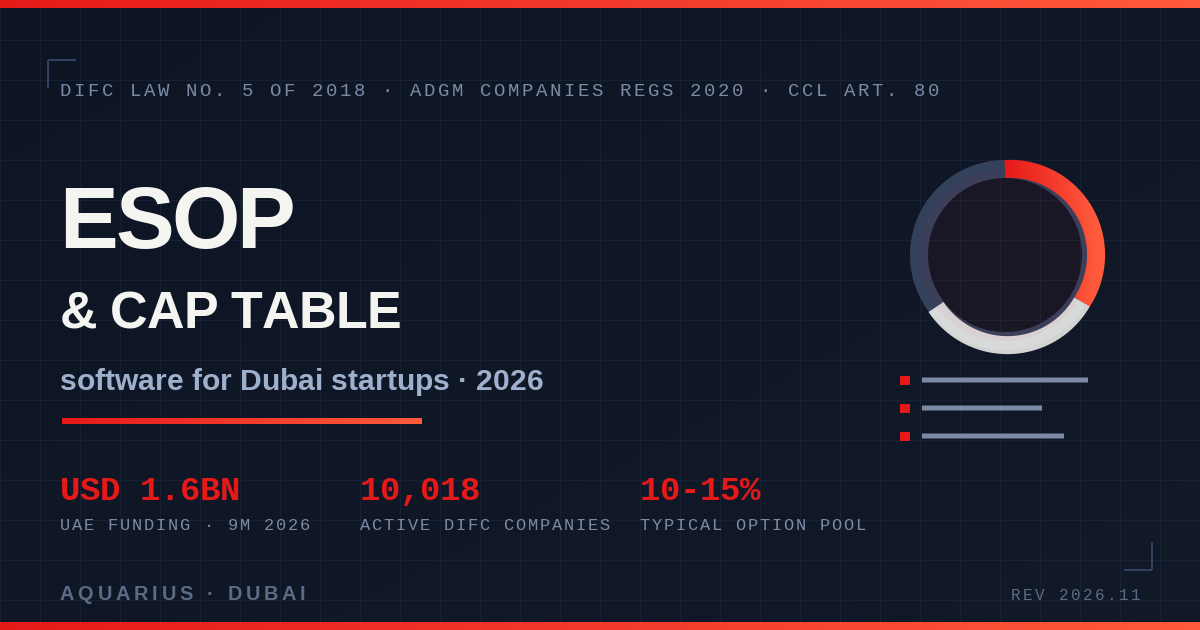
Short answer: a Dubai startup can run a real employee share option plan, but almost never on a mainland LLC. Options, vesting schedules, leaver rules and multiple share classes work cleanly inside DIFC (Companies Law No. 5 of 2018) or ADGM (Companies Regulations 2020), where pre-emption rights can be disapplied in the articles and the registry moves grants through in days. On a mainland LLC, every single share movement needs a notarised MoA addendum and a pre-emption offer to existing shareholders first. The upside: because the UAE levies no personal income tax, there is no tax event for the employee at vest or exercise — a structural advantage no London or Bangalore plan can match.
The money arrived before the plumbing did. UAE startups raised USD 1.6 billion (about AED 5.9 billion) in the first nine months of 2026, up 17% year on year and more than half of the roughly USD 3 billion raised across MENA, with close to USD 1 billion of the UAE total coming from mega rounds above USD 100 million each. In H1 2026 alone UAE funding rose 53% to USD 895 million — 66% of all MENA capital — across 79 deals, even as the UAE deal count fell 37%. Fewer, larger, more institutional rounds. Every one of those term sheets asks to see the cap table and the option pool.
The holding jurisdictions tell the same story. Active registered companies in DIFC passed 10,000 for the first time, hitting 10,018 in H1 2026, up 30% after adding 2,318 firms in twelve months, with the Innovation Hub's AI, FinTech and innovation cohort up 39% to 1,933 companies. ADGM's active licences climbed to 13,974 from 11,120, with operational entities up 34% to 3,986. Thousands of founders now sit in common-law vehicles that support option plans — and administer them on a spreadsheet.
Most Dubai startups get this wrong: they grant options the entity cannot deliver
This is the mistake we see most often in diligence. A founder promises an engineer “1% vesting over four years” in an offer letter, the engineer stays four years, and then nobody can issue the shares — because the company is a mainland LLC under Federal Decree-Law No. 32 of 2021.
Three provisions bite. Article 71 caps an LLC at 50 partners, so a scaled plan hits a hard ceiling. Article 80 requires any transfer to a third party to be offered to existing shareholders first, who may dispute the price and force a formal valuation — and there is no ESOP carve-out from that pre-emption right. And every transfer needs notarisation of an MoA addendum plus registration with the Department of Economic Development, with notary fees charged at 0.25% of the share transfer value and government fees typically AED 2,000 to AED 5,000 per movement. A plan with 20 employees exercising is 20 notary appointments. Federal Decree-Law No. 20 of 2025 did introduce multiple share classes for LLCs, but the implementation detail is still settling, so it does not yet rescue a live plan.
There is a statutory route on the mainland, just not for most startups: Article 228 of the CCL lets a joint stock company increase capital to implement an employee share incentive scheme, with a special resolution carried by 75% of the general assembly, no pre-emption over scheme shares, and participation restricted to employees — directors are explicitly excluded. For a listed public JSC, SCA Chairman Resolution No. 22/R.M of 2016, Articles 30 bis 1-4 caps all incentive schemes together at 10% of paid-up capital, requires a minimum three years between successive schemes, mandates a non-board administering committee, and forces annual disclosure of names, allocations, amounts paid and market values.
DIFC vs ADGM vs mainland: where to put the pool
For a venture-backed startup the practical answer is a common-law holding company with the operating entity beneath it. Investors recognise the documents, the share classes exist, and the option pool lives where it can actually be exercised.
| Vehicle | Can it run an option plan? | Registry mechanics | Year-one registry cost |
|---|---|---|---|
| DIFC company Companies Law No. 5 of 2018 | Yes. Pre-emption rights can be disapplied in the Articles of Association. No ESOP-specific percentage cap; grants below 10% of issued share capital typically avoid a shareholder vote. | Share issuances and transfers registered with the DIFC Registrar of Companies, usually 5-10 business days. | Prescribed Company (holding/SPV): USD 1,100 — USD 100 application plus USD 1,000 commercial licence — plus USD 300 annual confirmation statement. Open to any individual or entity worldwide from 24 July 2026. |
| ADGM company Companies Regulations 2020 | Yes. Section 525 allows pre-emption rights to be removed in the Articles. Schemes under 15% of equity face reduced paperwork. | FSRA registration triggered if the scheme covers more than 10% of shares or more than 10 participants; filing runs 2-4 weeks end to end. | SPV: USD 1,900 — USD 200 name reservation, USD 700 registration (including USD 300 data protection) and USD 1,000 commercial licence. |
| Mainland LLC Federal Decree-Law 32/2021 | Not practically. 50-partner cap (Art. 71), mandatory pre-emption with no ESOP exemption (Art. 80). | Notarised MoA addendum plus DED registration for every movement. | Notary at 0.25% of transfer value plus roughly AED 2,000-5,000 in government fees per transfer. |
| Mainland JSC CCL Art. 228 / SCA 22/2016 | Yes, statutorily. 75% special resolution; employees only, directors excluded. | Capital increase mechanics; listed companies add SCA disclosure and a non-board committee. | Listed schemes capped at 10% of paid-up capital, minimum three years between schemes. |
DIFC and ADGM both permit SPVs, trusts and nominee shareholders to hold shares on behalf of employees, which is how plans cover staff across multiple operating countries without putting 60 names on the register. If your startup is also regulated — payments, lending, wealth — the same jurisdiction choice drives your licensing path too; see our breakdown of fintech app development in DIFC and ADGM.
What an equity system actually has to track
The spreadsheet fails not at the cap table but at the grant ledger. A pool percentage is one number; a plan is hundreds of dated events, each of which changes a number. Across MENA, 67% of startups use a four-year vesting cycle with a one-year cliff — 25% unlocking at the cliff, the remaining 75% monthly over years two to four — and pools typically sit at 10-15% of share capital, with 5-10% common pre-seed and an employee pool now treated as table stakes at Series A and beyond.
Run that structure for three years with 30 hires, 6 leavers, two bonus top-ups and a bridge round, and these are the records that must reconcile on demand:
- Pool authorisation vs allocation vs grant — three different numbers that founders routinely treat as one. Over-granting against an unapproved pool is the single most common diligence finding.
- Per-grant vesting state as at any date, not just today: investors ask for the position at the last round's close, and auditors ask for the position at year end.
- Leaver treatment — good leaver, bad leaver, exercise windows, lapse dates. An unexercised option that silently lapsed and was never returned to the pool corrupts every later percentage.
- Exercise price and payment trail, with the exercise notice signed and retained. UAE e-signature law supports this: Federal Decree-Law No. 46 of 2021 makes an electronic signature valid, with a short list of documents that still need wet ink — the detail is in our guide to e-signature legality in the UAE.
- Share register and registry filings, matched to the DIFC or ADGM record rather than diverging from it.
- Valuation and IFRS 2 expense schedules, because the accounting charge spreads across the vesting period and your auditor will want the model, not the conclusion.
- Employee-facing view. Equity you cannot see is equity nobody values. A portal showing vested units, exercise price and next vest date converts a line in an offer letter into retention.
One more link worth closing: the HR system. Joiner, leaver and termination dates are the input that drives vesting and lapse, and re-typing them is how plans drift. If you are already building WPS-compliant HR and payroll software, the equity ledger should read employment dates from it, not from a second spreadsheet.
Tax: the part that genuinely favours Dubai
The UAE imposes no personal income tax, so an employee receiving shares or exercising options faces no UAE tax liability at grant, vest, exercise or sale. That is the whole pitch: in most jurisdictions an option plan is a tax-design exercise first and a motivation tool second. Here it is the reverse.
On the employer side, corporate tax has applied since June 2023 at 9% on taxable income above AED 375,000. The share-based payment expense recognised under IFRS 2 over the vesting period is generally deductible under the normal “wholly and exclusively for the business” principle — but be straight with your board about the limit here: the Federal Tax Authority has published no specific guidance on how an employer's share-based payment charge is treated for corporate tax, including the timing question of grant versus exercise versus settlement. Keep the IFRS 2 workings auditable and take position advice; do not let a plan design depend on an untested deduction.
Two further points worth writing into the plan rules. Forfeiting unvested options does not reduce statutory end-of-service gratuity under Federal Decree-Law No. 33 of 2021 — equity sits alongside gratuity, it does not substitute for it. And an employee dismissed without valid cause can bring a labour claim regardless of how the ESOP classifies them as a leaver, so “bad leaver” drafting is not a shield against employment law.
Buy the SaaS or build the platform? Real numbers
Below roughly 25 stakeholders, buy — and probably pay nothing. Above that, the per-stakeholder model starts to bite, and the decision turns on whether your equity data has to talk to anything else.
| Option | 2026 cost | Where it fits |
|---|---|---|
| Carta | Launch free under 25 stakeholders and USD 1m raised; paid tiers from USD 2,988, then USD 5,988 and USD 11,988 per year. Per-stakeholder overage USD 20-50 above tier limits. Across 405 brokered contracts the median annual spend was USD 15,400, from about USD 2,900 to over USD 55,000 late-stage, with migration professional services often USD 15,000-25,000. | Default for startups raising from US funds. Watch the 5-10% annual escalators in the contract. |
| Qapita | Spark free up to 25 stakeholders and under USD 1m raised; Surge USD 1,600/year for 40 stakeholders; Growth USD 3,000/year. Publishes every price above the free tier. | Built for India, Southeast Asia and MENA rather than adapted from a US product. Predictable at the stage most Dubai startups are at. |
| Spreadsheet | AED 0, then a diligence delay and a restatement. | Honest answer: fine for three founders and one SAFE. Not fine once a vesting schedule, a leaver and an auditor exist in the same year. |
| Custom platform | See AED bands below. | When equity must join HR, payroll, e-sign and investor reporting, or when a fund, holding group or multi-entity structure needs one ownership view no SaaS models. |
What it costs to build, in AED
Our 2026 bands for equity and ownership work, Dubai-delivered:
| Scope | AED | Timeline |
|---|---|---|
| Cap table reconstruction and clean-up, plan data model, SaaS configuration and migration | 18,000 - 40,000 | 2-4 weeks |
| Custom ESOP portal: grant ledger, vesting engine, leaver and lapse rules, employee view, exports | 75,000 - 180,000 | 6-10 weeks |
| Full equity platform: HR/payroll sync, e-signature, IFRS 2 schedules, investor and board reporting, multi-entity | 180,000 - 420,000 | 3-5 months |
| Ongoing care, filings support and schedule maintenance | 3,500 - 14,000 / month | Retained |
Set that against the cost of getting it wrong. MENA recorded just 16 M&A exits in H1 2026, down 56% year on year and tracking well below the 48 recorded in 2025, with mean deal size at USD 7.9 million against a median of USD 2.0 million. Capital is concentrating into fewer, more scrutinised transactions. In that market an unreconciled cap table is not an administrative nuisance — it is a reason to re-price or walk. A clean ownership record is cheap insurance on the one event the whole company is built toward.
How Aquarius does it
We start with the register, not the software: reconcile the DIFC or ADGM filed position against your internal cap table and the grant ledger, and list every gap in writing. Then we fix the data model — pool authorisation, allocation, grant, vest, lapse as distinct records with dates — before anything is built or migrated. If a SaaS tool covers you, we say so and configure it; we would rather set up Qapita in three weeks than sell you a platform you do not need. When you do need custom, you get source code, your own cloud accounts, AED-first fixed-scope pricing with VAT handled correctly, and no lock-in. Ranges are on our pricing page and the wider build capability on services.
FAQ
Can a mainland Dubai LLC give employees shares?
In theory yes, in practice rarely. Article 71 of the Commercial Companies Law caps an LLC at 50 partners, Article 80 forces a pre-emption offer to existing shareholders with no ESOP exemption, and every transfer requires a notarised MoA addendum plus DED registration with notary fees at 0.25% of transfer value. Most founders instead hold the business under a DIFC or ADGM company and run the plan there.
Do UAE employees pay tax on share options?
No. The UAE imposes no personal income tax, so there is no UAE tax liability at grant, vest, exercise or sale. Employees who are tax resident elsewhere, or who were resident elsewhere when the options were granted, may still have an obligation in that country — check before promising a net outcome.
How big should the option pool be?
Typically 10-15% of share capital, with 5-10% common at the earliest stage and a pool expected as standard from Series A onward. Reserve against the next round's dilution rather than the current headcount, and authorise the pool formally before granting from it.
How long do DIFC and ADGM take to register a share issue?
DIFC share issuances and transfers are generally processed by the Registrar of Companies within 5-10 business days. In ADGM, FSRA registration is triggered where a scheme covers more than 10% of shares or more than 10 participants, and the filing runs about 2-4 weeks end to end.
Is a spreadsheet really a problem?
It is a problem the first time two numbers have to agree on a date in the past. Vesting state at a round's close, an option that lapsed unexercised, an IFRS 2 charge spread over four years — each is a dated event, and spreadsheets store conclusions rather than events. The restatement always lands in the middle of diligence.
Sitting on a plan you have promised but never papered, or a cap table nobody has reconciled since the pre-seed? Send us the current sheet — we will tell you what is missing before an investor does.