
In-App Subscriptions & Paywalls for Dubai Apps (2026): RevenueCat vs Adapty vs Superwall vs StoreKit 2, Trial-to-Paid Benchmarks and AED Costs
Hard paywalls convert 10.7% of installs to paid vs 2.1% for freemium. Compare RevenueCat, Adapty, Superwall and native StoreKit 2 / Play Billing 8 for Dubai apps with 2026 AED costs and UAE rules.
- PUBLISHED
- 11 NOV 2026
- READ TIME
- 10 MIN
- AUTHOR
- AQUARIUS · DUBAI
- UNIT
- REV 2026.09
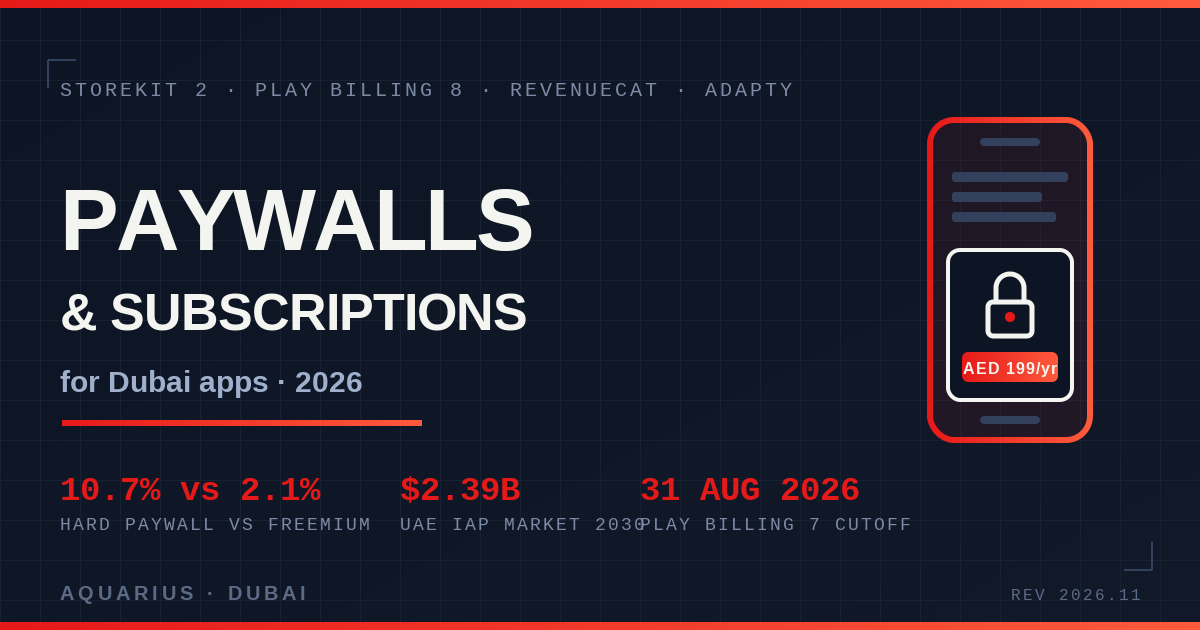
Short answer: a Dubai app earning AED 73,000 a month from subscriptions (about $20,000) pays roughly AED 735 a month to run its subscription stack on RevenueCat or Adapty (1% of tracked revenue), AED 0 on Superwall’s infrastructure, or nothing at all on native StoreKit 2 and Play Billing Library 8 if you are willing to own receipt validation yourself. The platform is the cheap part. The expensive part is the paywall: hard-paywall apps convert a median 10.7% of installs to paid by Day 35 against 2.1% for freemium, and trials of 17 days or longer convert at 42.5% against 25.5% for trials of four days or less. Most Dubai apps ship the opposite of both.
Why subscription revenue is the growth lever for UAE apps in 2026
The UAE is already a paying market. Grand View Research puts UAE in-app purchase revenue at USD 812.6 million in 2023, forecast to reach USD 2.39 billion by 2030 at a 16.7% compound rate, with iOS taking 47.6% of that revenue in 2023 and Android growing fastest through the forecast. Auto-renewable subscriptions are one of the four purchase types the research tracks, and across the global dataset they are the one that has been eating consumables and ads for a decade.
The growth is real and recent. Sensor Tower and Bidease’s 2026 Middle East App Growth Report shows GCC in-app purchase revenue grew 41% between Q1 2024 and Q1 2026 against a 21% global benchmark, while downloads grew only 9%. Revenue grew 4.5 times faster than installs, and the UAE led the region at 46% revenue growth. The 2025 edition of the same report sized GCC in-app purchase revenue at $700 million for the trailing period, up 20% year on year, with the UAE up 26%. Residents here spend about 4 hours 27 minutes a day on a phone in a market with 98% smartphone penetration. The attention is there; the question is whether your app bills for it properly.
The warning is in RevenueCat’s State of Subscription Apps 2026, built on more than 115,000 apps and $16 billion in tracked revenue. Growth is polarising: the top quartile of apps grew monthly recurring revenue by more than 80% year on year while the bottom quartile shrank by more than 33%, a 113-point spread. The apps in the top quartile are not the ones with the best code. They are the ones that treat the paywall, trial and renewal flow as a product.
Subscription benchmarks Dubai product teams should hold themselves to
Five numbers from the 2026 RevenueCat dataset belong on your dashboard before you argue about which SDK to use.
- Install-to-paid by Day 35. Hard paywall median 10.7%, freemium median 2.1%. The hard-paywall figure fell from 12.1% in 2025 as more apps crowded into the pattern, so the edge is real but shrinking.
- Revenue per install at Day 60. $3.09 for hard paywall against $0.38 for freemium. Year-one retention is almost identical (27% against 28%), which means the hard paywall is not scaring away loyal users, it is filtering out people who were never going to pay.
- Trial-to-paid by trial length. Trials of 17 to 32 days convert at a 42.5% median; trials of four days or less convert at 25.5%. Yet the share of apps using those short trials rose from 42.1% to 46.5% this year. On three-day trials, 55.4% of all cancellations happen on Day 0 and 84% by Day 1.
- Annual plan churn. About 35% of all annual-subscription cancellations happen in the first month, which is a refund-window problem, not a product problem. Year-one churn across the dataset sits near 72% in 2026.
- Billing failures. 31% of cancellations on Google Play are involuntary billing failures, against 14% on the App Store. A Dubai Android audience paying with cards that expire, hit limits or get reissued needs grace periods and account-hold handling or you lose a third of your churn to nothing at all.
Most Dubai subscription apps do not have a billing problem. They have a three-day trial on a freemium paywall and no grace period. Fix those three and the SDK choice becomes a spreadsheet exercise.
RevenueCat vs Adapty vs Superwall vs native StoreKit 2 and Play Billing: what each actually costs
Every option below ends in the same two places: Apple’s StoreKit and Google’s Play Billing Library. What you pay a third party for is the layer on top: cross-platform entitlements, server-side receipt validation, webhooks to your backend, a paywall builder, A/B testing and analytics. List prices below are as published in November 2026, converted at AED 3.6725 to the dollar.
| Option | Free tier | Paid pricing | Cost at $20,000 MTR (AED 73,450) | Best for |
|---|---|---|---|---|
| Native StoreKit 2 + Play Billing 8 | Always free | Your engineering time only | AED 0 platform fee | Single-platform apps with a backend team that will own validation and renewals |
| RevenueCat | Up to $2,500 MTR | 1% of tracked revenue (Pro); Growth Tools such as Paywalls and A/B/n testing bill 1% on conversions they drive | About $200 (AED 735) a month | Cross-platform apps that want the largest ecosystem and most integrations |
| Adapty | Up to $5,000 in a rolling 30 days | 1% of monthly tracked revenue; the $99 monthly minimum was removed in February 2026 | About $200 (AED 735) a month | Teams that want a native-rendering paywall builder, A/B tests and analytics bundled |
| Superwall | Infrastructure free at any scale; paywalls free to $10,000 a month paywall-attributed revenue | 1% of paywall-attributed revenue only | AED 0 if under $10,000 flows through its paywalls; about $100 (AED 367) if $20,000 does | Apps that want aggressive paywall experimentation and already have entitlements elsewhere |
The native route in 2026: no longer optional to modernise
Even if you pick a third-party SDK, your app still has to sit on current store APIs, and both stores forced the issue this year.
- Apple. The original StoreKit in-app purchase API, including the unified receipt, has been deprecated since iOS 18. It still works, but it receives no new features, and StoreKit 2 is where transaction history, renewal info, currency and price fields, and the Swift async APIs live. Any Dubai app still parsing receipts with the old API is building on a frozen foundation.
- Google. Play Billing Library 7 stopped being accepted for new apps and updates on 31 August 2026, with an extension request window that closed on 1 November 2026. Library 8, generally available since 30 June 2025, runs until 31 August 2027, and version 9 was announced at Google I/O 2026. Version 8 removed the SKU-era APIs (querySkuDetailsAsync, queryPurchaseHistoryAsync and the no-argument enablePendingPurchases), so an app that has not been touched since 2024 will not compile against it without work.
The subscription stack a Dubai app actually needs
Whichever SDK you choose, a production build for the UAE has six parts. The gaps between them are where lost revenue hides.
1. Products and price points in AED
Set AED prices on the UAE storefront deliberately rather than letting the store auto-convert from a USD base. Apple collects and remits the UAE’s 5% VAT and calculates your proceeds on the price net of that tax, so a listed AED price already contains VAT and your payout is roughly 95% of it before commission. Charm pricing that works in dollars (AED 36.99) reads oddly here; AED 29, 49, 99 and 199 are the shelf the market recognises. Offer weekly, monthly and annual plans and let the paywall default to annual.
2. Paywall and trial design
Hard paywall after onboarding, annual plan pre-selected, trial length matched to the plan. RevenueCat’s analysis of 17,000 apps between August 2025 and July 2026 found monthly plans convert best with 10 to 16 day trials (46.6%) and annual plans with 17 to 32 day trials (44.6% against 24% for trials of four days or less). Longer trials also renew better: first-renewal rates on monthly plans climb from 54.2% with trials of four days or less to 77.5% with 17 to 32 days. Weekly plans are the exception, where 81 to 100% of top apps use trials of four days or less.
3. Entitlements and receipt validation
A server-side source of truth for who is entitled to what, fed by App Store Server Notifications V2 and Google’s Real-time Developer Notifications. Never trust the device. This is the piece RevenueCat and Adapty sell, and the piece Dubai teams most often skip when they build native.
4. Renewal, grace period and win-back
Enable Billing Grace Period on the App Store and account hold on Google Play so a failed card does not become a cancellation. Pair it with a transactional push and a WhatsApp nudge, since WhatsApp reaches roughly 85.8% of UAE social media users. This single step attacks the 31% of Android cancellations that are involuntary.
5. Compliance in the UAE
Federal Law No. 15 of 2020 and its implementing Cabinet Decision No. 66 of 2023 require any business selling subscriptions to UAE consumers to disclose the full cost, the auto-renewal terms and the cancellation procedure before signup, with fines for violations running from AED 1,000 to AED 5,000,000 depending on severity. The stores already force the disclosure on the purchase sheet; your paywall copy and your website terms need to match it. Subscriber data is personal data under the PDPL (Federal Decree-Law 45 of 2021), so consent and retention belong in the design. For the commission rules, the Small Business Program and when you may send users to the web instead, see our App Store and Google Play commission guide for UAE apps.
What a subscription and paywall build costs in Dubai in 2026
These are Aquarius ranges for UAE builds, inclusive of design, integration, server-side validation and QA across sandbox and production on both stores. They exclude the app itself; see our pricing page for full-app bands.
| Scope | What is included | Typical Dubai cost (AED) | Timeline |
|---|---|---|---|
| Subscription foundation | StoreKit 2 and Play Billing 8 integration via RevenueCat or Adapty, products and AED price points on both storefronts, entitlement checks, one paywall, grace period and account hold, sandbox testing | 25,000–55,000 | 3–5 weeks |
| Full subscription layer | Foundation plus server-side webhooks into your backend, remote-configured paywalls with A/B testing, trial and win-back flows, cohort analytics dashboard, Arabic and English paywall copy, Consumer Protection and PDPL disclosure review | 60,000–140,000 | 6–10 weeks |
| Native custom stack | Own StoreKit 2 and Play Billing 8 implementation, App Store Server Notifications V2 and Real-time Developer Notifications, your own entitlement service, receipt storage and audit trail, web checkout where store rules allow, full compliance pack | 120,000–260,000 | 10–16 weeks |
| Ongoing care | SDK and billing-library updates, paywall experiments, renewal monitoring, monthly revenue report | 3,000–9,000 a month | Continuous |
The conversion maths that justifies the spend
Take a Dubai fitness or productivity app acquiring 20,000 installs a month at AED 15 blended cost, so AED 300,000 a month in acquisition. At the freemium median of 2.1% install-to-paid and an AED 199 annual plan, that is 420 payers and AED 83,580 of annual-plan revenue a month, well below spend. Move to a hard paywall with a 14-day trial and the dataset median of 10.7% gives 2,140 payers and AED 425,860. The acquisition budget did not change. The paywall did. Even a conservative lift to 6% pays for the full subscription layer in the first month.
How Aquarius builds subscription and paywall systems for UAE apps
We start with the paywall and the price grid, because no SDK fixes a three-day trial on a freemium screen. We default to RevenueCat or Adapty for cross-platform apps and only recommend a native stack when a client has a backend team that will own it or a revenue scale where the 1% matters more than the engineering. Every build ships on StoreKit 2 and Play Billing 8, with grace periods on, AED price points set on the UAE storefront, Arabic and English paywall copy, Consumer Protection disclosures that match the store sheet, and a cohort dashboard for trial-to-paid and renewal. If the first 90 days of experiments do not lift install-to-paid above where you started, we keep iterating at no extra design cost. Book a subscription audit or explore our mobile app development services in Dubai.
FAQ
Do I need RevenueCat or Adapty, or can I use StoreKit 2 and Play Billing directly?
You can go native. StoreKit 2 and Play Billing Library 8 are free and fully capable. What you give up is the cross-platform entitlement layer, server-side receipt validation, webhooks and the paywall builder, which you then build yourself for roughly AED 60,000 to 120,000 more than an SDK integration. Below about $250,000 a month in subscription revenue, the 1% fee is usually cheaper than owning it.
How much does RevenueCat cost for a Dubai app?
Nothing up to $2,500 in monthly tracked revenue, then 1% of tracked revenue. At $20,000 a month (about AED 73,450) that is around AED 735. Growth Tools such as Paywalls and A/B/n testing bill 1% on the conversions they generate. Adapty charges the same 1% but is free up to $5,000, and Superwall charges 1% only on revenue through its paywalls above $10,000 a month.
What is a good trial length for a UAE subscription app?
For monthly plans, 10 to 16 days converted best in RevenueCat’s 2026 analysis at 46.6%. For annual plans, 17 to 32 days converted at 44.6% against 24% for trials of four days or less. Only weekly plans should use three-day trials. Longer trials also renew better, so the gain compounds.
Is a hard paywall legal under UAE consumer protection rules?
Yes. The law requires clear disclosure of the full cost, the auto-renewal terms and the cancellation procedure before signup, which the Apple and Google purchase sheets already enforce. Your own paywall copy and website terms must say the same thing, and users must be able to cancel through the store without obstruction. Fines for violations range from AED 1,000 to AED 5,000,000.