
App Store and Google Play Commission in Dubai (2026): Why the UAE Storefront Still Pays 30% While the US Pays 0%
Apple link-outs cost 0% in the US and Google dropped Play Billing in the US, UK and EEA on 30 June 2026. The AE storefront is on none of those lists. What a Dubai app really pays.
- PUBLISHED
- 30 OCT 2026
- READ TIME
- 12 MIN
- AUTHOR
- AQUARIUS · DUBAI
- UNIT
- REV 2026.09
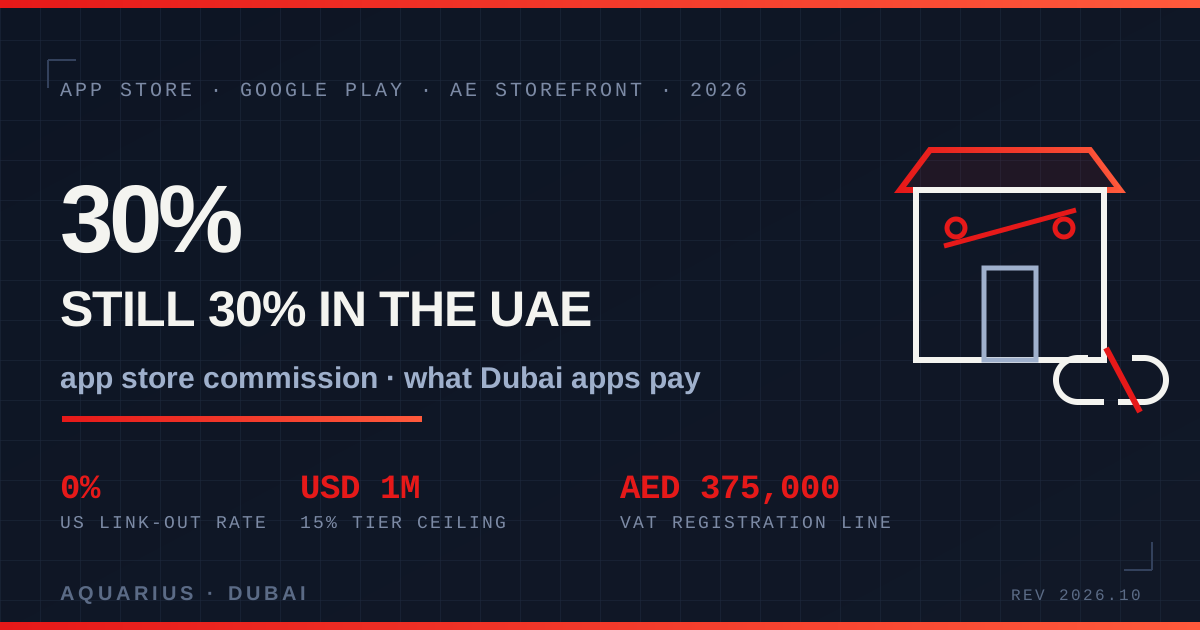
Short answer: an app selling digital goods from the UAE App Store or Google Play storefront still pays Apple 30% — or 15% under the Small Business Program — and Google its standard service fee, because none of the 2026 relief applies here. Apple’s 0% external purchase links exist only in the United States, and its entitlement route covers the EU/EEA, Japan and Brazil; Google stopped requiring Play Billing on 30 June 2026 in the US, UK and EEA only. The UAE is on none of those lists. The levers that genuinely work from an AE storefront are different ones: the Small Business Program, Apple’s own rule that real-world goods and services must not use in-app purchase, and web-first account creation.
The UAE pays the old price on a market that grew 25% in a year
Start with the size of the toll. The UAE recorded roughly 569 million app downloads in the most recent full year, up 4%, while in-app consumer spending hit about USD 432 million — a 25.3% annual jump. Across the GCC, in-app purchase revenue grew 20% year on year to around USD 700 million, and the UAE led that with a 26% surge. Forecasts put the UAE in-app purchase market at roughly USD 2.39 billion by 2030 on a 16.7% CAGR. This is a mobile-first market by any measure: mobile accounts for about 75.3% of all UAE web traffic and 96% of internet users reach the web from a phone.
Now apply the rate. At a blended platform cut of 30%, something close to AED 475 million a year leaves UAE app revenue as store commission before a single developer is paid. For 2026 that number is not falling, because every rate cut announced this year was attached to a legal jurisdiction the UAE is not in.
Most Dubai app founders get this wrong: they read “Apple now allows 0% external payments” and budget for it. That headline is a United States court remedy. Build your 2026 revenue model on it from an AE storefront and your margin is wrong by up to 30 points.
What a Dubai app actually pays in 2026
Here is the honest rate card for an app whose users are in the UAE, alongside what the same app would pay with US or EU users, so you can see exactly what you are not getting.
| Scenario | Apple | Google Play | Applies to UAE users? |
|---|---|---|---|
| Digital goods, store billing, standard developer | 30% | Standard service fee, 30% tier | Yes — this is the default |
| Digital goods, under USD 1M annual proceeds | 15% (Small Business Program) | 15% on first USD 1M | Yes — opt in, it is not automatic |
| Auto-renewing subscription after year one | 15% | Reduced tier applies | Yes |
| Link out of the app to your own checkout | 0% (US storefront only) | No billing fee on external web link transactions (US, UK, EEA) | No |
| Alternative in-app billing provider | Entitlement needed; EU/EEA, Japan, Brazil | US, UK, EEA from 30 June 2026 | No |
| Real-world goods or services consumed outside the app | 0% — in-app purchase is prohibited here | 0% — Play Billing not required | Yes — the big one |
Apple: three jurisdictions of relief, none of them here
In the United States, the April 2025 contempt ruling in Epic v. Apple forced Apple to allow external purchase links with no commission and no restriction on placement, formatting or wording. That 0% baseline has held: the Supreme Court declined to pause the order in May 2026 and again in August 2026, and on 30 June 2026 granted certiorari on one narrow question — whether a court may hold a party in contempt for violating the spirit of an injunction. Apple has proposed charging between 5% and 15% on linked-out purchases; Epic has said it will appeal any figure above zero. So the US rate is 0% today and genuinely unsettled.
Outside the US, Apple’s relief runs through the StoreKit External Purchase Link and external-purchase entitlements, which are storefront-scoped: you declare the permitted two-letter country codes in the entitlement itself. The covered regions are the EU/EEA, Japan — where the Mobile Software Competition Act opened app-to-web purchases and third-party processing to all app categories — and Brazil, via the external custom purchase link regions entitlement from iOS 26.5. In the US no entitlement is required at all. There is no AE in that list.
The EU terms also changed shape on 1 October 2026, which is worth knowing if you have European users. Apple replaced the old per-install Core Technology Fee of EUR 0.50 above one million first annual installs with a 5% Core Technology Commission on digital goods sold through alternative marketplaces or the web, and scrapped the proposed 2% initial acquisition fee and the 5–13% store services fee layered on top of it. App Store apps in the EU using Apple’s in-app purchase now pay 26%, falling to 15% for developers in the Small Business, Video Partner or Mini Apps Partner programmes.
Google: Play Billing became optional on 30 June 2026 — in three markets
Google’s change is cleaner and, for a Dubai developer, just as out of reach. After Epic and Google jointly withdrew their proposed settlement on 15 July 2026, Judge Donato’s October 2024 permanent injunction governs instead: Google cannot require its own billing system, cannot stop developers telling users about other payment methods, and cannot force price parity based on billing choice. From 22 July 2026 rival app stores began gaining access to the Play catalog in the United States.
The commercial restructure landed on 30 June 2026 and splits the old single cut in two: a service fee of 10% on the first USD 1 million of annual earnings regardless of billing method — which also covers auto-renewing subscriptions — plus a separate 5% billing fee only when you use Google Play’s billing system. External web links and alternative billing carry no billing fee. The catch is the footprint: US, UK and EEA at launch, with other markets’ billing fees to be announced and a staggered rollout through the rest of 2026. The earlier user choice billing pilot — the one offering a 4% service fee reduction — covered the EEA, Australia, Brazil, Indonesia, Japan, South Africa, the UK and the US. The UAE was not in that eight either.
Two dates matter if you do have US users: developers enrolled in the US external-links and alternative-billing programmes must report transactions and pay the relevant service fees from 1 October 2026, and for external content links specifically the reporting deadline moved to 1 December 2026.
The lever that actually works in the UAE: most Dubai apps should not be using in-app purchase at all
This is the part that gets missed, and it is worth more than every link-out headline combined. Apple’s guideline 3.1.5(a) does not merely permit non-Apple payment for physical goods and real-world services — it requires it. If what the customer buys is consumed outside the app, you must collect with something other than in-app purchase, such as Apple Pay or card entry. Google takes the same position: Play Billing is not required for physical goods and services.
Look at what Dubai actually builds. Food delivery, salon and clinic bookings, home maintenance, car recovery, laundry, moving services, tutoring, fitness coaching, equipment rental, retail with shipping, event tickets, property viewings: all real-world fulfilment, all outside the scope of in-app purchase, all 0% to the stores. The commission question only truly bites a narrower set — games, content subscriptions, SaaS consumed in the app, AI tools, dating, learning platforms with no live human delivery, and in-app credits or coins.
So before anyone negotiates with a platform, classify the product correctly. We have seen UAE apps voluntarily plumb a real-world service through in-app purchase because a developer assumed it was mandatory, and hand over 30% of a booking fee that was never owed. The fix is a payment-layer change, not a legal one.
What a UAE app can legitimately do from an AE storefront
Five routes survive contact with the review guidelines. None of them is a loophole, and anything that smells like one gets your build rejected.
- Enrol in the Small Business Program. 15% instead of 30% if your total proceeds across all apps stayed under USD 1 million in the previous calendar year and the current one. It is an opt-in, and it counts associated developer accounts together — a second entity holding another app can disqualify you. Google applies 15% to the first USD 1 million of annual earnings as well.
- Sign users up on the web, not in the app. If the account and the paid plan are created on your website and the app merely signs an existing subscriber in, no in-app purchase is involved. You may not advertise the external option inside the app from an AE storefront, which is precisely why acquisition has to run through SEO, paid search, WhatsApp and email instead.
- Use the multiplatform and reader-app carve-outs. Apps whose content is bought and consumed across several platforms, and reader apps for magazines, newspapers, books, audio, music and video, have long-standing routes for account sign-in without in-app purchase. The rules are specific; read them against your actual product before architecting around them.
- Region-gate the entitlement, do not ship it everywhere. If you serve US, EU, Japanese or Brazilian users too, the external purchase link entitlement takes an explicit country array. Build the link behind that gate and keep it dark for AE — a stray external link in a UAE build is a straightforward rejection.
- Ship as a mini app inside a super app. Distribution inside an established UAE super app sidesteps store billing for the right products, at the cost of platform dependence and the host’s own revenue share. Our breakdown of super app and mini app development in Dubai covers where that trade works.
Where the VAT lands when you leave store billing
Moving off in-app purchase moves a tax obligation onto your own balance sheet, and this surprises people. Today Apple and Google act as merchant of record for UAE app store sales and collect the 5% VAT themselves. Sell direct from your own checkout and you are the supplier: VAT registration becomes mandatory once taxable supplies and imports exceed AED 375,000 a year, voluntary registration is available from AED 187,500, and missing the registration deadline carries an AED 10,000 penalty from the Federal Tax Authority. Price your web plan VAT-inclusive from day one so a later registration does not force a price rise. The full treatment for digital products is in our guide to VAT on SaaS and digital products in the UAE.
The arithmetic, and what the work costs in AED
Take a Dubai app with AED 1,000,000 of genuinely digital annual revenue. At 30% the stores take AED 300,000. In the Small Business Program that falls to AED 150,000 — a AED 150,000 saving for a form submission and a proceeds check. Where the product legitimately supports a web checkout, local card processing runs roughly 2.5–3%, or AED 25,000–30,000 on the same revenue. The gap against store billing is close to AED 270,000 a year, which is why this is a board-level question and not a developer preference.
Be honest about the other side of it. Web checkout converts worse than a one-tap store purchase — expect to give back a meaningful share of that saving in drop-off, chargebacks, failed-renewal recovery and support load. The decision is net margin after conversion loss, not the headline percentage. Below are the fixed-scope phases Aquarius quotes in 2026 for this work; they are our ranges, not a market survey.
| Scope | Our 2026 range (AED) | Typical duration |
|---|---|---|
| Commission audit: product classification, proceeds test, tier restructure | 9,000 – 18,000 | Under 1 week |
| Move a real-world-service app off in-app purchase to card and Apple Pay | 24,000 – 55,000 | 3 – 6 weeks |
| Web checkout plus account linking and entitlement sync into the app | 28,000 – 60,000 | 3 – 5 weeks |
| Server-side receipt validation and one entitlement service across iOS, Android and web | 35,000 – 75,000 | 4 – 8 weeks |
| Region-gated external purchase link build for US, EU, JP storefronts | 40,000 – 90,000 | 5 – 10 weeks |
| Mini app build inside a UAE super app | 60,000 – 140,000 | 6 – 12 weeks |
How Aquarius approaches it
We start with the audit, because it is cheap and it frequently ends the project early in the client’s favour: roughly half the UAE apps we review are paying commission on something guideline 3.1.5(a) says must not go through in-app purchase at all, and the correct answer is a two-week payment-layer change rather than a re-architecture. Where the product really is digital, we build one server-side entitlement service as the single source of truth so a subscriber bought on the web, on iOS or on Android resolves to the same account — that service is what makes every later pricing decision reversible. External purchase links, when they apply at all, ship behind an explicit region gate reviewed before every release, and renewal, dunning and refund flows are specified up front, because a web subscription you cannot recover is not a saving. See how we package phases, and our notes on subscription billing and recurring payments in the UAE and publishing to the App Store and Google Play from Dubai.
Frequently asked questions
Can a Dubai app add a link to its own payment page inside the app?
Not for UAE users. Apple’s 0% link-out is a United States remedy and needs no entitlement there, while the external purchase link entitlements cover the EU/EEA, Japan and Brazil. There is no AE storefront entitlement, and an external purchase link in a UAE build is a rejection. Google’s external-link and alternative-billing programmes are likewise limited to the US, UK and EEA as of 30 June 2026, with other markets staged later.
Do we pay 30% on a delivery, booking or home-service app?
No, and you must not route it through in-app purchase. Guideline 3.1.5(a) requires goods and services consumed outside the app to be collected with a method other than in-app purchase, such as Apple Pay or card entry. Google does not require Play Billing for physical goods and services either. If your app is currently paying commission on a real-world booking, that is a mistake to fix, not a fee to negotiate.
How do we get the 15% rate?
Enrol in the App Store Small Business Program. The test is that you and your associated developer accounts earned no more than USD 1 million in total proceeds in the twelve fiscal months of the previous calendar year, and no more than USD 1 million in the current year. It is opt-in, so nobody applies it for you, and the associated-accounts clause catches groups that hold apps under more than one entity. Google applies 15% to the first USD 1 million of annual earnings.
Will the UAE get a Digital Markets Act of its own?
Nothing specific to app stores has been announced. The UAE regulates competition federally rather than through a platform-specific gatekeeper regime, so there is no AE equivalent of the DMA or of the US injunctions to plan around. Treat the current rates as the planning assumption for 2026 and 2027, and keep the architecture flexible enough that a future change is a configuration switch rather than a rebuild.
Is the US 0% rate safe to build a business on?
Not yet. The Supreme Court granted review on 30 June 2026 on whether a court can find contempt for breaching the spirit of an injunction, and Apple has proposed 5–15% on linked-out purchases. The 0% baseline has survived two refusals to pause the order, but any model that only works at 0% should be stress-tested at 15%.
Does moving to our own checkout change our tax position?
Yes. Apple and Google currently collect the 5% UAE VAT as merchant of record. Selling direct makes you the supplier, with mandatory VAT registration above AED 375,000 of annual taxable supplies, voluntary registration from AED 187,500, and an AED 10,000 penalty for late registration.
If you are budgeting a 2027 app on the assumption that the commission headlines apply to you, get the classification checked first — it is the cheapest hour in the project. Tell us what your app sells and which storefronts it ships to, and we will come back with the rate you should actually be paying and a priced phase one. If you are still at the estimate stage, start with what a mobile app really costs in Dubai and App Store optimisation for Dubai apps.