
Incident Response in Dubai (2026): The 4-Hour Clock, Severity Ladders and Blameless Postmortems
CBUAE Circular 1/2026 gives licensed firms 4 hours to report. The real UAE incident clocks, a SEV1-SEV4 ladder, blameless postmortems and what readiness costs in AED.
- PUBLISHED
- 28 OCT 2026
- READ TIME
- 12 MIN
- AUTHOR
- AQUARIUS · DUBAI
- UNIT
- REV 2026.09
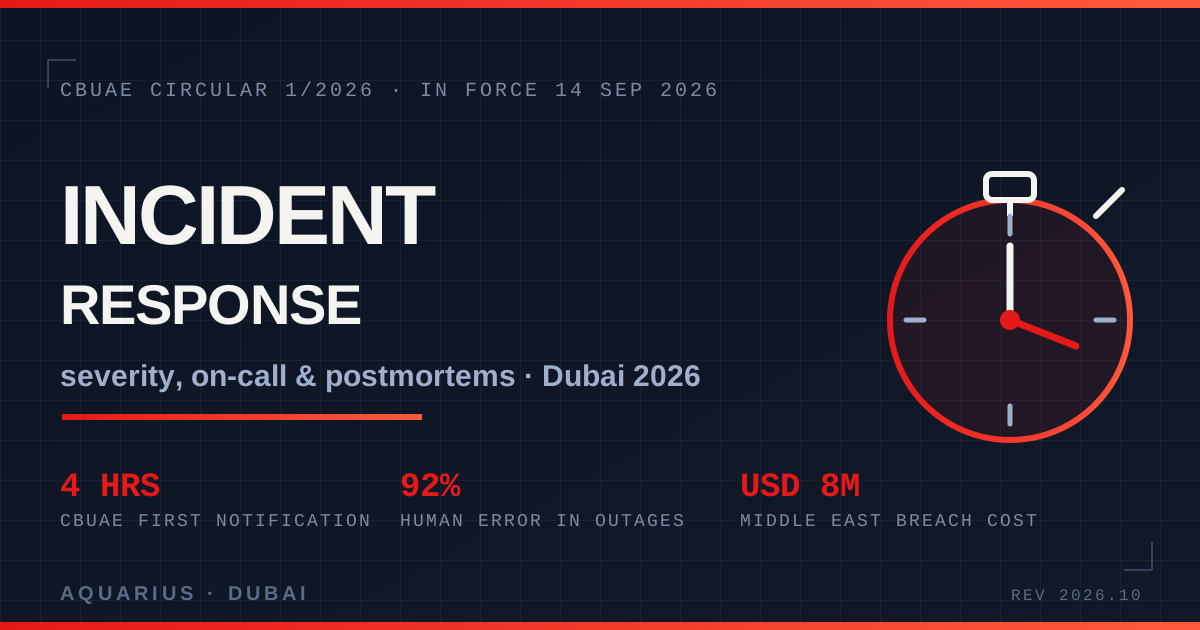
In Dubai, incident response is now on a clock set by regulators, not by your engineering team. A UAE-licensed financial institution has four hours to notify the Central Bank of an event that significantly affects Critical Operations, 24 hours to file a summary report and 72 hours for any high-risk incident, under Operational Risk Management Regulation Circular No. 1/2026, in force since 14 September 2026. Everyone else still has a clock: mainland PDPL requires breach notification immediately, and the familiar 72-hour grace period belongs to DIFC and ADGM, not to the federal law.
That changes what an incident process has to look like. A WhatsApp group and a developer who happens to see the alert cannot produce a defensible notification in four hours. This guide covers the severity ladder, the on-call rota, the UAE reporting clocks, the blameless postmortem that stops repeat incidents, and what each tier of readiness actually costs in AED in 2026.
The stakes: the expensive part is the response, not the outage
Four numbers frame the problem for any Dubai operator.
- The average data breach in the Middle East now costs USD 8 million, roughly AED 29.4 million, according to IBM 2026 Cost of a Data Breach findings for the region. The biggest line item is lost business at USD 3.57 million (about AED 13.1 million), followed by post-breach response at USD 2.17 million and detection and escalation at USD 1.9 million. Financial services and technology firms average USD 10.67 million each.
- The UAE Cyber Security Council says the country blocks around 600,000 cyberattacks a day, about 25,000 an hour, and reported thwarting close to 750,000 attempts against vital sectors including energy and education in October 2026. Phishing, DDoS and ransomware dominate the mix.
- 26% of malicious breaches in the region were AI-enabled on IBM 2026 numbers, with a further 11% where AI involvement could not be ruled out. Attack tempo is going up while most SME response processes stay manual.
- 92% of operators say human error contributed to their most recent impactful outage, per the Uptime Institute Data Center Resiliency Survey 2026. In the 2025 analysis, 85% of human-error outages came down to staff not following procedures or to procedures that were flawed, and 80% of operators said better management and process would have prevented their last downtime incident.
Most Dubai businesses get this wrong: they buy monitoring and call it incident response. Monitoring tells you something broke. Incident response is who gets woken, who decides, who talks to the regulator, and what changes afterwards.
The 72-hour myth, and the clocks that actually apply in the UAE
Almost every compliance blog repeats a "72-hour UAE breach notification rule". Read the law. Article 9 of Federal Decree-Law No. 45 of 2021 (the PDPL) requires a controller to report a breach that would prejudice the privacy, confidentiality or security of personal data to the UAE Data Office immediately upon becoming aware of it, within the period and procedure set by the Executive Regulations. A processor must notify its controller immediately too. There is no 72-hour safe harbour written into the federal text, so treating 72 hours as your deadline is a choice, not a compliance position.
The 72-hour figure is real, it just lives elsewhere. Article 32(1) of the ADGM Data Protection Regulations 2021 uses the familiar "without undue delay, and where feasible not later than 72 hours" wording, and DIFC Data Protection Law No. 5 of 2020 runs its own Commissioner reporting regime. Here is the practical map.
| If you are | Instrument | First notification | Follow-up |
|---|---|---|---|
| CBUAE-licensed bank, insurer, exchange house, finance company or PSP | Operational Risk Management Regulation, Circular 1/2026 (effective 14 Sep 2026) | 4 hours for events significantly affecting Critical Operations | 24-hour summary report; 72 hours for high-risk incidents per board-approved classification |
| Mainland UAE company processing personal data | PDPL, Federal Decree-Law 45/2021, Article 9 | Immediately on becoming aware | Notify affected data subjects where there is risk to their privacy or security; keep the full record |
| ADGM entity | Data Protection Regulations 2021, Article 32(1) | Without undue delay, within 72 hours where feasible | Reasoned explanation if late |
| DIFC entity | DP Law No. 5 of 2020 (as amended) | Report to the Commissioner via the breach portal | Data-subject notification where high risk |
| Dubai government, semi-government or their suppliers and cloud providers | DESC Information Security Regulation v3, Domain 11 | Report to DESC per its coordination protocol; 24-hour obligation on Approved Service Providers for events affecting their operations | Documented post-incident review and lessons learned |
Two consequences follow. First, your severity classification has to be board-approved and written down, because Circular 1/2026 makes the classification criteria themselves a governance artefact. Second, the clock starts at awareness, so detection quality is a compliance control. If your first signal is a customer email, you have already burned the budget. That is why APM and observability tooling is the floor under any of this, not a nice-to-have.
This is commercial guidance, not legal advice. Have UAE counsel confirm which regimes apply to your entity, especially if you hold both a mainland licence and a free-zone one.
Build the severity ladder first
Severity is the routing table for everything else: who is paged, how fast, who speaks to customers, and whether a regulatory clock starts. Four levels is enough for almost every Dubai SME. Define them by customer impact, never by how hard the fix looks.
| Severity | Definition | Page | Comms | Regulatory trigger |
|---|---|---|---|---|
| SEV1 | Revenue path down or data exposed: checkout, login, payments, personal data leaving your control | Immediate page, incident commander named within 5 min | Status page inside 15 min, updates every 30 min | Start the clock. Assume notification is required until counsel says otherwise |
| SEV2 | Major feature broken or severe degradation, workaround exists | Page during business hours, within 30 min | Status page, in-app notice | Assess; log the assessment either way |
| SEV3 | Minor feature, single tenant, cosmetic breakage with low impact | Ticket, next business day | Internal only | None |
| SEV4 | Latent risk found, no customer impact yet | Backlog with an owner and a date | Internal only | None |
Three rules make the ladder work in practice. Anyone may declare a SEV1, including support and junior engineers, because hesitation is what turns a 20-minute incident into a four-hour one. Severity can be raised mid-incident but never lowered to avoid paperwork. And the incident commander coordinates, they do not debug: in a three-person Dubai team the commander is whoever is not typing.
On-call that a small Dubai team can actually sustain
Gulf Standard Time is UTC+4, which means a European or US customer base generates alerts during your night while a local customer base peaks on Friday and Saturday evenings. Two realities to design around:
- Rota size. A one-week primary rotation needs at least four people to stay humane, so a three-engineer team should run business-hours primary with a shared escalation path, not a fake 24/7 promise. Do not sell an availability number your rota cannot staff; the AED arithmetic behind UAE uptime SLAs shows what the gap costs when a 99.95% commitment meets a one-person rota.
- Alert hygiene. Every page that was not actionable should be deleted or converted into a ticket the same week. A rota drowning in noise stops reading alerts, and that is how a four-hour clock gets missed.
Ramadan and the UAE Friday-to-Sunday weekend pattern belong in the rota explicitly, with changed working hours covered by name rather than assumed. And because configuration and change management failures now lead the causes of network-related outages in Uptime Institute 2026 survey work, the cheapest reliability win available to most Dubai teams is not a bigger rota but shipping behind feature flags and canary releases, so a bad deploy is a toggle rather than an incident.
The blameless postmortem: the only part that compounds
An incident you do not learn from is an incident you will buy again. The Uptime Institute finding that 85% of human-error outages trace to procedures not followed or procedures that were wrong is the whole argument for blameless review: if the procedure was wrong, punishing the person who followed it guarantees a repeat.
Blameless does not mean consequence-free. It means the question is "what made this the reasonable action at the time?" rather than "who did it?". A workable UAE-ready postmortem has eight parts, written within five business days while memory is fresh:
- Timeline in GST with timestamps for first symptom, detection, declaration, mitigation and all-clear. This is also your evidence file if a regulator asks when you became aware.
- Impact in numbers: minutes down, orders or sessions affected, AED revenue at risk, records exposed. Vague impact produces vague priorities.
- Detection gap: the difference between first symptom and detection. Shrinking this is usually worth more than shrinking the fix time.
- Contributing factors, plural. Single-cause stories are nearly always wrong.
- What went well, so the things that worked survive the next reorganisation.
- Action items with a named owner and a date, capped at five. Twenty unowned actions means zero.
- Regulatory assessment: which clocks were triggered, what was filed, when, and the reasoning if nothing was filed.
- Repeat check: has this class of failure appeared before? A second occurrence is a process defect, not bad luck.
Track two things across postmortems and you will know whether the process works: median time to detect, and the share of action items actually closed within 30 days. Teams that close under half of their actions are writing documents, not fixing systems.
Error budgets stop the uptime argument
An error budget converts your availability target into a monthly allowance everyone can see. At 99.9% the allowance is 43 minutes a month; at 99.95% it is 21 minutes 36 seconds. Burn the budget and feature work pauses in favour of reliability work until the window resets. Keep it unspent and you are over-engineering, which is its own kind of waste.
The budget turns a political question into an arithmetic one. If your Dubai storefront takes AED 40,000 an hour at peak, 43 minutes of downtime is roughly AED 28,600 of exposure a month, and spending AED 4,000 a month to halve it is obviously correct while spending AED 25,000 is not. Run the same number against load: if traffic triples during the Dubai Shopping Festival or White Friday, the budget should be tested in advance with peak-traffic load testing rather than discovered live.
What incident readiness costs in Dubai, in AED
Tooling is the small number. Indicative 2026 list prices, converted at AED 3.6725 to the dollar and excluding VAT:
| Tool | List price | Per user / month in AED | Notes |
|---|---|---|---|
| PagerDuty Professional | USD 21/user/month annual, USD 25 monthly | About AED 77 | AIOps and AI add-ons priced separately, from USD 415 to USD 699 a month |
| incident.io Team plus on-call | USD 15/user/month annual plus USD 10 on-call add-on | About AED 92 | Pro tier USD 25 plus USD 20 on-call |
| Better Stack | Responders USD 29/month, logs USD 0.10/GB ingest plus USD 0.05/GB/month retention | Usage-based, about AED 107/month entry | No per-seat charge for reading dashboards |
| Grafana IRM or self-hosted alerting | Free tier available | 0 plus engineer time | Cheapest on paper, costs the most in maintenance |
The real cost is the process build and the rota. Dubai market ranges we see in 2026 for standing up an incident capability, not for ongoing AMC:
| Tier | What you get | One-off AED | Monthly AED |
|---|---|---|---|
| Minimum defensible | Severity matrix, single alert route, status page, postmortem template, clock sheet mapped to your licence | 6,000 - 14,000 | 400 - 1,200 |
| SME operational | Above plus paging tool configured, runbooks for the top five failure modes, business-hours rota, monthly review | 14,000 - 38,000 | 1,500 - 6,000 |
| Regulated or revenue-critical | Above plus board-approved classification criteria, 24/7 rota, CBUAE or DESC filing workflow, error budgets, quarterly game day and restore test | 38,000 - 120,000 | 6,000 - 25,000 |
Set that against the regional average breach at AED 29.4 million, of which AED 13.1 million is lost business, and the cost-of-inaction maths is not close. IBM 2026 regional data also found that organisations using AI and automation in security operations reported breach costs more than USD 3 million (about AED 11 million) lower than those that had not adopted them, and 59% of regional organisations plan to increase security investment. Where residual risk remains, price it: cyber insurance in the UAE is cheaper and more available when you can show a documented incident process, and most underwriters now ask for one.
How Aquarius does it
Every platform we run ships with a written severity matrix, an alert route that reaches a human, runbooks for the failure modes that platform actually has, and a postmortem within five business days of any SEV1 or SEV2 with named owners and dates. For clients under CBUAE, DESC or PDPL scope we map the clock sheet to the licence before go-live, so the four-hour question has an answer before the four hours start. Status page updates are drafted in advance, because nobody writes good customer comms at 2am.
If your current plan is "the developer will notice", that is the gap worth closing this quarter. See our pricing, review the services we support, or send us your last outage and we will write the postmortem you did not get, free, so you can see what the process produces.
FAQ
Does the UAE really have a 72-hour breach notification rule?
Not in the federal law. Article 9 of the PDPL (Federal Decree-Law No. 45 of 2021) requires reporting to the UAE Data Office immediately on becoming aware, with the detailed period left to the Executive Regulations. The explicit 72-hour wording sits in the ADGM Data Protection Regulations 2021, Article 32(1), and DIFC runs its own Commissioner reporting regime. CBUAE-licensed institutions face a much shorter four-hour clock for Critical Operations events.
Who does the CBUAE four-hour notification apply to?
All Licensed Financial Institutions under the Operational Risk Management Regulation, Circular No. 1/2026, which took effect on 14 September 2026 and replaced the 2018 operational risk rules. That covers banks, insurers and reinsurers, exchange houses, finance companies and payment service providers, whether UAE-incorporated or operating as a branch. The regulation also requires board-approved incident classification criteria and disruption tolerances reviewed annually.
How small is too small for an on-call rota?
Below four engineers, a true 24/7 primary rota burns people out. Run business-hours primary with a documented escalation path and an honest availability commitment, or buy out-of-hours cover from a partner. What you must not do is advertise 99.95% uptime against a rota of one.
What is the difference between an incident and a breach?
An incident is any unplanned disruption or security event. A breach is the subset involving personal data being accessed, disclosed, altered or lost, and that subset is what starts a data-protection clock. Every SEV1 should include an explicit yes or no breach assessment, recorded with its reasoning, because "we assumed not" is not a defence.
Do blameless postmortems mean nobody is accountable?
No. Accountability moves from the individual to the system and the action items. The person who ran the command is not the problem; the deploy path that let an untested change reach production unflagged is. Teams that name people stop reporting incidents, which is strictly worse than any individual mistake.
The takeaway: write the severity matrix, map your regulator clocks to your actual licence, make detection fast enough that awareness is not the customer job, and run a blameless postmortem every time. That is a few thousand dirhams of process standing between you and a seven-figure average. Talk to Aquarius before your next bad Friday.