
Load Testing for Dubai E-commerce (2026): Find the Number That Breaks Your Checkout
The median outage now costs about AED 33,000 a minute and White Friday 2026 lands 20 November. How to load test a Dubai store: real RPS maths, tools and AED costs.
- PUBLISHED
- 26 OCT 2026
- READ TIME
- 12 MIN
- AUTHOR
- AQUARIUS · DUBAI
- UNIT
- REV 2026.09
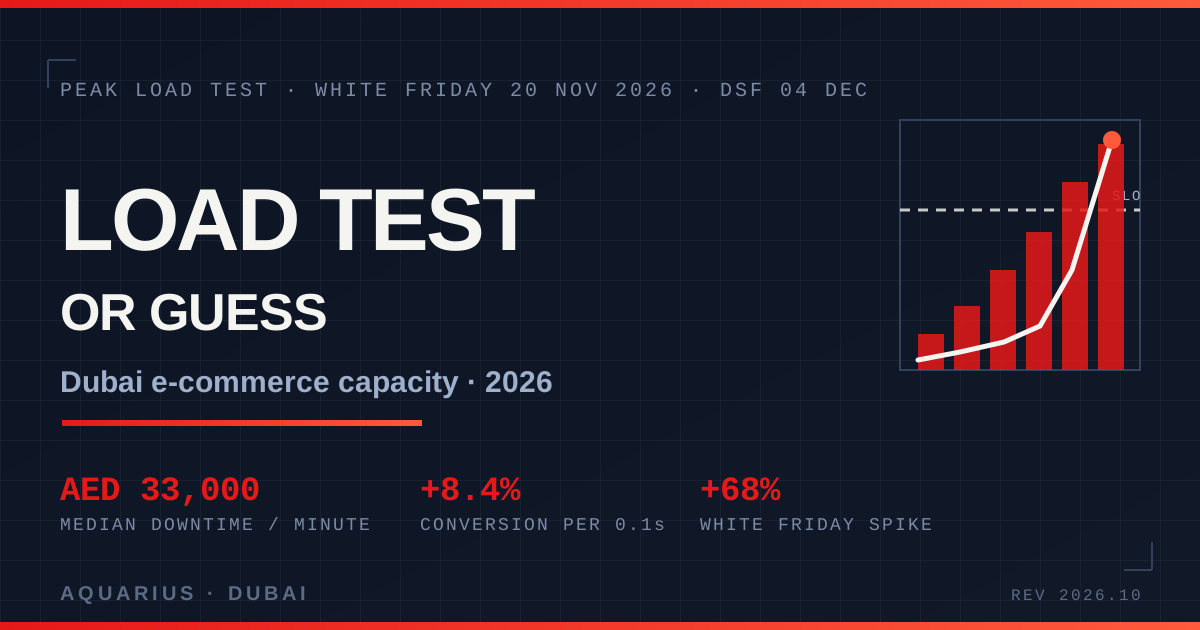
Short answer: You cannot know whether your store survives White Friday until you have broken it on purpose. A load test replaces the guess with one number — the requests per second at which your checkout starts failing — and in 2026 the median outage costs the equivalent of AED 33,000 per minute. For most Dubai stores the whole exercise costs less than fifteen minutes of being down.
Here is the timing problem. White Friday 2026 runs roughly 20–30 November, and Dubai Shopping Festival 2026–27 opens 4 December and runs to 17 January 2027 — 45 days, the longest edition yet. That is two spikes inside six weeks, and the second one lands while half your team is on leave.
The stakes, in numbers that are not vague
Three figures set the stage.
- The UAE e-commerce market is around USD 12.3 billion (about AED 45 billion) in 2026 and is forecast to grow 9.9% a year to AED 67.2 billion by 2030. Online was 15.7% of UAE retail in 2025 and is expected to pass 20% by 2030.
- ITIC’s 2025 downtime survey puts the median enterprise outage at USD 9,000 per minute — about AED 33,000 a minute, up from USD 5,600 in 2019. Mid-market firms of 200–1,000 staff average USD 2,400 a minute, roughly AED 8,800. An hour down on a sale day is not a glitch, it is a quarter.
- White Friday 2025 lifted UAE shopping-app conversions 68% year on year and app installs 38%. Traffic rises and intent rises at the same moment, which is exactly when a system under-provisioned for concurrency fails.
UAE traffic is also unusually unforgiving. There are 11.3 million internet users (99.0% of the population) and 23.0 million mobile connections at 202% penetration, on the fastest mobile network in the world — median mobile download of 614 Mbps at the end of 2025. Nobody here blames their connection. They blame your site.
Most Dubai stores get this wrong: they test users, not requests
The common brief is “test for 5,000 users.” That number means nothing on its own. Five thousand people reading a blog is trivial. Five thousand people hitting a cart recalculation with a live shipping lookup is a different system entirely. The quantity that breaks things is origin requests per second, and you derive it from your own order data.
Worked example. A store ships 800 orders a day at a 2.0% conversion rate, so about 40,000 sessions. Because the 2025 peak lifted conversion 68% and lifted traffic separately, plan for roughly 3x sessions, not 1.68x: call it 120,000 sessions on the day.
Now the shape. Until your own analytics says otherwise, assume the single busiest hour carries 20% of the day — UAE discounts drop at midnight and again after Isha, so the curve is spikier than a European one. That is 24,000 sessions in one hour. At roughly 18 uncached requests per session reaching your origin (the rest should stop at the CDN), you need 120 requests per second sustained, and with a 3x intra-hour peaking factor, about 360 RPS at the top.
360 RPS is a testable target. “5,000 users” is a feeling.
The four ceilings that break first
In Dubai e-commerce work, failures cluster in the same four places almost every time.
1. The database connection pool
This is the number one killer and it has nothing to do with CPU. Your app servers autoscale to twelve instances, each opens 20 connections, and your managed database accepts 150. Connection 151 onward is refused, and it surfaces as a blank checkout rather than as a server alarm. Find it by ramping until connection errors appear, then fix it with a pooler, not a bigger box.
2. Synchronous third-party calls in the checkout path
Payment authorisation, card or Aani tokenisation, a courier rate lookup, a TRN or VAT validation, an SMS OTP. Each is a network call you do not control, and under load the slowest one sets your checkout response time. Every third-party call in the critical path needs an explicit timeout, a retry budget and a documented fallback. A load test is how you discover which ones have none.
3. Cache-hit ratio collapse
At normal volume your CDN absorbs most traffic. On a sale day you launch 400 new SKUs, every product URL carries a fresh campaign parameter, your cache key fragments, and traffic that used to stop at the edge lands on your origin instead. A test run with realistic, varied URLs and query strings exposes this. A test that hammers one homepage URL never will.
4. Autoscaling too slow to matter
A scale-out rule that triggers on five minutes of sustained CPU is useless against a spike that peaks in ninety seconds. Pre-warm before announced events, scale on request count or queue depth rather than CPU, and prove it with a spike test — not with an architecture diagram.
Tooling and what it actually costs
The open-source tools are genuinely enough for most stores. You pay for managed platforms to get distributed load from several regions, retention and reporting — not for better results. List prices below, converted at AED 3.6725 to the dollar.
| Tool | Model | Entry cost | Practical ceiling | Best for |
|---|---|---|---|---|
| k6 (open source) | Self-hosted, JavaScript tests | AED 0 plus compute | 30,000–40,000 VUs and up to ~300,000 RPS per machine | Teams that want the test living in CI |
| Grafana Cloud k6 | Managed, billed per virtual-user hour | 500 VUh free, then USD 0.15/VUh (~AED 0.55); Pro adds USD 19/mo (~AED 70) | Distributed, multi-region | One-off peak rehearsals |
| Apache JMeter | Self-hosted, GUI and XML plans | AED 0 plus compute | Needs several nodes for high load | SOAP, JDBC and legacy stacks |
| Locust | Self-hosted, Python tests | AED 0 plus compute | Distributed workers | Python-first engineering teams |
| BlazeMeter | Managed | Free tier 50 concurrent users and 10 tests a month; Basic USD 99/mo annual (USD 149 monthly); Pro USD 499/mo annual (~AED 1,832) for 5,000 users and 80,000 VUh a year | Enterprise reporting | Audit and compliance-driven programmes |
Two self-hosting details that save a wasted afternoon. A single k6 instance handles 30,000–40,000 virtual users at roughly 1–5 MB of RAM per VU, so 10,000 VUs is a memory decision before it is a CPU one. And raise the file-descriptor limit (ulimit -n 250000) or the run dies with “socket: too many open files” long before your app does. On a 1 Gbit cloud NIC the network, not the tool, becomes the ceiling.
Run the generators from a region with realistic latency to your users. Testing a Dubai store from Virginia measures the Atlantic, not your stack. If you host in me-central-1 or UAE North, generate load from the Gulf, add one European edge if you serve expatriate traffic, and keep the two result sets separate.
The five tests, and the gates they must pass
One test is not a programme. Five short ones answer five different questions, and together they need under a day of machine time.
| Test | Duration | Load | Pass gate |
|---|---|---|---|
| Smoke | 1–2 min | 1–5 VUs | Zero errors. Proves the script, not the system. |
| Average load | 20–30 min | Your normal peak RPS | p95 response under 800 ms, error rate under 0.5% |
| Stress (ramp to break) | 45–60 min | Ramp past 3x until failure | You can state the break number, and no orders are lost at it |
| Spike | 5 min | 0 to 3x in 30 seconds | Recovery inside 2 minutes, autoscale demonstrably fires |
| Soak | 4–8 hours | 1x steady | Flat memory and connection counts, no slow leak |
Tie the front-end gates to Google thresholds, because the same slowness costs you rankings as well as orders: LCP at or under 2.5 s, INP at or under 200 ms, CLS at or under 0.1, judged at the 75th percentile over a rolling 28 days. INP is the one that bites — 43% of sites still fail the 200 ms bar, and heavy cart JavaScript is a frequent cause. If you have not tuned these yet, start with our Core Web Vitals guide for Dubai websites, then load test.
A load test also has to say what it does not cover. It is not functional QA and it is not a security test. Pair it with the rest of your QA and testing programme, and keep commercial readiness on its own list — our Dubai peak season checklist covers that side.
What it costs, and what it returns
Indicative Dubai ranges for the work, assuming an existing store rather than a rebuild:
- Peak readiness test — AED 12,000–22,000. RPS modelling from your analytics, five scripted scenarios, one break number, a prioritised fix list. About two weeks.
- Performance engineering sprint — AED 35,000–75,000. The test plus the fixes: pooling, caching strategy, query work, timeout and fallback policy on every third-party call, autoscale rules re-cut, then a re-test to prove the new ceiling.
- Ongoing in CI — AED 4,000–7,000 a month. Smoke and average-load tests on every release, so a regression is caught by a pipeline instead of by a customer.
The return is not theoretical. Google and Deloitte’s Milliseconds Make Millions study measured 30 million user sessions across 37 brands and found a 0.1-second improvement in mobile speed lifted retail conversion 8.4% and average order value 9.2%. Against a store turning over AED 45,000 a day in a peak week, a single tenth of a second is worth roughly AED 3,800 a day in conversion alone — before you count the outage you did not have.
Then put the two sides together. One avoided hour of downtime at the mid-market median of AED 8,800 a minute is AED 528,000. The test costs under AED 22,000. That is the entire argument.
How Aquarius runs it
We model your target RPS from your own analytics before writing a line of test code, script the five scenarios in k6 so you keep them after we leave, run generators from a Gulf region so the latency is honest, and hand over the break number with a ranked fix list rather than a 90-page PDF. If we cannot find a ceiling below 3x your projected peak, we say so and bill the smaller scope. Our pricing page sets out how engagements are structured.
Booked for White Friday or DSF and not certain what your checkout does at triple traffic? Tell us your order volume and we will come back with the RPS target and the test plan, no charge.
FAQ
How much does load testing cost in Dubai?
A focused peak readiness test runs AED 12,000–22,000 for most stores. The tooling itself can be AED 0 — k6, JMeter and Locust are open source, and managed platforms start free and reach about AED 1,832 a month on BlazeMeter Pro. Nearly all the cost is the engineering judgement about what to simulate and what the result means.
When should we run the test before White Friday?
With White Friday 2026 around 20–30 November, test by the first week of November. You need room to fix what you find and re-test, and most teams freeze deployments the week before the sale. A test three days out tells you how you will fail, not how to avoid it.
Can we load test against live production?
Against a production-sized staging environment, always. Against live production, only off-peak, with the payment gateway in sandbox, with synthetic orders flagged and purged afterwards, and with your hosting provider informed — unannounced high-volume traffic can trip their own abuse protection. Never point a stress test at a live payment provider.
Does load testing help SEO?
Indirectly but genuinely. Core Web Vitals are measured on real visits at the 75th percentile, so the slow responses your site serves under peak load land in the same dataset Google scores you on. A store that degrades every sale weekend carries that into its field data for 28 days afterwards.
Is open-source k6 enough, or do we need a paid platform?
For a single-origin UAE store, k6 on one cloud machine covers it — 30,000–40,000 virtual users is far past what most Dubai stores will ever see. Pay for a managed platform when you need load from several regions at once, long retention for audit, or non-engineers reading the reports.