
UAE Users Are 53% IPv6-Ready. Their Websites Are Not: We Scanned 780 .ae Domains
Etisalat users are 53.32% IPv6-capable, du 50.67%. We scanned all 780 .ae domains in the Tranco top 1M: only 47.9% answer over IPv6, and just 13.8% of .gov.ae. For 83 of them the fix is a free toggle.
- PUBLISHED
- 22 NOV 2026
- READ TIME
- 12 MIN
- AUTHOR
- AQUARIUS · DUBAI
- UNIT
- REV 2026.09
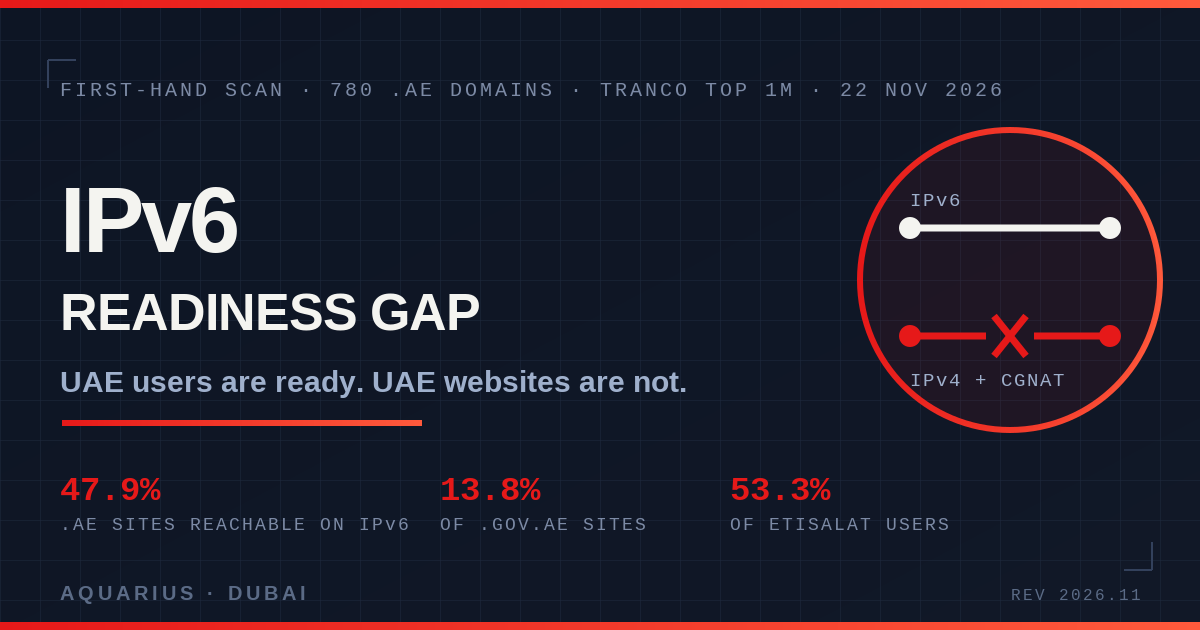
More than half of UAE internet users can already reach the internet over IPv6 — but fewer than half of the country’s most-visited websites can be reached that way. We parsed APNIC’s per-network measurements on 22 November 2026 and found Etisalat (AS5384) at 53.32% IPv6-capable users and du (AS15802) at 50.67%. Then we scanned all 780 .ae domains in the Tranco top 1M: only 374 (47.9%) publish an AAAA record at all, and just 13 of 94 .gov.ae domains (13.8%) do. The demand side of the UAE internet finished the migration. The supply side never started.
The numbers: UAE users vs UAE websites
Three hard figures set the stakes, and they do not agree with each other.
- 53.32% of Etisalat’s estimated 7,000,569 UAE users are IPv6-capable — 3,732,882 users, from 5,393,605 measurement samples. Du sits at 50.67% of 2,388,914 users. Those two networks carry roughly 95% of all UAE internet users between them.
- Globally, IPv6 traffic to Google crossed 50% for the first time on 28 March 2026. The UAE sits at about 50% capable and 48% preferring IPv6 on Google’s country measurement at the end of October 2026 — first in the Middle East, ahead of Saudi Arabia.
- Our own scan of the UAE’s top 780
.aedomains: 746 resolve an IPv4 address, only 374 publish any IPv6 address. That is a 5.4-point gap between what UAE users can do and what UAE websites let them do — and in government it is a 39-point chasm.
This matters because the UAE is one of the most mobile-first markets on earth: roughly 11.3 million internet users at about 99% penetration, 96% of them reaching the internet by phone, and 78.67% of UAE e-commerce transactions placed on mobile in a market worth about USD 12.30 billion in 2026 (roughly AED 45 billion). Mobile networks are exactly where IPv6 deployment runs ahead of everything else. The half of your audience that is on IPv6 is the half that buys on a phone.
What we did, and what we found
This is first-hand measurement, not a vendor survey. We pulled the Tranco top-1M list, extracted every hostname ending in .ae (780 of them), and queried a public DNS-over-HTTPS resolver for A, AAAA, MX and NS records on the apex, AAAA on www, and then AAAA on each domain’s mail and name servers. Results as measured on 22 November 2026:
| Measurement | Count | Share |
|---|---|---|
| Resolve an IPv4 (A) record | 746 of 780 | 95.6% |
| Reachable over IPv6 (AAAA on apex or www) | 374 of 780 | 47.9% |
| AAAA on the apex domain | 278 | 35.6% |
AAAA on www | 359 | 46.0% |
| AAAA on both apex and www (consistent dual-stack) | 263 | 33.7% |
| Mail server (MX) reachable over IPv6 | 231 of 627 with MX | 36.8% |
| Authoritative nameserver reachable over IPv6 | 478 of 773 | 61.8% |
.gov.ae domains reachable over IPv6 | 13 of 94 | 13.8% |
The thirteen .gov.ae domains that managed it: dewa.gov.ae, dm.gov.ae, dubailand.gov.ae, uaelegislation.gov.ae, investindubai.gov.ae, dubaidet.gov.ae, fcsc.gov.ae, moei.gov.ae, customerpulse.gov.ae, ai.gov.ae, iacad.gov.ae, sharjahports.gov.ae and afz.gov.ae. Everything else on the federal and emirate list answered on IPv4 only — including icp.gov.ae, tax.gov.ae, mohre.gov.ae, dubaipolice.gov.ae, moi.gov.ae, dubai.gov.ae and, with some irony, tdra.gov.ae. The commercial tier splits the same way: etisalat.ae publishes AAAA records, du.ae does not; amazon.ae, adnoc.ae, ounass.ae and thenational.ae are dual-stack, while uaepass.ae, u.ae, rta.ae and propertyfinder.ae are IPv4-only.
The half-configured failure nobody tests for
Here is the finding that should worry engineering teams more than the headline number. Of the 374 domains with any IPv6, only 263 have AAAA on both the apex and www. That leaves 96 domains with AAAA on www but not on the bare domain, and 15 the other way round. One of two canonical hostnames is dual-stack; the other is not.
That inconsistency is not cosmetic. It splits the redirect chain across protocol families, makes latency and TLS-handshake debugging non-reproducible depending on which hostname a client hit, and defeats the point of the deployment — a client on a degraded path still gets a degraded path half the time. We keep finding the same failure shape across Dubai infrastructure: the configuration exists, it is nearly right, and nobody checked the second hostname. Same root cause we measured in Dubai deep-link association files and in MTA-STS policy hosts on .ae domains.
Most Dubai businesses get this wrong: it is a toggle, not a project
The standard objection is that IPv6 is a big infrastructure programme. Our data says otherwise for most Dubai sites. We looked up the authoritative DNS provider for all 746 live domains and split IPv6 adoption by provider:
| Authoritative DNS provider | .ae sites | IPv6-reachable | Rate |
|---|---|---|---|
| Cloudflare | 291 | 254 | 87.3% |
| Microsoft Azure DNS | 3 | 2 | 66.7% |
| Akamai | 24 | 15 | 62.5% |
| AWS Route 53 | 46 | 14 | 30.4% |
| Etisalat-operated nameservers | 171 | 30 | 17.5% |
| GoDaddy / domaincontrol | 7 | 1 | 14.3% |
| Everything else | 195 | 56 | 28.7% |
Read the two bold rows together. Sites behind Cloudflare are IPv6-reachable 87.3% of the time, because the CDN terminates IPv6 at the edge and proxies to an IPv4 origin — one switch, no application change, no renumbering. Sites on Etisalat’s own hosting and DNS are IPv6-reachable 17.5% of the time. The same company that gave 3.7 million UAE subscribers IPv6 connectivity is hosting the websites that cannot answer them.
In many cases the fix is already paid for. Of the 372 live .ae domains with no IPv6 at all, 83 already sit on Cloudflare, Route 53, Azure DNS, Akamai or Google Cloud DNS — platforms where dual-stack is a free setting, not a migration. Another 139 are on Etisalat nameservers, which is a hosting-plan conversation rather than an engineering one.
Four ways IPv4-only quietly costs a Dubai business money
1. AWS bills you for every public IPv4 address
AWS charges USD 0.005 per hour for every public IPv4 address — in use or idle — across EC2, RDS, load balancers, NAT gateways and unattached Elastic IPs. That is USD 3.65 per month and USD 43.80 per year, or about AED 13.40 per month and AED 160.90 per year, per address at the pegged 3.6725 rate. A modest Dubai production estate with 40 public addresses across staging and production pays roughly AED 6,400 a year for addresses alone. IPv6 addresses on AWS are free, and addresses you bring yourself under BYOIP are exempt. AWS said the charge was partly meant to accelerate IPv6 adoption; in the UAE it is mostly just being paid.
2. Buying or leasing addresses is a real line item
The IPv4 transfer market averaged USD 20.16 per address in Q2 2026, with October 2026 pricing around USD 25 per address for a /24. Leasing runs USD 0.35 to 0.59 per address per month (about AED 1.29 to 2.17), with a buy-versus-lease breakeven around 34 months. Prices fell about 30.5% year over year — worth noting precisely because it kills the “IPv4 is an appreciating asset” argument some UAE hosts still make. You are not buying an investment. You are renting scarcity on a depreciating curve.
3. Your iOS app is already required to work without IPv4
Since 1 June 2016, every app submitted to the App Store must work on IPv6-only networks, and Apple’s review team tests on an IPv6-only DNS64/NAT64 network. Apps get rejected for hardcoded IPv4 literals or IPv4-only socket code while working perfectly on the developer’s dual-stack office Wi-Fi in Business Bay. If your backend is IPv4-only behind someone else’s NAT64 translator, you are outsourcing a store requirement that is yours. We handle that pattern as part of our development services.
4. Googlebot is nearly half IPv6 by address space
We downloaded Google’s published crawler range list on 22 November 2026 (file generated two days earlier): 317 prefixes, of which 147 — 46.4% — are IPv6. Googlebot is dual-stack and prefers IPv6 where a site advertises it. The SEO risk is not in lacking IPv6; it is in advertising an AAAA record that your firewall, origin or WAF does not actually serve. Googlebot tries IPv6, fails, and you collect crawl errors on a site that looks perfectly healthy in your browser. A broken AAAA is strictly worse than no AAAA — which is why those 96 half-configured domains in our scan are a live risk, not a tidiness issue.
What IPv6 readiness costs in Dubai, and what it buys
Honest ranges from the work we actually do, for a typical UAE SME or mid-market estate:
| Scope | What it involves | Timeline | Typical AED |
|---|---|---|---|
| Edge-only dual-stack (CDN in front) | Enable IPv6 at the CDN, add AAAA on apex and www together, verify TLS and redirect chains on both families | 1–2 days | 2,500–6,000 one-time |
| Readiness audit of an existing estate | 14-point scan of every domain, apex/www consistency, MX and NS checks, firewall and WAF IPv6 path test, AWS IPv4 cost report | 2–4 days | 4,000–9,000 one-time |
| Dual-stack origin on AWS me-central-1 | IPv6 CIDRs on the VPC and subnets, dual-stack ALB and target groups, egress-only internet gateway, security-group and NACL rules, health checks on both families | 1–3 weeks | 12,000–35,000 one-time |
| Mobile app IPv6-only certification | Remove IPv4 literals, move to hostname-based networking APIs, test against a NAT64 network, regression pass | 1–2 weeks | 8,000–22,000 one-time |
| Mail and DNS dual-stack | AAAA on MX hosts, IPv6 PTR records, SPF and reverse-DNS alignment for IPv6 senders, nameserver dual-stack | 3–5 days | 5,000–12,000 one-time |
| Ongoing verification | Dual-stack assertion wired into the deploy pipeline so a CDN or WAF change cannot silently break IPv6 | Continuous | 1,200–3,500/yr |
The cost-of-inaction number that usually ends the debate is not the AED 6,400 of AWS address fees. It is this: with roughly half of UAE mobile subscribers on IPv6 and 78.67% of UAE e-commerce happening on mobile, every IPv4-only site in this country routes half its highest-intent traffic through carrier-grade NAT — shared addresses, extra latency, session-state limits under load, and fraud-scoring systems that see hundreds of unrelated customers behind one IP. Checkout abandonment and false-positive fraud declines on a CGNAT path are real, and they are invisible in your analytics, because the users who fail never become a data point. See how this interacts with edge delivery in our Dubai CDN and edge delivery cost guide, and our pricing for budget framing.
How Aquarius does it
We treat IPv6 as a tested property of the deployment, not a checkbox. That means a baseline scan of every domain you own against the same 14 points we used on those 780 .ae domains; AAAA records added to apex and www in one change, never one of them; a real IPv6 request made against the origin through the production firewall before the record goes live, so a broken AAAA never reaches Googlebot; MX hosts, nameservers and PTR records brought along rather than left behind; and a dual-stack assertion in the deploy pipeline, because the usual way this regresses is a routine CDN or WAF change six months later. If you are on AWS, we hand back the public-IPv4 bill you stop paying as part of the report.
FAQ
Does my Dubai website actually need IPv6 in 2027?
If most of your audience is on Etisalat or du mobile, and those networks are 53.32% and 50.67% IPv6-capable, then half your traffic already prefers IPv6 and is being pushed down a carrier-NAT IPv4 path instead. You will not see an outage, which is exactly why this gets deferred. You will see slightly worse latency, worse fraud scoring and worse resilience on the half of your traffic that matters most. On a CDN it is a one-day change, so the cost-benefit is not close.
Will adding IPv6 hurt my SEO or break anything?
Adding a working AAAA record is neutral-to-positive — Googlebot publishes 147 IPv6 prefixes out of 317 and crawls dual-stack happily. Adding a broken AAAA record is the real hazard: Googlebot and roughly half your users try IPv6, hit a firewall that drops it, and fail on a site that looks healthy from your desk. Test an end-to-end IPv6 request through the production firewall before publishing the record, and publish apex and www in the same change.
Can I add IPv6 without touching my servers?
Usually yes. Put a CDN or reverse proxy in front, enable IPv6 at the edge, and let it proxy to your existing IPv4 origin. That is precisely why Cloudflare-fronted .ae sites are 87.3% IPv6-reachable while Etisalat-hosted ones sit at 17.5%. It is a standard, legitimate architecture and your origin can stay IPv4-only for years. Just remember your origin logs will show the proxy’s address, so read the forwarded-for header if you need the real client IP.
Is there a UAE regulation requiring IPv6?
There is no public TDRA mandate with a deadline for private-sector websites as of November 2026. TDRA launched the national IPv6 transition programme — the first in the region — and runs IPv6 training with RIPE NCC, which is exactly why the user-side numbers are so far ahead of the website-side numbers. Treat IPv6 as a procurement and resilience expectation rather than a compliance deadline; government tenders increasingly ask about it long before any regulation requires it.
What about IPv6 and email deliverability?
This is the trap. If your mail server sends from an IPv6 address, major receivers apply stricter rules than they do for IPv4: a valid IPv6 PTR record plus SPF or DKIM alignment is effectively mandatory, and mail without them is often rejected outright rather than filtered. Our scan found only 231 of the 627 .ae domains with MX records (36.8%) have an IPv6-reachable mail server. Do not enable IPv6 on sending infrastructure until reverse DNS is in place — see our guide to domain and mail security on .ae domains.
How do I check my own domain in two minutes?
Query a public resolver for AAAA on both your apex and www hostnames and confirm you get records for both. Then make a real request over IPv6 — not just a DNS lookup — from a network outside your office, to confirm the firewall and origin actually answer. If the record exists but the request fails, remove the record today and fix the path first.
Forty-seven point nine percent. That is how much of the UAE’s most-visited .ae estate can answer a customer who already has IPv6, against 53.32% of Etisalat subscribers who have it. For 83 of the laggards the fix is a setting they are already paying for. If you want your own domains measured against the same 14 points we used here, talk to Aquarius and we will send back the scorecard with the missing records named.