
DNSSEC Is Impossible on a .ae Domain in 2027: We Scanned All 780 and Found Zero Chains of Trust
The .ae zone is an insecure delegation in the IANA root, so no .ae domain can be DNSSEC-validated. We scanned all 780 .ae domains in the Tranco top 1M: 39 signed their own zone for nothing.
- PUBLISHED
- 22 NOV 2026
- READ TIME
- 13 MIN
- AUTHOR
- AQUARIUS · DUBAI
- UNIT
- REV 2026.09
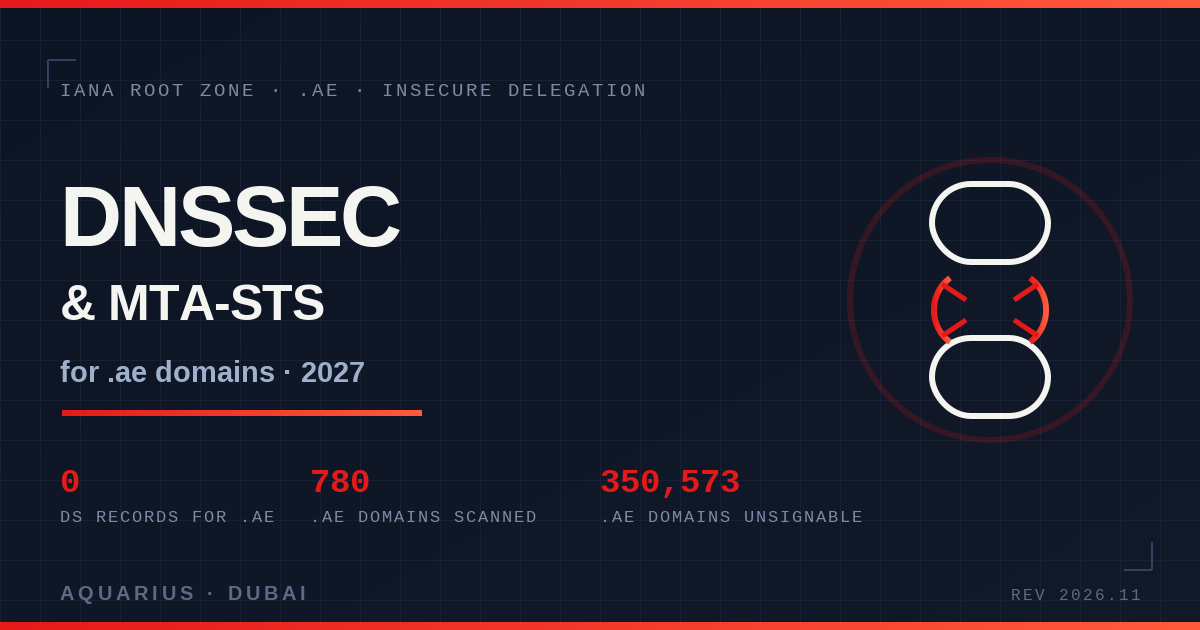
You cannot DNSSEC-protect a .ae domain in 2027, no matter what your registrar sells you. The .ae zone is an insecure delegation in the IANA root — there is no DS record for .ae, so the chain of trust cannot start and no resolver on earth will validate a .ae signature. We queried the root and then scanned all 780 .ae domains in the Tranco top 1M on 22 November 2026: 39 of them have signed their own zone anyway, buying cryptography that every resolver silently ignores.
What we found scanning every .ae domain in the Tranco top 1M
This is first-hand measurement, not a vendor survey. We pulled the Tranco top-1M list, extracted every hostname ending in .ae (780 of them), and asked Cloudflare’s resolver for DNSKEY, DS, CAA, MX, _mta-sts TXT and _smtp._tls TXT records, then fetched https://mta-sts.<domain>/.well-known/mta-sts.txt over HTTPS. The headline numbers:
- 0 of 780 have a DS record. Not one. The chain of trust is structurally impossible.
- 39 domains (5.0%) publish DNSKEY records — signed zones with no parent signature. Among them: banks, government portals, a national lottery and several large retailers.
- 42 domains (5.4%) publish a CAA record, against 9.4% of
.comdomains in 2026 measurements. - 627 domains (80.4%) have MX records, so four in five receive email.
- 35 domains (4.5%) publish an
_mta-stsTXT record, but only 18 (2.3%) serve a reachable policy file. 17 of 35 MTA-STS deployments — 48.6% — are broken. - 9 domains (1.2%) actually reach
mode: enforce. Seven more are stuck intesting. - Of the 94
.gov.aedomains in the list, 87 receive email, 3 publish CAA, and exactly 1 enforces MTA-STS.
Set that against the threat picture the UAE Cyber Security Council published in 2026: more than 75% of cyber breaches in the UAE begin with a phishing email, against a backdrop of 3.4 billion phishing messages sent worldwide every day. Abu Dhabi’s crisis-management centre recorded a 32% rise in phishing incidents in Q1 2026 alone, and 92% of UAE organisations suffered at least three identity-related breaches in the twelve months to April 2026. The attack surface everyone is defending is the one our scan says is almost entirely unguarded.
Why .ae cannot be signed: read the root zone yourself
DNSSEC works by delegation. The root zone signs a DS record for com; com signs a DS record for your domain; your domain signs its own records. Break any link and validation stops. For .ae, the first link does not exist.
IANA’s root zone database entry for .ae — sponsored by the Telecommunications and Digital Government Regulatory Authority (TDRA), with the registry operated by the .ae Domain Administration (aeDA) — states it plainly: “Insecure Delegation. This delegation is not secured using DNSSEC.” That was still true when we checked on 22 November 2026.
The practical consequence is visible in one query. Ask a validating resolver for a signed .ae zone and look at the AD (Authenticated Data) flag:
adib.ae → DNSKEY present, AD=false. salik.ae → DNSKEY present, AD=false. dfsa.ae → DNSKEY present, AD=false. cloudflare.com → AD=true.
Three UAE institutions have done the hard part — key generation, zone signing, rollover operations — and get the same security outcome as a domain that did nothing. The signatures are there. Nothing checks them.
The UAE is the outlier in the Gulf, not the norm
This is not a regional limitation. We queried the root for every GCC and neighbouring ccTLD on the same day:
| ccTLD | Country | DS record in root (22 Nov 2026) | DNSSEC validation possible? |
|---|---|---|---|
.sa | Saudi Arabia | Present (algorithm 8) | Yes |
.bh | Bahrain | Present (algorithm 13) | Yes |
.kw | Kuwait | Present (algorithm 8) | Yes |
.ae | United Arab Emirates | None | No |
.qa | Qatar | None | No |
.om | Oman | None | No |
.tr | Türkiye | Present (algorithm 13) | Yes |
.in | India | Present (algorithm 13) | Yes |
.com / .net / .org | Global | Present | Yes |
Saudi Arabia, Bahrain and Kuwait signed their national namespaces. With 350,573 .ae domains registered as of 11 October 2026 — the largest ccTLD in the Arab world — the UAE has the region’s biggest unsigned national zone. Globally, 4.27% of 240.3 million domains across 1,929 TLD zones were signed in February 2026, and ccTLDs that committed properly are far ahead: Denmark’s .dk at 61.2%, Czechia’s .cz at 58.3%, the Netherlands’ .nl at 56.9%.
So what actually protects a Dubai domain in 2027?
Here is the part most Dubai businesses get wrong. “We cannot do DNSSEC” gets treated as the end of the conversation, when DNSSEC was never the control that stops the attacks they are actually suffering. DNSSEC stops cache poisoning and on-path answer forgery. It does nothing about a hijacked registrar account, a mis-issued TLS certificate, a lookalike domain, or email delivered over a downgraded plaintext connection. Those four are where UAE money is actually lost, and every one of them has a control you can deploy today on a .ae domain.
| Control | What it actually stops | Works on .ae? | Setup effort | Typical cost (AED) |
|---|---|---|---|---|
| Registry / registrar lock + 2FA on the registrar account | Domain hijacking and unauthorised transfer — the highest-impact attack | Yes | 1–2 hours, one-time | 0–1,800/yr depending on registrar |
| CAA records (RFC 8659) | Mis-issuance of a TLS certificate for your domain by any CA you did not authorise | Yes | 30 minutes | 0 |
| MTA-STS (RFC 8461) + TLS-RPT (RFC 8460) | SMTP downgrade and man-in-the-middle interception of inbound email | Yes | Half a day plus 4–6 weeks in testing mode | 1,500–5,000 one-time |
DMARC at p=reject with SPF and DKIM aligned | Direct-domain spoofing of your brand in phishing email | Yes | 2–8 weeks of monitoring, then enforce | 3,000–9,000 one-time |
| Redundant authoritative DNS across two providers | Total outage when one DNS provider fails or is attacked | Yes | 1 day | 400–2,200/yr |
| Defensive registration + monitoring of lookalike domains | Homoglyph phishing and invoice fraud against your customers | Yes | Ongoing | 1,200–7,000/yr |
| DNSSEC | Cache poisoning and forged DNS answers | No — parent zone unsigned | n/a | Do not pay for it on a .ae |
The Gulf benchmark for how badly this is done sits in CSC’s Domain Security Report 2026: 67% of Forbes Global 2000 companies have adopted fewer than half of the recommended domain security measures, DNSSEC and CAA together sit at just 11% across that group, and 88% of lookalike domains imitating Global 2000 brands are owned by third parties — 40% of which have MX records configured, meaning they are set up to send and receive mail as you. Our .ae numbers are worse than all of those.
If you want the one control to deploy this week, it is the registrar lock. It is nearly free, it takes an afternoon, and it defends the single asset whose loss takes down your website, your email and your customer logins simultaneously.
MTA-STS: the control that matters most for UAE email, and half of it is broken
With DNSSEC off the table and 75% of UAE breaches starting in the inbox, MTA-STS is the highest-value thing on the list. It tells a sending mail server, over HTTPS, that your domain only accepts mail over authenticated TLS — closing the downgrade attack where an on-path adversary strips STARTTLS and reads your mail in plaintext.
It requires two things that must agree: a _mta-sts.<domain> TXT record carrying a policy ID, and a policy file served at https://mta-sts.<domain>/.well-known/mta-sts.txt with a valid certificate. Our scan found 35 .ae domains publishing the TXT record and only 18 serving the file. We re-probed all 17 failures with a 20-second timeout and redirect following, to be fair to them. All 17 still failed:
- 12 domains — the
mta-stshostname does not resolve or does not answer on 443 at all. The DNS record promises a policy that was never published. - 2 federal government domains — HTTP 500 from the policy host.
- 2 domains — HTTP 403, a WAF or bot rule blocking the plain HTTP client that every mail server uses.
- 1 domain — HTTP 404 after a redirect.
This is the same failure shape we keep finding in Dubai infrastructure: the configuration exists, the configuration is right, and the web server or WAF in front of it quietly breaks it. Globally MTA-STS adoption is only around 0.7% of the top 1M, but 80.8% of those deployments are valid. In the .ae top tier, barely half are. The UAE is not behind on intent — it is behind on verification.
One practical note before you deploy: an enforcing MTA-STS policy that lists the wrong MX hosts will cause senders to reject your mail rather than deliver it insecurely. Run mode: testing with TLS-RPT collecting reports for at least four weeks first. Our scan found 33 .ae domains publishing TLS-RPT, which is the only reason any of them can see failures at all.
What this costs, and what ignoring it costs
The economics are not close. IBM put the average data breach cost in the Middle East at USD 8 million in 2026 — roughly AED 29.4 million — among the highest in the world, with lost business alone averaging USD 3.57 million (about AED 13.1 million). Narrowing to DNS specifically, Forrester found 88% of organisations suffer at least one DNS-based attack a year at an average USD 942,000 (about AED 3.46 million) per incident, while IDC measured DNS attack costs rising 49% year over year to USD 1.27 million (about AED 4.7 million).
Against that, a complete domain-hardening pass on a Dubai SME estate — registrar lock, CAA, DMARC to p=reject, MTA-STS to enforce, TLS-RPT, redundant DNS and a lookalike-domain watchlist — lands in the AED 6,000 to AED 18,000 range as a one-time project, with AED 2,000 to AED 6,000 a year of monitoring after it. That is less than one percent of a single average regional breach. For context on where that sits alongside other build work, see our pricing.
How Aquarius does it
We treat domain and DNS security as infrastructure with a test suite, not a one-off checklist. That means: a baseline audit of every record across all your domains, registrar lock plus 2FA verified by attempting a transfer, CAA records scoped to the CAs you actually use, DMARC taken to p=reject on real report data rather than guesswork, MTA-STS held in testing until TLS-RPT is clean, a second authoritative DNS provider, and a scheduled re-check after every deploy — because the usual way this breaks is a routine CDN or WAF change six months later, exactly as it broke for those 17 domains. If DNSSEC becomes available on .ae, you will be one DS record away rather than one project away. Related reading: SPF, DKIM and DMARC for Dubai senders, the 100-day TLS certificate limit, and who really owns your domain after an agency handover.
FAQ
Can I enable DNSSEC on my .ae domain at all?
You can sign your own zone and publish DNSKEY records — 39 of the top .ae domains have — but no validating resolver will authenticate them, because there is no DS record for .ae in the root zone. IANA lists the delegation as insecure. Until TDRA and aeDA sign the .ae zone and publish a DS record to the root, DNSSEC on a .ae domain is cryptography with nothing on the other end.
Should I move to a .com just to get DNSSEC?
No. A .ae domain is a strong local trust and ranking signal in the UAE, and DNSSEC is not the control that stops the attacks hitting Dubai businesses. Keep the .ae, deploy registrar lock, CAA, DMARC and MTA-STS, and consider running a signed .com in parallel if you have a specific compliance requirement that names DNSSEC. Switching your primary domain to chase a control that fixes cache poisoning while phishing drives 75% of local breaches is the wrong trade.
My registrar sells DNSSEC for my .ae domain. Is that a scam?
Not deliberately — most registrar control panels expose DNSSEC generically and do not check whether the parent zone is signed. But you are paying for an effect you cannot get. Ask the registrar to show you the DS record in the parent zone. For a .ae domain there will not be one. Spend the money on registrar lock instead.
How do I check whether my own domain is validated?
Query a validating resolver and look at the AD flag. Using Cloudflare’s DNS-over-HTTPS endpoint, request your domain with accept: application/dns-json and read the AD field: true means the answer was cryptographically validated, false means it was not, regardless of what your own zone publishes. Run the same query against a known-signed domain to confirm your test is sound.
Does PDPL or the UAE Information Assurance Standard require DNSSEC?
The UAE Information Assurance Standard — originally the NESA standard, reissued as the IA Regulation v1.1 in 2020 and updated to version 2.1 by the UAE Cyber Security Council in November 2025 — includes secure name and address resolution controls in its communications security family. Auditors generally accept compensating controls where a ccTLD makes DNSSEC impossible, but you need the evidence: the IANA insecure-delegation record plus documented deployment of the alternatives. That evidence pack is worth assembling before an audit asks for it, not during. See also our cybersecurity basics for Dubai websites and apps.
How long does MTA-STS take to deploy safely?
Budget six weeks end to end for a single domain: a day to publish the policy host, the TXT record and TLS-RPT; four weeks in mode: testing while you read the reports; then a switch to mode: enforce once no legitimate sender is failing. Rushing straight to enforce with a stale MX list is the one way this control can lose you mail.
Zero out of 780. That is the state of DNSSEC on the UAE’s national namespace, and it is not your fault — but the six controls that do work on a .ae domain are, and our scan says fewer than one in twenty of the country’s most-visited domains has deployed them. If you want yours measured against the same 18 points we used here, talk to Aquarius and we will send back the scorecard with the failing records named.