
Last-Mile Delivery & COD Integration for Dubai Online Stores (2026): The Real AED Cost of a Failed Delivery
Around 20% of UAE cash-on-delivery orders come back unsold versus 6% prepaid. The real AED cost of a failed Dubai delivery, and the courier, COD and Makani integrations that stop it.
- PUBLISHED
- 25 SEPT 2026
- READ TIME
- 12 MIN
- AUTHOR
- AQUARIUS · DUBAI
- UNIT
- REV 2026.09
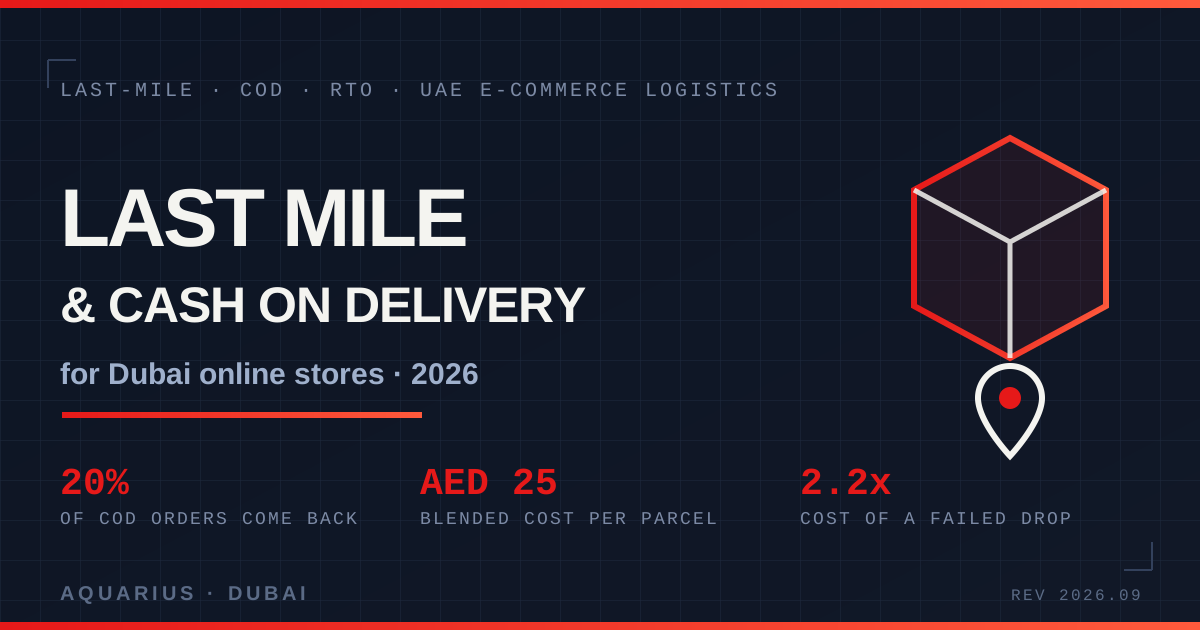
Short answer: Delivery is where Dubai online stores quietly lose their margin. Around 20% of cash-on-delivery orders in the UAE come back unsold against roughly 6% of prepaid orders, a blended parcel costs about AED 25 to move, and a failed first attempt costs 1.6–2.2x a clean delivery. Fixing that is not a courier negotiation — it is a checkout, address and API problem. Updated September 2026.
Three numbers that decide whether your store makes money
The UAE e-commerce headline is excellent. The unit economics underneath it are not, and almost nobody models them before launch.
- USD 12.42 billion — the size of the UAE e-commerce market in 2026, growing at an 11.29% CAGR with 11.04 million online shoppers. EZDubai and Euromonitor put the same market at AED 32.3 billion in 2024 heading to AED 50.6 billion by 2029.
- 53% — the share of total shipping cost consumed by the last mile alone, per Capgemini Research Institute, which also puts it at 41% of end-to-end supply-chain cost. It is the single largest cost line in fulfilment, and the one most stores treat as a fixed fee.
- 20% versus 6% — return-to-origin rates for COD orders versus prepaid orders in the UAE, from Shorages operator data. Quiqup puts the gap even wider, at 12–13x higher return rates for COD against card-paid orders.
Read those together and the conclusion is uncomfortable: the payment method most Dubai stores offer to reduce friction is the one destroying their delivery economics.
COD is shrinking — and it is still the most expensive option you offer
Cash on delivery accounted for about 40% of UAE online transactions in 2022. By 2026 it is down to 25–30% on KPMG figures. That is real progress, and it is exactly why the remaining COD volume needs managing rather than ignoring: the share is small enough to feel harmless and large enough to eat a quarter of your gross profit.
Three costs hide inside every COD order:
- The failed drop. Jeebly puts the cost of a rejected COD order at AED 25–50 in shipping and handling — paid twice, out and back, on an order that earned nothing.
- The cash-flow lag. Couriers pool collected cash and remit on cycles of 2–7 business days, and fixed weekly cycles can stretch an order delivered just after cut-off to 10–14 days. COD-heavy stores routinely run with 3–5 weeks of revenue trapped in settlement.
- The reconciliation tax. Someone on your team matches courier remittance files to orders by hand. That is a spreadsheet, not a system, and it breaks the moment you add a second courier.
Most Dubai stores get this wrong: they treat COD as a payment option. It is a credit product. You are shipping goods on unsecured credit to a customer you have not verified, and eating the logistics cost whether or not they pay.
What last-mile delivery actually costs in the UAE in 2026
Published and negotiated rates cluster tightly. These are 2026 market ranges for a standard parcel under 5 kg — useful as a benchmark before you sign anything.
| Service | Dubai | Northern Emirates | Notes |
|---|---|---|---|
| Standard next-day | AED 17–30 | AED 22–38 | Jeebly publishes a flat AED 17.31 up to 5 kg; Emirates Post EMX sits at AED 20–30 |
| Same-day | AED 35–60 | AED 45–75 | Same-day now reaches roughly 90% of Dubai urban population |
| 2–4 hour express | AED 55–90 | Limited coverage | Speed benchmark set by Noon Minutes (12 min) and Amazon Now (15 min) |
| Cross-border to Saudi Arabia | AED 40–65 | Cross-border COD remittance typically runs 2 weeks vs 1 week domestic | |
| Blended benchmark (80/20 next-day to same-day) | AED 25 per parcel | Sticker price only — before failures | |
Against a UAE average order value of roughly AED 375, that blended AED 25 is 6.7% of AOV on paper. Once failed attempts and RTO are loaded in, true last-mile cost lands at 8.5–10% of AOV. Cross 12% and the problem is no longer your courier rate card. Zone matters too: Nexdigm analysis puts delivery at 3–5% of basket value in urban cores and 15–25% in remote and northern zones — which is why one flat nationwide free-shipping threshold bleeds money in Ras Al Khaimah while being perfectly fine in Business Bay.
The failed-delivery multiplier
Typical UAE brands hit an 85% first-attempt success rate; well-run operations target 95%. That ten-point gap is the whole game, because a failure is not a lost delivery fee — it is a multiplied one. A failed first attempt plus one retry costs 1.6–2.2x a successful delivery. On a Dubai next-day parcel that is roughly AED 50 for one retry, and about AED 72 if the retry also fails and the parcel returns to origin.
Ten failed attempts per hundred orders, at AED 50–72 each, is AED 500–720 of pure waste per hundred orders. At 1,000 orders a month that is AED 60,000–86,400 a year spent on parcels that never arrived.
The Dubai-specific fix almost nobody codes: Makani
The UAE has no postal code system. Your checkout form, copied from a US or UK template, asks for a ZIP that does not exist and a street address that half of Dubai does not use conversationally. Drivers then phone the customer — and every phone call is a chance to fail.
Dubai solved this years ago and most stores still ignore it. The Makani number is a 10-digit code fixed to the facade of every completed building in Dubai, geo-tagged to the UAE National Grid with one-square-metre accuracy and pinned to the entrance rather than the building footprint. Dubai was the first city in the world to adopt a number-based addressing system of this kind.
Capturing it is a checkout change, not a logistics project:
- Add an optional Makani field with a 10-digit mask and inline help explaining where to find it — it is printed on the building facade.
- Offer a map pin fallback and store latitude and longitude alongside the text address, then pass both to the courier API.
- Validate the mobile number with an OTP at checkout, not at the door. An unverified phone number is the root cause of most retries.
- Send a pre-delivery confirmation on WhatsApp — penetration in the UAE is around 90%, making it the highest-answer-rate channel you have.
The integration stack that actually moves the number
Every store we audit in Dubai is missing the same four pieces. In build order:
1. Courier API integration, not a portal
If your team pastes orders into a courier web portal, you are paying staff to create typos. A direct API integration creates the shipment, pulls the airway bill, pushes status webhooks back into the order record, and gives the customer one branded tracking page instead of five different carrier sites.
2. Multi-carrier routing rules
One courier cannot be cheapest in Al Quoz and cheapest in Fujairah. A routing layer picks the carrier per order by emirate, weight, service level and COD flag — and fails over automatically when one carrier misses a pickup. This is where the 3–5% urban versus 15–25% remote cost gap gets arbitraged instead of absorbed.
3. COD risk scoring and prepaid nudges
Score every COD order before it ships: first-time buyer, prior RTO history, order value against category norm, address completeness, phone verification status. High-risk orders get an OTP confirmation or a partial-prepay requirement. Low-risk orders ship untouched. Pair it with a real incentive to prepay — a small discount costs far less than an AED 72 round trip, and BNPL through Tabby or Tamara converts a meaningful share of would-be COD shoppers to prepaid without cutting your price.
4. A returns flow that is compliant and cheap
Returns are not optional. Under Consumer Protection Federal Decree-Law No. 15 of 2020, e-commerce merchants must publish a clear returns policy, and the seven-day return window is the UAE standard. Global return rates average 16.9% of orders and apparel runs near 26%. Build the reverse flow properly — scan-and-refund for trusted customers, inspect-and-refund for high-value goods — and note that cross-border shipments under AED 1,000 get simplified customs handling, while dutiable goods must be re-declared before you refund.
The money: what this costs to build and what it returns
Unmanaged COD-heavy stores in the region routinely run RTO at 25–35%. Disciplined operations pull that to 15–18%. Here is the arithmetic on a mid-sized Dubai store, modelled by us on the published cost figures above.
Take 1,000 orders a month at AED 375 AOV, with COD at 30% of volume — 300 COD orders. At a 25% RTO rate, 75 of those come back. At AED 25–50 of wasted logistics each, that is AED 1,875–3,750 a month burned on nothing. Pull RTO to 15% and 30 of those orders complete instead: about AED 11,250 of recovered monthly revenue, or roughly AED 47,000 of recovered gross profit a year at a 35% margin — before counting the reduced retry spend and the freed-up working capital.
| Build | Typical Aquarius range (AED) | What it removes |
|---|---|---|
| Single-courier API integration + branded tracking page | 9,000–18,000 | Manual portal entry, where-is-my-order tickets |
| Checkout address upgrade: Makani, map pin, phone OTP | 7,000–15,000 | Wrong addresses, unreachable customers, retries |
| Multi-carrier routing engine with rules and failover | 25,000–55,000 | Overpaying per zone, single-carrier outages |
| COD risk scoring + prepaid conversion flow | 15,000–35,000 | RTO on high-risk orders, cash-flow lag |
| Returns portal + automated reconciliation | 20,000–45,000 | Spreadsheet reconciliation, compliance exposure |
| Ongoing support and carrier maintenance | 1,200–3,500 / month | API drift when carriers change endpoints |
Compare the first two rows against AED 60,000–86,400 of annual failed-attempt waste and the payback period is measured in weeks, not quarters. That is the cost of inaction most Dubai founders never put on a slide.
How Aquarius approaches it
We start with a two-week measurement pass, because most stores cannot state their real RTO rate by emirate and payment method. Then we ship in the order above — checkout fixes first, because they are the cheapest with the fastest payback, then the courier API, then routing and risk scoring once there is enough data to tune the rules. Everything lands in your existing stack; we do not replace a working Shopify or WooCommerce store to sell a rebuild. See pricing for how engagements are structured, or read our breakdown of payment gateway integration costs in Dubai if checkout is the bigger constraint right now.
FAQ
How much does last-mile delivery cost per parcel in Dubai in 2026?
Standard next-day delivery in Dubai runs AED 17–30 per parcel under 5 kg, same-day AED 35–60, and 2–4 hour express AED 55–90. A blended benchmark across a typical 80/20 next-day to same-day mix is about AED 25 per parcel — before failed attempts, which push the true figure to 8.5–10% of average order value.
What is a normal RTO rate for a UAE online store?
About 20% of COD orders return to origin versus roughly 6% of prepaid orders. Unmanaged COD-heavy stores commonly sit at 25–35%. A well-run operation with address validation, phone verification and COD risk scoring targets 15–18% or lower.
Should a Dubai store stop offering cash on delivery?
Not outright — COD is still 25–30% of UAE transactions and removing it costs real orders. The better move is to make prepaid more attractive than COD: OTP verification on high-risk COD orders, a small prepay incentive, and BNPL options so customers who want to pay on receipt still have a card-based alternative.
Do I need a Makani number at checkout?
It is optional for the customer but valuable for you. The UAE has no postal codes, and a Makani number geo-locates a building entrance to one square metre on the UAE National Grid. Capturing it, plus a map pin and a verified mobile number, removes the most common causes of a failed first attempt in Dubai.
How long do UAE couriers take to remit COD cash?
Typically 2–7 business days, though fixed weekly settlement cycles can stretch to 10–14 days for an order delivered just after cut-off. Cross-border COD generally settles in about two weeks. COD-heavy stores should plan for 3–5 weeks of revenue sitting in the settlement pipeline.
What does UAE law require for e-commerce returns?
Consumer Protection Federal Decree-Law No. 15 of 2020 requires a clear, published returns policy and prohibits unfair contract terms, with penalties for non-compliance. The seven-day return window is the UAE e-commerce standard, aligning online purchases with physical retail.
The short version
Your courier rate card is not your delivery cost. Failed attempts, RTO and settlement lag are, and all three are fixed upstream — in the checkout form, the address data and the API between your store and your carriers. If you know your AOV but not your RTO rate by emirate, that is the first thing worth measuring this quarter.
If you want a second pair of eyes on it, tell us what you sell and where you ship — we will tell you where the money is leaking before anyone talks about a build.