
Law Firm Website Development in Dubai (2026): DIFC-Ready, Bilingual and Built to Convert
DIFC Courts logged AED 10.02bn in claims in H1 2026 — up 48%. Yet most Dubai law firm websites are brochures. Real build costs in AED, compliance limits and what actually converts.
- PUBLISHED
- 13 SEPT 2026
- READ TIME
- 09 MIN
- AUTHOR
- AQUARIUS · DUBAI
- UNIT
- REV 2026.09
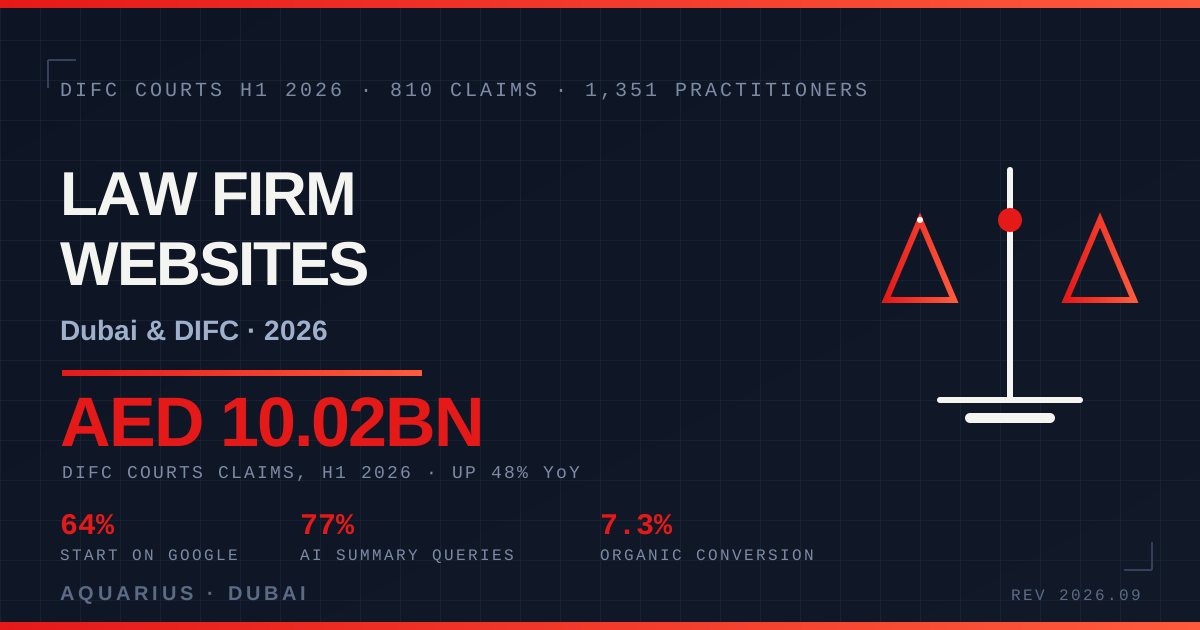
Short answer: A Dubai law firm website is not a brochure — it is your intake channel. 64% of people now start their search for legal help on Google, organic search converts at 7.3% in the legal sector, and 65% of firms say their website delivers their highest marketing ROI. In Dubai that means bilingual English/Arabic practice-area pages, a compliant intake form that respects UAE PDPL, and content structured for AI answers — because AI summaries now appear on roughly 77-78% of legal search queries, the highest share of any industry. Budget AED 18,000-45,000 for a credible boutique firm site and AED 60,000-140,000 for a multi-practice firm with bilingual content and routed intake.
Key takeaways
- The market is growing faster than the websites are. Grand View Research puts the UAE legal services market at USD 5.0 billion in 2024, heading to USD 7.6 billion by 2030 at a 7.4% CAGR — the fastest-growing legal market in the Middle East & Africa.
- Disputes are getting bigger, not just more numerous. DIFC Courts recorded 810 cases and AED 10.02 billion in claims in H1 2026 — caseload up 25%, claim value up 48% year-on-year, averaging AED 55 million filed per day.
- Your competitive set is small and countable. DIFC alone listed 1,351 registered practitioners across 256 firms at the half-year mark. That is a winnable SERP, unlike most Dubai verticals.
- Justice here is already digital. 99% of DIFC Courts proceedings (818 of 824) were conducted online, and Dubai Courts processed 1.7 million smart requests and 24,507 remote hearings in 2025. Clients who litigate through a browser expect to hire through one.
- AI search is eating the legal SERP first. AI summaries surface on about 77-78% of legal queries — more than any other sector — so content written to be quoted beats content written to be skimmed.
TOFU: Dubai's legal sector digitised. Its marketing did not.
Dubai has spent a decade building one of the most digital justice systems on earth, and the numbers are not subtle. In the first half of 2026 the DIFC Courts handled 810 cases carrying AED 10.02 billion (USD 2.73 billion) in claims — a 25% rise in caseload and a 48% rise in value against H1 2025, working out to roughly AED 55 million in new claims filed every single day. The Court of First Instance and specialised divisions took 110 claims worth AED 9.02 billion, averaging AED 117.2 million each. The Arbitration Division grew 61% to 37 claims worth AED 3.17 billion. Enforcement filings more than doubled, from 106 to 220.
On the mainland side the picture has the same shape. Dubai Courts' 2025 performance report logged 1.7 million smart service requests, 24,507 remote hearings and 21,121 published judgments, with an average 114 days to rule at first instance and a 90% settlement rate across AED 10.2 billion in case and request value, including AED 3.68 billion through enforcement. Blockchain-backed transactions reached 173,013 requests.
Now hold that against how the work is actually won. Clients who file, plead and settle through a portal do not tolerate a firm whose website is a PDF profile, a stock photo of a gavel and an info@ mailbox. 64% of people looking for legal help start on Google, 94% of firms name search engines as their top brand-awareness channel, and organic search drives as much as 66% of call conversions in the legal industry. The shortfall is not demand. It is the last fifty metres between a search result and a signed engagement letter.
The opportunity is unusually concrete because the competitive set is small. At the half-year mark DIFC listed 1,351 registered practitioners across 256 firms. Mainland legal consultancies licensed through the Dubai Legal Affairs Department add to that, but this is still a market measured in hundreds of competitors, not the tens of thousands a Dubai restaurant or brokerage faces. A genuinely useful practice-area page in Dubai can rank. Most verticals cannot say that.
MOFU: the six things a Dubai law firm website must actually do
Strip away the design debate and a legal website has six jobs. Miss one and the build is decorative.
1. Practice-area pages that answer, not list
A page titled "Corporate & Commercial" ranks for nothing. A page titled "Shareholder Disputes in DIFC: Jurisdiction, Costs and Timelines" ranks, because it matches how a general counsel actually searches. Each core service needs its own page covering the forum (DIFC Courts, Dubai Courts, ADGM, DIAC arbitration), the realistic timeline, the cost structure, and what the client must prepare. Corporate work is the largest and fastest-growing revenue segment in the UAE legal market, so that is where the depth belongs.
2. Genuine Arabic, not a translate widget
Mainland Dubai Court proceedings run in Arabic; DIFC and ADGM run in English. A firm serving both needs both languages at equal quality, with proper right-to-left layout, Arabic typography and natively written copy. This is the same discipline covered in our guide to Arabic and RTL website design in the UAE, and in legal content the stakes are higher: a mistranslated procedural term reads as incompetence to exactly the client you want.
3. Intake that captures the matter, not just the email
The generic contact form is where legal websites bleed. A working intake asks matter type, jurisdiction, opposing party (for conflict checking), urgency and value band — then routes to the right partner automatically. Conflict-check triage before a callback saves hours every week and prevents an embarrassing decline after the client has already told you everything.
4. Lawyer profiles built for E-E-A-T and for AI
Each fee earner needs a real page: bar admissions and jurisdictions, DLAD or MOJ registration where applicable, languages spoken, reported matters, publications and speaking. Search engines and AI answer engines both lean hard on demonstrable expertise signals, and in a regulated profession these are the cheapest credibility you will ever publish. Mark them up with Person and LegalService schema so machines can read them.
5. A client portal, once volume justifies it
For firms running recurring corporate, conveyancing or immigration volume, a secure document portal — matter status, document exchange, e-signature, invoice history — is the highest-retention feature available. It is also where your data obligations get serious, which is the next point.
6. PDPL-grade data handling from day one
Everything a legal intake form collects is personal data, and some of it is sensitive. UAE Federal Decree-Law No. 45 of 2021 applies alongside professional secrecy duties. That means lawful-basis consent language, encryption in transit and at rest, defined retention, controlled access and a breach process. Our UAE PDPL compliance checklist covers the build-side requirements in full — treat it as a specification, not as reading material.
What you cannot do: the advertising limits
Legal practice in Dubai is regulated by the Dubai Legal Affairs Department under the federal law regulating the legal profession, and promotion must preserve the dignity of the profession. In practice: no guaranteed outcomes, no sensational or fear-based claims, no comparative attacks on named competitors, no soliciting individuals in a manner deemed undignified, and truthful, non-misleading statements throughout. Paid search and social carry the additional UAE requirement to run from permitted, registered advertising accounts with clear "sponsored" labelling. Design the site so its persuasion comes from demonstrated expertise and published thinking — which is also, conveniently, what ranks. Confirm your own position with compliance counsel before any campaign goes live.
MOFU: what a legal website costs in Dubai in 2026
Real AED ranges, excluding 5% VAT. These sit at the upper end of the Dubai professional-services market — where a brochure site runs AED 3,000-8,000 and custom builds start around AED 25,000 — because legal adds bilingual content, compliance review and intake logic.
| Tier | Who it fits | What's included | Build (AED) | Annual run (AED) |
|---|---|---|---|---|
| Solo / boutique | 1-5 fee earners, single focus | 8-14 pages, EN-first, 4-6 practice areas, basic intake, insights blog | 18,000 - 45,000 | 4,000 - 12,000 |
| Full-service firm | 6-30 fee earners, multi-practice | Full bilingual EN/AR with RTL, 10-20 practice pages, lawyer profiles, routed intake with conflict fields, schema markup | 60,000 - 140,000 | 15,000 - 35,000 |
| Firm + client portal | Volume corporate, immigration, conveyancing | Everything above plus authenticated portal, matter status, document exchange, e-signature, CRM/PMS integration | 120,000 - 320,000 | 30,000 - 70,000 |
| Content & SEO retainer | Any firm competing on search | Bilingual practice-area content, technical SEO, AI-answer optimisation, monthly reporting | — | 60,000 - 300,000 / yr |
Two cost realities Dubai firms consistently miss. First, annual maintenance runs 15-20% of the original build — hosting, security patching, content updates and support — and a legal site that goes stale loses rankings faster than most, because legal content decays with every new decision and regulation. Second, the content is the expensive part, not the code. Bilingual practice-area writing that a partner will actually sign off on is billed like professional services, because it is.
MOFU: the AI search problem that hits law firms first
Here is the stat most Dubai managing partners have not internalised: AI summaries now appear on roughly 77-78% of legal search queries — the highest rate of any industry. Legal questions are exactly the kind of definitional, procedural, high-intent query that AI Overviews, ChatGPT search and Perplexity answer directly. The traditional blue-link click is being intercepted before it reaches you.
That does not make search worthless. It changes what wins. Content that gets cited by an answer engine states a direct answer in the first two sentences, uses real jurisdictional specifics, carries verifiable author credentials, and is structured so a machine can lift a clean passage. Content that opens with "in today's fast-paced business environment, legal matters can be complex" gets nothing, from humans or from models. We go deeper on this in our guide to how Google AI Overviews are changing UAE search.
The practical rewrite for a Dubai firm: lead every practice-area page with a two-sentence answer to the question that page targets. Name the forum. Give a timeline range. Give a cost band. Attribute it to a named, credentialled lawyer. Then expand. That single structural change is worth more than a redesign.
BOFU: what it returns, and how Aquarius builds it
The ROI math on a legal site is unusually clean, because matter values are high. Organic search converts at an average 7.3% in the legal sector, and 65% of firms report their website as their highest-ROI channel. Take a full-service build at AED 100,000 amortised over three years, plus AED 25,000 a year to run it — about AED 58,000 per year, all in. Against a DIFC Small Claims matter averaging AED 94,000 in claim value, or a Court of First Instance matter averaging AED 117.2 million, the site pays for itself on a single additional instructed matter a year. Most firms are not one matter away from break-even. They are several, and they are leaving them on the SERP.
The cost of inaction is the mirror image. In a market compounding at 7.4% a year toward USD 7.6 billion by 2030, a firm whose website does not rank is not standing still — it is ceding compounding share to the firms whose sites do.
In a profession where the client cannot evaluate the work before buying it, the website is the evidence. Most Dubai firms publish a business card, then wonder why they compete on price.
How Aquarius does it
We build law firm websites the way we build regulated platforms: a page architecture mapped to how UAE clients actually search, bilingual EN/AR with native Arabic copy and proper RTL, intake forms with conflict-check fields routed to the right partner, LegalService and Person schema on every profile, PDPL-aligned consent, encryption and retention configured at build time, and answer-first content structured to be cited by AI search rather than skimmed past. Client portals when volume justifies them, not before. Boutique builds typically ship in 4-7 weeks, full-service bilingual firms in 8-14 weeks. You own the source code and every account — no lock-in, ever. See our pricing, browse what we build, or book a 20-minute teardown of your current site and intake flow.
FAQ
How much does a law firm website cost in Dubai in 2026?
A boutique or solo practice site runs AED 18,000-45,000; a full-service bilingual firm site with lawyer profiles and routed intake runs AED 60,000-140,000; adding a secure client portal with document exchange takes it to AED 120,000-320,000. Add 15-20% of the build cost annually for hosting, security and maintenance, plus 5% VAT throughout. Legal sits above the general Dubai professional-services range because of bilingual content, compliance review and intake logic.
What are the advertising rules for law firms in Dubai?
The Dubai Legal Affairs Department regulates advocacy and legal consultancy in the emirate, alongside the federal law governing the legal profession. Marketing must be truthful, non-misleading and consistent with the dignity of the profession: no guaranteed outcomes, no sensational claims, no undignified solicitation of individuals. Paid digital ads carry the additional UAE requirement to run from a permitted, registered advertising account with clear "sponsored" labelling. Confirm your specific position with compliance counsel before a campaign goes live.
Does a Dubai law firm website need to be in Arabic?
If you appear before Dubai Courts, yes. Mainland proceedings run in Arabic while DIFC and ADGM run in English, so a firm serving both needs both at equal quality — native copy with proper RTL layout, not a translate widget. Firms working exclusively in DIFC or ADGM on international corporate matters can credibly launch English-first and add Arabic later, but Arabic remains the cheaper, less contested search market.
Should we build a client portal?
Only once recurring matter volume justifies it. Portals pay off for corporate retainers, immigration, conveyancing and any practice where clients exchange documents repeatedly — and Dubai clients already expect it, given 99% of DIFC Courts proceedings ran online in H1 2026. For a litigation boutique running a handful of large matters, secure document exchange and a well-run matter-management system are enough. Start with intake; add the portal when the support load proves the case.
How long does it take to rank a law firm website in Dubai?
Expect 4-6 months for meaningful movement on mid-competition practice-area terms and 9-18 months on high-value head terms, assuming consistent publishing. The competitive set is comparatively small — DIFC listed 1,351 practitioners across 256 firms at mid-2026 — which makes Dubai legal SEO far more winnable than sectors with thousands of competitors. The same fundamentals apply as in our broader Dubai SEO guide.
Do AI Overviews mean SEO is dead for law firms?
No — the format changed, not the value. AI summaries now appear on roughly 77-78% of legal queries, the highest share of any industry, so pages written to be quoted outperform pages written to be browsed. Lead with a direct two-sentence answer, name the jurisdiction and forum, give real timeline and cost ranges, attribute to a credentialled lawyer, and mark it up with schema. Firms that restructure this way get cited inside the AI answer; firms that do not disappear from both the answer and the links beneath it.
Can we just use a WordPress template?
For a small practice with English-only content and no portal, a well-configured WordPress build at AED 8,000-30,000 is a reasonable starting point. It stops being reasonable the moment you need equal-quality Arabic RTL, routed conflict-check intake, PDPL-grade handling of sensitive matter data, or an authenticated portal. At that point plugin maintenance and security become the expensive part — see our breakdown of WordPress versus custom builds in Dubai.