
Legal Case Management Software for Dubai Law Firms (2026): Real AED Costs, goAML Duties and the 2027 Invoicing Wall
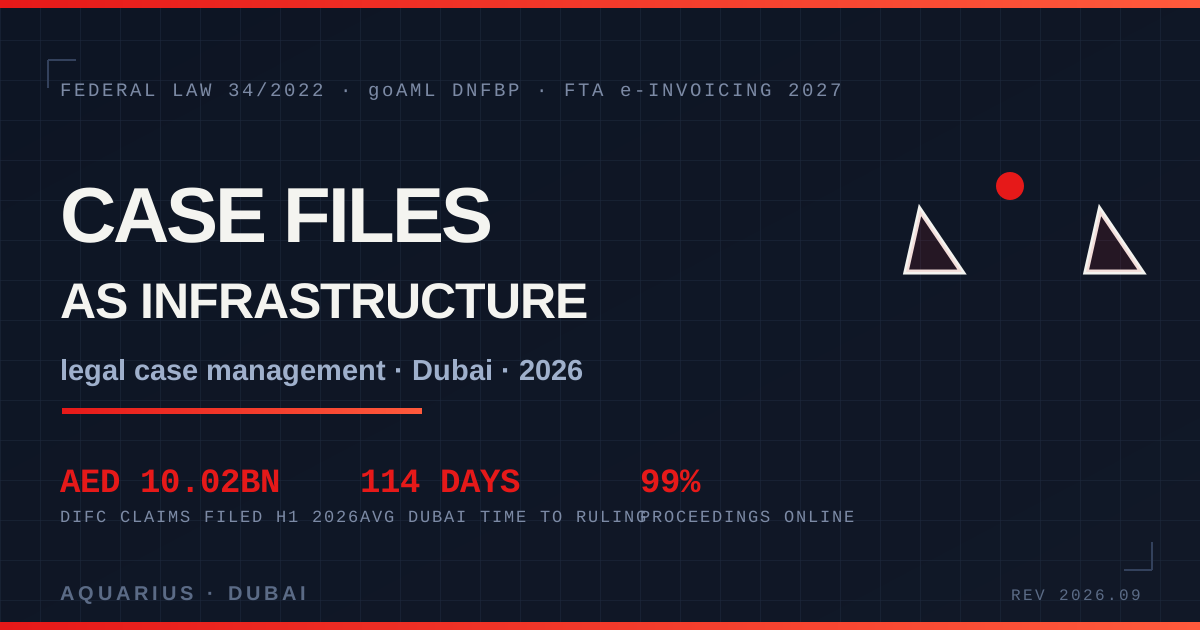
DIFC Courts logged AED 10.02 billion of claims in H1 2026 and 99% of proceedings ran online. What case management software really costs a Dubai law firm in AED, and the compliance duties it has to carry.
- PUBLISHED
- 24 SEPT 2026
- READ TIME
- 11 MIN
- AUTHOR
- AQUARIUS · DUBAI
- UNIT
- REV 2026.09
Short answer: A Dubai law firm running on off-the-shelf legal practice management software pays roughly AED 145–550 per fee-earner per month, plus setup and data migration. A custom case management build that fits UAE practice — bilingual matter files, Dubai Courts and DIFC filing references, goAML-ready client due diligence and FTA e-invoicing — runs AED 55,000–140,000 for a single-office firm, AED 160,000–380,000 for a multi-practice firm with trust accounting and a client portal, and AED 400,000–900,000 for a regional platform. The line nobody budgets for is compliance: your firm is a DNFBP under UAE anti-money-laundering law, and administrative fines run from AED 10,000 to AED 5,000,000 per violation.
Here is what most Dubai firms get wrong. They shop for case management software as if the problem were billing. It is not. The problem is that the matter file is not the system of record — it is scattered across a shared drive, three WhatsApp threads, a paralegal’s inbox and a spreadsheet of deadlines. In a jurisdiction where 99% of DIFC Court proceedings now run online and Dubai Courts processed 1.7 million smart requests in a single year, a file that only exists in someone’s head is an operational risk with a price tag attached.
The stakes: Dubai litigation is now a data pipeline
Start with what the courts themselves published, because it explains why paper-shaped workflows stopped working.
- The Dubai Judicial Authority’s 2025 annual report records 1.7 million smart requests completed, 24,507 remote hearings held, 21,121 judicial rulings published, 23,438 smart bail applications processed and 173,013 blockchain requests.
- Average time from case registration to ruling is now 114 days, with a 90% case settlement rate and ruling accuracy of 86.5% at first instance and 87.1% on appeal.
- Enforcement moved real money: AED 3.68 billion paid through enforcement proceedings, against AED 10.2 billion in total value of case settlements and requests.
- On the DIFC side, 810 cases were filed in H1 2026 — up 25% year on year — carrying AED 10.02 billion of claims, up 48%. That is roughly AED 55 million of new claims every single day.
- 99% of DIFC proceedings (818 of 824) ran online, producing 1,766 digital orders and judgments.
And the supply side is small. The DIFC Courts register lists 1,351 lawyers across 256 law firms. That is the competitive set fighting over a caseload growing at 25% a year, where the average Court of First Instance claim now stands at AED 117.2 million across 110 filings worth AED 9.02 billion.
The uncomfortable version: your competitors are not winning matters because they argue better. They are winning because they answered the client in forty minutes with the file already assembled.
There is a deadline on the horizon too. On 28 July 2026 the UAE announced what it describes as the world’s first fully integrated AI-powered judicial platform, covering case analysis, legal research, precedent retrieval and judicial document preparation, with judges retaining sole authority over rulings. Phase one began in September 2026, with a phased rollout across 18 months. When the bench’s side of the process is structured and machine-assisted, a firm submitting unstructured work product is the slow party in the room.
What UAE practice actually demands from the software
Generic legal software is built for common-law billing in North America. UAE practice adds obligations no default template covers.
1. The firm itself is a regulated reporting entity
Lawyers, notaries and independent legal professionals are DNFBPs — Designated Non-Financial Businesses and Professions — when they carry out certain transactions for clients. That means mandatory registration on the UAE Financial Intelligence Unit’s goAML platform, documented customer due diligence, a designated compliance officer, record keeping and suspicious transaction reporting. A solo legal consultant carries the same statutory obligation as a bank branch network.
The current framework is Federal Decree-Law No. 10 of 2025, in force 14 October 2025, with executive regulations in Cabinet Decision No. 134 of 2025, in force 14 December 2025. Administrative fines under Article 17 range from AED 10,000 to AED 5,000,000 per violation, and supervisors have penalised firms both for failing to register and for failing to file. Practically: your client intake screen is a compliance artefact, not a contact form. If CDD documents, screening results, risk rating and the date of the last review are not fields on the matter record, the evidence does not exist when a supervisor asks for it. We cover the underlying stack in our AML and KYC compliance software guide for Dubai.
2. Conduct rules that map straight to workflow
Federal Law No. 34 of 2022 regulating advocacy and legal consultancy came into force on 2 January 2023. It requires registration and professional liability insurance for advocates, obliges in-house lawyers in Dubai to register as non-practising with yearly renewal, and caps visiting legal consultant permits at 30 working days a year. It obliges practitioners to disclose conflicts, keep clients informed of case stages and return original documents at the end of an engagement. It also permits contingency arrangements of up to 25% of the amount awarded by the court. Discipline escalates from written warning to suspension of up to two years or removal from the roll, with 30 days to appeal.
Read that as a software spec. Conflict checks before matter opening. A client-visible status trail. Document custody tracking with a return-of-originals step at closure. A fee model that supports percentage-of-award alongside hourly and fixed. None of those are exotic features — they are just not defaults in imported systems.
3. Bilingual by design, not by translation
Onshore Dubai Courts operate in Arabic; DIFC Courts operate in English. A firm doing both needs matter records, document naming, templates and search that treat Arabic and English as equal citizens, including right-to-left rendering. Bolting Arabic on at the end is how firms end up with two half-systems. Our Arabic and RTL build guide covers the same trap on the web side.
4. Client data is personal data
Client files are among the most sensitive personal data any UAE business holds, and Federal Decree-Law No. 45 of 2021, the UAE PDPL, sets the baseline for consent, retention, cross-border transfer and breach handling. Retention is the awkward one: the professional duty to keep a file and the data-protection duty to delete when the purpose ends have to be reconciled as a policy encoded in the system, not left to whoever cleans out the drive. See our PDPL compliance checklist.
| Requirement | Why it exists in the UAE | What the system has to do |
|---|---|---|
| goAML / CDD record | Federal Decree-Law 10/2025, fines AED 10,000–5,000,000 | Client risk rating, screening evidence, review dates, STR trail |
| Conflict check | Federal Law 34/2022 conduct duties | Blocking check at matter-open, logged and timestamped |
| Arabic and English file | Dubai Courts Arabic, DIFC Courts English | Bilingual fields, RTL rendering, bilingual document templates |
| Court reference tracking | 114-day average to ruling, online filing | Case number, division, hearing dates, deadline alerts |
| Client money | Funds held on account for clients | Segregated ledger, no commingling, reconciliations |
| VAT and e-invoicing | 5% VAT, FTA e-invoicing mandate | TRN on invoice, correct place of supply, ASP-ready output |
| Retention and deletion | PDPL 45/2021 against professional duty | Per-matter retention clock with a defensible policy |
Buy or build, and what each costs in AED
Licensed platforms are the right answer more often than custom software vendors like to admit. Clio, the most widely deployed cloud practice management system, publishes plans from about USD 39 per user per month billed annually at entry level to USD 129–149 for bundled tiers, with most firms landing at USD 89–149 once intake and automation are switched on. In AED that is roughly AED 145–550 per fee-earner per month, and month-to-month billing costs about 10–15% more than annual.
For a ten-fee-earner Dubai firm on a mid tier, that is around AED 3,000–5,500 a month, or AED 36,000–66,000 a year, before setup and migration. Over five years, roughly AED 180,000–330,000 — the number worth holding next to any build quote.
Here are our own 2026 quote bands for custom work.
| Scope | AED range | What you get | Timeline |
|---|---|---|---|
| Compliance layer on a licensed platform | 35,000–70,000 | goAML-ready CDD workflow, conflict-check gate, bilingual templates, deadline engine, wired into your existing system | 3–6 weeks |
| Single-office case management build | 55,000–140,000 | Matter lifecycle, bilingual documents, hearing and deadline tracking, time capture, VAT-correct invoicing, role-based access | 6–12 weeks |
| Multi-practice firm platform | 160,000–380,000 | The above plus client portal, client-money ledger, cross-office conflict database, reporting by practice group, document assembly | 3–6 months |
| Regional or multi-entity platform | 400,000–900,000 | Multi-jurisdiction matter models, cross-border data controls, court and e-filing reference integration, analytics, audit-grade logging | 6–10 months |
| Licensed platform, per fee-earner | 145–550 per user per month | Vendor cloud, standard feature set, vendor roadmap, plus setup and migration | 2–8 weeks to deploy |
Budget 15–20% of build cost per year for hosting, support and maintenance — the same run-rate we apply across custom software builds in Dubai.
The honest rule: licence when you are under roughly fifteen fee-earners doing mainstream commercial and litigation work, and spend the saved budget on configuration and training. Build when your matter model is genuinely unusual — large-scale debt recovery, corporate services attached to legal work, insurance defence panels — when Arabic is at least half your output, or when compliance evidence has to be reconstructable per matter, per day.
The 2027 invoicing wall
This is the deadline that turns a software project into a dated one. The UAE’s mandatory e-invoicing regime runs on a Peppol five-corner model using the PINT AE specification, and the phases are published:
- 1 July 2026: pilot and voluntary adoption opens.
- 30 October 2026: businesses with revenue of AED 50 million or more must have appointed an FTA-accredited service provider.
- 1 January 2027: mandatory e-invoicing begins for that group.
- 31 March 2027: ASP appointment deadline for everyone else.
- 1 July 2027: mandatory e-invoicing for the remaining businesses.
For a law firm the constraint is simple and unforgiving: your billing system must emit structured invoice data an ASP can transmit. If your fee notes are Word documents with a logo on top, that is a rebuild, not a setting. Any case management system you buy or build in the next twelve months should be specified against that output today — detail in our UAE e-invoicing guide.
VAT adds a second trap specific to legal services. Exported services can be zero-rated under Article 31(1)(a) of the VAT Executive Regulation only where the recipient has no place of residence in an implementing state and is outside the UAE when the services are performed. A non-resident client who sends a representative into the UAE to appear before a court breaks that condition, and the supply becomes standard-rated at 5%. That is a per-matter determination, which means it belongs as a field on the matter record rather than a judgement call made at invoicing time.
The number that justifies the spend
Run the downside first. One AML administrative violation can reach AED 5,000,000, and the floor is AED 10,000. Even a mid-range penalty exceeds the entire single-office build band. Add a missed limitation date in a market where the average DIFC Court of First Instance claim is AED 117.2 million, and the professional-indemnity conversation dwarfs every software quote on this page.
Now the upside. DIFC filings grew 25% and claim values 48% in a single half-year, against a register of just 256 law firms, while enforcement filings more than doubled to 220. Capacity, not demand, is the constraint for most Dubai firms right now — and capacity is exactly what a system returns when intake, conflict checks, document assembly and billing stop eating fee-earner hours. A senior associate reclaiming five hours a week of administration at a conservative AED 900 blended rate recovers roughly AED 200,000 a year of billable capacity. One associate. That is the build.
Note where the loss usually happens. It is rarely a dramatic failure. It is a partner who cannot answer “what is the status” without three phone calls, on a matter that was won eleven months ago and still has not been invoiced.
How Aquarius builds these
We build law firm systems matter-first and evidence-first. The matter is the record: parties, conflict-check result, CDD status and risk rating, court and division references, hearing and limitation dates, document custody, fee model and retention clock all live on it, and a matter cannot reach active state with the compliance fields empty. Arabic and English are peers from the first schema decision, not a translation pass. Invoicing is specified against PINT AE structured output, so the 2027 deadline becomes a configuration change rather than a migration. Every access to a client file is logged, because in a dispute about a dispute, the log is the defence. Everything ships on your own cloud tenancy with full source handover, and our build bands are published up front, so the AED number in the proposal is the AED number on the invoice.
Frequently asked questions
How much does legal case management software cost in Dubai?
Licensed cloud platforms run roughly AED 145–550 per fee-earner per month, so a ten-lawyer firm typically spends AED 36,000–66,000 a year before setup and migration. A custom build costs about AED 55,000–140,000 for a single office, AED 160,000–380,000 for a multi-practice firm with client portal and client-money ledger, and AED 400,000–900,000 for a regional multi-entity platform, plus 15–20% of build cost per year for hosting and support.
Do Dubai law firms have to register on goAML?
Yes. Lawyers and independent legal professionals carrying out specified transactions for clients are DNFBPs and must register on the UAE Financial Intelligence Unit’s goAML platform, maintain customer due diligence records and file suspicious transaction reports. The framework is Federal Decree-Law No. 10 of 2025, in force 14 October 2025, with Cabinet Decision No. 134 of 2025 in force 14 December 2025. Administrative fines run from AED 10,000 to AED 5,000,000 per violation.
When does e-invoicing become mandatory for UAE law firms?
Firms with revenue of AED 50 million or more must appoint an FTA-accredited service provider by 30 October 2026 and issue mandatory e-invoices from 1 January 2027. All other businesses must appoint an ASP by 31 March 2027 and comply from 1 July 2027. A voluntary pilot opens on 1 July 2026. Invoicing output must be structured to the PINT AE specification — a PDF does not qualify.
Can a Dubai law firm zero-rate VAT on services to overseas clients?
Only where the conditions in Article 31(1)(a) of the VAT Executive Regulation are met: the recipient must have no place of residence in an implementing state and must be outside the UAE when the services are performed. If the non-resident client sends a representative into the UAE in connection with the service — for example to appear before a court — the supply is standard-rated at 5%. Keep the evidence of residence and location on the matter file.
Should we buy an international platform or build our own?
Buy when you are under roughly fifteen fee-earners doing mainstream commercial and litigation work, and invest the difference in configuration and training. Build when Arabic is half or more of your output, when your matter model is unusual, or when compliance evidence has to be reconstructable per matter, per day. A middle path works well: licence the platform and commission a compliance layer for AED 35,000–70,000 covering CDD workflow, conflict gating and bilingual templates.
What about client confidentiality and data residency?
Client files are high-sensitivity personal data under Federal Decree-Law No. 45 of 2021, the UAE PDPL, which governs consent, retention, cross-border transfer and breach handling. Most Dubai firms we work with prefer UAE-region hosting with role-based access and full access logging, so confidentiality is enforceable and provable rather than assumed.
The bottom line
Dubai’s courts completed 1.7 million smart requests last year, rule in an average of 114 days, and run 99% of DIFC proceedings online while claim values climb 48% year on year. The AI judicial platform launched in July 2026 is phasing in over eighteen months. In that environment a law firm’s real product is not advocacy alone — it is a defensible, retrievable, bilingual file, produced faster than the firm across the road. That is a systems problem with an AED number attached. Talk to Aquarius and we will map your matter types, compliance duties and billing model to an architecture and a fixed AED band in one session.