
Live Order Tracking in Dubai Apps (2026): iOS Live Activities vs Android 16 Live Updates
Android is 80.69% of UAE mobile traffic and Android 16 already 40.52% of that. How iOS Live Activities and Android Live Updates really work, with AED build ranges for Dubai delivery apps.
- PUBLISHED
- 04 NOV 2026
- READ TIME
- 11 MIN
- AUTHOR
- AQUARIUS · DUBAI
- UNIT
- REV 2026.09
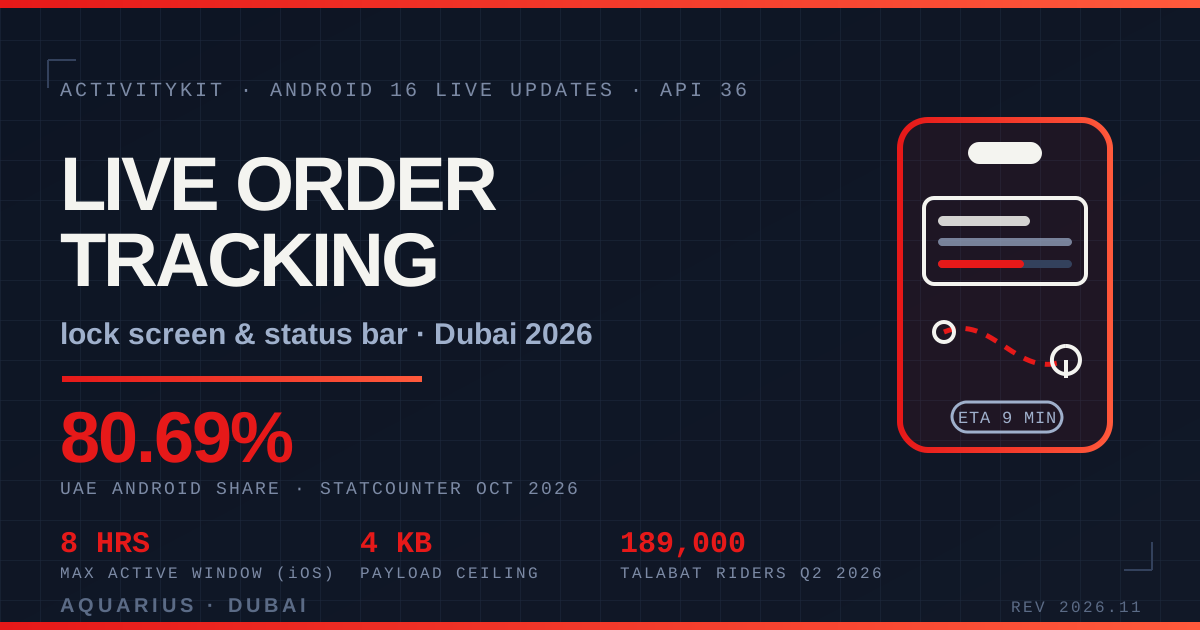
Short answer: If your Dubai delivery, logistics or services app still makes customers reopen the app to see where their order is, you are losing the most valuable 20 minutes of the journey. iOS Live Activities and Android 16 Live Updates put a live, self-updating order card on the lock screen and status bar — no tap required. On iOS the activity can stay active for up to 8 hours (plus 4 more on the Lock Screen), and on Android it needs targetSdk 36 plus a promoted-notification permission that most UAE apps have not shipped yet.
Why this matters in the UAE right now
Three numbers set the stakes. First, the UAE is an Android-majority market with a large, high-spend iPhone minority: StatCounter put Android at 80.69% and iOS at 19.29% of UAE mobile traffic in October 2026. Second, Android 16 — the release that introduced Live Updates — was already the single biggest Android version in the UAE at 40.52% of Android traffic, ahead of Android 15 on 18.55%. A feature that needs Android 16 is no longer a 2027 problem; it is addressable today.
Third, the delivery volume behind those screens is enormous. Talabat Holding reported H1 2026 GMV of USD 5,601 million and Q2 2026 GMV of USD 2,916 million (up 11% year on year), fulfilled through roughly 189,000 active riders (+25%) and about 97,000 active partners (DFM filing, 12 August 2026). Every one of those orders generates a tracking question, and every tracking question that forces an app reopen — or worse, a call to your support line — is cost you chose to carry.
Regulation is pushing the same way. The RTA told The National (2 November 2026) that its smart monitoring system for delivery motorcycles — cameras and IoT tracking speed, sudden acceleration, harsh braking and route — is optional until the end of H1 2027 and mandatory after mid-2027. Operators in Dubai will soon have rider telemetry whether they planned for it or not. The gap between “we have the location data” and “the customer can see it without opening anything” is a product decision, not a data problem.
The myth: “it is just a push notification”
This is the single most common misunderstanding we hear in scoping calls. A push notification is an interruption with a timestamp. A Live Activity or Live Update is a persistent, mutating surface that you own for the duration of a task — it updates in place, shows progress, and never stacks into a pile of 14 “your rider is nearby” alerts. The average smartphone user already receives roughly 46 push notifications a day (Business of Apps aggregation). You do not win attention by adding to that queue; you win it by replacing the queue with one card.
How iOS Live Activities actually work
ActivityKit drives the Lock Screen card and the Dynamic Island. The constraints that decide your architecture:
- Lifetime: an activity can stay active up to 8 hours, then remain on the Lock Screen for up to 4 more hours — a 12-hour hard ceiling. Fine for food delivery; a real design constraint for multi-day freight.
- Payload: static plus dynamic data must fit inside 4 KB combined. Send IDs and deltas, not objects. No images-by-value.
- Updates: remote updates go over APNs with
apns-push-type: liveactivityand topic<bundleID>.push-type.liveactivity. Priority 10 updates count against the system’s hourly budget and get throttled; priority 5 does not. Use 5 for routine ETA ticks and save 10 for state changes the customer actually cares about. - Push-to-start: you can start an activity from the server with a push-to-start token, so a web or WhatsApp order can light up the lock screen without the app being opened.
- Frequent updates:
NSSupportsLiveActivitiesFrequentUpdatesraises your budget, but the user can switch it off — so your UI must degrade gracefully, never show a frozen ETA, and set a stale date.
The UI lives in your widget extension, not the app target. That matters for estimates: it is a separate build target with its own state model, previews and QA matrix.
How Android 16 Live Updates actually work
Android calls the same idea a Live Update: a promoted ongoing notification that appears at the top of the shade, on the lock screen, and as a status-bar chip. The rules are stricter than most teams expect:
- targetSdk 36 (Android 16) and the
android.permission.POST_PROMOTED_NOTIFICATIONSpermission in the manifest. - Request promotion with
setRequestPromotedOngoing(orEXTRA_REQUEST_PROMOTED_ONGOING). The notification must be ongoing and have a content title. - Only certain styles qualify: Standard, BigTextStyle, CallStyle,
ProgressStyleand MetricStyle.ProgressStyleis the one built for delivery — segments, points and a tracker icon that walks the route. - Disqualifiers: custom RemoteViews content, group summaries,
setColorized(true), or a channel atIMPORTANCE_MIN. Any of these and your notification silently stays ordinary. - Verify, do not assume: check
NotificationManager.canPostPromotedNotifications(),hasPromotableCharacteristics()and theFLAG_PROMOTED_ONGOINGflag, and deep-link users toSettings.ACTION_MANAGE_APP_PROMOTED_NOTIFICATIONSif they turned it off. OEMs may add their own criteria, so Samsung and Honor devices need real-device QA. - Status-bar chip: max 96dp.
setShortCriticalTextandsetWhenwith a chronometer give you the countdown; keep text under about 7 characters or it will not show.
Google is explicit about appropriate use: active navigation, calls, rideshare and food-delivery tracking. Promotions, ads, chat messages and passive package tracking are not acceptable and risk the whole capability being pulled for your app. Also note that on Android 16.0 and lower, notifications still update in place — they just are not promoted — so a single implementation degrades sensibly across the roughly 59% of UAE Android devices not yet on 16.
iOS vs Android: what changes in your build
| Dimension | iOS Live Activities | Android 16 Live Updates |
|---|---|---|
| Entry requirement | iOS 16.1+, widget extension target | targetSdk 36, POST_PROMOTED_NOTIFICATIONS |
| Max lifetime | 8 hrs active + 4 hrs Lock Screen | No fixed cap; tied to the ongoing task |
| Payload ceiling | 4 KB static + dynamic combined | Standard notification extras |
| Always-on surface | Dynamic Island + Lock Screen | Status-bar chip (96dp) + top of shade |
| Server trigger | APNs liveactivity, push-to-start token | FCM to a foreground service or worker |
| Throttling lever | apns-priority 5 vs 10 | OEM criteria + channel importance |
| UAE reach (Oct 2026) | 19.29% of mobile traffic | 80.69% of traffic, 40.52% on Android 16 |
Practical consequence: build the data contract once, render it twice. One server-side order-state event stream, two thin presentation layers. Teams that instead build two independent trackers pay for the ETA engine twice and still ship inconsistent statuses — the exact trap we flagged in our breakdown of Flutter vs React Native vs native for Dubai apps, because both of these surfaces need native code whatever cross-platform framework you pick.
What it costs in Dubai (AED, 2026)
These are our real build ranges for adding live tracking to an existing app that already has working order states. If you do not yet have a courier location pipeline, the last two rows are where your budget goes.
| Scope | AED range | Timeline |
|---|---|---|
| iOS Live Activity (Lock Screen + Dynamic Island, one state model) | 14,000 – 26,000 | 2 – 3 weeks |
| Android 16 Live Update (ProgressStyle + status-bar chip + permission flow) | 12,000 – 22,000 | 2 – 3 weeks |
| Push plumbing (APNs liveactivity, push-to-start, FCM, token lifecycle, dedupe) | 9,000 – 18,000 | 1 – 2 weeks |
| Courier location pipeline + ETA engine (map matching, traffic, stale handling) | 18,000 – 45,000 | 3 – 5 weeks |
| Both platforms, production-hardened, OEM device matrix tested | 55,000 – 110,000 | 6 – 9 weeks |
For where this sits inside a full build, see our Dubai food delivery app development cost guide and, for the rider side of the same data, logistics software and fleet tracking in Dubai.
How Aquarius ships it
We treat live tracking as one event stream with two renderers. Week one is the state machine: the finite list of order states, who emits them, and what the customer is allowed to see at each one. Week two is the surfaces — an ActivityKit widget extension and an Android ProgressStyle notification driven by the same payload shape, both kept under 4 KB so iOS never rejects an update. Week three is the unglamorous part that decides whether customers trust it: stale-date handling, “Rerouting…” and “Thinking…” copy instead of a blank ETA, APNs priority-5 budgeting for routine ticks, and real-device testing on Samsung and Honor because OEMs can add their own promotion criteria.
We also keep location handling PDPL-aware from day one: rider coordinates are personal data, the retention window is written down before the first commit, and the customer-facing card shows only what is needed to answer “where is my order”.
The conversion case is straightforward. OneSignal (vendor data) reports that apps using iOS Live Activities see 23.7% higher average 30-day retention. Set that against a market where Talabat alone pushed USD 5.6 billion of GMV through UAE and GCC screens in H1 2026, and where talabat pro subscribers already account for 51% of its GMV — retention is the whole game. A tracking surface that removes the “where is my order” support ticket pays for itself in deflected contacts long before it pays for itself in retention.
Risk reversal: we scope live tracking as a fixed-price module with the device matrix agreed up front, and we do not invoice the Android half if your promoted notification does not actually get promoted on the agreed test devices.
FAQ
Do Live Activities work if the customer never opens my app?
On iOS, yes — with a push-to-start token the server can start the activity remotely, so an order placed on your website or through WhatsApp can appear on the lock screen. The app must have been launched at least once to register for ActivityKit.
What happens to UAE users still on Android 13 or 15?
They get a normal ongoing notification that updates in place: progress, ETA and status all still work, just without the promoted card and the status-bar chip. Nothing breaks, and that covers the roughly 59% of UAE Android traffic not yet on Android 16 (StatCounter, October 2026).
Can I use this for package tracking or marketing?
No. Google explicitly lists promotions, ads, chat and passive package tracking as inappropriate uses of Live Updates. Keep it to user-initiated, time-critical, actively-progressing tasks: a delivery in flight, a ride en route, navigation, calls.
How often can I update the ETA?
Often enough to be useful, not as often as you would like. On iOS, apns-priority 10 updates count toward the system’s hourly budget and get throttled, so routine ETA ticks should go at priority 5 and significant state changes at 10. Declaring NSSupportsLiveActivitiesFrequentUpdates raises the budget, but the user can disable it — so always set a stale date.
Does this need a native app, or can Flutter or React Native do it?
Both surfaces require platform-native code — a Swift widget extension and a Kotlin notification builder — wired to your cross-platform app through a plugin or platform channel. Flutter and React Native are fine; the tracking layer is simply not where you save native effort.
Next step
If your orders already have states and your riders already have GPS, live tracking is a three-week module, not a rebuild. Send us your current order-state list and we will tell you in one call which states deserve a lock-screen surface and which are noise — talk to Aquarius, or see our pricing for how fixed-price modules work.