
Managed SOC and MDR Cost Dubai 2026: Real AED Prices
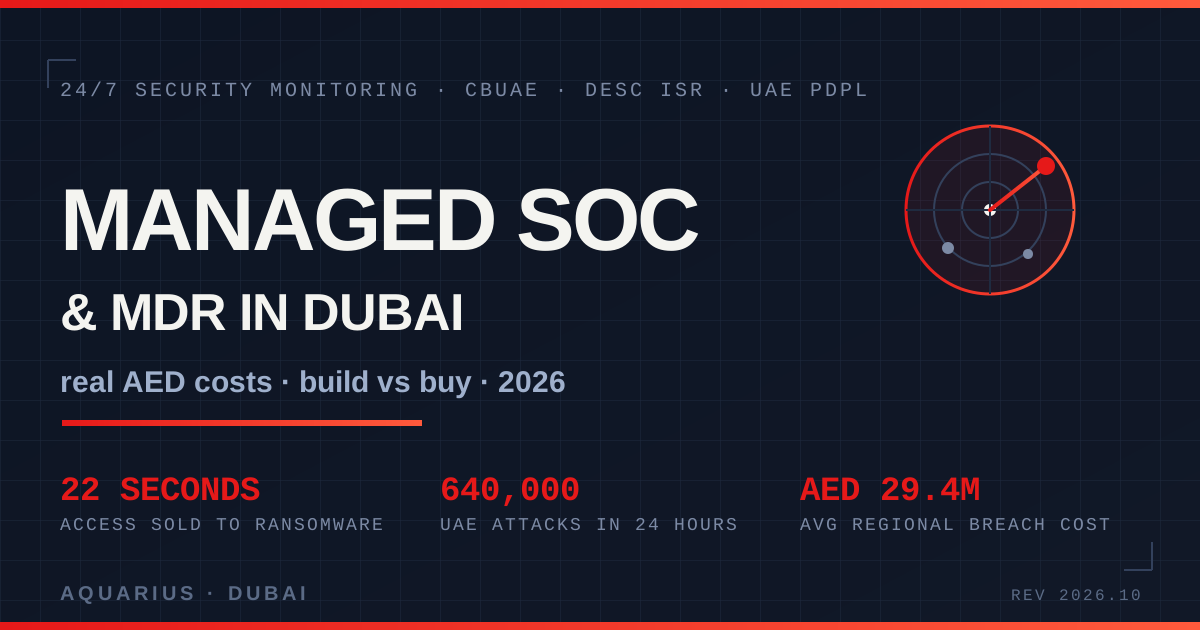
The UAE neutralised 640,000 attacks in a single 24-hour window, and access to a breached network now resells to ransomware crews in 22 seconds. What 24/7 monitoring really costs in Dubai, in AED.
- PUBLISHED
- 13 OCT 2026
- READ TIME
- 12 MIN
- AUTHOR
- AQUARIUS · DUBAI
- UNIT
- REV 2026.09
Short answer: in Dubai in 2026, outsourced 24/7 security monitoring costs roughly AED 6,000-8,000 a month for a small environment under 100 endpoints, AED 12,000-20,000 for a 100-500 endpoint mid-market setup with vulnerability management and a named analyst, and AED 25,000-50,000 for an enterprise or regulated estate with threat hunting, SOAR and a 30-minute response SLA. Building the same rota in-house starts at over AED 1 million a year in salaries alone — before a single licence.
That gap is the whole decision. A five-person rotation is the bare minimum for genuine round-the-clock cover in the UAE, and payroll for it clears seven figures before you buy a SIEM, an EDR agent or a threat-intel feed. Managed detection and response exists because almost nobody outside banking and government can justify that line item twice.
Why 2026 is the year Dubai stopped treating monitoring as optional (awareness)
Three numbers set the stakes, and all three moved against defenders this year.
First, volume. The UAE Cyber Security Council reported neutralising roughly 640,000 attacks in a single 24-hour period in September 2026, with daily figures crossing 800,000 attempts in recent months — up from the 90,000-200,000 a day reported in February, when officials noted that more than 70% of the traffic was state-sponsored and originated across 14 countries. Government bodies absorbed about 30% of targeted incidents and financial services around 7%.
Second, cost. IBM’s 2026 Cost of a Data Breach study puts the average Middle East breach — a dataset dominated by the UAE and Saudi Arabia — at about USD 8 million, roughly AED 29.4 million. Lost business accounts for USD 3.57m of that, post-breach response USD 2.17m, and detection and escalation USD 1.9m. Financial services and technology firms average USD 10.67m. The single most expensive cost driver named in the report is the inability to prioritise threats — which is a monitoring problem, not a firewall problem.
Third, speed. Mandiant’s M-Trends 2026 found global median dwell time rose to 14 days, up from 11, and that intrusions caught internally are contained in 9 days versus 25 days when somebody else tells you. More alarming: the handoff from an initial-access broker to a ransomware affiliate has collapsed to 22 seconds. Sophos’ Active Adversary Report 2026 adds the operational detail — median time to the first Active Directory access attempt is now 3.40 hours, about 70% faster year on year, while average detection delay rose 16%.
Most Dubai businesses get this wrong: they buy tools and assume someone is watching them. 88.10% of ransomware in the 2026 Sophos dataset was deployed outside business hours, and 37.1% of incidents landed in the 11pm-3am window. An EDR console nobody opens until 9am Gulf Standard Time is a logging product, not a defence.
SOC, MDR, SIEM: what you are actually buying (consideration)
The three terms get sold interchangeably in the UAE market. They are not the same purchase.
SIEM
A log platform. It collects, correlates and retains. Microsoft Sentinel — the most common choice in Dubai because most mid-market firms already sit on Microsoft 365 — charges USD 4.30 per GB pay-as-you-go, dropping to USD 3.23/GB at a 50 GB/day commitment and USD 2.67/GB at 300 GB/day. Basic Logs run USD 0.50/GB. A SIEM generates alerts. It does not answer them.
Managed SOC
Humans on a rota watching that platform, triaging alerts, escalating to you. You keep the response. This is what most UAE “SOC-as-a-service” contracts actually are.
MDR
Monitoring plus a mandate to act — isolate the host, kill the process, disable the account, at 2am, without waiting for your approval. The measurable difference shows up in dwell time: in the 2026 Sophos data, MDR cases ran a 2-day median dwell versus 5 days for incident-response cases, and 6 days for non-ransomware IR engagements.
Why the root causes matter for scoping
67.32% of 2026 incidents traced back to identity — 42.06% compromised credentials and 15.58% brute force — against 16.04% from exploited vulnerabilities and 6.35% from phishing. If your monitoring scope covers endpoints but not Entra ID sign-in logs, VPN authentication and privileged account activity, you have bought cover for the minority of cases. Pair monitoring with periodic penetration testing in Dubai and you cover both halves: what is exposed, and what is being used right now.
What 24/7 monitoring costs in Dubai, in AED
Market bands for UAE-delivered managed SOC and MDR, with UAE data residency and SIEM licensing bundled in:
| Tier | Scope | What is included | Response SLA | Monthly (AED) |
|---|---|---|---|---|
| SOC Essential | Up to 100 endpoints, up to 5 log sources | Sentinel SIEM-as-a-service, 24/7 alert monitoring, monthly reporting | 4 hours | 6,000 - 8,000 |
| SOC Standard | 100-500 endpoints, up to 15 log sources | Above, plus UEBA, vulnerability management, quarterly tabletop, named analyst | 2 hours | 12,000 - 20,000 |
| SOC Enterprise | 500+ endpoints, critical infrastructure | Above, plus threat hunting, SOAR automation, OT/SCADA coverage, unlimited log sources | 30 minutes | 25,000 - 50,000 |
| Endpoint-only MDR | Per endpoint, no SIEM | Managed EDR, business-hours-plus triage, containment on confirmed detections | Varies | 33 - 90 per endpoint |
Endpoint-only MDR prices globally at USD 9-75 per endpoint per month, with the mid-market cluster at USD 7-25 — Huntress Managed EDR lists at USD 8.99, CrowdStrike Falcon Pro at USD 15-25. For a 500-endpoint firm that is USD 48,000-210,000 a year, or roughly AED 176,000-771,000, covering endpoints only. No identity logs, no firewall, no SaaS.
The build-it-yourself comparison
Dubai salary reality, per month: a SOC L1 analyst runs AED 8,000-14,000, L2 AED 14,000-22,000, L3 AED 22,000-35,000, and a cybersecurity consultant averages AED 13,500. Five analysts is the minimum for 24/7/365 with leave and sickness cover, which is why an in-house rota clears AED 1 million a year in payroll alone. Then add SIEM ingestion, EDR licences, threat intel, and the hiring risk: 87% of UAE companies report a cybersecurity talent shortage. Outsourced monitoring is not cheaper because it is worse. It is cheaper because the rota is shared.
The regulation is already written (decision)
For a large share of Dubai businesses this is no longer a budget choice.
- CBUAE requires licensed financial institutions to run documented 24/7 incident detection under continuous monitoring and threat management, with log retention of at least five years, spanning its Information Security Regulation, Operational Risk Standard and the SVF, Retail Payment Services and Open Finance frameworks.
- DESC ISR v3.1 obliges Dubai government departments, semi-government entities, cloud providers and key suppliers to maintain 24/7 continuous SOC monitoring under a dedicated SOC security standard, across 13 domains, with quarterly vulnerability assessments and annual external penetration testing. If you sell to Dubai Government, see our breakdown of DESC ISR compliance costs.
- NESA IAS sets a minimum 12-month log retention baseline.
- UAE PDPL (Federal Decree-Law 45/2021) requires notifying the UAE Data Office without undue delay and, where feasible, within 72 hours of becoming aware of a breach. Fines run AED 50,000 to 5 million, and up to AED 20 million for serious violations. You cannot report inside 72 hours on evidence you never collected.
The commercial signal matches: the UAE managed security services market is growing from USD 314.5 million in 2025 to USD 550.2 million by 2030, an 11.8% CAGR. Buyers are not experimenting.
How Aquarius does it
We scope monitoring around the attack paths that actually get used in this market, not a product catalogue. That means identity logs first, because two-thirds of incidents start there; Microsoft Sentinel on a commitment tier sized to your real ingestion volume rather than pay-as-you-go retail; retention set to the longest rule that applies to you — five years for CBUAE entities, twelve months minimum elsewhere; and a written containment mandate so nobody is waiting on an email at 2am. Onboarding runs alongside your existing IT AMC rather than replacing it.
Two honest risk-reversals. First, we will tell you if endpoint-only MDR is enough for you — for a 30-person office with no regulated data, it often is, and that is an AED 2,000-a-month conversation, not AED 20,000. Second, the first month runs in monitor-and-report mode before any automated containment goes live, so you see the alert volume and the false-positive rate before you trust it with your production servers.
One number for the business case: IBM found organisations using extensive AI and security automation in their defences reported breach costs more than USD 3 million lower than those without. Against a regional average of AED 29.4 million, a year of enterprise-tier monitoring at AED 50,000 a month is about 2% of one breach.
FAQ
Is MDR worth it for a 40-person Dubai company?
Usually yes, in endpoint-only form. At roughly AED 33-90 per endpoint per month, 40 endpoints is AED 1,300-3,600 a month — less than one junior analyst’s weekly salary, and it covers the off-hours window where 88% of ransomware deploys. A full SIEM-based SOC only pays off once you have regulated data, multiple sites or a compliance obligation.
How fast should the SLA be?
Judge it against the threat clock, not the sales deck. Attackers reach Active Directory in a median 3.40 hours, and access gets resold to ransomware affiliates in 22 seconds. A 4-hour response SLA is acceptable for alert triage in a small estate; anything holding regulated data or internet-facing infrastructure needs 30-120 minutes with an explicit mandate to isolate hosts.
Does a managed SOC satisfy CBUAE or DESC ISR on its own?
It covers the monitoring, detection and log-retention controls, which is a large slice. It does not cover governance, risk assessments, policy, training or the annual penetration test those frameworks also require. Treat it as one domain of a programme, not the programme.
What does the SIEM data bill really come to?
Ingestion volume decides it. Microsoft Sentinel analytics logs run USD 4.30/GB pay-as-you-go and USD 2.74-3.23/GB on commitment tiers, with Basic Logs at USD 0.50/GB and data lake ingestion at USD 0.05/GB. A mid-market Dubai firm ingesting 30-50 GB a day lands around USD 3,200-4,800 a month on data alone — which is why log-source selection, not log-everything, is the first design decision.
Can monitoring be delivered from outside the UAE?
Analysts can sit anywhere; your data often cannot. CBUAE-regulated entities and DESC-scoped suppliers face data residency and sovereignty expectations, so the SIEM tenant and log storage should be UAE-region. Confirm the region in writing before signing — retrofitting residency means re-ingesting your history.
Next step
If you cannot name who looked at your security alerts last Saturday night, that is the finding. Send us your endpoint count, your log sources and any framework you are scoped under, and we will come back with a monitoring scope and a real AED number — see pricing or talk to us.