
Manpower Supply and Staffing Agency Software in Dubai (2026): WPS Deadlines, Timesheets and Real AED Costs
Resolution 340 of 2026 killed the WPS grace period: permits freeze on day 5. Real AED costs for manpower supply software, the margin leak in timesheets, and build vs buy.
- PUBLISHED
- 24 SEPT 2026
- READ TIME
- 13 MIN
- AUTHOR
- AQUARIUS · DUBAI
- UNIT
- REV 2026.09
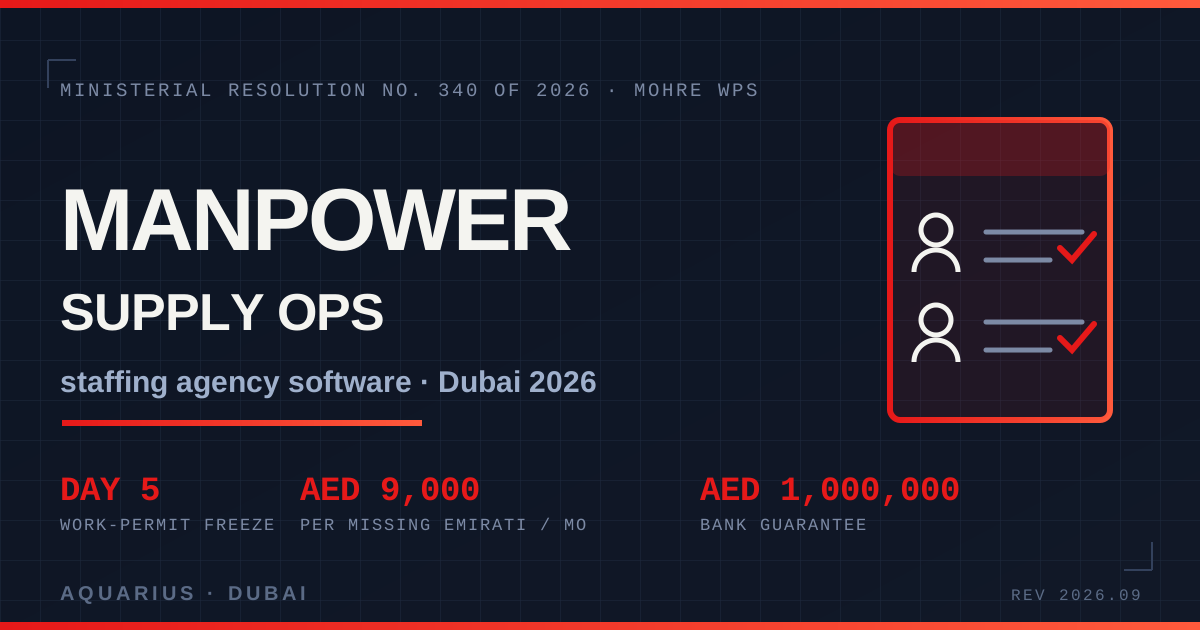
Short answer: A manpower supply company in Dubai does not sell people, it sells proof — proof that hours were worked, that wages landed on time, and that every deployed worker is legally yours to deploy. Since Ministerial Resolution No. 340 of 2026 took effect on 1 June 2026, the old 15-day wage grace period is gone: new work permits freeze on day 5 of a missed payroll cycle and legal proceedings can start by day 21. Off-the-shelf staffing platforms run roughly USD 25–315 per recruiter per month (about AED 92–1,157), while a custom Dubai-shaped manpower supply system — timesheets, WPS-ready payroll export, client invoicing and permit expiry tracking — typically lands between AED 70,000 and AED 260,000 to build.
Here is what most Dubai labour supply firms get wrong. They buy a recruitment ATS, because that is what “staffing software” means everywhere else. But an ATS is built for the moment of hire. A manpower supply business earns its margin in the thousands of days after the hire: a worker on a client site in Jebel Ali, clocking overtime on a Friday, billed at one rate and paid at another, under a permit that expires in 41 days. None of that lives in an ATS. It lives in a spreadsheet — and the spreadsheet is where the margin quietly leaks out.
The 2026 numbers that changed manpower supply economics
This is a big, fragmented, fast-growing market that has just been handed a much harder compliance clock. Both halves of that sentence matter.
- The market is large and compounding. The UAE staffing services market was worth an estimated USD 8.2 billion in 2024, reached roughly USD 8.9 billion in 2025, and is forecast to grow at a 9.8% CAGR to about USD 14.2 billion by 2030. Dubai is the largest emirate in that market, and the sector is described as fragmented — which is the analyst’s way of saying no one has won it on operations yet.
- Demand is structural, not cyclical. Per PwC Middle East’s Workforce Study 2025, more than 60% of employers in project-driven sectors rely on manpower outsourcing for at least part of their workforce.
- The workforce keeps expanding. MOHRE data shows the UAE private-sector workforce grew 2.5% in Q1 2026, skilled workers grew 1.5%, and the number of private-sector companies grew 0.4% in the same quarter.
- Entry is expensive by design. A temporary employment (manpower supply) licence commonly requires a bank guarantee reaching AED 1,000,000, against roughly AED 100,000 for a recruitment brokerage licence, with minimum share capital frequently cited at AED 300,000 deposited before issuance.
Read the last two points together. You put up as much as AED 1,000,000 of guaranteed capital to hold the licence — and then run the operation that guarantee protects on a shared spreadsheet. That asymmetry is the entire argument for building the system properly.
The compliance clock: what Resolution 340 of 2026 actually does to you
Resolution No. 340 of 2026 replaced Resolution 598 of 2022 and is the biggest Wage Protection System overhaul since WPS launched. The headline change is the removal of the 15-day informal grace period. Salaries for the previous month are due through WPS by the 1st of the following Gregorian month, and monitoring now begins immediately. Compliance is assessed at an 85% of total wages threshold, with an individual counted as paid at 85% or more of entitled wage excluding lawful deductions.
The escalation is mechanical. That is the point — it does not require an inspector to notice you.
| Day after due date | What MOHRE does | Operational impact on a supplier |
|---|---|---|
| Day 2 | Notifications and warnings issued | Flag appears before your accounts team has reconciled the month |
| Day 5 | Work permit freeze on new applications; formal notification | You cannot onboard for the client contract you just won |
| Day 11 | Administrative fines; classification downgrade on repeat | Higher permit fees and lost tender eligibility follow the downgrade |
| Day 16 | Labour dispute registered automatically; suspensions continue | Dispute exists whether or not the worker complained |
| Day 21 | Legal proceedings; asset restrictions and travel bans | Owners and signatories personally exposed |
For an ordinary employer, this is a payroll problem once a month. For a manpower supplier it is a cash-conversion problem, because your wage obligation is fixed on the 1st while your client invoices settle on 30, 60 or 90 days. A supplier with 400 deployed workers is financing one to three months of wage bill continuously. Miss the timing once and the penalty is not a fine — it is a permit freeze that stops you delivering the contract that was going to pay for it.
MOHRE also tightened the monitoring rails themselves: WPS moved to near real-time monitoring alongside instant-payment infrastructure, so late wages surface on ministry dashboards in days rather than weeks. If you want the payroll-engine detail, our guide to HR and payroll software with WPS in Dubai covers the salary-file mechanics.
What a manpower supply system must actually prove
Strip away the demo glitter and a supplier’s system has to answer five questions on demand, for any worker, on any date. Most Dubai firms can answer two of them well.
- Is this worker legally deployable today? Passport, Emirates ID, work permit, labour card, medical, insurance and any trade-specific card each have an expiry date. One expired document on a client site is a stop-work risk for the client and a penalty exposure for you.
- What did they actually work? Site check-in, shift, overtime, absence, and which client cost-centre it belongs to — captured at the site, not retyped on Sunday.
- What do we bill and what do we pay? Two different rate cards against one timesheet line, including overtime multipliers and per-client contract terms.
- Did the wage clear WPS on time? A payroll run that exports a valid salary information file and reconciles the bank acknowledgement back against each worker.
- Where does the quota stand? Emiratisation status, live, against headcount — not discovered at the deadline.
The margin leak nobody puts on a dashboard
Ask a Dubai supply firm what its gross margin per worker is and you will get a number from the contract. Ask what it actually was last month and you will get silence, because the answer sits in three disconnected places: a messaging group where site supervisors report attendance, a payroll sheet, and an invoicing file that was assembled by hand.
The gap between those three is where money disappears, and it disappears in unglamorous ways. Overtime paid at a premium multiplier but billed at the flat rate because the invoice template has one column. Hours worked in the last three days of a month that miss the invoice cut-off and are never billed at all. A worker demobilised on the 12th but kept on payroll until the 30th. A client rate that was renegotiated in an email and never reached the billing sheet. Individually these are small. Across a few hundred workers, month after month, they are the difference between a supply business and a charity with a licence.
A system fixes this with one structural decision: the timesheet line is the single source of truth, and both the payslip and the client invoice are generated from it — never typed twice. Everything else in the platform is convenience. That one rule is the product.
Emiratisation is now a supplier-side problem too
If your own entity has 50 or more skilled employees, the standard quotas apply: a 2% annual increase in skilled Emirati headcount, delivered as 1% by 30 June 2026 and a further 1% by 31 December 2026, on the path to 10% by the end of 2026. The penalty for shortfall is AED 9,000 per month per missing Emirati — the highest rate since the programme began, and it accrues monthly, not annually.
The classification detail is what catches suppliers. MOHRE counts an employee as skilled where the role sits in a qualifying occupational category, the worker holds a qualification above high-school level, and the contractual salary is at least AED 4,000 per month excluding commissions, within a framework of 725 occupational categories across nine occupational levels and five skill levels. A supplier’s headcount churns constantly, so the skilled-employee count that decides whether you are even in scope moves every month. Momentum matters too: more than 190,000 Emiratis now work in the UAE private sector across nearly 32,000 establishments, and 95% of covered establishments hit their H1 2026 targets — being in the non-compliant minority is increasingly conspicuous. Our Emiratisation and NAFIS compliance software guide goes deeper on the tracking model.
Buy, configure or build: the honest comparison
| Option | Typical cost | Fits when | Where it breaks |
|---|---|---|---|
| Global ATS (Zoho Recruit tier) | USD 25–75 per user/month (approx. AED 92–276) | Placement-fee recruitment, low deployed headcount | No deployment, timesheet, WPS or dual rate-card model |
| Enterprise staffing suite (Bullhorn tier) | USD 99–315 per seat/month (approx. AED 364–1,157) | High recruiter count, contract staffing at scale | Priced per recruiter, not per deployed worker; UAE compliance still needs custom work |
| UAE HR/payroll suite plus manual ops | AED 15,000–60,000 per year | Payroll and WPS are the main pain | Client billing and site timesheets stay manual |
| Custom manpower supply platform | AED 70,000–260,000 build | 200+ deployed workers, multiple client rate cards | Needs a real discovery phase and clean rate-card data |
The pricing-model mismatch in row two is the one to internalise. Seat-based staffing software charges by recruiter. A manpower supply firm might have six recruiters and eleven hundred deployed workers. You are being priced on the smallest number in your business while the risk and the admin load sit on the largest one.
What a custom build costs in Dubai, and in what order
| Scope | Indicative AED | Timeline |
|---|---|---|
| Core: worker master, document expiry engine, deployment register | 70,000–110,000 | 6–8 weeks |
| Plus mobile site timesheets, approvals and dual rate-card invoicing | 120,000–180,000 | 10–14 weeks |
| Plus WPS-ready payroll export, Emiratisation tracking, client portal | 180,000–260,000 | 14–20 weeks |
| Arabic and English bilingual UI, offline site capture | +20,000–45,000 | +3–4 weeks |
| Annual support, hosting and regulatory updates | 18,000–45,000 per year | ongoing |
Build in that order and the first module pays before the third is scoped. The document-expiry engine alone — a register that alerts the PRO 60, 30 and 7 days before any of nine document types lapse — prevents the single most common stop-work event on a client site, and it is the cheapest thing on the list. See our pricing for how these phases are quoted.
The cost of not fixing it
Run the arithmetic on a 300-worker supplier before deciding this is a nice-to-have. One missed WPS cycle triggers a work-permit freeze from day 5, which stalls onboarding for a contract worth six figures in monthly billing. One Emiratisation shortfall of three roles costs AED 27,000 every month at AED 9,000 per missing Emirati. And a 3% under-billing leak on overtime across 300 workers at an average AED 4,500 monthly bill rate is roughly AED 40,500 a month — close to AED 486,000 a year, which is more than the top of the custom build range. The leak is invisible precisely because nothing in the current process is designed to surface it.
Frequently asked questions
Do I need a manpower supply licence or a recruitment licence in Dubai?
They are different permissions. A recruitment or employment-intermediation licence lets you connect candidates with employers without sponsoring them. A temporary employment or manpower supply licence lets you sponsor workers and deploy them to third parties — and it carries the far heavier financial requirement, with bank guarantees commonly reaching AED 1,000,000 against roughly AED 100,000 for brokerage. Both sit on top of a mainland trade licence plus a separate MOHRE permit that must be in place before you place anyone.
What changed in the UAE Wage Protection System in 2026?
Ministerial Resolution No. 340 of 2026 took effect on 1 June 2026, replacing Resolution 598 of 2022, and removed the 15-day grace period. Wages are due through WPS by the 1st of the following month, compliance is measured at an 85% wage threshold, and escalation is automatic: warnings on day 2, a new work-permit freeze on day 5, fines from day 11, an automatic labour dispute on day 16 and legal proceedings from day 21.
Can standard staffing software handle UAE payroll and WPS?
Rarely out of the box. Global platforms model placement and commission, not sponsored deployment. The three UAE-specific pieces you will end up building or bolting on are the WPS salary-file export with bank acknowledgement reconciliation, the worker document-expiry engine covering permits and labour cards, and Emiratisation quota tracking against the skilled-employee definition.
How long does it take to build a manpower supply system in Dubai?
A worker register, document-expiry engine and deployment log is typically 6 to 8 weeks. Adding mobile site timesheets with approvals and dual rate-card invoicing takes it to 10 to 14 weeks. A full platform with WPS-ready payroll export, Emiratisation tracking and a client portal runs 14 to 20 weeks, and bilingual Arabic and English adds three to four.
What is the single highest-ROI module to build first?
Mobile site timesheets feeding both payroll and client invoicing from one record. It closes the under-billing leak, removes the manual re-keying that causes WPS timing errors, and produces the audit trail you need when a client disputes hours. Document-expiry alerts are a close second and cost far less.
Where Aquarius fits
We build operational systems for Dubai businesses that live under a regulator — clinics on NABIDH, brokers under RERA, employers under MOHRE. For manpower supply that means starting with the worker register and the document-expiry engine, proving the timesheet-to-invoice chain against one real client contract for a full month, then extending into payroll export and the client portal. Fixed scope, fixed price, quoted in AED, source code yours. Browse what we build, or send us one month of timesheets and one client rate card and we will show you the gap between what you worked and what you billed.
The bank guarantee is already posted. The compliance clock is already running. Talk to us about making the operation underneath them visible.