
Microsoft 365 Backup for Dubai Businesses: The 2026 Guide
Microsoft hosts your data but does not back it up. Real 2026 retention windows, AED pricing, UAE data residency and the record-retention rules that make it urgent.
- PUBLISHED
- 17 NOV 2026
- READ TIME
- 09 MIN
- AUTHOR
- AQUARIUS · DUBAI
- UNIT
- REV 2026.09
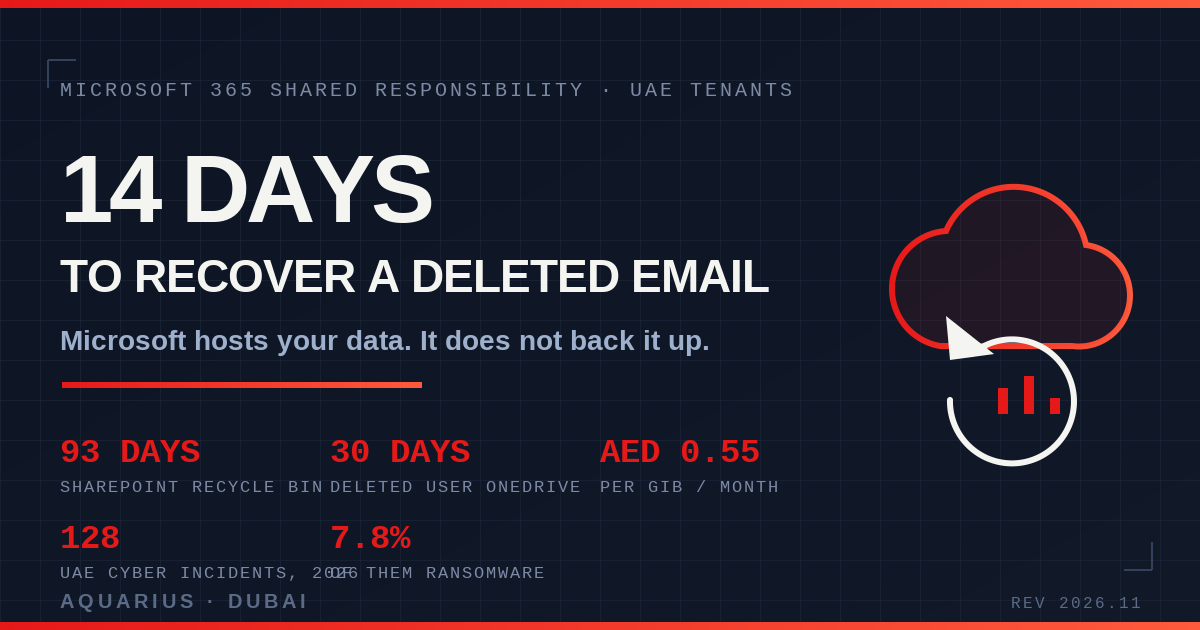
Short answer: Microsoft does not back up your Microsoft 365 data — it replicates it. Under the shared-responsibility model Microsoft guarantees the service is available; you own the data inside it. Delete an email permanently and Exchange Online holds it for 14 days by default (30 days maximum). Delete a SharePoint file and the site recycle bin holds it for 93 days, then it is gone. For a Dubai business that must keep tax records for five to seven years, that gap is not a technicality — it is an audit failure waiting to happen.
The stakes: why UAE tenants cannot assume “the cloud has it”
The UAE Cyber Security Council confirmed 128 cyber-threat incidents against UAE entities in 2026, of which 7.8% were ransomware, 25.8% data leaks and 13.3% data breaches — while the country blocks up to 200,000 attack attempts a day. Separately, the average cost of a data breach in the UAE now sits around USD 6.93 million (roughly AED 25.4 million), well above the global average.
None of those numbers are about Microsoft’s uptime. Microsoft’s uptime is excellent. They are about your data being encrypted, exfiltrated or quietly deleted inside a tenant that is working perfectly. Ransomware that lands on a synced OneDrive folder does not care that Azure has three copies of the ciphertext.
And the most common data-loss event in Dubai SMEs is not a hacker at all. It is an employee who leaves, an admin who removes the licence to save AED 140 a month, and a finance folder that quietly ages out 93 days later.
What Microsoft 365 actually retains, and for exactly how long
Exchange Online: 14 days
Items a user hard-deletes (Shift+Delete, or emptied from Deleted Items) land in the Recoverable Items folder. The default retention there is 14 days. An admin can raise it to a maximum of 30 days with Set-Mailbox -RetainDeletedItemsFor 30. That is the ceiling. There is no 90-day option, and no version history for mail.
SharePoint and OneDrive: 93 days, in two stages
A deleted file goes to the user’s recycle bin, then to the site-collection recycle bin. The combined window is 93 days, after which it is permanently purged. Recovery from the second-stage bin is PowerShell-only. Critically, the recycle bin is not indexed — meaning eDiscovery searches and holds cannot reach content sitting in it.
Departed employees: 30 days, then a cliff
When a user account is deleted, their OneDrive is retained for 30 days by default (tunable via Set-SPOTenant -OrphanedPersonalSitesRetentionPeriod). Worse, if you simply strip the licence instead, the OneDrive is automatically archived on the 93rd unlicensed day — and after 12 months of unpaid archive, Microsoft may delete that data regardless of your retention policies, eDiscovery searches and legal holds. That last clause is the one that catches Dubai firms mid-dispute.
Teams: it depends where the message lives
Teams chat lives in a hidden Exchange mailbox folder; channel files live in SharePoint. So a Teams “deletion” is really two or three different retention clocks running at once, which is why partial Teams restores are the hardest thing to do without a backup product.
Myth-bust: a retention policy is not a backup
This is where most Dubai IT managers get caught. Purview retention policies and litigation holds prevent deletion. They do not give you a restore point. They cannot roll a mailbox back to how it looked last Tuesday, they cannot un-encrypt 40,000 ransomware-hit files, and they cannot recover a SharePoint library after someone overwrote the structure. Retention answers “is it still here somewhere?” A backup answers “give me Tuesday back.”
Three questions that separate a retention policy from a real backup: can you restore to a specific point in time, can you restore to a different tenant, and can you restore after the tenant admin account itself is compromised? Native Microsoft 365 answers no, no and no.
Your three options in 2026, priced in AED
There are now three realistic routes for a UAE tenant. Microsoft’s own first-party Microsoft 365 Backup (billed per GiB through Azure), a third-party SaaS backup vendor (billed per user), or a self-hosted appliance you run yourself. Converted at AED 3.6725 to the dollar:
| Option | List price | AED equivalent | Best for |
|---|---|---|---|
| Microsoft 365 Backup (first-party) | USD 0.15 per GiB/month, restores free | AED 0.55 per GiB/month — approx. AED 13.80 per user/month at 25 GB | Tenants that must keep data inside the Microsoft trust boundary |
| Veeam Data Cloud for M365 (Foundation) | USD 3.50 per user/month (10–50 users); USD 2.63 at 251+ | AED 12.85 down to AED 9.65 per user/month | Predictable per-seat billing, unlimited storage |
| Afi SaaS Backup | USD 3.00 per user/month annual; USD 5.00 monthly | AED 11.00–18.35 per user/month | Small teams, 5-user minimum |
| IDrive Microsoft 365 Backup | USD 20 per user/year | AED 73 per user/year | Budget tenants that accept a lighter restore UX |
| Keepit, Datto, Acronis | Quote only | Typically AED 11–30 per user/month in the UAE channel | Regulated firms wanting a named local partner |
Run the arithmetic for a typical 40-seat Dubai agency: per-seat backup lands between AED 4,600 and AED 6,200 a year. Against an average UAE breach cost near AED 25 million, that is a rounding error — and it is roughly what the same firm spends on coffee.
What the first-party option actually gives you
Microsoft 365 Backup creates restore points every 10 minutes for the first two weeks, then weekly (Exchange keeps 10-minute granularity for the prior 52 weeks). Recovery windows are configurable at 3 months, 6 months or 1–10 years, defaulting to one year. Restores run at 1–3 TiB per hour, and a single site with an express restore point typically completes in about 30 minutes. The catch: granular file-and-folder restore only works within the last 14 days — beyond that you restore at site or mailbox level. It is also append-only rather than fully immutable, and there is a 90-day grace period after offboarding.
The Dubai-specific catch: where does the backup actually sit?
This is the question almost no generic backup article asks, and it is the one that matters most for a UAE-regulated business.
The UAE is a Local Region Geography for Microsoft’s Advanced Data Residency add-on, which pins Exchange Online, SharePoint, OneDrive, Teams, Microsoft 365 Copilot, Defender for Office P1, Exchange Online Protection and select Purview services to UAE datacentres. Qualifying SKUs include Microsoft 365 Business Basic, Standard and Premium plus E3 and E5 — but ADR requires 100% paid-licence coverage across the tenant, so one free or trial seat breaks eligibility.
Microsoft 365 Backup inherits that posture: the backup data never leaves the Microsoft 365 trust boundary and honours your tenant’s geographic residency. A third-party vendor does not inherit anything — your data lands in whatever region that vendor’s storage sits in, frequently EU or US. If you have told clients, a regulator or a DIFC counterparty that data stays in the UAE, you need that answer in writing from the backup vendor before you sign, not after.
How long a UAE business is legally required to keep records
Backup retention is not a preference — it is set by statute, and the statutory floor is far longer than anything Microsoft gives you natively:
- Corporate Tax (Federal Decree-Law No. 47 of 2022): records and supporting documents must be kept for seven years after the end of the relevant tax period.
- VAT (Cabinet Decision No. 74 of 2023): accounting records and tax invoices for five years, extended to seven years for real-estate records, plus four additional years where a dispute or audit is live.
- PDPL (Federal Decree-Law No. 45 of 2021): personal data must not be kept longer than the purpose requires — which cuts the other way, and is why “keep everything forever” is also wrong. Our UAE PDPL compliance checklist for websites and apps covers the retention and deletion side.
Compare those years against 14 days and 93 days. The gap is the whole argument.
What we set up, and what it costs
Aquarius configures Microsoft 365 backup for Dubai businesses as a fixed-scope engagement rather than a monthly retainer you cannot leave. A typical rollout for a 20–60 seat tenant runs AED 3,500–7,500 one-off, on top of the per-seat or per-GiB licence cost above, and covers:
- Mapping every workload — Exchange, SharePoint, OneDrive, Teams, Entra ID — against your actual legal retention obligation, not a vendor default.
- Extending native windows first (free):
RetainDeletedItemsForto 30 days, orphaned-OneDrive retention raised, second-stage recycle bin documented. - Choosing first-party versus third-party on the residency question, with the vendor’s data-location answer captured in writing.
- A documented restore test — a real mailbox and a real site library recovered to a timestamp, with the elapsed time recorded. An untested backup is a rumour.
- A one-page runbook your office manager can follow at 2am without calling us.
If the restore test fails on our watch, we fix the configuration at no charge. We also do not resell backup licences, so the vendor recommendation is not a margin decision. The same thinking drives our disaster recovery and backup plan guide for Dubai, which covers the infrastructure side — websites, servers and databases — that sits outside Microsoft 365 entirely.
Most Dubai businesses discover this gap on the day they need it, which is the most expensive possible day. Fixing it costs less than one month of the downtime it prevents. Tell us your seat count and we will size it, or see our transparent AED pricing first.
FAQ
Does Microsoft back up Microsoft 365 data?
No. Microsoft replicates your data for service availability and provides short recycle-bin and retention windows, but it does not provide point-in-time backup or restore. Microsoft’s own shared-responsibility documentation places data ownership and protection with the customer. Microsoft 365 Backup is a separate paid product, billed at USD 0.15 per GiB per month.
How long does Microsoft 365 keep deleted files in the UAE?
The same as everywhere: 14 days by default (30 maximum) for permanently deleted Exchange Online items, and 93 days across the two SharePoint and OneDrive recycle-bin stages. Residency changes where the data sits, not how long it is kept.
How much does Microsoft 365 backup cost in Dubai?
Roughly AED 9.65–18.35 per user per month for a third-party product, or about AED 0.55 per GiB per month for Microsoft’s first-party backup — close to AED 13.80 per user at 25 GB of data. A 40-seat firm should budget AED 4,600–6,200 a year.
Does a Purview retention policy count as a backup?
No. Retention policies and litigation holds stop data being deleted; they do not create restore points, cannot roll a mailbox back to a specific moment, and cannot reverse mass ransomware encryption. They are a compliance control, not a recovery control.
Will my backup data stay in the UAE?
With Microsoft 365 Backup, yes — it stays inside the Microsoft 365 trust boundary and honours your tenant’s geography, and the UAE is a Local Region Geography for Advanced Data Residency. With a third-party vendor, only if that vendor stores in a UAE or approved region. Ask for it in writing before you sign.