
Disaster Recovery for Dubai Websites and Apps (2026): RTO, RPO and Real AED Costs After AWS Lost a UAE Zone
AWS confirmed in September 2026 that data held only in UAE zone mec1-az2 cannot be restored. Real AED costs for every DR tier in Dubai, plus the RTO and RPO numbers worth committing to.
- PUBLISHED
- 11 OCT 2026
- READ TIME
- 12 MIN
- AUTHOR
- AQUARIUS · DUBAI
- UNIT
- REV 2026.09
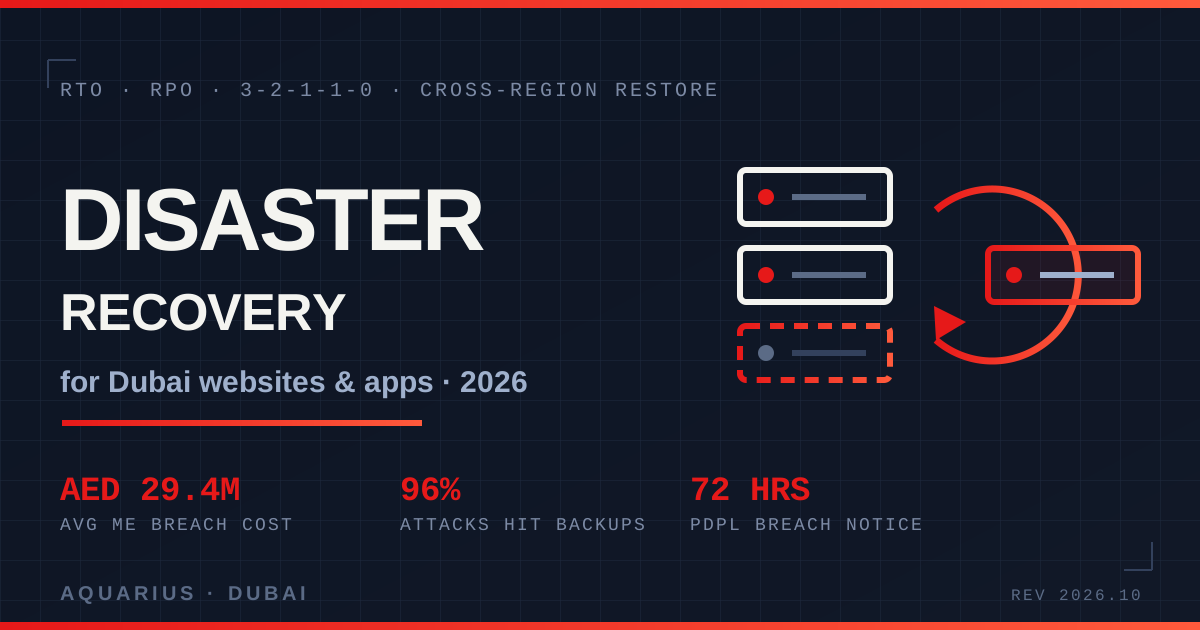
Short answer: a credible disaster recovery setup for a Dubai website or app costs AED 12,000–35,000 to build as cross-region immutable backups (restore in 12–48 hours), AED 35,000–90,000 for a pilot-light standby (restore in 1–4 hours), and AED 90,000–220,000 for warm standby (restore in 10–30 minutes), plus AED 900–30,000 a month to run. The reason to budget it this quarter: on 15 September 2026 AWS confirmed it cannot restore data held only in UAE Availability Zone mec1-az2, and told customers to restore from backups in other Regions. Multi-AZ is no longer a disaster recovery plan.
Key takeaways
- A UAE zone was lost permanently. AWS said the damage to its Middle East infrastructure “spanned multiple Availability Zones and exceeded what our regional and multi-AZ services are designed to withstand”, and strongly recommended customers migrate accessible resources to other Regions and restore the rest from remote backups.
- Breaches in this region cost more than anywhere else. IBM’s 2026 Cost of a Data Breach put the Middle East average at USD 8 million (about AED 29.4 million), up from USD 7.29 million in 2025 and well above the USD 4.99 million global average. Lost business alone averaged USD 3.57 million.
- Your backup is the target, not the safety net. Sophos’ 2026 ransomware research found backup repositories are attacked in 96% of incidents and compromised 76% of the time — and organisations whose backups were compromised paid recovery costs roughly 8x higher.
- UAE attack volume is industrial. The UAE Cyber Security Council blocks roughly 600,000 cyberattacks a day and reported more than 640,000 blocked in a single day in September 2026. By 18 February 2026 it had logged 128 confirmed cyber threat incidents against UAE entities.
- The clock is legal, not just commercial. Article 9 of the UAE PDPL requires notifying the UAE Data Office of a personal data breach without undue delay, generally read as 72 hours from becoming aware. You cannot describe the scope of a breach you cannot reconstruct.
The month multi-AZ stopped counting as a plan
For a decade, the standard answer to “what is your disaster recovery plan?” in Dubai was “we are multi-AZ”. Three data centres, separate power, separate flood risk, one Region. It was a reasonable answer right up to 2026.
Then the region’s cloud substrate took physical damage. AWS operations in Bahrain were disrupted in March 2026, and by 15 September 2026 AWS confirmed it was unable to restore access to resources and data hosted exclusively in mec1-az2, one of the three Availability Zones in its Middle East (UAE) Region, me-central-1. Recovery work continued on mec1-az1 and mec1-az3. For the Bahrain Region the company said damage spanned multiple zones and exceeded what regional and multi-AZ services are designed to withstand, and that it would help customers migrate operations to other Regions.
Read that as a product requirement, not a news story. If your only copy of a database volume, an S3 bucket or a zonal snapshot sat in one zone, it is gone. Not degraded — gone. The customers who recovered in days rather than never were the ones holding a copy outside the Region and a runbook for starting somewhere else.
The financial stakes in this region are already the highest in the world. IBM’s 2026 Cost of a Data Breach report, which surveyed organisations in the UAE and Saudi Arabia between March 2025 and February 2026, put the average breach at USD 8 million — roughly AED 29.4 million — against a USD 4.99 million global average. Technology and financial services averaged USD 10.67 million, industrial USD 9.6 million. Phishing, the single most common entry vector at 18% of incidents, carried the highest average cost of all at USD 10.41 million.
RTO and RPO: the only two numbers to agree on
Most Dubai businesses we audit have backups and no plan, because nobody has ever written down two numbers:
- RTO (recovery time objective) — how long the business can be down. Not how long you would like to be down. How long before you are refunding customers, breaching an SLA or losing an RTA, DHA or DED-facing integration window.
- RPO (recovery point objective) — how much data you can afford to lose, measured in time. A nightly backup means an RPO of 24 hours: a failure at 17:00 discards a full trading day of orders, bookings and invoices.
Write both per system, not per company. A Dubai e-commerce checkout might need RTO 15 minutes and RPO 1 minute, while the marketing site behind the same brand is fine at RTO 8 hours. Paying checkout-grade resilience for a brochure site is the most common way DR budgets get wasted — and the reason unrealistic quotes get rejected outright.
The four DR tiers, and what each costs in Dubai
Disaster recovery is a dial, not a switch. These are the build and run ranges we quote in Dubai in 2026 for a typical business web app or e-commerce platform on AWS, Azure or a UAE-hosted VPS estate. Monthly figures include the extra infrastructure plus monitored restore testing.
| Tier | What you actually get | RTO / RPO | Build (AED) | Run (AED/month) |
|---|---|---|---|---|
| Backup and restore | Immutable, versioned backups copied to a second Region, documented restore runbook, quarterly restore drill | 12–48 hrs / 24 hrs | 12,000–35,000 | 900–4,000 |
| Pilot light | Database replica and infrastructure-as-code in a second Region, compute switched off until needed, DNS failover scripted | 1–4 hrs / 5–15 min | 35,000–90,000 | 2,500–9,000 |
| Warm standby | Scaled-down but live second Region, continuous replication, health-checked failover, tested monthly | 10–30 min / under 5 min | 90,000–220,000 | 7,000–30,000 |
| Active-active multi-region | Traffic served from two Regions, global load balancing, conflict-aware data layer, zero-downtime deploys | Near zero / near zero | 220,000–650,000 | 25,000–90,000 |
For most Dubai SMEs the honest answer is tier one done properly, then pilot light for the revenue path. That combination typically lands at AED 45,000–120,000 to build and AED 3,000–12,000 a month — a rounding error against the AED 29.4 million regional average breach cost, and cheaper than a single day of a stalled checkout for most retailers. Our standard ranges for build and retainer work sit on the pricing page.
3-2-1-1-0, and why the extra digits matter now
The old 3-2-1 rule (three copies, two media, one offsite) has been extended for the ransomware era: 3-2-1-1-0 adds one immutable or offline copy and zero errors in a verified restore test. That extra 1 is the whole game. Sophos’ 2026 report found attackers go after backup repositories in 96% of ransomware incidents and succeed 76% of the time; where backups were compromised, recovery costs ran about 8x higher. Average recovery cost per incident reached USD 1.7 million globally, up 11% year on year, and 48% of organisations whose data was encrypted paid the ransom anyway.
The UAE-specific figure is the one to take to a budget meeting: organisations here reported an average ransomware recovery cost of USD 665,000, about AED 2.44 million, excluding any ransom. That is the price of discovering your backups were mounted on the same credentials as production. If you are already mid-incident, our Dubai hacked-website recovery cost guide covers the triage sequence.
Where the second copy should live
The region now has enough options that there is no excuse for a single-Region estate:
- Azure runs two UAE regions — UAE North in Dubai and UAE Central in Abu Dhabi — which are paired with each other, so a cross-emirate copy can stay on Emirati soil.
- AWS me-central-1 (UAE) has three Availability Zones, but after 2026 you should treat the Region, not the zone, as the failure domain and replicate to a second Region.
- Oracle operates UAE East in Dubai and UAE Central in Abu Dhabi, another in-country pair.
- Out-of-country copies are faster and often cheaper, but PDPL and sector rules on cross-border transfer apply to the backup exactly as they apply to production. Classify the data first — see our UAE data residency guide and the PDPL compliance checklist.
One nuance that catches people: a “paired region” is a platform convenience, not a guarantee that your specific service replicates automatically. Object storage, managed databases, secrets, DNS records, container registries and CI pipelines each need their own answer. The item teams forget most often is the one that makes the rest useless — the encryption keys.
What not having a plan costs
Downtime benchmarks are brutal and consistent. ITIC’s survey work puts a single hour of downtime above USD 300,000 for more than 90% of mid-size and large enterprises, with 41% losing USD 1 million or more per hour. For small businesses it is smaller but still existential: an hour can cost a micro business up to USD 100,000 — about AED 367,000. The Uptime Institute’s 2026 data has 54% of operators reporting their most recent significant outage cost more than USD 100,000, and one in five above USD 1 million.
Three Dubai-specific costs sit on top of the lost revenue:
- Regulatory exposure. PDPL Article 9 breach notification runs on a 72-hour clock from awareness, and the notice must describe what data was affected and how many people. Without reliable logs and restorable snapshots, you are filing a guess with a regulator.
- Lost tenders. ISO 22301 business continuity certification is increasingly scored at pre-qualification for Dubai government work, and auditors are explicit that backup infrastructure alone does not satisfy it — you need a tested management system. Dubai government suppliers also face the ISR control set; our DESC ISR compliance cost guide has the detail.
- Insurance and board scrutiny. IDC’s 2026 Middle East research found cloud security and multiregional backup is now the fastest-growing investment area in the region, cited by 56% of technology buyers across the Middle East, Turkey and Africa. Your competitors are being asked the same question you are.
And the thing most Dubai businesses get wrong: fewer than 30% of SMEs have a fully implemented and tested DR plan. Untested is the operative word. A backup job with a green tick is a hypothesis. A restore you have actually performed, timed and signed off is a plan.
How Aquarius does it
We run DR as a two-week audit first, because quoting a tier before measuring the data is how agencies sell warm standby to a business that needed a working nightly restore.
- Week one — map and measure. Every data store, bucket, secret, key and third-party dependency, with its current real RPO. We time an actual restore of your largest database rather than reading the backup dashboard.
- Week two — cost the options. RTO/RPO per system agreed with the business, mapped to the four tiers above with AED build and run numbers, including an honest “do nothing” row.
- Build. Infrastructure-as-code in a second Region, immutable backups with separate credentials, documented failover runbook with named owners and a decision tree.
- Game day. We fail your staging stack over for real, in working hours, with a stopwatch. If the measured recovery misses the RTO you signed off, we re-engineer it at no additional cost.
- Keep it true. Quarterly drills and restore evidence on the maintenance retainer, because an untested runbook decays in about one deployment cycle. Our website maintenance cost guide shows where DR sits in a retainer.
If you are mid-migration, fold DR into the move rather than bolting it on later — the cost difference is roughly half. The Dubai cloud migration cost guide covers the sequencing.
FAQ
How much does disaster recovery cost for a Dubai business?
Cross-region immutable backups with a tested restore runbook cost AED 12,000–35,000 to set up and AED 900–4,000 a month. A pilot-light standby with a 1–4 hour recovery time is AED 35,000–90,000 to build and AED 2,500–9,000 a month. Warm standby with 10–30 minute recovery runs AED 90,000–220,000 and AED 7,000–30,000 a month. Active-active multi-region starts around AED 220,000.
Is multi-AZ enough in the UAE?
No longer. In September 2026 AWS confirmed it could not restore data held exclusively in UAE Availability Zone mec1-az2, and said the damage to its Middle East infrastructure exceeded what regional and multi-AZ services are designed to withstand. Treat the Region as the failure domain and keep at least backups in a second Region.
What RTO and RPO should a Dubai e-commerce site target?
For the revenue path — checkout, payments, order data — aim for an RTO under 30 minutes and an RPO under 5 minutes, which means warm standby or continuous replication. Content, blog and brochure pages can sit at an RTO of 4–24 hours on backup and restore. Setting one target for the whole estate is what makes DR unaffordable.
Can we keep backups outside the UAE?
Sometimes, but the backup carries the same obligations as production. Cross-border transfer of personal data under the UAE PDPL requires an adequacy finding or an appropriate safeguard, and sector regulators in health and finance impose stricter in-country rules. Many Dubai businesses solve it with an in-country pair — Dubai plus Abu Dhabi — and keep a sanitised copy abroad.
How often should we test a restore?
Quarterly as a floor, monthly for anything taking payments, and always after a significant architecture change. Test the restore, not the backup job: measure elapsed time to a working application, verify data integrity at the application layer, and record who did it. Fewer than 30% of SMEs have a fully implemented and tested plan, and the untested half of that sentence is where incidents become disasters.
Where to start: time one real restore this week. If nobody can say how long it takes to bring your production database back in a different Region, you do not have a disaster recovery plan — you have a backup bill. Talk to Aquarius and we will run the two-week DR audit and send the Dubai disaster recovery checklist with your current gaps marked.