
App Attribution in Dubai (2026): AdAttributionKit, the ATT Prompt and Why 24% of Teams Never Even Ask
Apple moved Apple Ads postbacks to AdAttributionKit in iOS 26.2 and 27% of marketers have not heard of it. How iOS attribution really works in 2026, plus real AED setup costs for Dubai apps.
- PUBLISHED
- 07 NOV 2026
- READ TIME
- 12 MIN
- AUTHOR
- AQUARIUS · DUBAI
- UNIT
- REV 2026.09
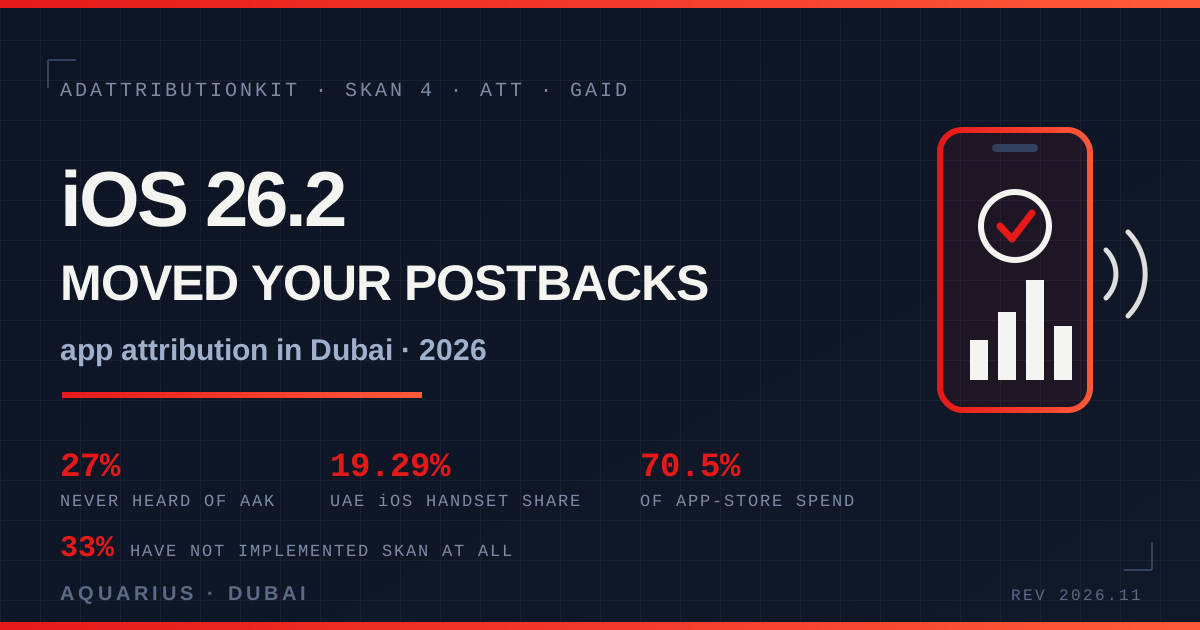
Short answer: from iOS 26.2 onwards Apple Ads delivers its install postbacks through AdAttributionKit, not SKAdNetwork. If your app’s Info.plist still declares only SKAdNetwork IDs, those postbacks quietly stop arriving — nothing errors, the dashboard still looks plausible, and your cost-per-install just got wrong in a direction that flatters nobody.
That is the live trap for Dubai app teams: 27% of mobile marketers say they have never heard of AdAttributionKit, and 24% of apps never show an App Tracking Transparency prompt at all. You cannot defend a media budget on evidence you deleted by omission.
Why measurement is the expensive part in the UAE
The spend is real and it is growing faster than the plumbing. UAE digital ad spend is tracking around US$2.64 billion in 2026, up 15.2% year on year, and a 17.7% compound growth rate puts it near US$4.3 billion by 2029. Mobile takes the majority of that, because mobile is where the audience is.
Three numbers explain why attribution errors cost more here than in most markets:
- The UAE is an 80/20 market, inverted on revenue. Statcounter put UAE handset share at 80.69% Android and 19.29% iOS in October 2026. Yet globally the App Store took 70.5% of the US$167 billion consumers spent across both stores in 2025 — US$117.6bn against US$49.2bn, roughly 2.4x the revenue on about a third of the downloads. Your installs are Android. Your payback is disproportionately iOS. You have to measure both, differently.
- Acquisition prices are moving. Adjust recorded UAE gaming cost-per-install climbing 54% during 2025, against roughly 15% across MENA as a whole. Dubai is the expensive end of an expensive region.
- Measurement gaps are the norm, not the exception. 33% of app marketers have never implemented SKAdNetwork at all, and 67% of those who did run into privacy-threshold reporting gaps — postbacks that arrive with the detail stripped out.
At a median install price around AED 5 for UAE app campaigns (we break the full picture down in our Dubai app install ads cost guide), a 20% attribution blind spot on a AED 150,000 quarter is AED 30,000 of spend you cannot assign, defend, or optimise.
The three frameworks you are actually dealing with
People say “attribution is broken on iOS” as if one thing broke. Three separate systems are in play, and they answer different questions.
1. App Tracking Transparency (ATT) — the permission
ATT is the prompt. Consent to it and you get the IDFA, which means device-level, deterministic attribution: the old world, intact. Decline, and you fall back to privacy-preserving aggregate reporting. ATT is a permission layer, not a measurement system.
2. SKAdNetwork 4 (SKAN) — Apple’s aggregate reporting
SKAN reports installs and post-install value without identifying the user. Version 4 added hierarchical source IDs, web-to-app support and three observation windows measured from first launch: 0–2 days, 0–7 days, and 0–35 days. Each window can fire one postback, so you get a coarse view of early value, week-one value, and five-week value.
3. AdAttributionKit (AAK) — the successor
AAK is SKAN’s replacement and is where Apple is moving. It adds re-engagement attribution, support for alternative app marketplaces, and cryptographically signed JWS postbacks so you can verify a postback was genuinely issued by the platform rather than spoofed by a fraud farm. Apple states that SKAN plus AAK together account for about 77% of referral-based App Store conversions.
And then Android, which is the opposite story
Android still has the Google Advertising ID. Google retired the core Privacy Sandbox technologies on 17 October 2025, and as of 14 August 2026 the Attribution Reporting API on Android is listed as “deprecate and remove”. GAID stays. In a market that is 80.69% Android, that means deterministic attribution is still available for four devices in five — the part most iOS-panicked teams forget to exploit.
The iOS 26.2 change, in one paragraph
From iOS 26.2 (rolling out from mid-December 2025), Apple Ads postbacks are delivered via AdAttributionKit. Devices on iOS 26.1 and earlier continue on SKAdNetwork. So you must support both at once. Practically, that means declaring AdAttributionKit alongside SKAdNetwork in Info.plist, accepting both postback copies on your endpoint, and de-duplicating on the server rather than picking a winner in the app. Teams that treat it as a migration instead of a dual-run lose the older install base.
SKAN 4 vs AdAttributionKit vs Android GAID
| Capability | SKAdNetwork 4 | AdAttributionKit | Android (GAID) |
|---|---|---|---|
| Identifier | None (aggregate) | None (aggregate) | GAID, per-device |
| User-level data | No | No | Yes, when GAID available |
| Attribution windows | 0–2, 0–7, 0–35 days from first launch | Same three windows, plus re-engagement | Configurable in your MMP |
| Re-engagement | Not supported | Click-based re-engagement supported | Fully supported |
| Postback integrity | Unsigned | Signed JWS, verifiable | Depends on your MMP and fraud tooling |
| Alternative marketplaces | No | Yes | Yes (APK and third-party stores) |
| Privacy threshold | Crowd anonymity tiers gate fine vs coarse conversion values | Same tiering model | None |
| Apple Ads postbacks | iOS 26.1 and earlier | iOS 26.2 and later | n/a |
The row that burns budgets is privacy threshold. Crowd anonymity decides whether a postback carries a fine-grained conversion value, a coarse one (low, medium, high), or no value and no source ID at all. It is driven by install volume per campaign, not by how much you spent: no amount of spend guarantees a tier. And when detail is withheld, SKAN does not report a zero — the field is simply absent. Teams that pipe SKAN into a BI tool that reads a missing value as zero manufacture their own bad news.
The fix is structural, not clever: fewer campaigns with more volume each beats a tidy matrix of eleven geo-and-creative splits that each fall below the threshold.
The ATT opt-in myth, with both numbers
You will see two very different opt-in rates quoted. Both are correct, and the gap between them is the whole lesson.
Adjust’s Mobile App Trends 2026 puts the industry average opt-in rate at 38% in Q1 2026, up from 35% a year earlier — gaming at 39%, publications climbing from 18% to 26%, e-commerce roughly flat at 34%. That is the rate across all users.
Kochava, measuring only users who were actually shown a prompt, reported 69.7% opting in as of June 2026 — up from 37% at ATT’s launch, having crossed 50% in September 2024.
Reconcile those and the conclusion is uncomfortable: the average is dragged down by apps that never ask. 24% show no ATT prompt at all, and 36% ship only Apple’s default system prompt with no pre-prompt explaining the value exchange. Users will consent at scale in 2026. Most Dubai apps simply never put the question to them, then blame the framework.
What moves the number: ask after a first moment of value rather than on launch, use a bilingual pre-prompt (Arabic and English) that names the benefit in plain terms, and never ask during checkout or onboarding friction. A pre-prompt is a day of work and it is the single highest-leverage attribution change available to a UAE app.
What a mobile measurement partner costs
You need an MMP to receive postbacks, de-duplicate across SKAN, AdAttributionKit and GAID, and reconcile with your in-app events. Published 2026 pricing:
| MMP | Entry pricing | Notes |
|---|---|---|
| AppsFlyer (Growth) | US$0.07 per conversion, 12,000 conversions free in the first 12 months | Attributed installs typically US$0.06–0.12; largest partner integration catalogue |
| Adjust | Custom per-attribution or MAU tiers, unpublished | Enterprise agreements commonly land in five to six figures annually |
| Singular | First 15,000 conversions free, then US$0.05 per conversion | Often 20–40% cheaper above US$100k monthly ad spend; strongest cost aggregation |
For a Dubai app running AED 100,000–200,000 a month in media, MMP fees land around AED 1,100–5,500 per month — roughly 1–3% of spend. The integration work, not the licence, is where projects stall.
What this costs to get right in Dubai
Our AED bands for attribution work, excluding MMP licence fees and 5% VAT:
| Scope | AED | Timeline |
|---|---|---|
| Attribution audit: Info.plist, SKAN and AdAttributionKit readiness, postback and event QA, written findings | 4,500–8,000 | 5–7 days |
| MMP integration, one platform (iOS or Android), SDK plus event schema | 12,000–22,000 | 2–3 weeks |
| Both platforms, SKAN + AdAttributionKit dual-run, conversion-value mapping, bilingual ATT pre-prompt | 26,000–45,000 | 3–5 weeks |
| Server-side postback endpoint, JWS verification, warehouse pipeline and dashboards | 18,000–35,000 | 2–4 weeks |
| Ongoing measurement retainer: threshold monitoring, campaign restructuring, monthly reconciliation | 4,500–9,000 / month | Rolling |
Compare that against the cost of doing nothing. A single broken postback path on a AED 150,000 monthly budget misattributes roughly AED 30,000–45,000 a month at typical blind-spot rates, which means a AED 35,000 dual-run build pays for itself inside the first month before any optimisation gain. That is before the second-order cost: every campaign decision made on bad data compounds into next month’s budget split.
How Aquarius approaches it
We treat attribution as data engineering, not a dashboard subscription.
- Audit before spend. We verify the Info.plist declarations, the SDK version, the event schema and the postback endpoint before a single dirham of media runs. Most engagements start by finding an iOS 26.2 gap.
- Dual-run by default. SKAdNetwork and AdAttributionKit together, de-duplicated server-side, until the older install base is genuinely gone.
- Campaign structure designed for crowd anonymity. We consolidate campaigns to keep postbacks above the privacy threshold, so conversion values stay fine-grained instead of collapsing to coarse.
- Android treated as the opportunity it is. Four in five UAE devices still give deterministic attribution. We build that side properly rather than mirroring iOS limitations onto it.
- Bilingual ATT pre-prompt. Arabic and English, timed after first value, tested on wording.
- Reconciliation you can audit. Postbacks land in your own warehouse alongside ad-platform cost data — the same discipline we apply to web tracking in our GA4 server-side tracking setup.
Risk reversal: if our audit finds no material attribution gap, we refund the audit fee in full.
Frequently asked questions
Do I have to migrate from SKAdNetwork to AdAttributionKit right now?
You have to add AdAttributionKit, not replace SKAdNetwork. Apple Ads postbacks use AdAttributionKit from iOS 26.2 and SKAdNetwork on iOS 26.1 and earlier, so both must be declared and both postback copies accepted until the old install base ages out.
Why did my SKAN postback arrive with no conversion value?
Crowd anonymity. If a campaign’s install volume is too low, Apple withholds the fine conversion value, the coarse value, or the source ID. Spend does not buy a tier — volume per campaign does. Consolidate campaigns, and make sure your pipeline treats the missing field as missing rather than as zero.
Is attribution worth it when the UAE is 80% Android?
That is exactly why it is worth it. Android still exposes GAID and deterministic attribution, while the App Store generates about 2.4x the consumer revenue of Google Play globally. Measure Android properly for volume and iOS properly for value; the two sides need different setups.
What ATT opt-in rate should a Dubai app expect?
The 2026 industry average is 38%, but among users who are actually shown a prompt it is close to 70%. If you are below 38%, the usual cause is prompt timing or a missing pre-prompt — not UAE users being unusually privacy-averse.
How does this relate to App Store Optimization?
ASO drives organic installs; attribution tells you which paid sources are worth scaling and how much organic lift is actually paid spillover. Without attribution you cannot separate the two, which is how ASO budgets get cut for someone else’s results. See our Dubai ASO guide for the organic half.
If your app is spending in the UAE and nobody can tell you whether Apple Ads postbacks still arrive after iOS 26.2, that is the first thing to check this week. Talk to Aquarius for an attribution audit, or see our pricing for the full AED bands.