
Mobile App Fraud in Dubai (2026): Play Integrity, App Attest and the Real AED Cost of an Anti-Abuse Layer
Finance apps on Android hit a 31% install fraud rate in Q1 2026 and 52% of fraudulent installs now arrive as organic. What Play Integrity, App Attest and an anti-abuse layer really cost in Dubai.
- PUBLISHED
- 06 NOV 2026
- READ TIME
- 12 MIN
- AUTHOR
- AQUARIUS · DUBAI
- UNIT
- REV 2026.09
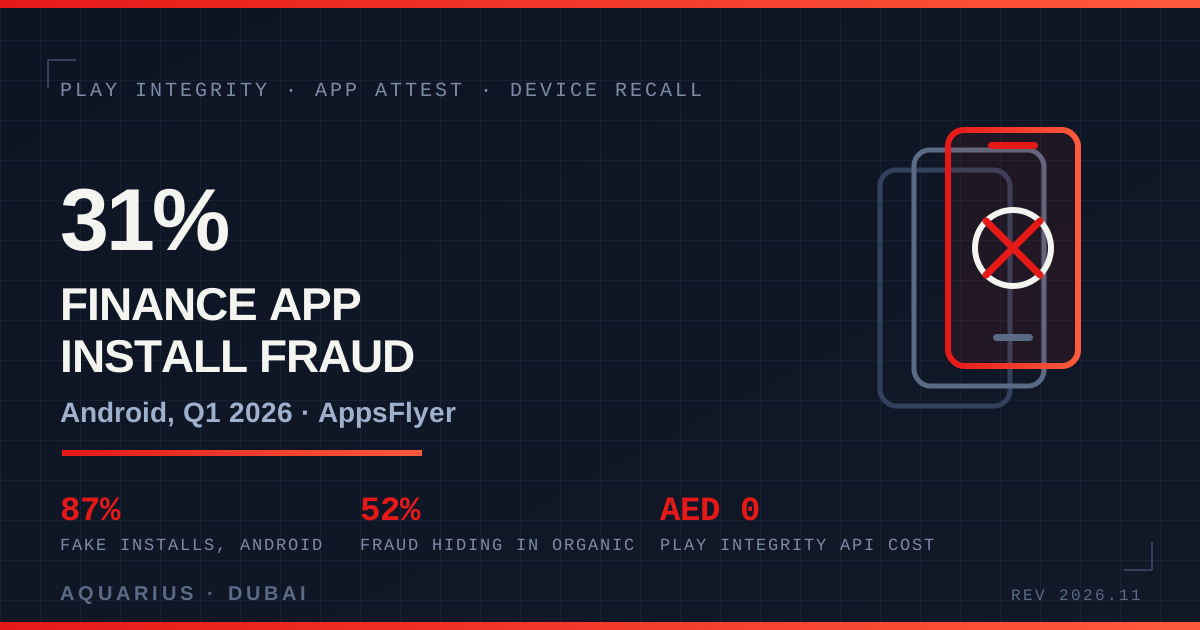
Short answer: Dubai app fraud in 2026 is no longer mostly fake ad clicks — it is cloned devices, emulators and multi-accounting hitting your signup, promo and payout flows directly. AppsFlyer’s State of Fraud for Marketers 2026 found fake installs account for 87% of Android fraud and 92% of iOS fraud, and 52% of all fraudulent installs now arrive labelled as organic, where no ad network refunds you. The fix is not a bigger fraud vendor invoice: it is device attestation — Google’s Play Integrity API and Apple’s App Attest — wired into your own server, which costs AED 0 in licence fees and roughly AED 18,000 to 55,000 to implement properly.
Most Dubai businesses get this backwards. They buy an anti-fraud SaaS subscription before they have told their own backend whether a request even came from a real phone running their real app. Here is the 2026 picture, with the numbers.
The scale of the problem, in current numbers
AppsFlyer’s 2026 fraud report is the largest public dataset on this: 106.4 billion installs, 55.3 billion of them paid, across 246,000 apps, covering Q1 2025 to Q1 2026. Three findings matter for anyone running an app from Dubai.
First, finance apps on Android recorded a 31% install fraud rate, against 10% for shopping and 7% for gaming. In a market where the UAE’s fintech and neobank cohort competes hardest for installs, that is the single most expensive vertical to acquire users in. Gambling sat at 59%, up from 49% year on year — the only vertical still rising.
Second, the platform assumption flipped. iOS fraud fell 33%, from 17.5% to 11.7%, dropping below Android for the first time in the series. Android now runs in the 14–15% band. If your Dubai app team still treats iOS as the safe platform and Android as the risky one, your enforcement thresholds are a year out of date.
Third, and most important: organic traffic is now the single largest fraud channel at 52% of fraudulent installs, with affiliates at roughly 40%. Together those two sources carry about 90% of fraud, while self-reporting networks such as Meta and Google sit at 1.5% — a 36x gap between affiliate and self-reported fraud rates in Q1 2026. Fraud that arrives as organic has no network to claw back from. It lands in your database as a real user and then abuses your promos.
That is the shift Dubai product teams keep missing. Attribution fraud steals your media budget. Device fraud steals your unit economics — and it shows up in the column labelled “organic growth”.
Why Dubai is a high-value target specifically
Three local conditions stack up. Mobile is the default surface: Statcounter put UAE traffic at 67.8% mobile against 31.37% desktop in October 2026, and DataReportal counts 11.3 million UAE internet users at 99.0% penetration. There is no desktop fallback to absorb abuse.
The incentives are large and concentrated. The UAE online food delivery market is sized at roughly USD 10.86 billion in 2026, and Dubai-headquartered Talabat reported about USD 5.6 billion in GMV for the first half of 2026, up 15% at constant currency, holding a 42% share of UAE delivery sales value and 46% of orders. Delivery, ride-hailing and q-commerce apps run exactly the promo, referral and courier-payout mechanics that fraud rings industrialise.
And the media spend is there to steal: UAE digital ad spend is forecast at USD 2.64 billion in 2026, up 15.2% year on year, heading toward USD 4.30 billion by 2029. A rising install budget in the highest-fraud verticals is the definition of a soft target.
The four attack patterns Dubai apps actually see
1. Emulators and app cloners
One operator with an app cloner and an Android emulator can generate hundreds of accounts from a single machine, cycling each one through your first-order discount. Incognia’s delivery-platform research found that 1% to 2.5% of devices on food delivery platforms access three or more accounts, with some single devices reaching over 50 accounts; in one three-month window, 4% of accounts on one platform belonged to users engaged in multi-accounting.
2. Promo and referral abuse
This is the pattern that hides inside organic. In food and drink, organic accounts for 43% to 64% of fraud — not because of bad media buying, but because bots and multi-accounts game offers, referral bonuses and first-purchase discounts directly. Juniper Research expects the global cost of food delivery fraud to pass USD 5 billion a year in 2026, and individual delivery companies have been estimated to lose as much as USD 1.5 million a month to commonly abused promotion campaigns.
3. Supply-side and courier fraud
If your app has a two-sided marketplace, the rider app is the weaker side. Incognia reports that fake accounts now represent 57% of driver-side fraud on gig platforms, and 75% of fraud professionals rank application tampering — including device farming — as their top concern going into 2026. Fake courier accounts collect incentives, self-deliver to a colluding customer account, or sell verified access on.
4. Rooted, hooked and overlay-attacked devices
The quiet one. A rooted or API-hooked phone lets an attacker read your in-app traffic, bypass client-side checks and automate flows. An overlay or screen-capture app sitting on top of your login is how OTPs and card details leave a real customer’s real device — related to, but distinct from, the SMS pumping and OTP fraud pattern draining UAE verification budgets.
Play Integrity vs App Attest: what each one actually tells you
Both are platform-native attestation APIs. Both are free. Both only work if your server — never the app — does the verification, because a compromised client cannot be trusted to assess its own integrity.
| Play Integrity API (Android) | App Attest / DeviceCheck (iOS) | |
|---|---|---|
| Replaces | SafetyNet Attestation, now fully retired | Nothing — introduced inside the DeviceCheck framework with iOS 14 |
| Core question answered | Is this a genuine certified device, running my real Play-distributed binary, with a licensed account? | Is this request coming from an authentic, uncompromised instance of my app, cryptographically? |
| Device signal | MEETS_DEVICE_INTEGRITY; optional MEETS_BASIC_INTEGRITY and MEETS_STRONG_INTEGRITY; blank value on rooted, hooked or emulated devices | Hardware-backed attestation key per app install, validated against Apple’s root |
| App signal | appRecognitionVerdict: PLAY_RECOGNIZED or UNRECOGNIZED_VERSION, plus package name, version code and certificate digest | Assertions signed per request; iOS 27 adds authenticator-data extensions for launch validation category and bundle version |
| Account signal | appLicensingVerdict: LICENSED / UNLICENSED / UNEVALUATED — catches sideloaded installs | None directly; pair with your own identity layer |
| Abuse-velocity signal | recentDeviceActivity levels 1–4, where LEVEL_4 means more than 50 standard token requests from one device in the last hour | A 30-day count of unique attested keys per device, read from the App Attest data server using a stored receipt |
| Repeat-abuser memory | Device recall (beta): per-device bits you can write server-side and read back after reinstall | DeviceCheck two persistent bits plus a last-updated date, surviving reinstall and device reset |
| Environment signal | appAccessRiskVerdict flags apps that could capture the screen, overlay or control your app; playProtectVerdict flags known malware | Not exposed — build your own jailbreak and hooking heuristics |
| Cost and limits | No per-request charge; default quota 10,000 requests per day per app across all installs; increases approved manually in 2–3 working days | No charge; attestation once per key per install, assertions per request |
The practical division of labour: Play Integrity is the richer signal, App Attest is the harder cryptographic guarantee. Android gives you a verdict about the whole environment, including whether a screen-capture app is running. iOS gives you a narrow but near-unforgeable proof that the binary is yours, and leaves jailbreak detection to you. You need both, and you need them to feed the same risk decision on your backend.
Two implementation details cause most of the production incidents we see. The 10,000-requests-per-day default quota catches teams the week a campaign lands — request the increase before launch, not after. And on Android 13 and higher, the optional MEETS_BASIC_INTEGRITY and MEETS_STRONG_INTEGRITY labels are only returned if the app is licensed, so an unlicensed sideload silently loses the very labels you were tiering on.
Tiered enforcement, not a wall
The expensive failure mode is not fraud. It is blocking paying customers. Attestation fails for legitimate reasons constantly: outdated Play Store versions, non-phone form factors, devices on Android 5, users not signed into Play, transient network errors. Hard-blocking on a blank verdict will cost you more in Dubai than the fraud does.
Tier it instead. Allow browsing and catalogue access on any verdict. Require MEETS_DEVICE_INTEGRITY plus PLAY_RECOGNIZED — or a valid App Attest assertion — before anything with money or incentives attached: claiming a promo code, redeeming a referral, adding a payment method, requesting a courier payout. Reserve MEETS_STRONG_INTEGRITY for your highest-risk action, and always pair a block with a remediation path rather than a dead end.
Then layer velocity. A device returning LEVEL_4 recent activity — more than 50 token requests in an hour — is not a customer with a slow connection. Combined with device recall bits written when you previously banned that hardware, you get something a pure account-level ban never gives you: memory that survives an uninstall, a new phone number and a fresh email. That is the mechanism that actually ends promo abuse, and it is the same defensive posture we describe for bot traffic and account takeover on the web side.
What this costs in Dubai, in real AED
The APIs are free. The engineering is not. Indicative Dubai market ranges for 2026:
| Scope | What it includes | Indicative AED | Typical timeline |
|---|---|---|---|
| Attestation baseline, one platform | Play Integrity or App Attest wired in, server-side token decryption and verification, verdict logging, one gated flow | 9,000 – 22,000 | 1 – 2 weeks |
| Attestation baseline, both platforms | Both SDKs, unified server-side risk endpoint, quota increase requested, nonce and request-hash binding, replay protection | 18,000 – 55,000 | 2 – 4 weeks |
| Promo and referral abuse rules | Device-to-account graph, referral-chain checks, per-device promo caps, velocity thresholds, manual review queue | 25,000 – 75,000 | 3 – 6 weeks |
| Two-sided marketplace hardening | Courier or driver onboarding checks, payout-side attestation, collusion detection between customer and courier accounts | 45,000 – 140,000 | 5 – 9 weeks |
| Install-fraud audit of paid media | MMP configuration review, organic-channel fraud analysis, affiliate-source scoring, rejection-rule tuning | 12,000 – 35,000 | 1 – 3 weeks |
| Ongoing fraud operations | Threshold tuning, verdict-drift monitoring, SDK upgrades, quarterly rule review, incident response | 3,500 – 14,000/mo | Retained |
Now the cost of inaction, as arithmetic rather than a vendor claim. Take a Dubai fintech app spending AED 150,000 a month on Android user acquisition. At AppsFlyer’s measured 31% finance-vertical Android install fraud rate, roughly AED 46,500 a month — about AED 558,000 a year — buys installs that will never transact. That is ten to thirty times the cost of the full both-platform attestation build, and it ignores the promo budget leaking through the organic door.
The UAE legal exposure is real too, and it runs in your favour if you can evidence the abuse. Under Federal Decree-Law No. 34 of 2021, creating a fake account or website and falsely attributing it to a person carries a fine of AED 50,000 to AED 200,000, while electronic fraud carries no less than one year in prison and a fine of AED 250,000 to AED 1,000,000. Attestation logs and device recall history are exactly the kind of technical evidence a UAE cybercrime complaint needs. For context on the downside of getting security architecture wrong at scale, IBM’s 2026 Cost of a Data Breach puts the Middle East average at USD 8 million, roughly AED 29.4 million.
How Aquarius builds it
We start by instrumenting before enforcing. Week one, attestation goes in on both platforms in log-only mode, so you see the real distribution of verdicts across your actual UAE install base instead of guessing. That almost always changes the plan — we have seen teams convinced they had an emulator problem discover that their losses were entirely referral-chain abuse from genuine devices, and the reverse.
Then we gate flows in order of money at risk, not order of ease: payouts and promo redemption first, signup later. Server-side verification lives in one risk endpoint so iOS and Android resolve to the same decision, quota increases are filed before the campaign, and every block ships with a remediation prompt. Fixed scope, fixed price — see pricing, or send us your current install volume and promo budget and we will size the leak before you commit to anything. If you are budgeting the surrounding work, our mobile app maintenance cost breakdown covers where an anti-abuse retainer sits against the rest of your run cost.
FAQ
Is the Play Integrity API free to use in the UAE?
Yes. Google charges nothing per request anywhere, including the UAE. The constraint is quota, not price: the default allowance is 10,000 requests per day per app across all installs, and a higher quota has to be requested manually through Play Console, with approval typically taking two to three working days. For a Dubai app planning a Ramadan or back-to-school campaign, file that request weeks ahead — hitting the ceiling mid-flight means your risk endpoint starts failing open exactly when fraud volume peaks.
Can Play Integrity and App Attest detect emulators and cloned apps?
Mostly, and from different angles. On Android, a device running an emulator that does not pass Google’s integrity checks returns a blank deviceRecognitionVerdict, as does a rooted device or one showing signs of API hooking. A cloned or repackaged binary fails appRecognitionVerdict because the certificate digest will not match Play’s records. On iOS, App Attest’s per-install hardware key means a tampered or re-signed build cannot produce valid assertions at all. Neither is absolute — determined attackers work around client signals — which is why both have to be combined with server-side velocity and device-to-account graph rules.
Why is my organic install channel showing fraud?
Because organic is where fraud goes when it has nowhere to be attributed. AppsFlyer’s 2026 data has organic at 52% of all fraudulent installs, and in food and drink it is 43% to 64% of fraud. Two mechanisms dominate: click-spamming and attribution hijacking that fail to claim the install and so fall through to organic, and bots or multi-accounts registering directly to farm first-order promos and referral bonuses. The giveaway is a cohort with normal install numbers, abnormally high promo redemption and near-zero second purchases.
Do I need a paid anti-fraud vendor as well?
Not on day one. Platform attestation plus your own velocity and device-graph rules removes the cheap, high-volume abuse, which is most of it, for a one-off build cost and no licence fee. Bring in a specialist vendor when you have measured residual loss that your own rules cannot reach — typically sophisticated collusion on two-sided marketplaces, or behavioural biometrics for account takeover. Buying the subscription first means paying monthly to detect what a free API would have blocked.
How does this interact with UAE PDPL and data residency?
Attestation is designed to minimise what you collect: the verdict is a judgement about a device and a binary, not a persistent advertising identifier, and device recall stores bits you define rather than personal data. You still need the usual disciplines — a documented lawful basis for processing device risk signals, a retention limit on verdict logs, and a privacy-notice line explaining that you assess device integrity for fraud prevention. Keep the decision and the log on your own infrastructure so residency and retention stay under your control rather than a vendor’s.
Sources: AppsFlyer, State of Fraud for Marketers 2026 (published June 2026; 106.4bn installs, 55.3bn paid, 246,000 apps, Q1 2025–Q1 2026); Android Developers, Play Integrity API integrity verdicts, device recall and setup documentation; Google Play Console Help, Play Integrity API quota; Apple Developer, DeviceCheck and App Attest documentation and WWDC26 session 201; Incognia promotion-abuse and gig-economy fraud research; Juniper Research food delivery fraud forecast 2026; Talabat H1 2026 results; Statcounter UAE, October 2026; DataReportal UAE; UAE Federal Decree-Law No. 34 of 2021 on Countering Rumours and Cybercrimes; IBM Cost of a Data Breach Report 2026 (Middle East).