
Mobile App Maintenance Cost in Dubai (2026): The Bill Apple and Google Now Enforce
Budget 15–20% of build cost a year. Google Play now requires API 36 and Apple requires Xcode 26 — skip maintenance and your Dubai app stops shipping.
- PUBLISHED
- 16 SEPT 2026
- READ TIME
- 09 MIN
- AUTHOR
- AQUARIUS · DUBAI
- UNIT
- REV 2026.09
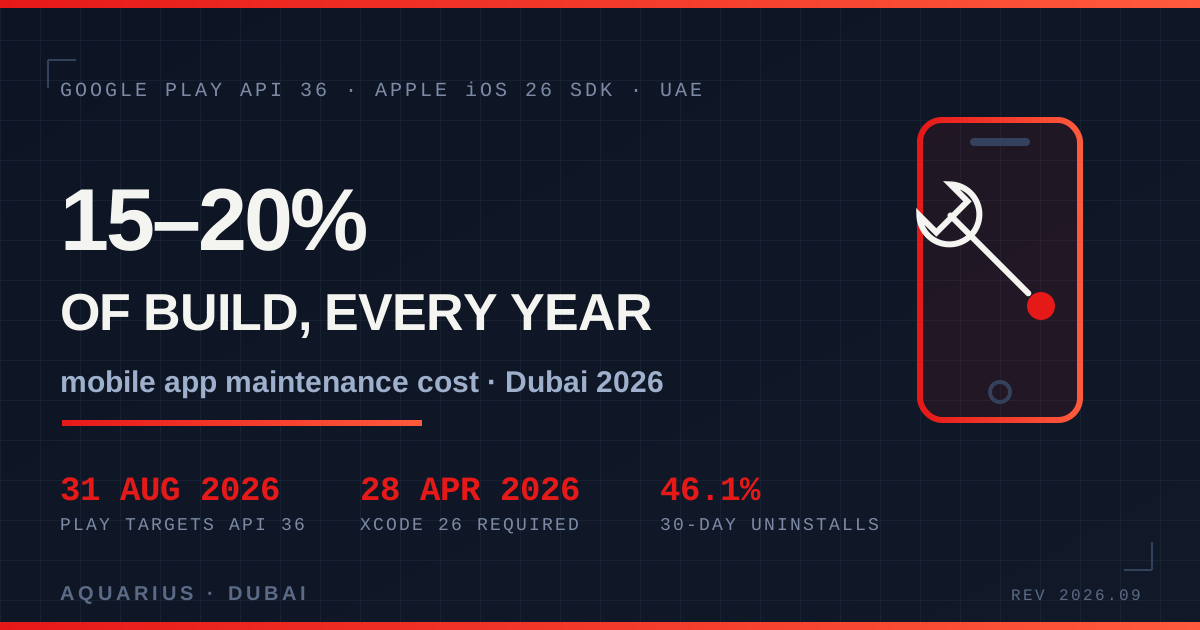
Short answer: Budget 15–20% of your app’s original build cost every year to keep it maintained in Dubai. An app that cost AED 150,000 to build needs roughly AED 22,500–30,000 a year; a AED 400,000 platform needs AED 60,000–80,000. That money is not optional polish — in 2026 both Apple and Google turned “keep your app current” into a hard store rule, and an app nobody updates quietly disappears for new users.
Key takeaways
- Google moved the goalposts on 31 August 2026. New apps and updates on Google Play must now target Android 16 (API level 36). Existing apps must target at least API 35 to stay visible to new users on newer Android phones. An extension to 1 November 2026 is available on request.
- Apple did the same on 28 April 2026. Every upload to App Store Connect must be built with Xcode 26 and the iOS 26 SDK — which also switches native UI to Apple’s new Liquid Glass look by default.
- The UAE punishes a broken app faster than most markets. 10.8 million active smartphone users, 99% internet penetration and a median mobile download speed of 614 Mbps mean your users never blame the network. They blame the app.
- The real benchmark is 15–20% of build cost per year, delivered as a monthly retainer, not ad-hoc invoices when something breaks.
Why maintenance matters more in the UAE than almost anywhere (TOFU)
Start with the audience. According to DataReportal’s Digital 2026: United Arab Emirates report, the country had 11.3 million internet users at the end of 2025 — a 99.0% penetration rate — and 23.0 million cellular connections, equal to 202% of the population. Roughly 10.8 million of the UAE’s 11.4 million residents use an active smartphone.
Then look at the pipe. The UAE’s median mobile download speed hit 614.42 Mbps in August 2025, up 54.2% in a year. When a Dubai customer’s booking screen hangs, it is not the 5G. It is your API, your outdated SDK or the crash nobody fixed after the last OS update.
And the patience window is short everywhere. AppsFlyer’s 2025 uninstall benchmark, built on 2,200 apps and 402 million uninstalls, found a 46.1% 30-day uninstall rate on Android in 2024 — with most uninstalls happening on day one. Nearly half of the users you paid to acquire are gone within a month even when the app works. A stale, crashing app just accelerates that.
The myth most Dubai businesses believe
“The app is finished, so the cost is finished.” It is the single most expensive assumption we see. An app is a tenant on two platforms that change the rent every year. Apple and Google release a major OS each autumn, deprecate APIs, tighten privacy rules and then enforce new build targets on a fixed calendar. An app left untouched for 18 months is not “stable” — it is scheduled for removal from new users’ search results.
What you are actually paying for (MOFU)
Maintenance is five different jobs bundled into one line item. Know which ones your vendor is quoting:
- Platform compliance. Retargeting to the new Android API level, rebuilding on the new Xcode and SDK, fixing whatever breaks: permissions, background tasks, notifications, edge-to-edge layouts. In 2026 that means the API 36 and iOS 26 migrations.
- Stability and bug fixing. Crash monitoring (Firebase Crashlytics, Sentry), triage and hot-fixes. The industry target for a healthy consumer app is a crash-free session rate well above 99.9%.
- Security and dependencies. Patching vulnerable third-party libraries, rotating keys and certificates, renewing push-notification credentials. If your app handles personal data, the UAE’s Personal Data Protection Law applies — see our UAE PDPL compliance checklist for websites and apps.
- Infrastructure. Cloud hosting, databases, CDN, SMS/OTP, maps and payment-gateway fees. These scale with users, not with code.
- Small improvements. Copy changes, a new payment method, a Ramadan campaign banner, Arabic RTL fixes. Useful, but this is where retainers quietly turn into feature development — ring-fence it.
Dubai mobile app maintenance cost by app size (2026)
| App type | Typical build cost | Annual maintenance (15–20%) | Monthly retainer equivalent |
|---|---|---|---|
| Simple app (catalogue, booking, loyalty) | AED 60,000–120,000 | AED 9,000–24,000 | AED 750–2,000 |
| Mid-complexity app (payments, user accounts, admin panel) | AED 150,000–300,000 | AED 22,500–60,000 | AED 1,900–5,000 |
| Marketplace / on-demand platform (multiple apps, real-time) | AED 350,000–700,000+ | AED 52,500–140,000+ | AED 4,400–11,700+ |
Cloud hosting, third-party API usage and store fees sit on top of these figures. The fixed store fees are small — USD 99 a year for the Apple Developer Program and a one-off USD 25 for a Google Play developer account — but SMS OTP, maps and payment gateway fees can outgrow the retainer once you have real traffic. All agency figures exclude 5% UAE VAT.
Retainer, hourly or in-house? The honest comparison
| Model | Dubai 2026 cost | Best for | Main risk |
|---|---|---|---|
| Ad-hoc hourly (local contractor) | Roughly AED 300–600 per hour for senior freelance or contract developers | Very small apps with rare updates | No monitoring; you find out about crashes from one-star reviews |
| Agency maintenance retainer | 15–20% of build cost per year, billed monthly | Most SMEs with a live, revenue-linked app | Vague scope — insist on hours, response times and deliverables in writing |
| In-house developer | Senior retainer-level talent commonly AED 14,000–25,000 per month, before visa and benefits | Apps that are the core product with weekly releases | One person covering iOS, Android, backend and DevOps is a single point of failure |
For most Dubai businesses whose app supports the business rather than being the business, the retainer wins. It is cheaper than a hire, it covers holidays and resignations, and the OS migration work gets done on the platform’s schedule instead of after the warning email.
The 2026 compliance calendar you cannot skip
If your app has not shipped an update since early 2026, check these two dates first.
Google Play: API level 36 from 31 August 2026
Google’s Play Console policy is explicit: from 31 August 2026, new apps and app updates must target Android 16 (API level 36) or higher. Existing apps must target Android 15 (API level 35) or higher to remain available to new users on devices running newer Android versions. Apps still targeting API 34 or lower stop being available to Google Play users on newer Android versions. You can request an extension to 1 November 2026 — which buys weeks, not a strategy.
Apple: Xcode 26 and the iOS 26 SDK since 28 April 2026
Since 28 April 2026, Apple only accepts uploads built with Xcode 26 or later using the iOS 26 SDK. The deployment target is still your choice, so older iPhones stay supported, but the rebuild changes native controls to the Liquid Glass design by default. That means QA on every screen — especially Arabic RTL layouts, which break in subtle ways when system components change. Our Arabic localisation and RTL guide covers the common failures.
The practical point: you cannot ship even a one-line bug fix or a new promo until these migrations are done. Businesses that skip maintenance discover this on the day they urgently need a release.
What skipping maintenance really costs (BOFU)
Do the maths on the downside. If your app acquired users with paid campaigns, every avoidable uninstall is wasted ad spend. With a 46.1% baseline 30-day uninstall rate already built into the market, a crash-prone release pushes you further from breaking even on acquisition. Add store visibility loss from the API level rule, one-star reviews that drag down conversion on your store listing — see our app store optimisation guide for Dubai — and the emergency premium developers charge for rescuing an unfamiliar, outdated codebase.
In our experience, an emergency migration of a two-year-neglected app to current SDKs regularly costs more than the maintenance retainer it replaced would have — and it arrives with a deadline attached.
How Aquarius maintains apps for Dubai businesses
- Onboarding audit first. We review the code, dependencies, store compliance status and crash data before quoting, so the retainer reflects your actual app — not a template.
- Platform calendar built in. Annual Android API retargeting and Xcode/SDK rebuilds are scheduled months ahead of the Google and Apple deadlines.
- Monitoring, not waiting. Crash reporting, uptime alerts and dependency vulnerability scans run continuously, with agreed response times.
- Fixed monthly AED fee, clear hours. Unused improvement hours are reported monthly. No surprise invoices, and new features are quoted separately.
- Bilingual QA. Every release is tested in English and Arabic on current iOS and Android devices.
See our pricing and app development services, or compare the full build-plus-run picture in our cost to build a website or app in Dubai guide. If your concern is the website rather than the app, read website maintenance cost in Dubai.
FAQ
How much does mobile app maintenance cost in Dubai per year?
Plan on 15–20% of the original build cost annually. For a typical AED 150,000–300,000 business app that is about AED 22,500–60,000 a year, excluding cloud hosting, third-party API fees and 5% VAT.
What happens if I do not update my app for Google Play in 2026?
From 31 August 2026 you cannot publish updates unless the app targets API level 36. Existing apps targeting below API 35 become unavailable to new users on newer Android devices. An extension to 1 November 2026 can be requested in Play Console.
Do I have to rebuild my iPhone app for iOS 26?
Only when you upload an update — but you will need to. Since 28 April 2026 every App Store Connect upload must be built with Xcode 26 and the iOS 26 SDK. The existing live version keeps working until you ship a change.
Is a maintenance retainer better than hiring an in-house developer in Dubai?
For most SMEs, yes. A senior in-house developer commonly costs AED 14,000–25,000 a month before visa and benefits, and one person rarely covers iOS, Android, backend and security. A retainer usually costs less and removes the single point of failure.
Can a different agency take over maintenance of my existing app?
Yes, provided you own the source code, store accounts and cloud accounts. Expect a paid onboarding audit first; it is the fastest way to find the compliance and security gaps before they become outages.
Next step: Not sure whether your app already missed the API 36 or Xcode 26 cut-off? Send us your store links and Aquarius will tell you exactly where it stands and what a fixed monthly maintenance plan would cost — in AED, before you commit.