
Mobile App OTA Updates and Release Pipelines: The Dubai 2026 Guide
Apple clears 90% of reviews in under 48 hours; Play can take 7 days. How Dubai teams ship legal OTA hotfixes in minutes, with real AED costs for Expo, Bitrise, Codemagic and Xcode Cloud.
- PUBLISHED
- 19 NOV 2026
- READ TIME
- 09 MIN
- AUTHOR
- AQUARIUS · DUBAI
- UNIT
- REV 2026.09
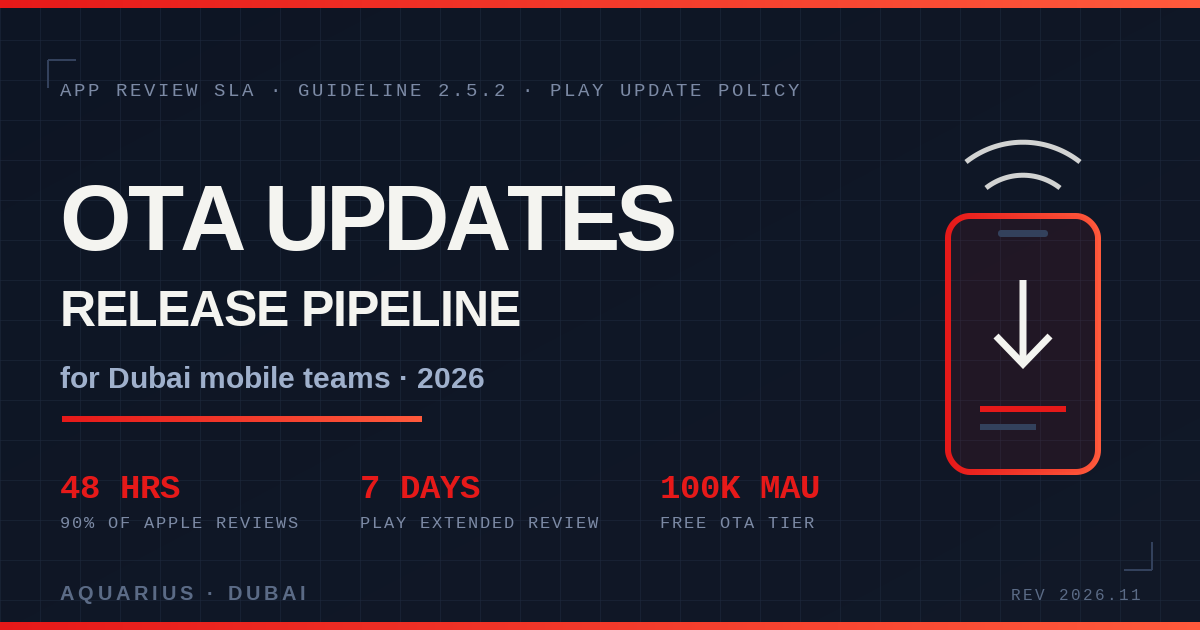
An over-the-air (OTA) update lets you push a fix to a live mobile app in minutes instead of waiting on app review — but only for the JavaScript and asset layer, never for native code. Apple typically reviews 90% of submissions in under 48 hours, and Google Play can take up to seven days for accounts flagged for extended review, so a store-only release process means a broken checkout stays broken for days. The fix is a two-track pipeline: OTA for anything interpreted, a staged store rollout for anything native.
Most Dubai teams only discover they need the second track the week a payment bug ships.
Why release speed is a Dubai problem, not a developer problem
The UAE is one of the most connected markets on earth, which means mistakes propagate fast. Kepios analysis for DataReportal put internet users in the UAE at 11.3 million in October 2025 — a 99% penetration rate, the cap the report applies to its top-tier markets. GSMA Intelligence counted 23.0 million cellular mobile connections at the end of 2025, equal to 202% of the total population and up 1.7 million (+8.1%) year on year. Ookla's figures put the median mobile download speed at 614.42 Mbps, up 215.91 Mbps (+54.2%) in twelve months.
Read those three numbers together. Your Dubai users are on two SIMs each, on a connection fast enough to pull a 30 MB bundle before the lift reaches the lobby, and they will have hit your bug long before an app reviewer picks up your submission. Release latency, not download size, is the constraint.
Myth-bust: "we'll just ship a hotfix" is not a plan. Without an OTA channel already wired in, your fastest possible fix is bounded by someone else's review queue.
What you can legally ship over the air — and what you cannot
This is where most of the bad advice lives, so take it from the primary sources. Apple's App Store Review Guideline 2.5.2 reads: "Apps should be self-contained in their bundles, and may not read or write data outside the designated container area, nor may they download, install, or execute code which introduces or changes features or functionality of the app, including other apps." The only carve-out in the guideline itself is for educational apps that teach code.
Google's Device and Network Abuse policy is just as blunt: "An app distributed via Google Play may not modify, replace, or update itself using any method other than Google Play's update mechanism. Likewise, an app may not download executable code (such as dex, JAR, .so files) from a source other than Google Play." Then comes the sentence the entire OTA industry is built on: "This restriction does not apply to code that runs in a virtual machine or an interpreter where either provides indirect access to Android APIs (such as JavaScript in a webview or browser)."
So the working rule for a React Native, Expo or Capacitor app in Dubai:
- Safe to ship OTA: JavaScript bundles, images, fonts, copy, config, feature-flag state, styling, bug fixes in the JS layer.
- Must go through the stores: native modules, new SDKs, permission changes, anything touching entitlements, and anything that changes what the app is for.
- Never: using OTA to slip past review a feature that review would have rejected. That is the one thing both policies actually care about, and it is how apps get pulled.
Practically, Expo's tooling encodes this for you with native fingerprints: if the native layer is byte-identical to the build already in the store, it will ship a JS-only update; if it is not, it forces a new binary. That check is the compliance boundary made mechanical.
The four-layer release pipeline
1. Build and sign automatically
Hand-built IPAs die with the laptop that made them. fastlane, Expo Build, Bitrise, Codemagic and Xcode Cloud all solve the same problem: reproducible signed artifacts from a clean, ephemeral machine with certificates and provisioning profiles held centrally rather than in a developer's keychain.
2. Test with real testers before real users
TestFlight on iOS, internal and closed testing tracks on Android. Google Play's pre-launch report runs your build on physical devices and reports crashes and accessibility problems before you ever expose a user to them. This stage is free and almost universally skipped.
3. Stage the store rollout
Google Play's staged rollouts are the strongest safety net in mobile, and the rules are specific. They apply to updates only, never a first publish. Recipients are chosen at random. Halting a rollout stops new users receiving the build but does not claw it back from users who already have it. The percentage will not increase on its own — you must raise it manually. Users are not told they are in a rollout. And critically for this market, a rollout can be limited to specific countries: ship to the UAE first, watch your own market, then open the rest.
On iOS, phased release plus managed publishing on Play gives you the matching control — review happens on the store's schedule, but the moment of publication is yours, which is how you line a mobile release up with a campaign launch or a Ramadan promotion.
4. Keep an OTA channel for the JS layer
Expo Update, Codemagic's Patch and the self-hosted CodePush server are the three live options in 2026. Note that Visual Studio App Center was retired on 31 March 2025; its Analytics and Diagnostics remained usable until 30 June 2026, with support running to the end of March 2027. CodePush itself survived the shutdown as a standalone, self-hostable server. If your pipeline still assumes App Center, it is already broken.
What the tooling actually costs in AED
List prices, converted at the pegged rate of AED 3.6725 per USD. This is the part Dubai procurement actually asks for, and the numbers are smaller than most founders expect.
| Tool / tier | Unit | USD | AED | What it buys |
|---|---|---|---|---|
| Expo Free | per month | $0 | AED 0 | 1,000 OTA MAU, 45-min build cap, shared queue |
| Expo Starter | per month | $19 | AED 69.78 | 3,000 OTA MAU, 2-hour build cap |
| Expo Production | per month | $199 | AED 730.83 | 50,000 OTA MAU, 1 TiB edge bandwidth, end-to-end code signing |
| Expo OTA overage | per extra MAU | $0.005 | AED 0.018 | Tiers down to $0.00085 (AED 0.003) at volume |
| Expo build (flat) | per build | $1–$4 | AED 3.67–14.69 | Android medium $1 to iOS large $4 |
| Expo macOS CI | per minute | $0.075–$0.150 | AED 0.28–0.55 | macOS medium to large runners |
| Codemagic PAYG | per minute | $0.095–$0.114 | AED 0.35–0.42 | Mac mini M2 to M4; Linux/Windows $0.045 (AED 0.17) |
| Codemagic fixed | per year | $3,990–$9,000 | AED 14,653–33,053 | 3 concurrencies, unlimited build minutes |
| Codemagic Patch (OTA) | per 100k MAU/month | $99 | AED 363.58 | First 100,000 MAU free; unlimited releases |
| Bitrise Starter | per month (annual) | $89 | AED 326.85 | 100 builds, 4 concurrent, 210-min timeout |
| Bitrise Pro | per month (annual) | $200 | AED 734.50 | 250–2,000 builds, 10 macOS concurrencies |
| Xcode Cloud | per month | $0–$399.99 | AED 0–1,468.96 | 25 compute hours free with the Developer Program; 1,000 h at the top |
Two things stand out. First, OTA for a small Dubai app is effectively free — Patch's first 100,000 monthly active users cost nothing, and even at 1,000,000 MAU the bill is $891/month (AED 3,272) or $9,622/year (AED 35,337). Second, the expensive line is never the tooling: it is macOS build minutes on a badly cached pipeline. Cache your dependencies and the CI bill drops by more than any plan change will save you. We break the ongoing side of this down further in our guide to mobile app maintenance costs in Dubai.
What a blocked release actually costs a Dubai business
Run the arithmetic before you argue about tooling. Levels.fyi data puts median total compensation for a software engineer in Dubai at AED 316,000 per year — roughly AED 151.92 per hour. A four-person squad stalled for two working days waiting on a review queue burns AED 9,723 in salary alone, before you count the revenue leaking through the bug they were trying to fix.
Replacing the people is worse. Quantalent's 2026 UAE tech hiring data reports 23,500 open technology roles against a talent gap of 10,500 (+75%), with an average time-to-fill of 48 days. A release process that burns out your mobile engineers is not a process problem; it is a 48-day hiring problem.
How Aquarius does it
We wire the same four layers into every app we ship from Dubai: signed CI builds on every merge, a TestFlight and internal-track lane for real testers, a UAE-first staged rollout with a documented halt threshold, and an OTA channel scoped strictly to the JS and asset layer so nothing we push could trip Guideline 2.5.2 or Play's update policy. Rollback is a single command, and the runbook lives with your team, not with us. If you want the store-submission side as well, start with our walkthrough on publishing an app to the App Store and Google Play from Dubai.
Risk reversal, plainly: if a release we set up cannot roll back inside fifteen minutes, we fix the pipeline at our cost. Fixed scope, fixed fee, documented handover — our pricing is published.
FAQ
Are OTA updates allowed on the App Store?
Yes, within limits. Guideline 2.5.2 bans downloading code that "introduces or changes features or functionality of the app". Updating the interpreted JavaScript and assets of an existing feature is standard practice and is what Expo Update, Patch and CodePush do. Using OTA to add a feature review has not seen is the violation.
How long does app review take in 2026?
Apple states that App Review typically clears at least 50% of submissions in under 24 hours and 90% in under 48 hours, with expedited review available for date-bound events. Google Play processes standard updates as soon as possible, but warns that certain apps and accounts face extended reviews of up to seven days or longer in exceptional cases.
Can I roll back a staged rollout on Google Play?
Not completely. Halting a staged rollout stops the build reaching new users, but users who already received it keep it. That is exactly why you ship a bumped version rather than relying on a halt, and why the OTA channel matters for JS-layer regressions.
Do I still need App Center?
No. Visual Studio App Center was retired on 31 March 2025. Analytics and Diagnostics were usable until 30 June 2026 with support to the end of March 2027, and CodePush continues as a self-hostable server. New Dubai projects should start on Expo Update, Codemagic Patch or self-hosted CodePush.
What is the cheapest compliant setup for a small UAE app?
Expo Free or Starter (AED 0–69.78 per month) for OTA plus Xcode Cloud's included 25 compute hours covers a single-app team at close to zero marginal cost. Upgrade when your monthly active users cross the OTA allowance, not before.
Ship the fix, not the apology
Every hour between "we found the bug" and "the user has the fix" is a cost you can engineer away. Two tracks, one afternoon of setup, and your worst release day stops being a week-long incident. If you want that wired into your app properly, talk to us — we will audit your current release path for free and tell you exactly where the days are going.