
Multi-Currency Accounting in Dubai 2026: IAS 21, CBUAE Rates and the Dirham Your Tax Return Demands
The dirham is pegged to the dollar, not to the euro, rupee or lira. What IAS 21 and FTA Decision 13 of 2023 actually require from a Dubai ledger, plus the real AED cost of getting currency right.
- PUBLISHED
- 13 NOV 2026
- READ TIME
- 13 MIN
- AUTHOR
- AQUARIUS · DUBAI
- UNIT
- REV 2026.09
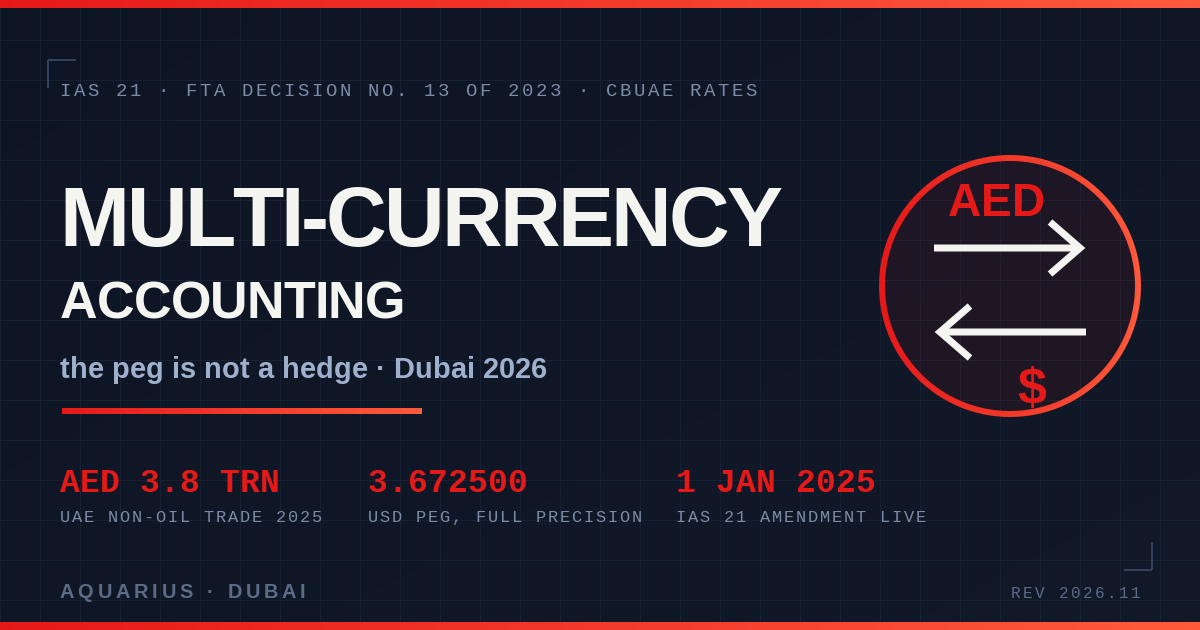
Short answer: a Dubai company trading in more than one currency has three separate obligations that most ledgers collapse into one. IAS 21 decides your functional currency and which balances get revalued at the closing rate; UAE VAT law requires every foreign-currency tax invoice to show AED converted at the Central Bank rate on the date of supply, to the full published precision; and Article 43 of Federal Decree-Law No. 47 of 2022 requires every amount on your corporate tax return to be quantified in dirhams, converted under the hierarchy in FTA Decision No. 13 of 2023. Three rules, three different dates, one general ledger that usually stores a single rate.
Here is the thing most Dubai finance teams get wrong, and it starts with a comfort: the dirham has been pegged to the US dollar at 3.6725 since 22 November 1997. Nearly three decades of a fixed rate teaches a business that currency is somebody else’s problem. But the peg fixes exactly one leg. Your euro supplier, your Indian payroll, your Turkish subsidiary and your Egyptian receivable are all floating, and the peg does nothing for them. The peg is not a hedge. It is a single bilateral rate that happens to be the one you least need to worry about.
Three numbers that set the stakes
The first number is exposure. UAE non-oil foreign trade passed AED 3.8 trillion in 2025 — the first time it has cleared USD 1 trillion in the country’s history — up roughly 27% on 2024 and 44.3% on 2023, with Q4 2025 alone worth about AED 1.1 trillion. Inside that figure, non-oil imports climbed 25.7% to AED 2.1 trillion, re-exports rose 15.7% to AED 830.2 billion, and non-oil exports jumped 45.5% to AED 813.8 billion. Dubai’s own non-oil external trade reached AED 1.2 trillion in H1 2025. A re-export economy is, by construction, a multi-currency economy: goods bought in one currency, sold in another, financed in a third.
The second number is volatility, and it moved in both directions inside 24 months. EUR/USD gained about 13% during 2025, from roughly 1.035 in January to 1.1732 at year end — then reversed, trading near 1.1090 on 12 November 2026, about 4.3% below the 1.1591 of a year earlier. The Indian rupee broke 90 per dollar for the first time in January 2026, settling at an all-time low of 90.21, and set further record lows past 96 per dollar by mid-2026. The Turkish lira approached 50 per dollar in October 2026, a fresh record, down roughly 19% over twelve months. A Dubai trading company with a EUR payable and an INR cost base was hit from both sides in the same financial year.
The third number is who is watching. More than 651,000 businesses are registered for UAE corporate tax, and the conversion method you used is now an auditable record, not a spreadsheet convention. FTA Decision No. 13 of 2023 requires you to apply a consistent conversion method across the whole tax period and to retain documentation of the method chosen, the rates used and the rationale. “Whatever rate the ERP had cached” is not a rationale.
What IAS 21 actually decides
IAS 21 is short and it answers two questions. Teams tend to skip the first one.
1. Functional currency is a finding, not a preference
Functional currency is the currency of the primary economic environment in which the entity operates — the one that drives its selling prices, its labour and material costs, and its financing. It is a conclusion you reach from evidence, and it is not the same thing as presentation currency, which is whatever currency you choose to report in. A Dubai entity that invoices in USD, buys in USD and funds itself in USD may well have a USD functional currency even though it is licensed in the UAE and files in dirhams. A DIFC subsidiary of a European group may have a EUR functional currency. Get this wrong and every downstream number — which balances revalue, where the gain lands, what the deferred tax looks like — is wrong in a way no reconciliation will surface.
2. Monetary versus non-monetary, then where the gain goes
Once functional currency is fixed, IAS 21 splits the balance sheet. Monetary items — cash, trade receivables and payables, loans, lease liabilities — are retranslated at the closing rate each reporting date, and the difference goes to profit or loss. Non-monetary items carried at historical cost — inventory, property, plant and equipment, prepayments, goodwill — stay at the rate on the date of the transaction and are never retranslated. This is the line that breaks in practice: an ERP configured to revalue “all foreign-currency balances” will happily retranslate a USD-denominated prepayment or a fixed asset and create a gain that should not exist.
For a subsidiary with a different functional currency, the arithmetic changes again. Assets and liabilities translate at the closing rate, income and expenses at transaction-date rates (an average is acceptable if rates have not fluctuated significantly), and the residual difference goes to other comprehensive income as a foreign currency translation reserve — where it sits, sometimes for years, until the subsidiary is disposed of and the cumulative amount is recycled to profit or loss. If your group reporting pack cannot produce that reserve as a movement schedule by entity, your consolidation is being plugged.
3. The 2025 amendment nobody in the Gulf can ignore
The IASB’s Lack of Exchangeability amendment to IAS 21 is effective for annual reporting periods beginning on or after 1 January 2025. It fills a real hole: what do you do when a currency simply cannot be exchanged? The amendment sets out how to assess exchangeability — a currency is exchangeable if you can obtain the other currency through available markets or mechanisms, without undue delay, at the measurement date and for the relevant purpose — and, when it is not, requires you to estimate a spot rate and disclose enough for a reader to understand the effect.
For UAE groups this is not theoretical. The International Practices Task Force’s May 2026 assessment listed economies with three-year cumulative inflation above 100%: Argentina, Haiti, Iran, Lebanon, Malawi, Nigeria, South Sudan, Sudan, Turkey, Venezuela and Zimbabwe, with Egypt in the adjacent category of economies that exceeded the threshold in the recent past. Dubai is the natural holding location for African and Levantine operations, so a great many UAE parents consolidate at least one subsidiary that now needs an estimated rate, IAS 29 restatement, or both.
The three dates your ledger has to store
This is the operational core of the article, and it is where software either helps or quietly creates exposure. The same transaction is converted three times, for three regulators, at three different moments.
| Purpose | Rate and date required | Where it is defined |
|---|---|---|
| VAT on a foreign-currency tax invoice | CBUAE approved rate at the date of supply, used at the full published precision (3.672500, not 3.7) | Article 69, Federal Decree-Law No. 8 of 2017; CBUAE began publishing rates 17 May 2018 |
| Corporate tax return amounts | CBUAE spot rate at the transaction date; if impractical, the CBUAE monthly average; if neither is practical, the annual average — applied consistently all period | Article 43, Federal Decree-Law No. 47 of 2022; FTA Decision No. 13 of 2023 |
| IFRS reporting | Transaction-date rate on initial recognition; closing rate for monetary items at each reporting date; historical rate for non-monetary items | IAS 21 (as amended for lack of exchangeability, effective 1 January 2025) |
| Group consolidation | Closing rate for assets and liabilities, transaction-date or average rates for P&L, residual to the translation reserve in OCI | IAS 21; recycled to P&L on disposal of the foreign operation |
The Central Bank publishes daily reference rates, and the VAT guidance is unusually specific about precision: for tax invoices issued on or after 17 May 2018 you must use the rate as published, with the same number of decimal places. Rounding a published 3.672500 down to 3.7 on the invoice is a defect in the document itself, regardless of whether the VAT total happens to be right.
E-invoicing turns a convention into a validation rule
Until now, a sloppy rate was an audit finding. Under the UAE e-invoicing programme — voluntary from July 2026 and mandatory from 1 October 2027 — it becomes a rejected document. The PINT AE specification carries the exchange rate in BTAE-04, and business rule ibr-159-ae makes that field mandatory whenever the document currency is not AED. The tax accounting currency field (IBT-006) is always AED, the VAT total in AED sits in IBT-111, and AED amounts are required per line, not only at document level. Carry the published six-decimal rate into BTAE-04, round the AED results rather than the rate, and expect line-level rounding to differ from the converted document total by up to a fils — which the specification tolerates and your reconciliation logic must too.
In other words: in roughly eleven months, the exchange rate stops being a reporting input and becomes a field that an Accredited Service Provider validates before the invoice exists. Most Dubai ERPs we open store one rate per document. The format wants a rate, an AED tax amount and AED line amounts, each derived at the right date.
The election that decides whether your FX loss is deductible
Now the part that costs real money, and it is the inverse of what most people assume. Article 20(3) of the Corporate Tax Law lets a company preparing accounts on an accrual basis elect to recognise gains and losses on a realisation basis for tax. The election can be made either for all unrealised accounting gains and losses, or only for those on assets and liabilities held on the capital account — in which case items on the revenue account continue to be taxed on an unrealised basis.
Read that against IAS 21. A foreign-currency trade receivable, payable, bank balance or working-capital loan is a monetary item on the revenue account. So the popular “capital account only” election — chosen by many Dubai businesses to avoid being taxed on property and investment revaluations — leaves your year-end FX revaluation fully in taxable income, unrealised, every year. A company that translated a large USD-funded EUR payable at 31 December can therefore owe 9% on a gain it has not banked, while a company that elected for all unrealised items waits until settlement.
The election was made in your first tax period and it is irrevocable except in exceptional circumstances approved by the FTA. If nobody in your business can point to which variant was filed, that is the first document to find — before you model anything.
Two further details matter for groups. Foreign tax credits are allowed in the tax period in which the foreign-source income enters UAE taxable income, so tax paid abroad on an unrealised gain is creditable only in the year the UAE taxes that gain — a timing mismatch the realisation election can create or cure. And a tax group needs all members on the same financial year end and the same accounting standards, with the aggregated financial statements presented in AED; a subsidiary with a different functional currency does not block grouping, but it does mean the group’s AED figures depend on translation you must be able to reproduce.
What this costs to fix in Dubai, in AED
The reason this gets deferred is that it looks like an accounting-policy conversation and gets priced like an ERP project. In practice it is four discrete pieces of plumbing, and they can be delivered independently.
| Scope | What you get | Typical AED |
|---|---|---|
| CBUAE rate service | Daily rate ingestion with full published precision, monthly and annual averages derived, every rate stamped with source and date for audit | 18,000 – 45,000 |
| Multi-currency ledger revaluation | Monetary versus non-monetary tagging, closing-rate revaluation that skips non-monetary balances, realised and unrealised FX split, revenue versus capital account flags for Article 20(3) | 45,000 – 110,000 |
| Group translation and consolidation | Per-entity functional currency, closing and average rate translation, translation reserve movement schedule, recycling on disposal, IAS 29 restatement hooks | 90,000 – 240,000 |
| E-invoicing currency mapping | BTAE-04 rate, IBT-006, IBT-111 and line-level AED amounts mapped and validated against PINT AE rules before submission | 25,000 – 60,000 |
| Ongoing care | Rate-feed monitoring, period-end revaluation runs, regulation and schema updates | 3,500 – 12,000 / month |
Set that against the cost of not doing it. On an AED 10 million foreign-currency payable book, a 4.3% adverse move — precisely what EUR/USD did in the twelve months to November 2026 — is AED 430,000 of P&L. If your election leaves it taxable unrealised, add 9% corporate tax on the gain side in a good year with no cash to pay it from. The rate feed that would have let treasury see the exposure monthly costs less than one month of that swing.
How Aquarius approaches it
We start by reading two documents, not by scoping software: your filed first-period corporate tax return, to establish which Article 20(3) variant is live, and your trial balance by currency, to see which balances are being revalued that should not be. That usually takes a few days and it reorders the whole project — sometimes the fix is a tagging change in an existing ERP rather than anything new. Then we build the rate service first, because every other piece depends on a defensible, dated, full-precision rate with a source stamp. The consolidation engine comes last, when the inputs are trustworthy.
If you are already rebuilding reporting for IFRS 18 and the IAS 7 cash flow statement, do the currency layer in the same pass — the statement of cash flows needs the effect of exchange rate changes on cash held, and that is the same data. The same applies if you are producing transfer pricing documentation, where intercompany balances have to be stated consistently in AED, or computing deferred tax, where a non-AED functional currency creates temporary differences that pure accounting translation never shows. Our pricing page sets out how we scope this kind of work.
Frequently asked questions
Which exchange rate must a Dubai company use for corporate tax?
Article 43 of Federal Decree-Law No. 47 of 2022 requires all amounts to be quantified in AED at the rate set by the Central Bank of the UAE, under conditions set by the FTA. FTA Decision No. 13 of 2023 gives the hierarchy: the CBUAE spot rate on the date of the transaction; if that is not practical, the CBUAE average monthly rate; and if neither is practical, the CBUAE average annual rate. The chosen method must be applied consistently throughout the tax period, with documentation of the method, the rates and the rationale.
Can a UAE company report in US dollars instead of dirhams?
For IFRS purposes, yes — presentation currency is a choice, and functional currency is a factual determination that may well be USD. But the corporate tax return must be in AED, VAT invoices must show AED converted at the Central Bank rate on the date of supply, and a tax group’s aggregated financial statements are presented in AED. Reporting in dollars does not remove the dirham conversion; it moves it to a reconciliation you have to be able to produce.
Does the dirham peg mean FX risk is not an issue in the UAE?
Only against the US dollar, which has been fixed at 3.6725 since 22 November 1997. Every other pair floats. In the twelve months to November 2026 the euro moved about 4.3% against the dollar, the rupee set record lows beyond 90 per dollar, and the lira weakened roughly 19%. A Dubai importer paying in euros or employing staff in India carries full currency risk regardless of the peg.
What changed in IAS 21 for 2025 and 2026 reporting?
The Lack of Exchangeability amendment applies to annual reporting periods beginning on or after 1 January 2025. It defines how to assess whether a currency is exchangeable into another, requires an estimated spot rate when it is not, and adds disclosures so readers can see the effect. UAE parents holding subsidiaries in restricted-currency economies are the main population affected, often alongside IAS 29 restatement.
Are unrealised foreign exchange gains taxable in the UAE?
It depends on the Article 20(3) realisation-basis election made in your first tax period. With no election, accounting treatment follows through and unrealised FX gains are taxable as booked. With an election limited to capital-account items, revenue-account items — which is where foreign-currency receivables, payables and working-capital loans sit — remain taxable unrealised. With an election covering all unrealised gains and losses, FX is taxed on settlement. The election is irrevocable absent exceptional FTA approval.
Find the election, then fix the ledger
Currency is the rare compliance problem where the expensive mistake was made years ago, in one box on one return, and the cheap fix is data. Before you buy a treasury module, answer two questions: which Article 20(3) variant did you file, and is your ERP revaluing balances IAS 21 says to leave alone? Most Dubai businesses cannot answer either from a document today.
Talk to Aquarius and we will read your trial balance by currency against your filed election, tell you which revaluations are wrong and which gains are taxable before you bank them, and cost the rate service that stops it recurring. Or see our services if you want the wider picture first.