
Next.js 16, React Server Components and Why Dubai Websites Still Feel Slow (2026)
The UAE has the fastest mobile internet on earth at 675 Mbps median, yet only 49.1% of sites pass Core Web Vitals. The fix is rendering architecture, not bandwidth.
- PUBLISHED
- 12 NOV 2026
- READ TIME
- 11 MIN
- AUTHOR
- AQUARIUS · DUBAI
- UNIT
- REV 2026.09
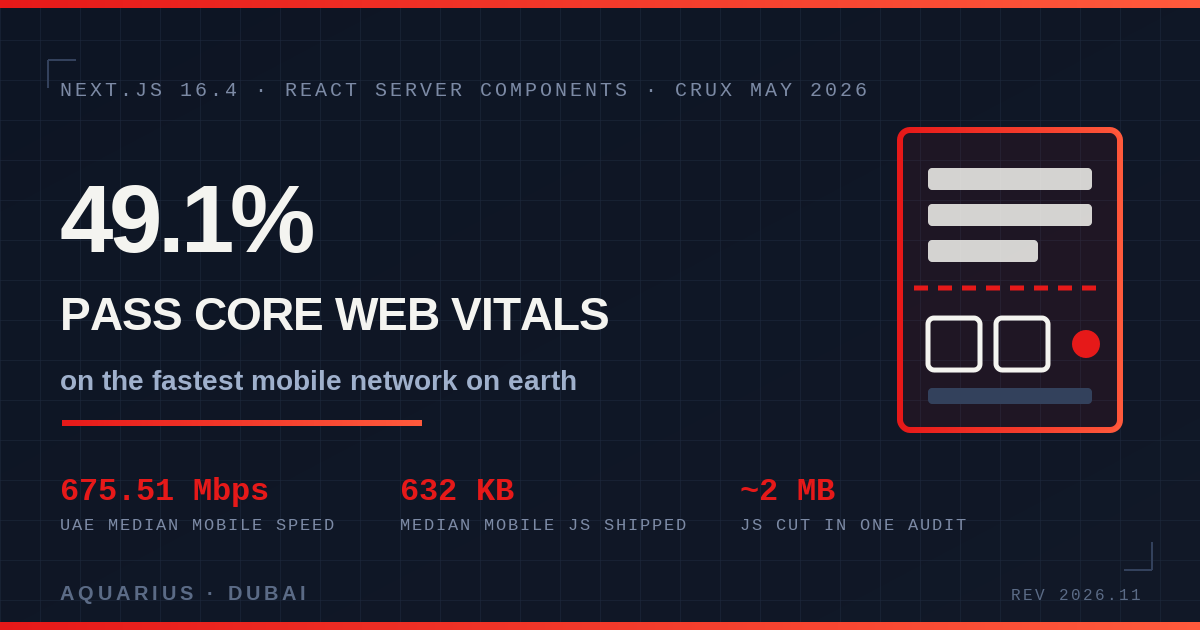
The UAE has the fastest mobile internet on the planet — a median mobile download of 675.51 Mbps — and yet only 49.1% of websites pass Google Core Web Vitals on mobile. That gap exists because modern websites are not bandwidth-bound, they are main-thread bound: the browser must download, parse, compile and hydrate your JavaScript before anything becomes interactive. Next.js 16 with React Server Components attacks that at the architecture level, by rendering on the server and shipping client JavaScript only where interactivity is genuinely needed.
Dubai has world-class bandwidth and average web performance
The connectivity numbers for the UAE are not close to normal. As of the October 2026 Ookla data published in DataReportal, the UAE median mobile download speed is 675.51 Mbps, up 9.9% year on year (+60.87 Mbps), and median fixed broadband sits at 382.40 Mbps, up 17.2% (+56.02 Mbps). Abu Dhabi has been measured as the fastest city on earth for mobile at 702.28 Mbps, with Dubai at 522.64 Mbps in August 2026.
Penetration is just as extreme: 11.5 million internet users at 99.0% of the population, and 24.9 million mobile connections — 215% of the population — all of them broadband-capable. If a Dubai website feels slow, you cannot blame the pipe.
Now the uncomfortable half. In the Chrome UX Report release for May 2026, covering up to 13.75 million origins, only 49.1% of origins passed all three Core Web Vitals on mobile against 58% on desktop. Interaction to Next Paint — the metric that measures how fast your page responds to a tap — passed on 82.5% of mobile origins versus 97.9% on desktop. And roughly two in three failing mobile sites fail on only one vital, usually a loading metric.
The weight data explains why. In the Web Almanac measurement run, the median mobile page shipped 2,164 KB in total, of which 632 KB was JavaScript and 911 KB images; at the 90th percentile a mobile page hit 8,337 KB. Median mobile home page weight rose 8.4% year on year, from 2.4 MB to 2.6 MB.
Most Dubai businesses respond to a slow site by buying a bigger server, a premium CDN plan or a caching plugin. None of those three touch 632 KB of JavaScript that a phone still has to compile on the main thread.
Where the JavaScript actually goes
Server Components are already the default — most builds undo them
In the Next.js App Router every component is a React Server Component until you write use client. That directive is widely misread as a file-level label. It is a boundary: everything imported below a client component is also sent to the browser, bundled, parsed and hydrated. One analytics wrapper or animation provider placed in the root layout can pull an entire page tree across the boundary, which is the single most common reason a brand-new Next.js build in Dubai still ships half a megabyte of JavaScript.
Server Components render to a serialised payload, never ship their dependencies to the client, and have no hydration cost at all. A marketing page, a service page, a property listing, a product grid, a blog article — none of these need to be client components. The interactive bits (a filter, a date picker, a cart drawer) should be small islands inside an otherwise server-rendered tree.
The code-splitting trap that silently does nothing
The standard fix people reach for is dynamic import: lazy(() => import('./Heavy')). Here is the trap — if any other module in the same bundle statically imports ./Heavy, the lazy import defers nothing. The module is already in the chunk. Teams ship this, see no improvement, and conclude that performance work does not pay.
Vercel published the results of running its own bundle-optimisation audit across v0 and vercel.com in late October 2026. It removed nearly 2 MB of compressed JavaScript. The individual findings are instructive because they are so ordinary: an experimental code editor loaded eagerly (150 KB), a dialog registry pulling 40–650 KB, an unused trace viewer at 7–61 KB, an agent panel dragging markdown rendering, syntax highlighting and charts onto the dashboard (255 KB), a natural-language date parser at 55 KB average, and a URL-parsing helper that pulled in an entire observability query engine (125 KB) on the deployments page.
If the company that builds the framework was shipping 2 MB of dead client JavaScript, the odds that your Dubai website is clean are not good.
Turbopack chunking: fewer requests, or less code
Turbopack — the default bundler since Next.js 16 — has to resolve a genuine conflict. Fewer, bigger chunks mean fewer requests but worse reuse across pages; one chunk per module means nothing is over-shipped but hundreds of requests and worse compression. Vercel measured three configurations on nextjs.org. On the initial page load: no merging gave 363.6 KB across 76 requests, the defaults gave 344.2 KB across 24 requests, and merging everything gave 315.3 KB across 6 requests. Across a full eight-page session the defaults shipped 554.8 KB in 38 requests, while maximum merging shipped 610.0 KB — 10% more code — in 15 requests.
The practical takeaway for a Dubai site: the defaults assume two thirds of sessions are a single page view. If your analytics disagree, tell the bundler. Next.js 16.3 and later expose firstPageLoadPriority (default 0.67, your bounce rate is a reasonable starting value), priorityRoutes and clusters for route groups visited together, plus turbopackCjsTreeShaking for CommonJS dependencies and turbopackSharedRuntime, which replaces per-page runtimes and saves a blocking request plus about 10 KB on every navigation after the first.
What actually ships, by architecture
The bands below are what we typically measure on a content-heavy page during Dubai audits, anchored against the 632 KB median mobile JavaScript figure above. Your numbers will vary with how disciplined the client boundary is.
| Architecture | Client JS on a content page | Hydration / INP risk | Where it still makes sense |
|---|---|---|---|
| WordPress + page builder + 25 plugins | 600 KB – 1.5 MB | High | Content sites with no developer on hand |
| Client-rendered SPA (Vite / CRA) | 400 KB – 1 MB | High | Internal dashboards behind a login |
| Next.js Pages Router + SSR | 250 – 500 KB | Medium | Existing apps mid-migration |
| Next.js 16 App Router, server-first | 80 – 180 KB | Low | Marketing, ecommerce, bilingual UAE sites |
Server-first + Cache Components (use cache) | 80 – 180 KB, served from cache | Low | High-traffic UAE sites with heavy data reads |
Compare this with the metric-level view in our Core Web Vitals and website speed optimisation guide for Dubai, which covers the thresholds and the fix list. This article is the layer underneath it: the rendering decision that determines whether those fixes are cheap or impossible.
The bilingual trap: Arabic and English served from the same cache
This is the part no Dubai performance article is covering yet, and it matters here more than almost anywhere else, because bilingual Arabic and English sites are the norm in the UAE and locale is usually a root routing parameter.
On 3 November 2026 Next.js shipped a security release patched in 16.4.5 on the Active LTS line and 15.5.29 on the Maintenance LTS line. One advisory in that release (GHSA-vc7v-qv4w-wrv8) describes nested use cache functions disclosing tenant-, site- or locale-specific content across the corresponding routing boundary. In plain terms: an Arabic visitor can be served content cached for the English route, or one tenant can see another tenant shell. A High-severity advisory in the same release (GHSA-mfr8-8qww-v76h) covers cross-tenant disclosure when unstable_cache and use cache are mixed.
Three more items in that release are worth a line each for anyone self-hosting in the region:
- Self-hosted
next startwith Cache Components enabled and Partial Prefetching left unset can have its shared shell poisoned. - GHSA-f3mh-rxg3-f5g2 — the
x-middleware-set-cookieheader can expose HttpOnly cookies to same-origin JavaScript in Edge routes. - GHSA-7qx7-33qx-rqx2 — an SVG can bypass
dangerouslyAllowSVG: falsethrough AVIF misclassification in the Image Optimization pipeline.
Why this is urgent rather than academic: Cache Components is already the default in new create-next-app projects as of 16.4, and becomes the framework default in Next.js 17. The caching model that carries this class of bug stops being opt-in. If you run a bilingual UAE site on Next.js, pin 16.4.5 or later, and verify that locale is part of every cache key. If you are still weighing platforms, our WordPress vs Next.js headless comparison for Dubai sets out when the move is worth making at all.
What rendering work costs in Dubai (2026 AED)
Dubai development rates in 2026 run roughly AED 100–600 per hour for experienced freelancers and AED 250–700 per hour at mid-market studios. The ranges below are those bands applied to realistic scopes, not a price list.
| Scope | Typical effort | Dubai range (AED) | What you get |
|---|---|---|---|
| Rendering and bundle audit | 8 – 12 hrs | 2,500 – 6,000 | Chunk report, client-boundary map, prioritised fix list |
| Security patch and cache-key review | 4 – 8 hrs | 1,200 – 4,000 | Upgrade to 16.4.5+, locale and tenant cache keys verified |
| Client-boundary refactor, top 10 routes | 30 – 50 hrs | 9,000 – 25,000 | Server-first conversion, real INP movement in field data |
| Full App Router migration with Arabic RTL | 120 – 250 hrs | 35,000 – 120,000 | Bilingual rebuild, CI bundle budget, cache strategy |
The business case does not rest on taste. Analysis of 2.4 million sessions published in 2026 found that each additional second of LCP cut conversion rate by 11.4% on the median site, and that INP above 200 ms was associated with conversion rates around 23% lower. On UAE traffic that is overwhelmingly mobile and overwhelmingly fast-connection, an interaction delay is a self-inflicted wound — the visitor had the bandwidth and your JavaScript spent it.
How Aquarius does it
We build server-first by default and treat every use client as a cost that has to justify itself. In practice that means: a client-boundary map before any code is written, interactive islands kept small and local, a bundle report generated in CI so a regression fails the build rather than the quarter, Arabic and English treated as root parameters with cache keys verified against the November 2026 advisories, and INP measured in the field on real UAE devices rather than in a lab on a desktop.
You get the before-and-after bundle report either way — if we audit and the honest answer is that your current stack is fine, we tell you that. If you proceed to build, the audit fee comes off the project cost. See our pricing for the engagement bands, or send us the URL and we will tell you how much of your page weight is removable.
FAQ
Is migrating to Next.js 16 worth it for a Dubai business website?
If your site is content-led and currently ships 400 KB or more of client JavaScript, yes — a server-first App Router build is the only change that removes the hydration cost rather than optimising around it. If you have a small brochure site that already passes Core Web Vitals, the migration will not pay for itself. Audit first, then decide.
Do React Server Components break Arabic RTL or bilingual sites?
No. RTL is a layout and typography concern handled with dir and logical CSS properties, and it works identically in Server Components. The real bilingual risk is caching: as the 3 November 2026 Next.js advisories show, locale has to be part of the cache key or you can serve the wrong language shell. Pin 16.4.5 or later and verify it.
Will faster rendering actually improve my Google ranking in the UAE?
Core Web Vitals are a confirmed ranking signal, but a modest one — content and relevance dominate. The reliable return is commercial, not positional: with only 49.1% of mobile origins passing all three vitals, and each second of LCP costing roughly 11.4% of conversions on the median site, the money is in the conversion rate, not the ranking.
How much client-side JavaScript should a Dubai marketing site ship?
Under 180 KB compressed on a content page is achievable with a server-first architecture, against a global median of 632 KB on mobile. Set it as a hard budget in CI. A number that nothing enforces is a wish.
Shipping less JavaScript is the one performance decision that cannot be undone by traffic growth, a cheaper host or a marketing campaign. Dubai gave you 675 Mbps. Stop spending it on hydration.