
Website Speed & Core Web Vitals for Dubai Sites (2026): Faster Pages, Better Rankings
A 2026 guide to website speed optimization Dubai teams can act on: fix Core Web Vitals (LCP, INP, CLS), cut UAE latency with CDN and edge, and win rankings.
- PUBLISHED
- 09 SEPT 2026
- READ TIME
- 07 MIN
- AUTHOR
- AQUARIUS · DUBAI
- UNIT
- REV 2026.09
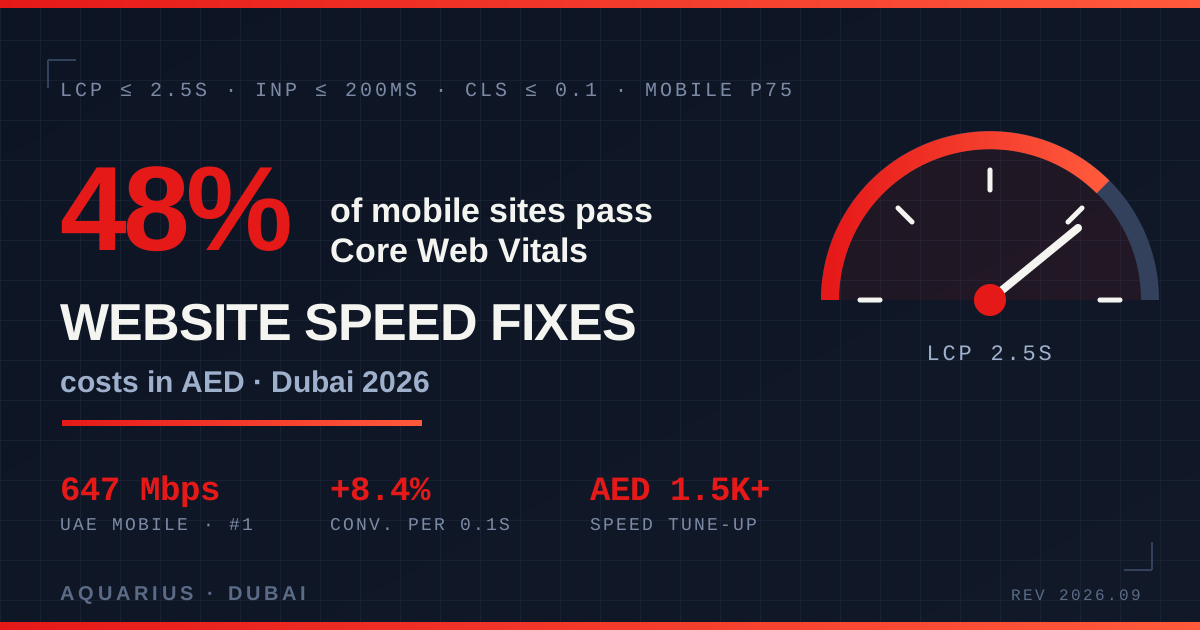
Short answer: A Dubai website passes Google's Core Web Vitals when real mobile visitors see the main content load in under 2.5 seconds (LCP), the page respond to taps in under 200 milliseconds (INP), and the layout stay stable with a shift score under 0.1 (CLS), measured at the 75th percentile of visitors. Only 48% of mobile websites worldwide hit all three. A proper speed optimisation in the UAE typically costs AED 1,500–8,000 for a WordPress, Shopify or WooCommerce site, and more when the fix is a rebuild rather than a tune-up.
Here's the myth most Dubai businesses believe: "Our network is the fastest in the world, so our site must be fast." The UAE does have the fastest mobile internet on the planet. That doesn't help if your homepage ships a 4 MB hero video, twelve tracking scripts and a slider plugin from 2019. A slow site on a fast network is still slow, because the delay comes from your code, images and server, not from the customer's 5G. This guide explains what Core Web Vitals mean, what to fix first, what it costs in AED, and when a tune-up stops being enough.
Why speed matters for Dubai websites (the numbers)
- The UAE has the world's fastest mobile internet. Ookla's Speedtest Global Index put the UAE's median mobile download speed at 647.28 Mbps in April 2026, first in the world. Your visitors notice a slow website even more, because every other app on their phone loads instantly.
- Most UAE online shopping happens on phones. Mobile accounts for roughly 78.67% of e-commerce orders in the UAE in 2026, in a market estimated at about US$12.3 billion (around AED 45 billion) this year. Google also ranks your site based on its mobile version.
- Most websites still fail. The HTTP Archive Web Almanac 2025 found that just 48% of mobile websites pass all three Core Web Vitals (56% on desktop). LCP is the metric that fails most: only 62% of mobile sites have a good LCP.
A 0.1-second faster mobile site lifted retail conversions by 8.4% and travel conversions by 10.1% in Deloitte's Milliseconds Make Millions study of 30 million user sessions across 37 brands.
So speed isn't a developer vanity score. It shapes your Google rankings, what you pay per click (landing page experience feeds Google Ads Quality Score, see our Google Ads cost guide), and how many visitors actually convert.
Core Web Vitals explained in plain English
Google measures three things from real Chrome users (the Chrome UX Report, or CrUX), not from a lab test on your office Wi-Fi. A page "passes" when at least 75% of visits are rated good.
| Metric | What it measures | Good | Poor | Usual Dubai culprit |
|---|---|---|---|---|
| LCP (Largest Contentful Paint) | How fast the main content appears | ≤ 2.5 s | > 4.0 s | Huge hero images or videos, slow shared hosting, lazy-loaded hero image |
| INP (Interaction to Next Paint) | How fast the page reacts to taps and clicks | ≤ 200 ms | > 500 ms | Chat widgets, heavy page builders, too many marketing tags |
| CLS (Cumulative Layout Shift) | How much the layout jumps while loading | ≤ 0.1 | > 0.25 | Cookie banners, late-loading Arabic fonts, images with no set size |
One detail matters a lot: a PageSpeed Insights score of 95 in the lab doesn't mean you pass. The pass or fail that Google uses comes from the "Discover what your real users are experiencing" section at the top of the report. Plenty of Dubai sites score well in the lab and still fail on real phones.
What actually slows Dubai websites down
1. Images, especially the hero
Images are the LCP element on 76% of mobile pages (Web Almanac 2025), and about 16% of pages lazy-load their LCP image. That one mistake tells the browser to wait before loading the most important picture on the page. Real estate, hospitality, yacht charter and interior design sites in Dubai are the worst offenders. They upload 5–8 MB photos straight from the camera.
Fix: serve AVIF/WebP at the size the screen actually needs, never lazy-load the hero, add fetchpriority="high" to it, and swap autoplay hero videos for a poster image on mobile.
2. Hosting far from your customers
Many UAE sites still run on cheap shared hosting in the US or Europe. Every request then has to cross continents before the first byte arrives. The major cloud providers now have regions in or near the Gulf: AWS Middle East (UAE) me-central-1, Azure UAE North, and Google Cloud in Doha and Dammam. A good CDN edge in the region brings Time to First Byte down sharply. If you handle personal data, hosting location also matters for compliance. See our Dubai hosting and data residency guide.
3. Third-party scripts
Meta Pixel, TikTok Pixel, Snap Pixel, Google Tag Manager, Hotjar, a live chat widget, a WhatsApp button plugin, a review widget and a BNPL banner can each add 50–300 ms of main-thread work. INP is where this shows up. Load non-critical tags after user interaction or through a server-side tag setup.
4. Page builders and plugin bloat
A WordPress site with Elementor, 40+ plugins and three slider libraries can load over 1 MB of JavaScript before anyone scrolls. Caching plugins hide some of the problem, but they don't remove unused code.
5. Bilingual font and layout issues
Arabic/English sites often load four or more font families (Latin and Arabic, regular and bold) from external servers. When those fonts arrive late, text reflows and CLS goes up. Host your fonts yourself, subset them, preload the one used above the fold, and use font-display: swap with matched fallback metrics. If you're building the Arabic side from scratch, our Arabic RTL localisation guide covers this.
Tune-up vs rebuild: which one do you need?
| Situation | Right move | Indicative cost (AED) | Timeline |
|---|---|---|---|
| Brochure WordPress/HTML site, fails LCP only | Speed tune-up: images, caching, CDN, fonts | 1,500–3,000 | 2–5 days |
| WooCommerce or Shopify store, fails LCP + INP | Deep optimisation: theme cleanup, app/plugin audit, script deferral | 3,000–8,000 | 1–2 weeks |
| Custom web app or portal, slow server responses | Backend profiling, database indexing, caching layer, regional hosting | 8,000–25,000 | 2–4 weeks |
| Page builder site failing all three after optimisation | Rebuild on a modern stack (e.g. Next.js, static rendering) | Project-priced, see pricing | 4–8 weeks |
The tune-up ranges reflect published UAE price lists. Specialists advertise basic WordPress speed work from about AED 1,500, and WooCommerce or custom sites at AED 3,000–8,000, usually finished in 3–7 days. Be careful with any quote that only promises "PageSpeed 90+". That's a lab score. Ask for a field-data (CrUX) pass as the goal instead.
A 30-day speed plan for Dubai businesses
- Days 1–3: Measure real users. Pull the CrUX field data in PageSpeed Insights and the Core Web Vitals report in Google Search Console. List the failing URL groups, such as product pages, blog posts and landing pages.
- Days 4–10: Fix LCP. Optimise and prioritise hero images, stop lazy-loading anything above the fold, turn on a CDN with a regional edge, and cache full pages where you can.
- Days 11–20: Fix INP. Audit every third-party tag, remove unused plugins and apps, defer chat and review widgets until the visitor interacts, and break up long JavaScript tasks.
- Days 21–25: Fix CLS. Set width and height on every image and embed, reserve space for banners, and self-host and preload fonts.
- Days 26–30: Lock it in. Add a performance budget to your deployment process and set up monthly monitoring. CrUX uses a rolling 28-day window, so Search Console takes about four weeks to show the improvement.
Most of this belongs in ongoing care, not a one-off project. New plugins, new pixels and new campaign pages bring speed problems back. Our website maintenance cost guide shows what a sensible monthly plan includes.
The cost of doing nothing
Here's a simple way to estimate what a slow site costs you. Take a Dubai store doing AED 200,000 a month online. Applying Deloitte's retail finding (+8.4% conversions for 0.1 s faster) to that store suggests roughly AED 16,800 in extra monthly revenue from a small improvement. That one month is enough to pay for a typical AED 3,000–8,000 optimisation several times over. Your own numbers will differ. The direction doesn't: on a mobile-first market like the UAE, where most orders come from phones, speed is revenue. Pair it with conversion rate optimisation and the two effects add up.
How Aquarius fixes Core Web Vitals
- Field data first: we set targets based on the CrUX data Google actually uses, not a lab score that looks good in a screenshot.
- Fixed-scope quote in AED: after a free audit you get a clear list of fixes and a fixed price before any work starts.
- Tune-up or rebuild, honestly: if optimising your current site won't pass, we tell you, and show what a modern rebuild would cost. See our website redesign cost guide.
- Bilingual and compliance-aware: Arabic/English performance, UAE-region hosting options, and consent-friendly tag loading.
- Risk reversal: changes go to staging first with a full backup, so your live site and revenue are never the test bed.
Explore our web development services, or send us your URL for a free Core Web Vitals audit of your Dubai website.
FAQ
Are Core Web Vitals a Google ranking factor in 2026?
Yes. Core Web Vitals are part of Google's page experience signals. They rarely beat relevance and content quality, but when two pages are equally relevant, the faster one has the edge. They also affect conversions and Google Ads landing page experience directly.
What are the Core Web Vitals thresholds?
LCP of 2.5 seconds or less, INP of 200 milliseconds or less, and CLS of 0.1 or less, all measured at the 75th percentile of real visitors, separately for mobile and desktop.
How much does website speed optimisation cost in Dubai?
About AED 1,500–3,000 for a simple WordPress or HTML site, AED 3,000–8,000 for WooCommerce, Shopify or custom sites, and more for backend work on web apps. If the platform itself is the bottleneck, a rebuild is quoted as a project.
Why is my site slow if the UAE has such fast internet?
Network speed only removes one delay. Oversized images, render-blocking scripts, distant servers and page-builder bloat all slow the page down inside the phone's browser, whatever the connection speed.
How long until Google sees the improvement?
Search Console's Core Web Vitals report uses a rolling 28-day window of real-user data, so allow roughly four weeks after the fixes go live for the status to move from "Poor" or "Needs improvement" to "Good".
Sources: Ookla Speedtest Global Index (April 2026); HTTP Archive Web Almanac 2025, Performance chapter; Deloitte and Google, "Milliseconds Make Millions"; Google web.dev Core Web Vitals thresholds; published UAE speed optimisation price lists (2026).