
Office Wi-Fi 7 Setup in Dubai (2026): Real AED Costs and the 6 GHz Catch
Dubai offices get 500 MHz of 6 GHz Wi-Fi spectrum at 250 mW indoors, which is one 320 MHz channel, and the upper band went to 5G. Real AED costs, AP math and the TDRA import trap.
- PUBLISHED
- 18 NOV 2026
- READ TIME
- 10 MIN
- AUTHOR
- AQUARIUS · DUBAI
- UNIT
- REV 2026.09
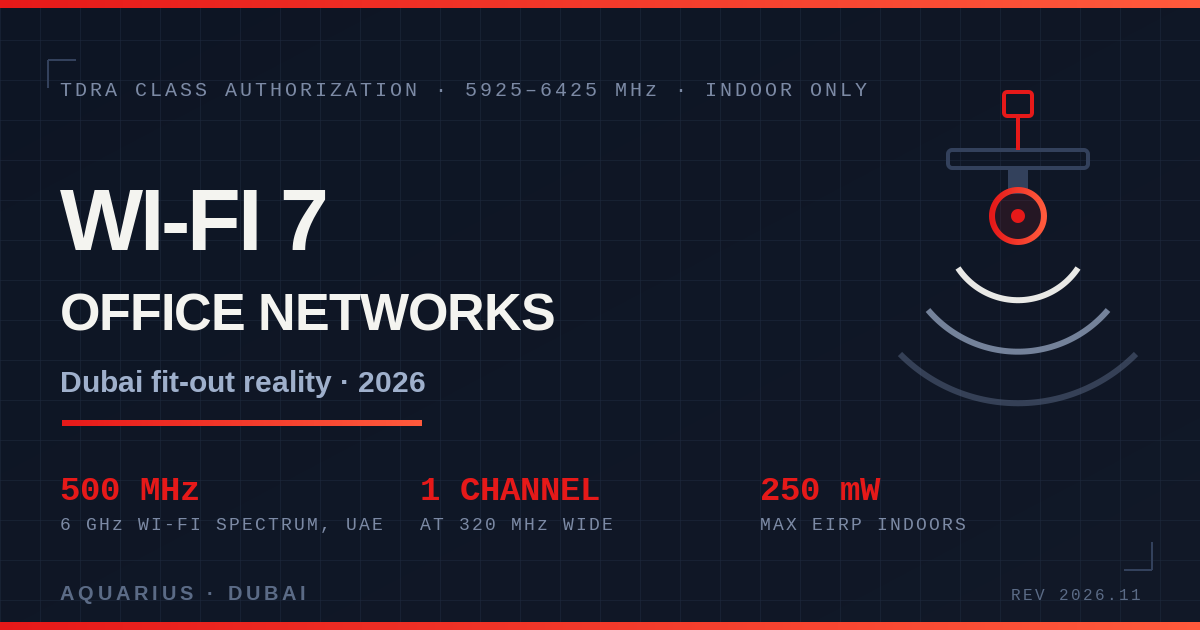
Short answer: Wi-Fi 7 is worth buying for a Dubai office in 2026, but not for the reason the box tells you. The UAE has designated only 500 MHz of 6 GHz spectrum (5925–6425 MHz) for indoor Wi-Fi, at a maximum EIRP of 250 mW under TDRA class authorization — that is exactly one contiguous 320 MHz channel for the entire building, and the upper 6 GHz band that would have added more went to 5G instead. So the headline 320 MHz number is unusable in any office with more than one access point. What actually fixes Dubai office Wi-Fi is Cat6A cabling, honest AP density and a PoE budget — roughly AED 250–450 per data point and AED 500–2,500 per access point.
The stakes: the UAE has world-class internet and mediocre office Wi-Fi
Three numbers frame this. First, the UAE ranked second in the world for fixed broadband in the September 2026 Speedtest Global Index, with a median download speed of 382.4 Mbps — behind only Singapore. Second, e& business fibre now sells 1 Gbps to an SME for AED 3,375 a month (12-month Business Pro, excluding 5% VAT, plus a one-time AED 200 installation fee). Third, Wi-Fi 7 crossed more than 50% of the enterprise access-point market in Q2 2026 according to Dell'Oro Group, on an industry-record quarter for AP shipments.
Put those together and you get the single most common complaint we hear from Dubai offices: the line into the building is gigabit, the APs on the ceiling are brand new, and the Teams call in the corner meeting room still drops. The bottleneck is almost never the circuit. It is the three metres between the ceiling tile and the laptop — and in the UAE, that gap is shaped by a spectrum decision made in 2020.
The 6 GHz catch nobody puts in the brochure
On 27 December 2020, the TDRA designated an additional 500 MHz of the 6 GHz band, specifically 5925–6425 MHz, to Wi-Fi for indoor use at an EIRP of 250 mW under class authorization. That made the UAE the first country in the MENA region and roughly the fifth in the world to open 6 GHz for licence-exempt use. It was genuinely ahead of the curve, and it is still the operative rule in 2026.
Two details in that sentence decide how your office network has to be designed.
Detail one: 500 MHz is one 320 MHz channel, not three
Wi-Fi 7's flagship feature is the 320 MHz channel. A 500 MHz allocation fits exactly one of them with change left over. The United States and South Korea cleared the full 1,200 MHz (5925–7125 MHz), which fits three. The UAE took the conservative lower slice, the same approach the UK and most of the EU took.
In a single-AP home, one 320 MHz channel is fine. In an office with six APs, it is useless: you cannot re-use the only wide channel you have without every AP shouting over its neighbour. The practical design in Dubai is 160 MHz channels in 6 GHz, with a plan to drop to 80 MHz in dense floors. Anyone quoting you Wi-Fi 7 on the strength of "320 MHz support" has not checked which country you are in.
Detail two: the upper 6 GHz band is gone, and it went to 5G
This is the part that changes long-term planning. Following WRC-23, which identified 6425–7125 MHz for IMT in ITU Region 1, the TDRA identified the full upper 6 GHz range for IMT in the UAE National Frequency Plan and is incorporating it as band n104 in national type-approval requirements, with compatible devices expected from September 2026. e& UAE has an allocation of 6425–6775 MHz — up to 350 MHz of contiguous spectrum — with commercial rollout planned for the second half of 2026.
The TDRA's own UAE Spectrum Outlook (2026–2031) Version 2.0, published 17 November 2025, notes that WRC-23 "upheld flexibility for administrations to decide whether to allocate this band for RLANs or for IMT use", and that the authority "continues to monitor these developments". Its 6 GHz roadmap entries point at IMT and 6G, not at more Wi-Fi. The band it does schedule for Wi-Fi review is 5650–5850 MHz, in the 2026–2027 window.
Plan on the assumption that 500 MHz is all the 6 GHz Wi-Fi spectrum a UAE office will ever get. Design for channel re-use, not for one giant pipe.
Detail three: 250 mW means more access points
The FCC permits 30 dBm EIRP (1 watt) for low-power indoor 6 GHz APs. The UAE's 250 mW is about 24 dBm — roughly 6 dB lower, in line with European limits. Six decibels is not a rounding error: it is a materially smaller 6 GHz cell for the same hardware. The same AP model, mounted identically, covers less area in Dubai than in Dallas.
The consequence is purely commercial. Vendor coverage calculators and US-authored "one AP per 1,500 sq ft" rules of thumb will under-count your AP requirement. For a Dubai office we plan on one AP per 10 to 15 desks, with every enclosed meeting room treated as its own coverage problem — glass partitions and the gypsum-and-stud walls typical of DIFC and Business Bay fit-outs are far less forgiving at 6 GHz than at 2.4 GHz.
So is Wi-Fi 7 worth it for a Dubai office?
Yes — because the features that actually matter in the UAE have nothing to do with channel width.
| Wi-Fi 7 feature | Does it work in the UAE? | Why it matters in a Dubai office |
|---|---|---|
| 320 MHz channels | One channel only (500 MHz allocation) | Effectively unusable with multiple APs. Ignore it. |
| Multi-Link Operation (MLO) | Yes, fully | The real win. A client uses 5 GHz and 6 GHz at once, so a burst of interference no longer drops the call. |
| 4K-QAM | Yes, at short range | Around 20% more throughput for devices near the AP. Good for meeting rooms, irrelevant at the far desk. |
| Preamble puncturing | Yes | Lets a wide channel route around a narrow interferer instead of collapsing. Valuable in dense towers. |
| 6 GHz band itself | Indoor only, 250 mW | A clean band with no legacy clients. The biggest practical gain over Wi-Fi 5/6 in a crowded building. |
Buy Wi-Fi 7 for MLO and for a clean 6 GHz band. Do not pay a premium for a 320 MHz spec sheet you cannot deploy.
The unglamorous part that actually fixes office Wi-Fi
Every AP is only as good as the cable behind it. A Wi-Fi 7 AP that can push multiple gigabits over the air, hanging off a 1 GbE copper run and a switch port without PoE headroom, is an expensive ceiling ornament.
What a correct 2026 Dubai office drop looks like:
- Cat6A to every AP, not Cat6. Cat6A is what supports 10GBASE-T to 100 m and handles PoE heat better in a bundled tray.
- Two drops per AP location, terminated and tested. The second one costs a fraction of a return site visit after the ceiling is closed.
- A 2.5 GbE or better switch port per AP. Wi-Fi 7 APs routinely ship with 2.5 GbE uplinks for exactly this reason.
- PoE+ (802.3at) minimum, PoE++ (802.3bt) preferred, and a switch power budget sized for every port at once, not an average.
- A certified test report per point — Fluke-style results, labelled and handed over. If the contractor will not provide it, the points are not certified.
Current Dubai market rates, as quoted by local structured-cabling contractors for 2026:
| Item | Dubai 2026 range (AED) | Note |
|---|---|---|
| Cat6 data point, installed | 150 – 300 | Adequate for desks, not ideal for APs |
| Cat6A data point, installed | 250 – 450+ | Includes outlet, patch-panel termination and testing |
| Wi-Fi access point (hardware) | 500 – 2,500+ | Wi-Fi 7 APs start near the low end: UniFi U7 Pro lists around USD 199–209 |
| Patch panel installation | 300 – 1,500+ | Per panel |
| Network rack installation | 800 – 5,000+ | Wall-mount to full 42U |
| Core network gear (switching) | 5,000 – 20,000+ | Scales with port count and PoE budget |
| Business firewall and security | 2,500 – 15,000+ | Licence-dependent, renews annually |
| 200-point Cat6A system, fully installed | 50,000 – 90,000 | Typical mid-size Dubai office |
Check what the number includes. A per-point price that excludes the rack, patch panels, cable management and testing is not a price, it is a deposit.
The import trap: TDRA type approval and customs clearance
This is where Dubai office projects lose weeks, and it has nothing to do with radio engineering.
Any radio or telecommunications terminal equipment — which includes every Wi-Fi access point, router and switch with a radio — must hold TDRA type approval before it can be used, sold or distributed in the UAE. The certificate is valid for three years and typically takes three to four weeks once documentation is ready. Applications must be filed under a TDRA-registered UAE dealer or importer, which is the step most first-timers miss.
Then, on 2 February 2026, the TDRA clarified that type approval alone is not enough: regulated telecom equipment also needs a separate customs clearance permit, filed online via UAE Pass, and both must align before the shipment moves. The permit service itself is free and processes in about an hour when the paperwork is complete — and blocks the container indefinitely when it is not.
Two practical rules follow:
- Buy the UAE or EU SKU, never the US one. A US-model 6 GHz AP is built for a 1 W standard-power regime the UAE does not permit indoors, and it will not carry UAE type approval.
- Buy through a TDRA-registered local distributor. The AED saving on a grey-market or direct-import AP evaporates the first time a shipment is held at the border and the fit-out handover slips.
What a Dubai office network actually costs in 2026
Indicative all-in ranges, hardware plus installation, excluding the internet circuit and 5% VAT:
| Office size | APs | Data points | All-in (AED) |
|---|---|---|---|
| Small (10–15 desks) | 2 – 3 | 25 – 40 | 15,000 – 35,000 |
| Medium (30–60 desks) | 4 – 8 | 70 – 140 | 60,000 – 150,000+ |
| Large floor (100+ desks) | 10 – 18 | 200+ | 150,000 – 350,000+ |
Now the cost of getting it wrong. A medium Dubai office pays roughly AED 60,000 to 150,000 for its network once. It pays AED 3,375 a month for the gigabit circuit that network throttles, and it pays Business Bay or DIFC rent on meeting rooms that cannot hold a video call. The network is usually under 2% of a fit-out budget and the single most visible thing in the office when it underperforms. Re-cabling after the ceiling is closed and the furniture is in costs multiples of doing it right the first time.
How Aquarius approaches it
We design to the UAE's actual spectrum rules, not a vendor's global datasheet: a 6 GHz channel plan built for 500 MHz, AP density derived from a 250 mW EIRP ceiling and your real floor plate, Cat6A to every AP with two drops and a certified test report per point, and a PoE budget that survives every port drawing at once. Every radio we specify is checked for valid TDRA type approval and sourced through a registered local importer before anything is ordered. If you are also still backhauling staff through an office VPN, read how ZTNA and SASE replace the office VPN for Dubai teams — the cabling decision and the access decision are best made together. For ongoing support and monitoring after handover, see our managed IT and AMC cost guide, or go straight to pricing.
FAQ
Is Wi-Fi 6E hardware still worth buying in Dubai in 2026?
Only at a steep discount. Wi-Fi 6E and Wi-Fi 7 use the same UAE 6 GHz allocation under the same 250 mW indoor limit, so coverage is comparable. What Wi-Fi 7 adds is MLO, 4K-QAM and preamble puncturing. Since Wi-Fi 7 passed half the enterprise AP market in Q2 2026, 6E pricing no longer reflects a meaningful saving.
Can I use 6 GHz Wi-Fi outdoors in the UAE, for a villa compound or warehouse yard?
No. The TDRA designation is explicitly for indoor use at 250 mW EIRP under class authorization. Outdoor coverage has to come from 2.4 GHz and 5 GHz, or from a licensed link. Do not deploy US standard-power or AFC-enabled 6 GHz equipment outdoors here.
Will the UAE open more 6 GHz spectrum for Wi-Fi later?
Treat it as unlikely. The TDRA identified the full 6425–7125 MHz range for IMT in the National Frequency Plan after WRC-23 and is bringing it in as band n104, with e& holding 6425–6775 MHz for commercial rollout in the second half of 2026. The UAE Spectrum Outlook (2026–2031) v2.0 schedules a Wi-Fi and RLAN review for 5650–5850 MHz instead.
How many access points does a 5,000 sq ft Dubai office need?
Plan on four to six, then validate. Desk count matters more than area — we budget one AP per 10 to 15 desks — and every enclosed meeting room needs its own coverage check. Overrun a cable to one or two spare ceiling positions during the fit-out; adding a drop later, after the ceiling is sealed, is the expensive version.
Do I need TDRA approval for access points I bought abroad and carried in myself?
Personal imports are still within scope of the TDRA's customs clearance requirement, and equipment without valid type approval cannot legally be used, offered or supplied in the UAE. For a commercial office, buy the UAE SKU through a TDRA-registered importer. The saving is not worth a stranded shipment or non-compliant kit on your ceiling.
Before you sign the fit-out contract
Ask three questions. What channel width is the 6 GHz plan built on, and why? How many APs, derived from desk count rather than square footage? And is every radio TDRA type-approved under a registered importer? If the contractor cannot answer all three on the spot, the Wi-Fi will disappoint whatever the circuit does.
Planning a Dubai office fit-out, a floor move or a network refresh? Tell us the floor plan and the desk count and we will send back an AP plan, a Cat6A drop map and an honest AED range — before anyone pulls a cable.