
Replace the Office VPN: ZTNA and SASE for Dubai Businesses in 2026
VPNs are legal in the UAE - and now the No.1 breach entry point. What ZTNA and SASE cost per user in AED, what TDRA rules really say, and how to migrate safely.
- PUBLISHED
- 17 NOV 2026
- READ TIME
- 12 MIN
- AUTHOR
- AQUARIUS · DUBAI
- UNIT
- REV 2026.09
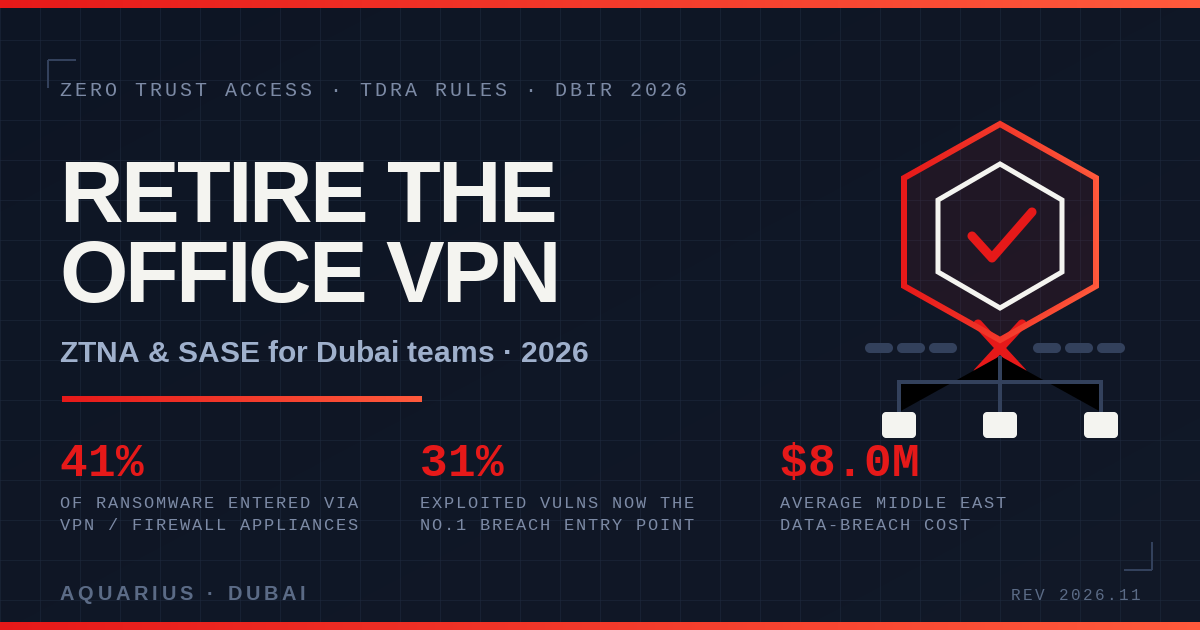
No — a VPN is not illegal for a business in the UAE, and that is exactly why so many Dubai companies are still running one they should have retired. The TDRA has stated plainly that "there are no regulations which prevent the use of VPN technology by companies, institutions and banks to access their internal networks through internet." The problem in 2026 is not legality. It is that the VPN appliance sitting in your server room has become the single most attacked device on your network.
Verizon's 2026 Data Breach Investigations Report — built from more than 31,000 incidents and 22,000 confirmed breaches across 145 countries — found that exploitation of vulnerabilities is now the number-one initial access vector at 31%, overtaking credential abuse, which fell to 13%. Mandiant's M-Trends 2026 is blunter about where those exploits land: 41% of ransomware intrusions entered through a VPN, firewall or remote-management appliance vulnerability. And edge devices and VPNs, which accounted for roughly 3% of exploitation-driven breaches two years ago, now account for about 22%.
This guide covers what Zero Trust Network Access (ZTNA) and SASE actually replace, what the UAE rules really say, what it costs in AED for a Dubai team of 10 to 200 people, and how to migrate without a weekend outage.
Why the Dubai VPN problem is worse than the global average
The UAE is one of the most actively probed digital economies in the world. The UAE Cyber Security Council reports blocking in the order of 90,000 to 200,000 attempted breaches every day, with 128 confirmed incidents logged in 2026 — and by late 2026 officials were citing figures closer to 600,000 attempted attacks per day, roughly 25,000 an hour. The confirmed incident mix is instructive: defacement 38.3%, data leaks 25.8%, data breaches 13.3% and ransomware 7.8%.
When one lands, it is expensive. IBM's Cost of a Data Breach 2026 puts the Middle East average at USD 8.0 million per breach — about AED 29 million, second only to the United States and far above the global average of USD 4.99m. Financial services and technology firms in the region average USD 10.67m each; industrial companies USD 9.6m. The largest single line item is lost business at USD 3.57m, followed by post-breach response at USD 2.17m.
Most Dubai businesses get the risk model backwards. They treat the VPN as a security control. An attacker treats it as a login page that, once passed, drops them onto a flat internal network with file servers, the ERP, the CCTV NVR and the accounts machine all reachable. That is the actual failure: not the tunnel, but what the tunnel connects you to.
The legal bit: what UAE law says about VPNs (and what it doesn't)
This is the part that generates the most bad advice in Dubai, so here it is precisely.
- Corporate VPNs for internal access are fine. The TDRA's position (published 31 July 2016 and never reversed) explicitly permits companies, institutions and banks to use VPN technology to reach their internal networks over the internet.
- Criminal liability requires criminal intent. Article 10 of Federal Decree-Law No. 34 of 2021 penalises using a fraudulent IP address or third-party computer protocol "for the purpose of committing a crime or preventing its discovery" — punishable by imprisonment and a fine of not less than AED 500,000 and not more than AED 2,000,000. Using a VPN to open your own CRM is not within a mile of that.
- Consumer VPN services are a different animal. Under the TDRA's Regulatory Policy on Internet Access Management, services whose purpose is to bypass ISP filtering fall under prohibited content categories. If you are building an app or portal, do not ship a feature that proxies UAE users around filtering — that is what gets blocked, not your office access.
- There is no official "approved VPN list." Any vendor claiming TDRA approval is marketing, not regulation.
Practical upshot: your decision to keep or kill the VPN is an engineering and risk decision, not a compliance one. Where compliance does bite is data residency and UAE PDPL obligations on who can reach personal data — and that is an argument in favour of ZTNA, because it gives you per-user, per-application access logs a flat VPN cannot produce.
What ZTNA and SASE actually replace
Strip the acronyms and there are only two ideas.
ZTNA: access to an app, not to a network
With a VPN, you authenticate once and receive an IP address on the corporate network. With ZTNA, a broker checks identity and device posture on every request and connects that user to one specific application — the ERP, a single internal dashboard, one SSH host — and nothing else. There is no inbound port open to the internet, because a lightweight connector inside your network dials out to the broker. Nothing to scan, nothing to exploit, nothing to patch at 2am when the next appliance CVE lands in CISA's Known Exploited Vulnerabilities catalogue.
That patching point is not theoretical. The DBIR 2026 found only 26% of KEV-listed critical vulnerabilities were fully remediated during 2025 — down from 38% — with a median full-resolution time of 43 days, up from 32. Six weeks of exposure on an internet-facing appliance is the whole ballgame.
SASE: the same logic for branches and internet traffic
SASE (Secure Access Service Edge) bundles ZTNA with a secure web gateway, cloud firewall, CASB for SaaS control and SD-WAN for site connectivity. It is what you want if you have multiple Dubai or GCC locations — a JLT head office, a warehouse in Al Quoz, a Sharjah factory, a Riyadh sales office — and you are currently stitching them together with site-to-site VPNs on consumer-grade routers. Gartner expects the majority of new SD-WAN purchases to arrive as part of a single-vendor SASE platform rather than standalone hardware, and the SASE market is forecast at roughly USD 19.2 billion in 2026, growing to USD 68 billion by 2032 (28.8% CAGR).
The honest trade-offs
- Legacy protocols. Thick clients, old SMB shares and some licence dongles still want a routed network. Most ZTNA platforms handle this, but it needs testing before you cancel anything.
- You are renting a dependency. If the broker has an outage, access stops. Keep one break-glass path — a hardened bastion with MFA — documented and tested quarterly.
- Latency. Check the vendor has a UAE or nearby GCC point of presence. A broker that hairpins Dubai traffic through Frankfurt will be noticed by every user on day one.
- Per-user billing changes behaviour. Contractor and seasonal-staff counts start mattering to the invoice in a way a one-off firewall never did.
What it costs in Dubai: real 2026 numbers
ZTNA is priced per user per month; connectivity is still priced per circuit. Both lines matter when you build a budget. Vendor list prices below are converted at AED 3.67 to the dollar and exclude 5% VAT.
| Option | List price | Approx. AED / user / month | Best fit in Dubai |
|---|---|---|---|
| Tailscale Personal | Free, up to 6 users | 0 | Founder-plus-developer setups, test environments |
| Cloudflare Access (Zero Trust) | Free to 50 users, then USD 7/user/mo | ~AED 26 | SMEs already behind Cloudflare DNS/WAF |
| Twingate Teams / Business | USD 5 / USD 10 per user/mo (annual) | ~AED 18 – 37 | Fast replacement of a single remote-access VPN |
| Tailscale Standard / Premium | USD 8 / USD 18 per user/mo | ~AED 29 – 66 | Engineering teams, multi-cloud and server access |
| Zscaler Private Access | USD 15 – 25 per user/mo | ~AED 55 – 92 | 200+ seats, regulated sectors, full SASE roadmap |
| Managed ZTNA rollout (one-off) | Project fee | AED 12,000 – 45,000 | Design, connectors, IdP integration, cutover, runbook |
Connectivity sits underneath all of it. e& (Etisalat) Business Pro AI on a 24-month term runs from AED 1,095/month for a 2-user, 300 Mbps line to AED 3,075/month at 10 users and 1 Gbps, with a one-time AED 200 installation and 5% VAT on top; the 12-month Business Pro tier tops out around AED 3,375/month. du Business Fibre starts near AED 810/month and reaches about AED 2,990 for 1 Gbps. A 25-seat Dubai office therefore lands at roughly AED 650 – 2,300/month in ZTNA licensing on top of a circuit it already pays for — against an average regional breach cost of AED 29 million.
The numbers that usually decide it are not the licences, though. They are the hardware refresh you avoid, the VPN concentrator support contract you cancel, and the hours your IT provider stops spending on emergency appliance patching.
How to migrate without breaking Sunday morning
- Inventory what the VPN is actually used for. Pull 30 days of logs. In most Dubai SMEs, 80% of VPN sessions exist to reach two or three applications — often just a file share and the accounting system.
- Fix identity first. ZTNA is only as good as the identity provider behind it. Microsoft Entra ID or Google Workspace with enforced MFA, plus conditional access, is the foundation. Do this even if you keep the VPN.
- Run both in parallel for two to four weeks. Deploy connectors, publish applications, move one department at a time. Nothing is cancelled yet.
- Add device posture once users are stable. Disk encryption, OS version, EDR present. Introducing posture checks on day one is how rollouts get rolled back.
- Close the inbound ports, then decommission. This is the step that actually removes the risk. Keep the appliance powered off but on the shelf for 30 days, and keep your documented break-glass path.
For a 10 to 60-seat Dubai business, this is a two-to-four week project, not a quarter. The slow part is almost always discovering an undocumented legacy application nobody owns.
How Aquarius does it
We handle this as a fixed-scope engagement: application and session audit, identity hardening, ZTNA platform selection against your actual circuit and latency constraints, connector deployment, phased cutover by department, PDPL-aware access logging, and a written runbook your team or your existing IT provider can operate without us. We are vendor-neutral — if Cloudflare Access on your existing plan solves it for AED 0 up to 50 users, we will tell you that rather than sell you a platform.
We also build the internal tools people reach through that access layer — dashboards, portals, operations software — so the access design matches how the application is actually used. See our services and pricing, or read our breakdown of managed SOC and MDR monitoring costs in Dubai for the detection layer that sits alongside it.
Risk reversal is simple: we scope in writing, quote fixed, and the parallel-run phase means your existing VPN stays live until you confirm the replacement works. If it does not, you have lost nothing but the audit — which you needed anyway.
One last number to frame the decision. Third-party involvement in breaches rose 60% to reach 48% of all cases in the 2026 DBIR, and 26% of malicious breaches in the Middle East now involve AI-enabled attacks. The attack surface you are defending is widening while remediation times get longer. A flat network behind a single appliance is not a position you want to hold in 2027.
Book a free 30-minute access review — we will tell you whether your VPN is a real risk or a fine solution for your size, with no obligation either way.
FAQ
Is using a VPN illegal in the UAE?
No. The TDRA has confirmed there are no regulations preventing companies, institutions and banks from using VPN technology to access their internal networks over the internet. Article 10 of Federal Decree-Law No. 34 of 2021 only criminalises using a fraudulent IP address or third-party protocol for the purpose of committing or concealing a crime, carrying a fine of AED 500,000 to AED 2,000,000. Ordinary corporate remote access is not an offence.
What does ZTNA cost for a small Dubai business?
Between roughly AED 18 and AED 92 per user per month depending on platform and tier, with Cloudflare Access free up to 50 users and Tailscale free up to 6. A managed design-and-cutover project typically runs AED 12,000 to AED 45,000 one-off. Budget separately for your internet circuit, which starts around AED 810 – 1,095 per month for business fibre in Dubai.
Do I still need a firewall if I move to ZTNA?
Yes, but its job shrinks. You still want egress filtering, segmentation and inspection for on-premise devices — printers, CCTV, POS terminals, factory equipment — that cannot run an identity agent. What you stop needing is an internet-facing VPN service on that firewall, which is the part being exploited.
Will ZTNA satisfy UAE PDPL requirements?
It helps materially rather than automatically. PDPL expects you to control and demonstrate who accessed personal data. ZTNA produces per-user, per-application access records that a flat VPN cannot, which makes access-control evidence straightforward. You still need the rest of your programme: lawful basis, retention, data-subject request handling and breach notification.
Is SASE overkill for a company with one Dubai office?
Usually yes. A single-site business with under 50 staff should start with ZTNA plus a hardened identity provider. SASE earns its keep when you have multiple sites or countries, heavy SaaS usage requiring CASB controls, or you are about to replace branch routers anyway.