
Offline-First App Sync for Dubai Field Teams: Conflict Rules and Real AED Costs (2026)
UAE 5G covers 99.5% of populated areas, yet warehouses, basements and site decks still kill signal. The three levels of offline, per-field conflict rules, sync engine picks and AED build costs.
- PUBLISHED
- 07 NOV 2026
- READ TIME
- 13 MIN
- AUTHOR
- AQUARIUS · DUBAI
- UNIT
- REV 2026.09
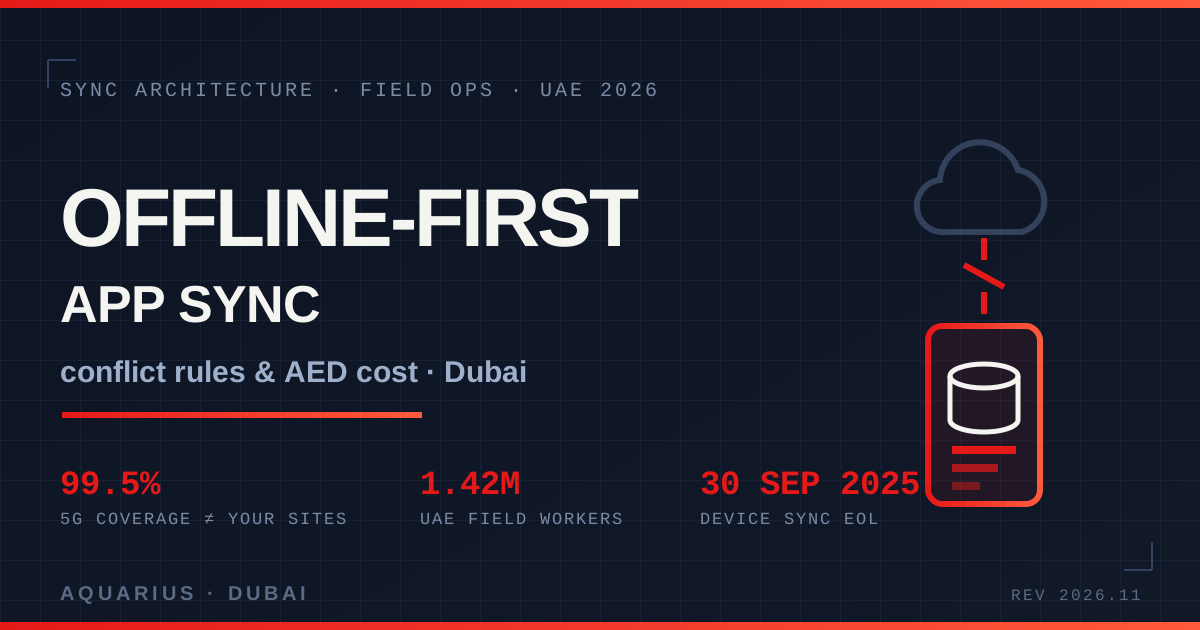
Short answer: offline-first means the device writes to its own local database first and syncs to your server later — it does not mean “we cache the last screen”. For a Dubai field team that distinction is worth real money: the UAE has 5G across more than 99.5% of populated areas from 23,000+ sites, yet the places your staff actually work — Jafza warehouse aisles, basement plant rooms, lift shafts, Dubai South construction decks, offshore vessels — are exactly where that signal dies. Build the local database and the conflict rules first, and the network becomes an optimisation rather than a dependency.
Three numbers set the stakes. The UAE runs 22.1 million mobile connections for a population of 11.4 million and posted a median mobile download speed of 614.42 Mbps in early 2026 — among the fastest on earth, which is precisely why Dubai product owners assume connectivity is solved. It is not: on 15 July 2026 a du system update knocked out calling across Dubai and Abu Dhabi, with Downdetector reports spiking from 07:35 and 72% of complaints about voice, 13% mobile signal and 8% mobile internet; in September 2025 severed Red Sea submarine cables slowed both e& and du data nationwide. And the workforce exposed to those gaps is enormous — roughly 1.42 million construction workers were active in the UAE in Q1 2026, with Dubai accounting for about 54% of new construction starts by permit count and 10,776 Dubai Municipality building permits in Q1 2026 alone, up 12% year on year.
99.5% coverage is not 99.5% of your job sites
Population coverage is measured where people live, not where work happens. The Dubai gap list is predictable once you have deployed a few field apps:
- Grade A warehouses. Steel racking, insulated panels and concrete tilt-up walls attenuate signal badly. Dubai took 12.3 million sq ft of new industrial requirements in H1 2026 (up from 11.5 million in H1 2025) at roughly 5% Grade A vacancy, with new stock clustered in Dubai South, Jebel Ali and Dubai Investment Park — large-format sheds where a picker walks out of coverage mid-aisle.
- Basements and plant rooms. Chiller rooms, pump rooms, substations and car-park levels B2 and below. Most FM and maintenance work orders in Dubai towers are closed in exactly these locations.
- Construction decks. Core-and-shell floors have no in-building system until handover, and site boundaries move weekly.
- Roads and the last mile. Dubai has around 65,000 delivery bike riders and roughly 92,000 registered commercial motorbikes (about 124,000 UAE-wide) across 2,948 delivery companies, an 18% increase in a year. Riders pass through tunnels, underground drop-offs and tower service lifts on nearly every order.
- Labour accommodation, desert and marine sites. Al Qudra, Margham, the Jebel Ali anchorage and the DWC perimeter all have usable but intermittent service.
Field-service software vendors put 40–43% of field work in areas with poor or no cellular coverage and claim technicians with proper offline access complete 15–20% more jobs per day. Treat vendor figures as directional, not gospel — but the direction matches every Dubai deployment we have audited. The cost of getting this wrong is not an outage; it is a technician re-typing a 40-field inspection form at the end of a shift, and a supervisor who stops trusting the data.
Three levels of “offline” — most Dubai apps only buy the first
When an agency tells you the app “works offline”, ask which of these three it means. The difference is the entire engineering budget.
| Level | What it really does | Fails when | Typical Dubai use |
|---|---|---|---|
| 1. Read cache | Last fetched screens render from memory or disk; writes still need the network | Any data capture — forms, photos, signatures, cash collection | Catalogue, price list, consumer app |
| 2. Queued writes | A local outbox holds mutations and replays them when signal returns, with retries and idempotency keys | Two people edit the same record, or the queue outlives the session | Proof of delivery, simple inspections |
| 3. Local database + sync engine | The device owns a real SQLite or embedded DB; a sync engine reconciles both directions against declared conflict rules | Rarely — but you must design the merge semantics yourself | Field service, van sales, warehouse, multi-day site work |
Level 2 covers a courier app. Anything where two users, or one user on two devices, can touch the same record — stock counts, job statuses, cash reconciliation — needs level 3. Our wider breakdown of field service management software in Dubai covers the operational side of the same build.
Conflict rules: the part that gets skipped and then breaks production
Sync is easy. Conflict is the product decision nobody wants to make, so it gets defaulted to last-write-wins and quietly destroys data for six months. The four patterns worth knowing:
- Last-write-wins (LWW). Highest timestamp survives. Cheap, fine for a status flag, catastrophic for a stock quantity — and a phone clock in the field can be wrong by minutes, so prefer server-assigned sequence numbers over device time.
- Server-wins with replay. The server is authoritative; rejected device writes come back as a visible task for the user. Best where compliance matters and a silent overwrite is unacceptable.
- Field-level merge. Reconcile per column instead of per row, so a technician updating a meter reading does not clobber a dispatcher reassigning the job.
- CRDTs (Yjs, Automerge, Loro). Mathematically convergent merges with no central referee — the right tool for shared notes, checklists and collaborative text, overkill for a transactional job record. Worth knowing: a counter CRDT merges increments correctly, which makes cycle-count and consumable-usage screens a genuine CRDT use case.
The rule we apply on every UAE build: write the conflict policy down per field, in the spec, before any code. One line each — “quantity: sum of deltas”, “status: server-wins”, “notes: CRDT merge”, “photos: append-only”. That single table removes the most expensive class of post-launch bug in offline apps.
Choosing the sync engine in 2026 (and the EOL that forced the question)
If your Dubai app was built on Realm with MongoDB Atlas Device Sync, it is already on borrowed time: MongoDB announced deprecation in September 2024 and Atlas Device Sync reached end-of-life on 30 September 2025, with three- to six-month support extensions available only to customers who filed a migration plan. Realm survives as a local-only open-source database from version 20.x; the hosted sync does not. We still find UAE apps shipping against it.
| Option | Model | Cost signal (Oct 2026) | Pick it when |
|---|---|---|---|
| PowerSync | Postgres, MongoDB or MySQL to on-device SQLite | Free tier 2 GB synced + 500 MB hosted, 50 peak clients; Pro from USD 49/mo (30 GB synced, 10 GB hosted, 1,000 peak clients, then USD 1/GB and USD 30 per 1,000 clients); Team USD 599/mo; self-hosted Open Edition free | You already run Postgres and want sync without rewriting the backend |
| Couchbase Lite + Capella App Services | Embedded NoSQL with peer-to-peer and cloud sync | Enterprise licensing, quoted per deployment | Large field fleets, device-to-device sync, the common Realm migration path |
| RxDB | JavaScript local-first database with pluggable replication | Open-source core, paid premium plugins | React Native or web-heavy stacks that want control over replication |
| Firestore offline persistence | Managed, last-write-wins by default | Pay per read/write; cheap at small scale, steep at high write volume | Small teams, simple documents, no complex merge rules |
| WatermelonDB | SQLite-backed React Native DB; you write the sync endpoint | Free — the cost is your backend work | Big local datasets and a team happy to own sync logic |
| Custom outbox queue | Local queue plus idempotent REST or GraphQL | Lowest licence cost, highest test burden | Level-2 needs only: proof of delivery, single-owner records |
What offline-first costs in Dubai, in AED
Vendor benchmarks put the offline-first premium at USD 50,000–80,000 on a USD 200,000 enterprise build — roughly AED 184,000–294,000 on an AED 735,000 project, a 25–40% uplift. That is a US enterprise figure. Dubai mid-market reality, from our own quoting:
| Scope | What you get | AED range |
|---|---|---|
| Level 2 — queued writes added to an existing app | Local outbox, idempotency keys, retry and backoff, single-owner records, offline photo queue | AED 28,000 – 55,000 |
| Level 3 — local DB + managed sync engine | On-device SQLite, sync engine wiring, per-field conflict policy, migrations, airplane-mode test suite | AED 70,000 – 160,000 |
| Level 3+ — multi-user collaborative records | CRDT merge on contested fields, audit trail, replay tooling, supervisor conflict queue | AED 150,000 – 320,000 |
| Sync infrastructure, running | Managed engine subscription plus UAE-region hosting and monitoring | AED 650 – 9,000 / month |
Set that against the cost of not doing it. Take a 40-technician Dubai FM contractor at a conservative AED 90 per hour fully loaded. Two connectivity stalls per technician per day at 20 minutes each is 13.3 hours lost daily — about AED 1,200 a day, or AED 300,000 a year across 250 working days, before a single disputed job sheet. On those numbers a level-3 build at AED 160,000 pays for itself in under seven months. For broader context on what a full build costs here, see our Dubai mobile app development cost guide and our published pricing.
Three UAE-specific traps that are not in the SDK docs
1. Tax invoices issued offline. If your van-sales or on-site app prints an FTA-compliant tax invoice while disconnected, two devices must never mint the same sequence number. Reserve device-prefixed sequence blocks and reconcile centrally. This gets stricter, not looser: UAE e-invoicing is voluntary from July 2026 and mandatory from 1 October 2027, with penalties live from 1 November 2026 at AED 5,000 initial plus AED 5,000 per month, capped at AED 50,000 over twelve months — and the rules bind the recipient as well as the issuer. Our UAE e-invoicing guide has the full timeline.
2. PDPL and the data sitting on the device. An offline-first app is, by definition, a copy of personal data parked in a basement in Al Quoz. Encrypt the local store, scope it to the records that user needs today rather than the whole table, set a purge window, and make sure remote wipe actually clears the local DB and the photo cache. Deletion requests have to propagate to devices, not just the server.
3. Arabic and RTL in the queue, not just the UI. Bilingual field apps fail in the merge layer more often than the layout layer: mixed-direction text in free-text notes, Arabic-Indic digits typed into numeric fields, and server-side validation messages that arrive in the wrong language six hours later. Test the offline replay path in Arabic, on a real device, with the keyboard your staff actually use.
How Aquarius builds it
We start with the conflict table, not the SDK. One page, every synced field, the merge rule beside it, signed off by whoever owns the operation. Then local SQLite with a managed sync engine (PowerSync against Postgres is our default), idempotent APIs, and a test suite that runs every critical flow in airplane mode, through a forced mid-sync kill, and after an app reinstall. UAE-region hosting where residency matters, Arabic and English from the first sprint, and a supervisor-facing conflict queue so the business sees disagreements instead of losing them. We also inherit broken builds: if your app is still on Atlas Device Sync, or quietly dropping field data, the first thing we deliver is a written diagnosis, not a rebuild quote.
FAQ
Is offline-first worth it when Dubai has one of the world’s fastest mobile networks?
Yes, because speed and availability are different properties. The UAE’s median mobile download hit 614.42 Mbps in early 2026, and a du system update still took down calling across Dubai and Abu Dhabi on 15 July 2026, while severed Red Sea cables slowed national data in September 2025. If your staff work in basements, warehouses or on construction decks, the dead zones are structural rather than a carrier problem.
Can a progressive web app be properly offline-first?
Partly. A PWA with a service worker and IndexedDB handles read caching and queued writes well. For large local datasets, reliable background sync and hardware such as rugged scanners, native or React Native with an embedded database is still more dependable — see our Flutter versus React Native comparison.
What replaced MongoDB Atlas Device Sync?
It reached end-of-life on 30 September 2025. The common migration paths are PowerSync (if your backend is Postgres, MongoDB or MySQL), Couchbase Lite with Capella App Services, or RxDB. Realm itself still works as a local-only open-source database from version 20.x.
How long does an offline-first build take in Dubai?
Adding level-2 queued writes to an existing app is typically 3–5 weeks. A level-3 local database with a sync engine and a per-field conflict policy is usually 8–14 weeks including the offline test suite — the part teams underestimate most.
What is the single most common offline-first mistake?
Defaulting every field to last-write-wins and trusting the device clock. A phone in the field drifts, and two technicians in the same plant room will edit the same job inside the same minute. Server-assigned sequence numbers plus a written per-field merge rule eliminate most of it.
Running a Dubai field, delivery or warehouse team on an app that assumes signal? Send us the app and we will come back with the conflict table it is missing and an AED range to fix it — no rebuild pitch unless the code earns one.