
Online Exam & Remote Proctoring Platform Development in Dubai (2026): Real AED Costs, PDPL Rules and Build vs Buy
A proctored exam platform costs AED 55,000-600,000 to build in Dubai; licensed proctoring runs AED 11-46 per session. The PDPL rules, AED maths and break-even.
- PUBLISHED
- 27 OCT 2026
- READ TIME
- 12 MIN
- AUTHOR
- AQUARIUS · DUBAI
- UNIT
- REV 2026.09
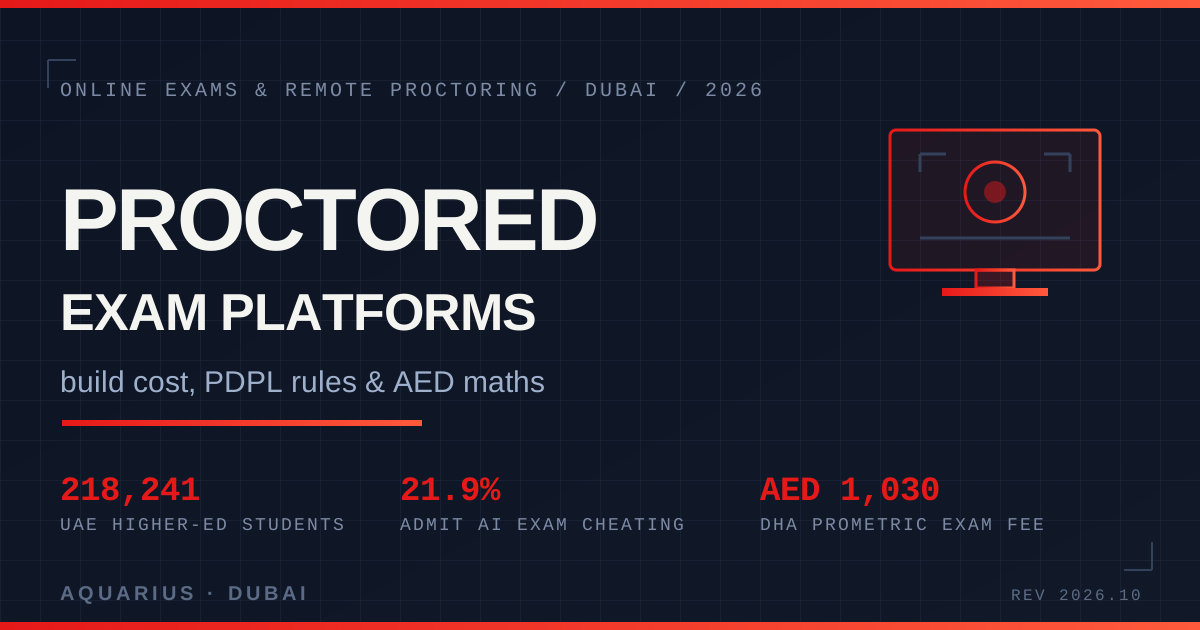
Short answer: a proctored online exam platform for a Dubai institution costs AED 55,000–110,000 for a timed exam engine with auto-marking, AED 110,000–220,000 once you add AI record-and-review proctoring, and AED 300,000–600,000 for a high-stakes build with ID verification, a lockdown browser, UAE data residency and a PDPL paper trail. Off-the-shelf proctoring runs roughly AED 11–46 per exam session, so the break-even against building your own sits near 15,000–20,000 sessions a year.
Key takeaways
- The UAE now has 218,241 higher-education students across 103 institutions and about 2,500 programmes — new admissions rose 15% in 2025–26 with over 64,000 students admitted.
- In the 2026 HEPI student survey, 95% of undergraduates use generative AI, 12% paste AI text straight into assessed work, and 21.9% admit using AI to cheat on an assessment.
- Under the UAE PDPL, webcam video, room scans and face-match data are sensitive personal data — they need explicit, separate, withdrawable consent and a published privacy notice before the first session.
- SaaS proctoring is cheap at low volume (AED 11–18 per automated session) and brutal at scale: a licensing body running 20,000 sessions a year pays roughly AED 480,000 annually for the hybrid tier alone.
Why Dubai suddenly needs proctoring that actually works
Three numbers set the stakes. First, scale: the Ministry of Higher Education and Scientific Research puts UAE higher-education enrolment at 218,241 students for the 2026–27 academic year, spread over 103 institutions, roughly 2,500 programmes and 10,633 faculty, with new admissions up 15% year on year and more than 64,000 new students admitted. Diploma and higher-diploma enrolment alone went from 3,995 in 2021–22 to 10,926 in 2025–26 — a 173% jump.
Second, the integrity problem. The Higher Education Policy Institute’s 2026 student survey of 1,054 undergraduates found 95% use generative AI, 94% use it for assessed work, 12% include AI-generated text directly in submissions, and — via indirect questioning — 21.9% said they had used AI tools to cheat on a university assessment in the past 12 months, rising to 26.4% among AI users. Unsupervised take-home assessment stopped being defensible somewhere around 2024.
Third, money. The UAE e-learning services market generated USD 4,144.1 million in 2025 and is forecast to reach USD 11,341.2 million by 2033 (a 13.4% CAGR), while the UAE learning-management-system market sits at USD 715 million in 2025 and is projected to hit USD 1,244.6 million by 2030 — a 20.6% CAGR. Assessment is the part of that stack institutions are least willing to outsource blindly, because it is the part regulators audit.
What a Dubai-grade exam platform actually contains
Most buyers ask for “proctoring” and mean five separate systems. Separating them is what keeps the budget honest.
1. The exam engine
Question bank with item types and tagging, randomised selection from a pool, timed delivery with server-side clocks, autosave against flaky home Wi-Fi, auto-marking for objective items, rubric marking for written answers, and a result-release workflow. This is the half nobody notices when it works.
2. Candidate identity
Emirates ID or passport capture, liveness check, face match against the enrolment photo. For UAE healthcare licensing candidates sitting DHA exams via Prometric, or Abu Dhabi DoH candidates via Pearson VUE, identity assurance is the entire point of the test centre — remote delivery has to replicate it, not approximate it.
3. Session monitoring
Three tiers, three price points: automated AI flagging (webcam, screen, audio, second-device detection) with no human in the loop; record-and-review, where flagged events are checked by a human afterwards; and live proctoring, where one invigilator watches 8–16 candidates in real time and can intervene. UAE schools already run the middle of this spectrum — senior students sitting exams from home are required to keep cameras on and phones away, with scheduled real-time invigilation.
4. Lockdown and environment control
Kiosk browser, clipboard and screenshot blocking, virtual-machine and remote-desktop detection, process allowlists. Worth knowing: a lockdown browser is a deterrent, not a wall. Anyone with a second phone defeats it, which is exactly why monitoring and lockdown are different line items.
5. The evidence trail
Immutable session logs, flag timelines with timestamps, an appeal workflow, a retention clock, and an export a regulator or accreditation panel can read. Build this last and you will rebuild everything.
Real AED build costs in 2026
| Scope | What you get | Typical build (AED) | Timeline |
|---|---|---|---|
| Exam engine only | Question bank, randomised timed delivery, autosave, auto-marking, LMS/SSO integration, results export | 55,000–110,000 | 6–9 weeks |
| + AI record-and-review | Webcam, screen and audio capture, automated flagging, reviewer console, consent flow, evidence storage | 110,000–220,000 | 10–14 weeks |
| + Live proctor console | Multi-candidate video wall, chat and intervention, session handover, proctor scheduling | 190,000–340,000 | 14–20 weeks |
| Regulated / high-stakes | Emirates ID and liveness verification, lockdown browser, UAE data residency, PDPL impact assessment and retention engine, full audit trail, appeals | 300,000–600,000 | 5–8 months |
| Run cost | Hosting, video storage and egress, transcoding, monitoring | 2,500–9,000/month plus ~1.50–4.00 per recorded session | ongoing |
Compare that with licensing. Published 2026 vendor pricing puts automated AI proctoring at roughly USD 3–5 per exam (about AED 11–18), hybrid record-and-review near USD 6.50 (about AED 24), and live human proctoring from USD 12.50 (about AED 46) per session; per-seat models run USD 8–16+ per student per year, usually with a 500-user floor. At 3,000 sessions a year, SaaS wins outright. At 20,000 sessions on the hybrid tier you are spending about AED 480,000 a year, every year, for software you do not own and cannot customise — and that is where a build starts to look like infrastructure rather than a project.
One more local benchmark for what candidates already pay: the DHA Prometric exam fee alone is USD 240–280 (AED 880–1,030) per attempt, with total Dubai healthcare licensing costs landing between AED 2,000 and AED 3,400. If you are a training institute or licensing body, a few dirhams of proctoring cost per session is not what breaks your unit economics — a failed audit is.
The PDPL part most vendors skip
Remote proctoring collects the most sensitive data an edtech product can touch: a video of someone’s face, a scan of their bedroom, their keystrokes, and often a biometric face match. Under Federal Decree-Law No. 45 of 2021 (the UAE PDPL, in force since 2 January 2022), biometric data — data derived from physical, physiological or behavioural characteristics that identifies a person, such as facial images or fingerprints — is sensitive personal data, alongside health and financial data.
Practically, that means five things your build has to do:
- Explicit, separate consent. Not buried in the enrolment terms. A distinct, affirmative, revocable consent for webcam, audio, screen and face-match processing, captured per session with a timestamp.
- A privacy notice published before processing starts — data types, purpose, retention period, data-subject rights, and how to complain.
- A retention clock with teeth. Pick a number (30, 90, 180 days), enforce it in code with hard deletion, and log the deletion. “We keep recordings indefinitely” is not a policy, it is a liability.
- Data residency and transfer control. If recordings leave the UAE you need a lawful transfer basis. The cheapest answer is usually to keep exam video in a UAE region in the first place.
- A documented appeal route. An AI flag is an accusation. Candidates must be able to see what was flagged and contest it — and you need the evidence export to support that.
If you are starting from zero on UAE data law, our PDPL compliance checklist for websites and apps covers the base layer, and the e-learning and LMS platform guide covers the learning stack this plugs into.
Build, buy, or both — how we scope it
The honest recommendation for most Dubai clients is a hybrid: build the exam engine and the evidence trail you will be audited on, and buy proctoring per session until volume justifies owning it. That gets you live in 6–9 weeks, keeps the compliance surface in your control, and leaves exactly one integration to swap later.
Where Aquarius adds the most value is the unglamorous middle: PDPL consent flows a legal team will actually sign off, retention and deletion that runs automatically, UAE-region hosting, and a reviewer console that lets two staff clear thousands of flagged sessions instead of twenty. We work in fixed-scope phases with published pricing, so phase one ships before you commit to phase four — and if the volume maths says keep buying SaaS, we will tell you that before you spend AED 300,000 proving it.
The cost of inaction is quantifiable. With the global online proctoring market moving from roughly USD 1.2–1.6 billion in 2026 toward USD 3.09 billion by 2030, every UAE institution competing for a slice of 64,000 new admissions a year will have a credible remote-assessment story by then. The ones still emailing PDF exams will be explaining themselves to an accreditation panel.
FAQ
How much does it cost to build an online exam platform in Dubai?
AED 55,000–110,000 for a timed exam engine with auto-marking, AED 110,000–220,000 with AI record-and-review proctoring, and AED 300,000–600,000 for a regulated high-stakes build with identity verification, a lockdown browser and full PDPL tooling. Run costs start around AED 2,500 a month plus roughly AED 1.50–4.00 per recorded session.
Is remote proctoring legal in the UAE?
Yes, with conditions. The UAE PDPL treats webcam recordings and face-match data as sensitive personal data, so you need explicit and separate consent, a published privacy notice issued before processing begins, a defined retention period, and a lawful basis for any transfer outside the UAE. UAE schools already run invigilated at-home exams with cameras on and phones away under ministry rules.
Should we build or just license Proctorio or Honorlock?
License it below roughly 15,000 sessions a year — at AED 11–46 per session the maths is unbeatable. Above that, or if you need UAE data residency, custom item types or an audit trail shaped to your regulator, building the engine and owning the evidence layer pays back inside two to three years.
How many candidates can one live proctor handle?
Plan for 8–16 concurrent candidates per proctor for live monitoring, depending on stakes and video quality. Record-and-review is far cheaper per head: a reviewer only looks at flagged segments, so one reviewer can clear several hundred sessions a day with a well-built console.
How long does a proctored exam platform take to build?
6–9 weeks for the exam engine, 10–14 weeks with automated proctoring, and 5–8 months for a fully regulated high-stakes platform including identity verification, data-residency work and compliance documentation.
Running exams for a UAE university, training institute or licensing body and wondering what it would take to bring assessment in-house? Tell us your session volume and we will send back a scoped AED estimate and a build-versus-buy break-even for your numbers.