
Permanent Establishment UAE 2026: When a Remote Team, Server or Agent Makes You Taxable
There is no 183-day safe harbour in UAE domestic law. How a remote developer, a leased server or a local agent can create a taxable UAE permanent establishment.
- PUBLISHED
- 17 NOV 2026
- READ TIME
- 10 MIN
- AUTHOR
- AQUARIUS · DUBAI
- UNIT
- REV 2026.09
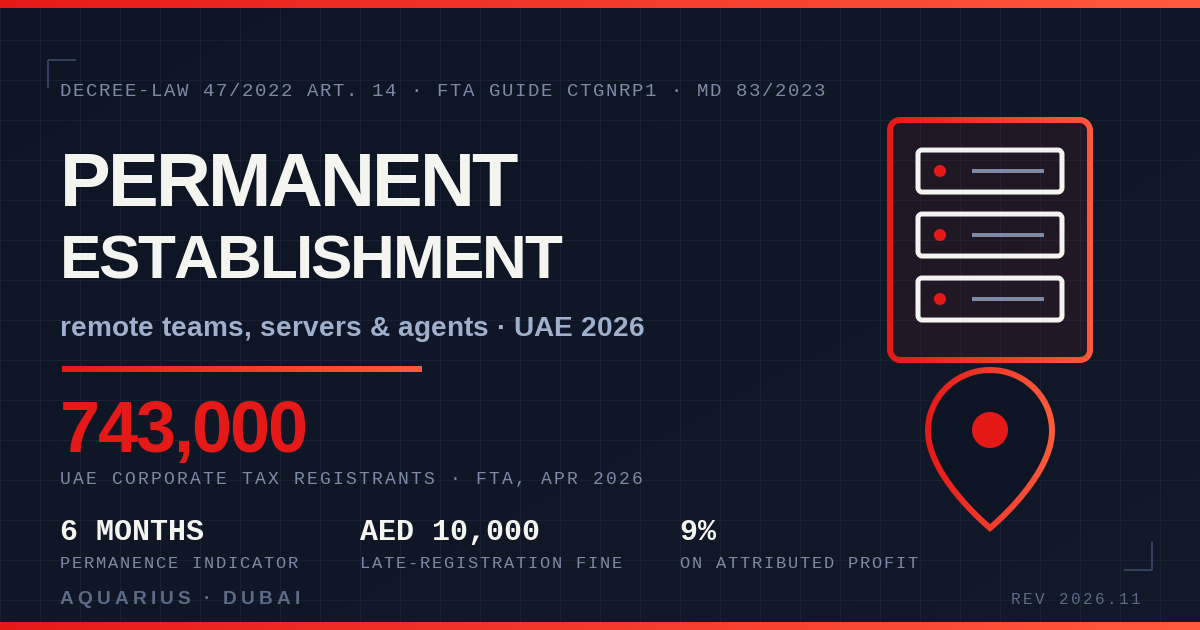
A foreign company creates a UAE permanent establishment (PE) when it has a fixed place of business here that passes four cumulative tests — place of business, permanence, disposal and core business activity — or when someone in the UAE habitually exercises authority to conduct its business. Once a PE exists, the non-resident pays 9% UAE Corporate Tax on the profit attributed to it above AED 375,000, files within nine months of year end, and gets no Small Business Relief. There is no 183-day safe harbour anywhere in UAE domestic law.
That last sentence is the part most Dubai-adjacent businesses get wrong. The 183-day test people repeat at networking events comes from treaty service-PE articles, not from Federal Decree-Law No. 47 of 2022. Domestic law has no day count at all — the Federal Tax Authority’s own guide says only that “an aggregate period of more than 6 months (even if not continuous), in the relevant 12 consecutive months, will typically indicate permanence.” Six months, aggregate, not 183 days continuous, and it is an indicator rather than a bright line.
The stakes in 2026: 743,000 registrants and a 137-treaty network
Three numbers frame why this matters now:
- 743,000 Corporate Tax registrants as of the Federal Tax Authority board meeting reported on 30 April 2026 — up from 710,000 two months earlier. The register is growing by roughly 16,000 entities a month, and non-resident registrations are part of that curve.
- 137 double taxation agreements concluded by the UAE with its major trading partners, per the Ministry of Finance (193 agreements in total once bilateral investment treaties are counted). Where a DTA conflicts with the Corporate Tax Law, the DTA prevails — which is exactly why the domestic test and the treaty test give different answers.
- 936 registered tax agents and 1,787 excise registrants in the same FTA release, alongside an agenda covering e-invoicing, Pillar Two and EmaraTax automation. The enforcement infrastructure is being built out, not wound down.
Meanwhile the penalty schedule under Cabinet Decision No. 75 of 2023 is unchanged and unsentimental: AED 10,000 for late Corporate Tax registration, AED 500 per month for a late return in months one to twelve rising to AED 1,000 per month from month thirteen, and AED 10,000 per violation for failing to maintain records. A PE you did not know you had is still a PE that should have registered.
The four cumulative tests for a fixed-place PE
Article 14(1)(a) of the Corporate Tax Law and section 7.2.1 of the FTA’s Corporate Tax Guide | Non-Resident Persons (CTGNRP1) break the fixed-place limb into four tests. All four must be satisfied. Fail one and there is no fixed-place PE.
| Test | What the FTA actually requires | Where companies trip |
|---|---|---|
| Place of business | A facility, office, work location or premises — and in certain cases machinery or equipment used on a regular or recurrent basis | A hotel room, a co-working desk, even a mobile structure can qualify. The FTA’s own example treats a floating balloon restaurant as a fixed place. |
| Permanence | No statutory day count. An aggregate period of more than 6 months, even if not continuous, within the relevant 12 consecutive months typically indicates permanence | Assuming 183 continuous days is the threshold. Short repeat trips aggregate. |
| Disposal | The right or effective power to use the place. “Mere presence at a particular location does not necessarily mean that the location is at its disposal” | This is the test that usually saves you — or sinks you. Long-term access cards and an assigned desk satisfy it; permission-per-visit does not. |
| Business activity | Core income-generating activity conducted wholly or partly through the place — not preparatory or auxiliary work | “It is unlikely that an activity that requires a significant proportion of the assets or employees of the enterprise could be considered as having an auxiliary character.” |
Three factors the FTA expressly calls immaterial are worth memorising, because they kill most of the DIY defences: ownership is irrelevant (rented premises count), a formal legal right is not required (a PE can exist where a non-resident illegally occupies a location), and exclusivity is irrelevant (shared or third-party premises can still be a PE).
Case one: the remote developer working from home in Dubai
The FTA guide’s most useful worked example for anyone in software is Company C — a software development services company whose employees occasionally work from home in the UAE. The conclusion is no permanent establishment, and the reasoning is a checklist:
- The company does not bear the cost of the home office.
- It has no formal or legal right of access to the employee’s home.
- Use is intermittent and incidental, so the disposal condition fails.
- Working from home was an option, never a requirement.
Flip any one of those and the answer flips. Reimburse a UAE home-office stipend, write “must work from the Dubai residence” into the contract, or lease the apartment yourself, and you have moved from incidental use to effective power to use the place. Contrast Company G in the same guide: a two-year UAE contract, no office, employees working from a hotel — the hotel became the place of business and created a PE.
Case two: the server in a Dubai data centre
Server location alone does not create a PE, and the UAE has no significant-economic-presence or digital-PE rule — there is no revenue-threshold trigger for selling into the UAE from abroad. But hardware is not immune. The FTA accepts that a PE “may exist if the Business of the Non-Resident Person is carried on mainly through automatic equipment where the activities of the personnel are restricted to setting up, operating, controlling and maintaining such equipment.”
The dividing line is operation versus leasing. In the guide’s vending-machine example, a non-resident that installs machines and then leases them to a UAE operator has no PE — once leased, the machines are no longer at its disposal. A non-resident that owns or long-term-leases racks in a UAE data centre and operates and maintains them for its own account, directly or through a dependent agent, is in PE territory unless the server performs only preparatory or auxiliary functions such as mirroring content.
Case three: the local agent, reseller or commissionaire
Article 14(1)(b) creates an agency PE where a person in the UAE habitually exercises an authority to conduct a business or business activity on the non-resident’s behalf. UAE domestic law is deliberately wider than the typical treaty wording: the FTA’s Example 29 finds an agency PE from negotiation activities alone, even though the agent had no authority to conclude contracts — and then notes that under the applicable DTA, habitual negotiation without conclusion would not create one. Same facts, two answers, treaty wins.
The independent-agent exception in Article 14(6) is narrower than it looks. An agent that acts exclusively or almost exclusively for the non-resident, or is legally or economically dependent on it, is not independent and still creates a PE. A commissionaire selling in its own name but on the non-resident’s behalf creates a PE. Pure marketing that does not directly result in contracts — the pharmaceutical-rep example — does not.
The exceptional-circumstances escape hatch is almost airtight
Ministerial Decision No. 83 of 2023 says a natural person’s UAE presence is “temporary and exceptional” — and therefore ignored — only if all five of these hold: the presence results from exceptional circumstances of a public or private nature; those circumstances could not reasonably have been predicted; the person expressed no intention to remain once they end; the non-resident had no UAE PE before they arose; and the non-resident did not treat the person as creating a PE or deriving UAE income under another jurisdiction’s tax law. A pandemic-grade event clears that bar. A developer who liked Dubai and stayed does not.
Registration deadlines and what you owe
FTA Decision No. 3 of 2024, effective 1 March 2024, sets the clock. It runs from when the PE or nexus came into existence, not from when you discovered it.
| Trigger | Registration deadline | Then what |
|---|---|---|
| PE existing before 1 March 2024 | Within 9 months of the date the PE came into existence | 9% on attributed profit above AED 375,000; 0% below |
| PE arising on or after 1 March 2024 | Within 6 months of the date the PE came into existence | Return due 9 months after financial year end |
| UAE nexus before 1 March 2024 | By 31 May 2024 | Nexus arises via UAE immovable property (Cabinet Decision 56/2023) or QIF/REIT interests (Cabinet Decision 35/2025) |
| UAE nexus on or after 1 March 2024 | Within 3 months | Standalone financial statements required |
| State Sourced Income only, no PE or nexus | Must not register | Withholding tax applies at 0% |
Two obligations catch people out after registration. First, a non-resident with a PE must prepare standalone IFRS financial statements for the PE and attribute income and expenditure using the arm’s length principle and internationally accepted attribution methodologies — the head office and its PE are treated as related parties. Second, transfer pricing documentation under Ministerial Decision No. 97 of 2023 kicks in at AED 200 million standalone revenue or AED 3.15 billion consolidated group revenue, requiring a Master File and Local File. Below those thresholds you still need the arm’s length analysis; you just do not file the formal documents.
And a detail that costs real money: non-residents with a PE cannot claim Small Business Relief. The AED 3 million revenue election is for resident persons only.
Build the evidence layer before the FTA asks for it
A PE determination is a fact fight, and facts live in systems. Every defence above depends on records you either have or do not: who approved a contract and where, whether an access card was issued for a day or a year, whether a home-office cost was reimbursed, which entity operates a rack. Dubai businesses that lose these arguments rarely lose on the law — they lose because the only evidence is a WhatsApp thread.
That is the part we build. Aquarius is a Dubai software company, and the systems work here is unglamorous and decisive:
- Approval and authority trails. A contract workflow that records who negotiated, who signed, and in which entity — the single most important dataset in an agency-PE argument.
- Presence and premises logs. Day-count aggregation across trips (because the 6-month indicator is cumulative), access-card issuance history, and lease term tracking per location.
- Cost-bearing flags in expense capture. Tagging any reimbursement that touches a UAE home office or workspace, so the Company C defence stays true.
- Attribution-ready reporting. Standalone P&L by branch or PE, related-party transaction registers, and the document set your advisers need for an arm’s length file. We covered the data side of this in our guides to Corporate Tax accounting software for Dubai SMEs and UAE transfer pricing and related-party data in your ERP.
Cost, concretely. A single-purpose compliance log or document portal starts at AED 500 on our Starter tier. A multi-module internal tool with CMS-managed policies, bilingual output and AI-assisted search sits in the AED 2,500 band. A full custom app — approval workflows, auth, dashboards, API integrations into your accounting stack — starts from AED 10,000; full tiers are on our pricing page. Set against AED 10,000 for a single late-registration penalty and AED 500 to AED 1,000 per month of late filing, the arithmetic is not subtle: one avoided penalty cycle pays for the system.
There is also a structural option worth naming. If your exposure comes from maintaining UAE-based delivery staff, contracting the work to a UAE agency that bears its own costs, owns its own premises and runs its own business removes the fixed place from your balance sheet entirely. That is a decision for your tax adviser, not us — but it is the lever most foreign software companies have not costed.
We scope before we quote, and we will tell you if a spreadsheet covers it. Send us the shape of your UAE presence and we will come back with what to build and what to skip.
FAQ
Does one employee working remotely from Dubai create a permanent establishment?
Not automatically. The FTA’s software-company example finds no PE where the employer does not bear home-office costs, has no right of access, use is intermittent, and remote work is optional rather than required. Reimburse the workspace, require the location, or lease it yourself and the disposal test starts to bite.
Is there a 183-day rule for permanent establishment in the UAE?
No. UAE domestic law contains no day-count test for a fixed-place PE. The FTA guide says an aggregate period of more than six months within the relevant 12 consecutive months typically indicates permanence. The 183-day service-PE test lives in some double taxation agreements, and a DTA prevails over the Corporate Tax Law where the two conflict.
Can a server in a UAE data centre create a permanent establishment?
Location alone does not, and the UAE has no digital or significant-economic-presence rule. But a non-resident that owns or long-term-leases equipment in the UAE and operates and maintains it for its own account can have a PE through automatic equipment. If it merely installs the equipment and leases it on to a UAE operator, there is no PE — the equipment is no longer at its disposal.
How long does a non-resident have to register for Corporate Tax?
Under FTA Decision No. 3 of 2024, six months from the date a PE came into existence if that was on or after 1 March 2024, or nine months if the PE existed before that date. Nexus cases are three months, or 31 May 2024 for pre-March nexus. Late registration is an AED 10,000 penalty.
What tax rate applies to a UAE permanent establishment?
0% on the first AED 375,000 of taxable income attributable to the PE and 9% above it, calculated from standalone IFRS financial statements with income and expenditure attributed on arm’s length principles. Small Business Relief is not available to non-residents with a PE.
Sources: Federal Decree-Law No. 47 of 2022 (Articles 11, 13, 14); FTA Corporate Tax Guide | Non-Resident Persons (CTGNRP1); Ministerial Decisions 83/2023 and 97/2023; Cabinet Decisions 56/2023, 75/2023 and 35/2025; FTA Decision No. 3 of 2024; UAE Ministry of Finance treaty data; FTA Board of Directors figures reported 30 April 2026. This is general information, not tax advice.