
Permissions-Policy in the UAE: We Scanned 584 .ae Sites and 87.7% Leave the Camera Open (2027)
We scanned 584 live .ae websites in November 2026. Only 17.6% send an author-written Permissions-Policy header, 87.7% leave camera access at the browser default, and 65.4% load third-party scripts with none.
- PUBLISHED
- 23 NOV 2026
- READ TIME
- 13 MIN
- AUTHOR
- AQUARIUS · DUBAI
- UNIT
- REV 2026.09
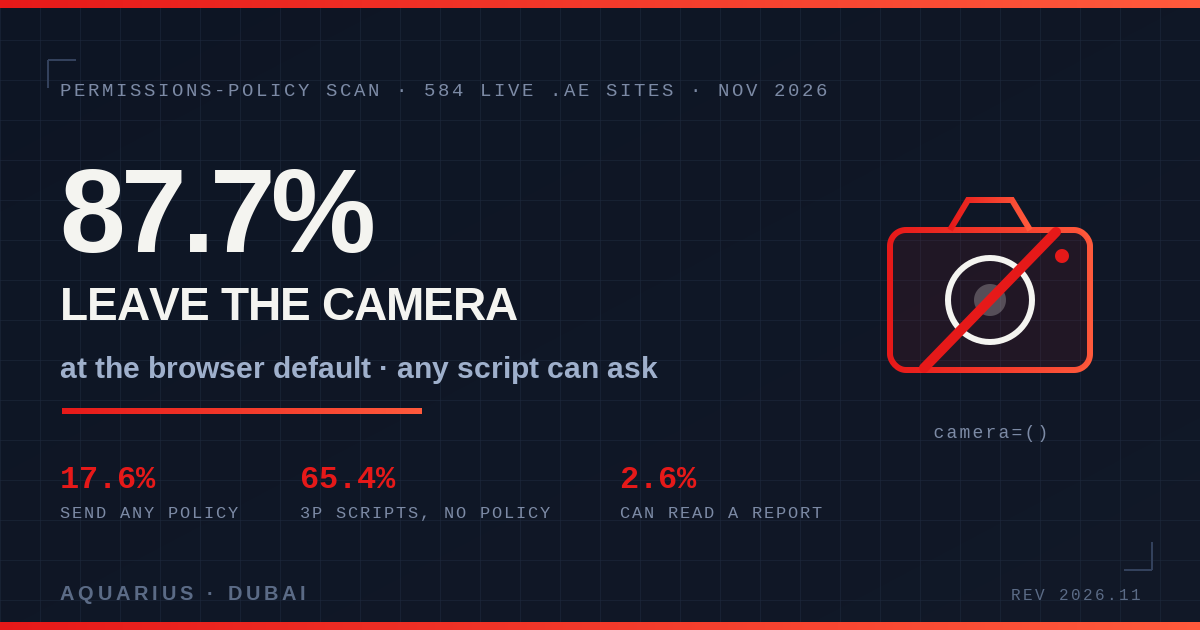
Short answer: Permissions-Policy is the HTTP response header that decides which powerful browser features your own pages are allowed to use — camera, microphone, geolocation, screen capture, payment. It matters because the browser default for camera, microphone and geolocation is self, which means every script running inside your top-level document — your tag manager, your chat widget, your ad pixel — inherits your site's permission to ask. We scanned 584 live .ae websites on 23 November 2026: only 103 (17.6%) send an author-written policy, 512 (87.7%) leave the camera at that default, and 381 (65.4%) load third-party scripts with no policy at all.
This is a one-line header that most Dubai sites could ship this afternoon. Almost nobody has. And the sites with the most third-party code — the ones that actually need it — are the least likely to send it.
Three numbers that set the stakes
1. The .ae estate is large and growing. TDRA recorded 350,573 registered .ae domains as of October 2026. Every one of those that runs a marketing tag is making the same bet.
2. Breaches in this region are the expensive kind. IBM's Cost of a Data Breach 2026 (Ponemon, 602 organisations, March 2025 to February 2026) puts the Middle East average — a sample of UAE and Saudi organisations — at USD 8 million, roughly AED 29.4 million per breach. Lost business alone is USD 3.57m, post-breach response USD 2.17m, detection and escalation USD 1.9m. And 26% of malicious breaches in the study were AI-enabled.
3. The law puts the duty on you, not on your vendor. UAE Federal Decree-Law No. 45 of 2021 (PDPL) has been in force since 2 January 2022, and its Executive Regulations were still unpublished as of November 2026 — four years on. The Federal Authority for AI and Data was established in 2026 to take the file forward. Waiting for the regulations is not a strategy: the controller obligation to apply appropriate technical measures is already in the primary law, and a third-party script asking your visitors for their camera is your controller problem, not the vendor's.
How we measured this
We took every .ae hostname in the Tranco top-1M list — 785 hosts — and fetched each homepage over HTTPS with a desktop Chrome user agent, following redirects. 584 answered with a 2xx; 583 returned parseable HTML. We then parsed the response headers and the HTML for third-party script origins and cross-origin iframe embeds. Everything below is from that single pass. Where a header was injected by infrastructure rather than written by the site owner, we say so and strip it out.
That last point matters more than it sounds. The raw count of .ae sites sending a Permissions-Policy header is 118 (20.2%). But 15 of those send nothing except Cloudflare Turnstile's auto-injected private-state-token-issuance and private-state-token-redemption directives — a CAPTCHA side effect, not a decision anyone made. Strip them and the real, author-written adoption figure is 103 of 584, or 17.6%. Every number in this article uses the stripped figure.
The adoption curve runs backwards
Here is the finding we did not expect. We counted distinct third-party script origins on each homepage, then cross-tabbed that against whether the site sends a policy:
| Distinct third-party script origins on the homepage | Sites | Send an author-written Permissions-Policy |
|---|---|---|
| 0 — fully first-party | 133 | 25.6% (34) |
| 1 – 4 | 386 | 15.5% (60) |
| 5 – 9 | 62 | 14.5% (9) |
| 10 or more | 2 | 0.0% (0) |
The sites with no third-party code at all are the most likely to restrict features they were never going to hand out. The sites carrying ten or more third-party script origins — the maximum exposure case — send nothing. Protection is inversely correlated with need.
The scale of the exposure: 450 of 583 sites (77.2%) load at least one third-party script, and 381 (65.4%) do it with no author-written policy of any kind. Google Tag Manager is on 360 sites (61.7%), Meta Pixel on 84, Google Analytics on 59, Microsoft Clarity on 38, DoubleClick on 33. Each of those is a code-delivery channel into your top-level document, configurable by whoever has access to the tag container — often your media agency, not your developers.
What the default actually allows
MDN's own wording for camera, microphone and geolocation is that the default allowlist is self: "the top-level browsing context and same-origin iframes are allowed access by default." Read that from an attacker's point of view. Your top-level document is where every tag you have ever pasted into GTM runs. They are not cross-origin iframes. They are you, as far as the permission model is concerned.
Set camera=() and the browser stops asking. getUserMedia() rejects with a NotAllowedError before any prompt renders; the Geolocation API fires its error callback with PERMISSION_DENIED. The user never sees a dialog, so there is nothing to mis-click. That is the whole value: it converts a social-engineering surface into a hard browser-enforced no.
Myth-bust: most people assume the risk is the iframes. It is not. We found 371 cross-origin iframes across 245 sites (42.0%), and only 62 of them carry an
allowattribute — 38 of those 62 are the verbatim YouTube embed boilerplate. Zero of the 371 grant camera, microphone or geolocation. Cross-origin iframes are denied by default, so an embed with noallowattribute is the safe case. The unguarded surface is the top document, and almost everyone is looking at the wrong one. We made the same argument about script injection in XSS, CSP and Trusted Types on Dubai websites: the dangerous code is usually the code you invited in.
The header to ship
This is the part that takes an afternoon. Pick the features you genuinely use, deny the rest, and send one header on every HTML response.
| Directive | What it gates | Safe value for most UAE sites | Keep it open only if |
|---|---|---|---|
camera | Video capture via getUserMedia() | camera=() | You run video KYC, telehealth, or a virtual try-on |
microphone | Audio capture via getUserMedia() | microphone=() | Voice notes, in-browser calls, speech search |
geolocation | The Geolocation API | geolocation=(self) | Branch finder, delivery-radius check, ride pickup |
display-capture | Screen sharing via getDisplayMedia() | display-capture=() | You offer co-browsing or in-browser support sessions |
payment | The Payment Request API | payment=(self) | Apple Pay / Google Pay through Payment Request |
usb, serial, hid | WebUSB, Web Serial, WebHID | All three =() | You drive POS terminals or label printers from the browser |
fullscreen | requestFullscreen() | fullscreen=(self) | An embedded player needs it — grant that through the iframe allow attribute instead |
Adoption of the individual directives in the .ae estate, for benchmarking: geolocation restricted on 85 sites (14.6%), microphone on 73 (12.5%), camera on 72 (12.3%), payment on 41 (7.0%), USB on 25 (4.3%), display-capture on 10 (1.7%). 64 sites (11.0%) cover all three of camera, microphone and geolocation; 91 (15.6%) cover at least one.
Three syntax traps that silently void the header
The structured-headers syntax is unforgiving and it fails quietly — no console error, the directive is simply dropped.
- Origins must be in double quotes.
geolocation=(self "https://maps.example.ae")is valid.instashop.aeships single quotes instead, so that directive does nothing at all. *and()can only appear alone. You cannot combine them with an origin list.selfandsrccan be combined.- The iframe
allowattribute does not quote its origins. Same feature names, different quoting rules, and copy-pasting between the two is the most common way to break both.
Four policies we found that do absolutely nothing
Shipping a header is not the same as shipping a policy. Among the 103 author-written policies, a measurable share are inert.
ajman.ae is serving MDN's documentation example. Its live header reads geolocation=(self "https://example.com"), microphone=(). That allowlisted origin is example.com — the reserved placeholder domain from the spec documentation, copied into production on a UAE government site and never edited.
ecmpermits.ae is using the wrong syntax entirely: document-domain none; encrypted-media none; microphone none; midi none; vr none. That is legacy Feature-Policy syntax — semicolons and a bare none — inside a Permissions-Policy header. The whole header is discarded. It looks like a security control in a scan report and enforces nothing.
Four sites' entire policy is a feature that no longer exists. alwaslsc.ae, branex.ae, jomla.ae and uowdubai.ac.ae send nothing but interest-cohort=() — the FLoC opt-out, for a proposal Google cancelled years ago. In total we found 22 dead directive instances across 17 sites (interest-cohort, battery, speaker, vibrate, notifications, push). Four sites send two conflicting Permissions-Policy headers (adnec.ae, albacars.ae, mbank.ae, mbzuh.ac.ae), and four more — including alhilalbank.ae, propertyfinder.ae and museumofthefuture.ae — are still on legacy Feature-Policy only. Two, alimart.ae and edgegroup.ae, explicitly set geolocation=*, which is wider than the default they started from.
The reporting illusion
You would think a third of the estate has browser-violation reporting wired up: 199 sites (34.1%) send a Report-To header. Then you read the endpoints. 187 of those 199 point at a.nel.cloudflare.com — Cloudflare's own Network Error Logging beacon, injected at the edge, reporting to Cloudflare. The site owner cannot read it.
Count only first-party pipelines — an endpoint the site actually controls, via Report-To or the modern Reporting-Endpoints header — and you get 15 of 584 sites, 2.6%. Only 7 sites use Reporting-Endpoints at all. And the number of .ae sites using Permissions-Policy-Report-Only, the staging header that lets you see what a policy would have blocked before you enforce it, is zero out of 584.
For context on the wider header baseline in the same scan: X-Content-Type-Options 390 sites (66.8%), X-Frame-Options 378 (64.7%), HSTS 340 (58.2%), CSP 251 (43.0%), Referrer-Policy 222 (38.0%), Cross-Origin-Opener-Policy 74 (12.7%), Accept-CH 54 (9.2%), Critical-CH 1 (0.2%). In the 60 live .gov.ae hosts specifically: HSTS 81.7%, CSP 46.7%, but Permissions-Policy only 15.0% — below the national average.
One sector is visibly different. Of the 11 live UAE bank, exchange and financial-market hosts in our sample, 7 send a Permissions-Policy — 63.6% against 17.6% for everyone else. The organisations with a regulator reading their headers do this. Nobody else does. We saw the same pattern when the ad-tech ground shifted under everyone in what Privacy Sandbox's retirement means for Dubai advertisers.
One honest caveat
The Permissions-Policy header is Chromium-only. Per MDN's browser-compat data, Chrome has shipped it since version 85 (the camera, microphone and geolocation directives since 88) and Edge mirrors it, but Firefox and Safari have not implemented the header at all — the Firefox bug (1531012) is still open. Firefox and Safari honour only the iframe allow attribute.
In the UAE that is less of a problem than it sounds. StatCounter's October 2026 UAE figures give Chrome 76.98%, Edge 2.70%, Opera 1.97% and Samsung Internet 1.41% — about 83.1% of UAE browser sessions run a Chromium engine. So the header covers roughly five sessions in six. It is defence in depth for the other one, not a substitute for server-side authorisation.
What this costs in Dubai, and how we do it
The header itself is free. What you are paying for is knowing which features your site genuinely uses across every template, and what your tag container is allowed to do.
| Scope | What is included | Typical AED range |
|---|---|---|
| Header audit & policy spec | Crawl all templates, inventory third-party script origins and iframe embeds, draft the exact header, written findings report | 6,000 – 12,000 |
| Implement on one stack | Header at the edge or in middleware, report-only rollout first, violation triage, regression test in CI | 9,000 – 18,000 |
| First-party report pipeline | Reporting-Endpoints collector, storage, dashboard, alerting — what 97.4% of .ae sites do not have | 14,000 – 30,000 |
| Full browser-security baseline | Permissions-Policy + CSP with nonces + HSTS + Referrer-Policy + COOP, staged and verified | 22,000 – 48,000 |
| PDPL-aligned tag governance | Consent gating for marketing tags, data-flow map, processor register entries, change-control on the tag container | 18,000 – 40,000 |
| Monthly monitoring | Weekly header regression check, alerts on new third-party origins, report triage | 1,500 – 4,000 / month |
How we run it: we scan every template, not just the homepage — checkout and account pages carry different tags. We ship Permissions-Policy-Report-Only first and watch real traffic for a week, because a policy that breaks your payment sheet gets reverted and then nobody tries again. We wire a first-party reporting endpoint so you can see violations yourself. Then we enforce, and pin the header in a test so the next deploy cannot quietly drop it.
The risk-reversal: if our audit finds your current headers already correct, we bill the audit and nothing else — and you get the benchmark table showing where you sit against the 584 sites we measured. Given an AED 29.4 million regional average breach cost against a four-figure audit, the arithmetic is not close. Our full pricing is published, and if you are starting from zero on data protection, begin with the UAE PDPL compliance checklist for websites and apps.
FAQ
Does UAE PDPL require a Permissions-Policy header?
No. Federal Decree-Law 45/2021 does not name HTTP headers, and its Executive Regulations were still unpublished as of November 2026. But the law already requires controllers to apply appropriate technical and organisational measures, and a browser-enforced deny on camera, microphone and geolocation is one of the cheapest measures available. Specific-header obligations, if they come, will come through the regulations.
Will this break Google Tag Manager?
Not for any standard tag. GTM itself, Google Analytics, Meta Pixel, Clarity and DoubleClick do not need camera, microphone or geolocation — we found GTM on 360 of 583 sites and none of the default configurations require those features. The one thing to check before enforcing is a live-chat or support widget that offers voice notes, screen sharing or video calls. That is exactly what report-only mode is for.
Does it work in Safari?
No. The header is Chromium-only: Chrome 85+ and Edge honour it, Firefox and Safari do not implement it at all. With about 83.1% of UAE browser sessions on a Chromium engine (StatCounter, October 2026), it covers most of your traffic — but it is a hardening layer, never your only control.
What is the difference between Permissions-Policy and Feature-Policy?
Feature-Policy is the superseded version with different syntax — semicolon-separated, bare none. Permissions-Policy uses structured-headers syntax: comma-separated, () for deny, double-quoted origins. Four of the .ae sites we scanned still send only the legacy header, and one sends legacy syntax inside the modern header, which voids it completely. Do not mix them.
How do I test a policy before enforcing it?
Send Permissions-Policy-Report-Only with your intended value alongside a Reporting-Endpoints header, leave it for a week of real traffic, and read the violation reports. Zero of the 584 .ae sites we scanned were doing this, which is a good part of why so many of the policies in production are broken.
The one-line version
Four in five .ae websites let any script in their top-level document ask a visitor for the camera, the microphone and their location — not because anyone decided that, but because nobody sent a header. The UAE's banks fix it at 63.6%. Everyone else sits at 17.6%. It is a single response header, it costs nothing to send, and it fails closed.
Want the exact header for your stack, and your site benchmarked against all 584? Talk to Aquarius — we will tell you in a week whether you have a problem, and what it takes to close it.