
Privacy Sandbox Is Retired: What Dubai Advertisers Should Actually Do in 2026
Google retired 10 Privacy Sandbox ad APIs and Chrome 153 finished removing them on 8 Sep 2026. Cookies stayed. What UAE advertisers should build instead, with real AED costs.
- PUBLISHED
- 07 NOV 2026
- READ TIME
- 13 MIN
- AUTHOR
- AQUARIUS · DUBAI
- UNIT
- REV 2026.09
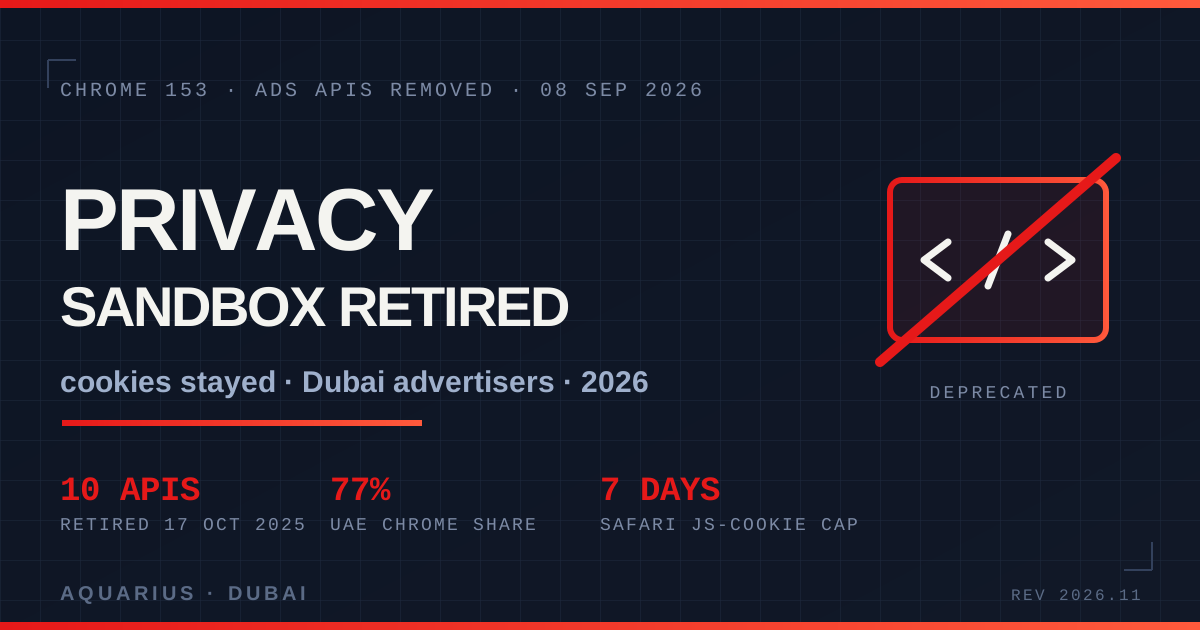
Short answer: the Privacy Sandbox is finished. Google announced the retirement of ten advertising APIs — Topics, Protected Audience, Attribution Reporting, Private Aggregation, Shared Storage and the rest — on 17 October 2025, began deprecating them in Chrome 144 on 13 January 2026, and finished removing them in Chrome 152 and Chrome 153 through August and September 2026. Third-party cookies did not die. The replacement did. So the “cookieless future” migration every Dubai agency was selling in 2024 is now a roadmap to a world that never arrived — and the work that genuinely recovers lost conversions is unglamorous first-party measurement plumbing you can finish in under a fortnight.
Three numbers set the stakes for anyone buying media in the UAE. Chrome held 76.98% of UAE browser sessions in October 2026, with Safari a distant second at 12.05% (Statcounter) — so Chrome’s policy decisions effectively are your measurement environment. UAE digital ad spend is forecast at USD 2.64 billion in 2026, growing around 15.2% a year toward USD 4.3 billion by 2029, and Dubai alone accounts for roughly 64% of national digital spend. And Google now puts a hard figure on what broken measurement costs: advertisers who fix their first-party data setup see an average 14% conversion uplift — money most Dubai accounts are currently leaving on the table while they wait for a sandbox that no longer exists.
What Google actually retired, and on which dates
This matters because half the Dubai marketing stacks we audit still contain code, consent categories and vendor line items built for APIs that no longer ship. The timeline, in order:
- 22 April 2025 — Google confirmed it would not roll out a standalone third-party cookie prompt in Chrome. Cookie choice stays where it was, inside Chrome settings. That was the quiet end of the phase-out, two years after the industry started budgeting for it.
- 17 October 2025 — Google announced the retirement of the advertising half of the Privacy Sandbox: Attribution Reporting API, Topics, Protected Audience, Private Aggregation, Shared Storage, SelectURL, IP Protection, Related Website Sets, On-Device Personalization and the Android equivalents (Protected App Signals, SDK Runtime) — ten APIs across Chrome and Android.
- Chrome 144, 13 January 2026 — deprecation began. Private Aggregation, Shared Storage and Protected Audience appeared in release notes as deprecated.
- Chrome 152, 25 August 2026 — Private Aggregation removed, with release notes confirming removal along with the related Privacy Sandbox APIs.
- Chrome 153, 8 September 2026 — removal of Protected Audience, Related Website Sets, Shared Storage, Attribution Reporting and
document.requestStorageAccessFor. - 14 August 2026 — Fenced Frames moved from “continue to support” to “deprecate and remove”, closing the last of the ads-oriented primitives.
Google’s stated reasoning was adoption, not privacy: the new APIs were barely used, regulatory pressure never let up, and keeping third-party cookies was simpler than defending a replacement nobody had integrated. The practical read for a Dubai advertiser is blunt. Any integration work scoped specifically against Topics, Protected Audience or Attribution Reporting is sunk cost. Delete the code, delete the consent categories that reference it, and stop paying for vendor modules that proxy it.
What survived the cull — and is worth wiring up
Nine web platform features were explicitly kept. These are not ad-targeting replacements; they are the plumbing that keeps logins, embeds and legitimate cross-site flows working now that partitioning is permanent.
| Still supported | What it does for you | Who in Dubai needs it |
|---|---|---|
| CHIPS (partitioned cookies) | Lets an embedded third party keep a cookie scoped to the top-level site | Anyone embedding a booking widget, chat, or payment iframe |
| Storage Access API | Permission-based access to unpartitioned storage inside an iframe | Portals embedding a separate LMS, CRM or ticketing app |
| FedCM | Browser-mediated federated sign-in without third-party cookies | B2B SaaS and portals with social or SSO login |
| Private State Tokens | Cross-site trust signals without identity — anti-fraud, not targeting | Ecommerce and lead-gen sites fighting bot traffic |
| Storage and network state partitioning | Permanent isolation of caches and storage per top-level site | Everyone; it silently breaks old cross-domain tricks |
| User-Agent Client Hints and UA reduction | Reduced device strings; request the detail you need explicitly | Teams whose analytics still parse raw user-agent text |
Bounce tracking mitigations and frame-ancestors | Kills redirect-hop identity stitching; controls who can frame you | Affiliate-heavy and multi-domain Dubai groups |
Note the two casualties in that neighbourhood. Related Website Sets is gone, which matters for Dubai groups running one brand across several domains — a .ae site, a .com site and a separate booking domain — on the assumption the browser would treat them as one family. It will not. And document.requestStorageAccessFor left with Chrome 153, so top-level requests for storage access on behalf of an embed need rethinking.
The mistake most Dubai businesses are about to make
Here is the part the “just move to first-party” advice gets wrong, and it is the single most expensive misunderstanding in UAE measurement right now: serving your tags from your own domain is not an exemption from Safari’s cookie cap.
Safari’s Intelligent Tracking Prevention deletes cookies created in JavaScript — plus localStorage, IndexedDB, sessionStorage and service worker caches — after 7 days without user interaction. If it detects CNAME or third-party IP cloaking, it caps cookies set in that HTTP response at 7 days too. Only cookies written by a genuine first-party server via aSet-Cookieheader, with modernSecureandSameSiteattributes, keep their declared expiry.
That distinction decides whether your Dubai attribution window is seven days or four hundred. A gateway or CDN proxy that still lets the Google tag write its cookie in JavaScript inherits the 7-day cap. A same-origin server container that issues the cookie itself from your own domain does not. In a market where Safari took 22.14% of UAE mobile browser sessions in September 2026 — roughly one in five mobile visitors, skewed toward exactly the higher-income iPhone audience most Dubai advertisers pay the most to reach — that is not an edge case. It is a fifth of your funnel quietly resetting every week.
The four fixes that actually recover conversions in 2026
Google replaced its own moonshot with a much more boring answer: consented first-party data, served properly. Four pieces, in the order we deploy them.
1. Consent Mode v2, advanced
Not legally mandated for UAE-only traffic, but it is the only clean mechanism that turns a UAE PDPL opt-out into a real signal inside Google’s tags rather than a banner that hides nothing. Under Federal Decree-Law No. 45 of 2021, persistent identifiers such as cookies and advertising IDs count as personal data when they can be tied to an identifiable person, so consent state has to be genuine. Advanced mode keeps cookieless pings flowing so Google can model the gap instead of reporting a hole. Our full walkthrough is in the UAE cookie consent and PDPL guide.
2. Google tag gateway
Free, and the quickest win on this list. It routes GA4, Google Tag Manager and Google Ads requests through your own domain via your CDN — Cloudflare has the native integration, with Akamai and Fastly also supported — so the script is no longer a known third-party hostname that an ad blocker or network filter drops on sight. Google reports an average 14% conversion uplift for advertisers who build data strength with tag gateway, and over 20% for Demand Gen campaigns. If your Dubai site already sits behind Cloudflare, this is a configuration change, not a build.
3. Enhanced conversions
Hashed first-party email and phone sent with the conversion, so Google can match a conversion it would otherwise never attribute. Google reports an average 11% increase in Search conversions versus standard conversion imports. Since June 2026 the web and leads variants are a single on/off setting that accepts data from website tags, Data Manager and the API simultaneously — which also means a half-migrated setup can now double-count if nobody reconciles the sources.
4. Data Manager for offline and app data
On 10 September 2026 Google wired Data Manager directly into Google Analytics and Display & Video 360 and shipped a Data Strength Uplift metric that quantifies how many conversions your first-party setup recovered. Advertisers who connect offline and app data to Data Manager see an average 26% increase in incremental ROAS. For a Dubai business whose real conversion is a signed contract, a showroom visit or a clinic appointment rather than a web form, this is the step that finally closes the loop. Pair it with a genuine holdout test — see our note on incrementality testing for Dubai advertisers — because platform-reported uplift and incremental revenue are not the same claim.
What this costs in Dubai, in dirhams
Typical Dubai agency rates for this work in 2026, excluding 5% VAT. These are the line items we quote; compare them against anything you are being charged for “cookieless readiness”.
| Scope | What it covers | Cost (AED) |
|---|---|---|
| Privacy Sandbox removal audit | Find and delete dead Topics, Protected Audience, Attribution Reporting and Shared Storage calls; test Chrome 153 breakage; clean consent categories | 1,500–4,000 one-off |
| Consent Mode v2 advanced | CMP wiring, bilingual banner, category mapping, tag gating, cookieless pings verified | 2,500–7,500 |
| Google tag gateway | Cloudflare or CDN configuration, path rewrite verification, QA across browsers | 2,000–6,000 (Google’s feature itself is free) |
| Enhanced conversions | Hashed identifier capture, GTM or API delivery, deduplication against existing imports | 2,500–8,000 |
| Data Manager offline import | CRM or POS mapping, consent flags, scheduled upload, Data Strength Uplift baseline | 6,000–18,000 |
| Same-origin server-side GTM | Own-subdomain container, server-set cookies that survive ITP, GA4 plus Ads plus Meta server tags | 7,000–20,000 plus 165–550/month hosting |
| Geo holdout or incrementality test | Design, matched-market split, read-out and decision memo | 8,000–25,000 |
Read that against your media budget, not against each other. A Dubai account spending AED 50,000 a month on Google Ads is spending AED 600,000 a year. Google’s reported averages — 14% from tag gateway, 11% from enhanced conversions — are platform figures measured across its own advertiser base, not a promise for your account. But even a third of that recovery on an AED 600,000 budget dwarfs the AED 5,000–14,000 it costs to deploy the first three rows of that table. The asymmetry is the whole argument. For how this sits inside a wider build, see our transparent pricing.
How Aquarius runs it
As a fixed-scope sprint, not a retainer you cannot audit. Week one: a written inventory of every tag and dead sandbox call on your site, the Safari 7-day cookie test run on a real device, and Consent Mode defaults verified against your PDPL position. Week two: tag gateway live on your CDN, enhanced conversions deployed with hashed identifiers and deduplicated against existing imports, and a Data Strength Uplift baseline recorded so the before-and-after is a number rather than a story. You get the documentation, the container exports and the measurement plan as deliverables — take them to another vendor afterwards and everything still works. Deeper server-side work is covered in our GA4 and server-side tracking cost guide, and the full build menu sits under services.
FAQ
Are third-party cookies still supported in Chrome in 2026?
Yes. Google confirmed on 22 April 2025 that it would not ship a standalone third-party cookie prompt, and the retirement of the Privacy Sandbox advertising APIs in 2025 and 2026 removed the intended replacement rather than the cookies. Users can still restrict them in Chrome settings, Safari and Firefox still block them by default, and storage partitioning still applies — so third-party cookies surviving in Chrome is not the same as third-party cookies working everywhere.
Do I need to remove Topics or Protected Audience code from my Dubai website?
Yes, and test it. Those APIs were removed in Chrome 152 and 153 during August and September 2026. Calls to them now fail or return nothing, which in badly written code can throw and take a tag, a consent banner or a checkout step down with it. The removal audit exists precisely because the failure is silent until it is not.
Does Google tag gateway replace server-side GTM?
No. Tag gateway changes where the script is served from; a server-side container changes where the cookie is written. Only the second one escapes Safari’s 7-day cap on JavaScript-written storage. If your audience skews iPhone — and in Dubai it does, at over a fifth of mobile sessions — you eventually want both.
Is any of this a PDPL problem?
It is a PDPL-relevant decision, not a PDPL violation by default. Under Federal Decree-Law No. 45 of 2021, cookies and advertising identifiers are personal data when they can be linked to an identifiable individual, so hashed-email uploads, offline conversion imports and CRM matching all need a lawful basis, a genuine consent record and a privacy notice that actually describes what you do. Hashing is a safeguard, not an exemption.
We have a small budget. What should we fix first?
In this order: delete the dead sandbox code, get Consent Mode v2 advanced correct, then turn on tag gateway. That sequence costs the least, carries no monthly fee beyond your existing CDN, and fixes the errors that make every downstream number wrong. Enhanced conversions next; Data Manager and server-side once monthly media spend justifies the engineering.
The short version
The industry spent three years preparing for a cookie apocalypse Google cancelled, then quietly deleted the replacement it had asked everyone to build. Dubai advertisers who treat October 2025 as permission to do nothing will keep losing a fifth of their Safari attribution every seven days. The ones who spend a fortnight on consent, first-party serving and hashed conversions get a measurable number back — and a measurement stack that does not depend on any single browser vendor changing its mind again.
Want the audit done properly? Talk to Aquarius — we will tell you in week one whether your account is leaking conversions and exactly what the fix costs in AED, before you commit to anything.