
Pest Control Software in Dubai (2026): Real AED Build Costs, FoodWatch Contracts and the 28-Firm Crackdown
Dubai Municipality disciplined 28 of the 283 licensed pest control firms in the emirate in one sweep. Real AED costs to build pest control software, plus FoodWatch registration and the DM record rules.
- PUBLISHED
- 07 OCT 2026
- READ TIME
- 12 MIN
- AUTHOR
- AQUARIUS · DUBAI
- UNIT
- REV 2026.09
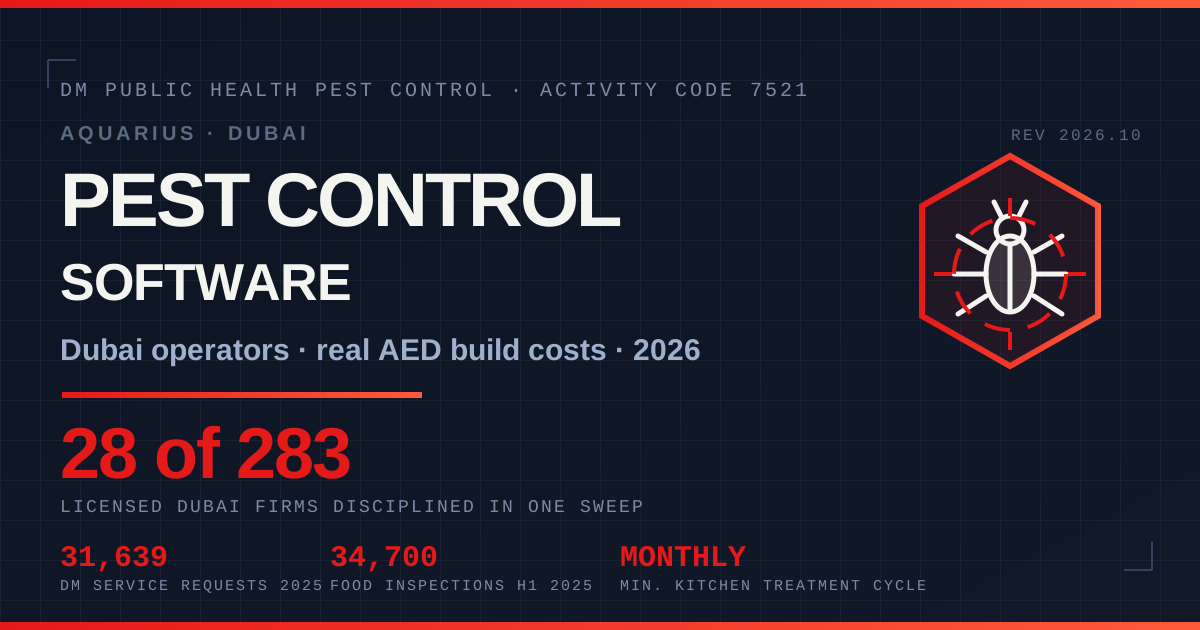
Short answer: a Dubai pest control operator can run on off-the-shelf field-service software for roughly AED 150 to AED 1,500 per month, but none of the mainstream platforms produce the treatment certificate Dubai Municipality inspectors actually ask for. A custom operations platform that generates DM-compliant certificates, keeps the pest activity log and tracks FoodWatch-registered contracts costs AED 45,000 to AED 180,000 to build in 2026, with care from AED 3,500 a month. For any firm past roughly ten technicians, that build is cheaper in year one than per-seat enterprise licences.
The urgency is new. In October 2025 Dubai Municipality announced disciplinary action against 28 pest control companies for failing to comply with approved standards — out of 283 approved and licensed firms operating in the emirate. That is roughly one in ten licensed operators penalised in a single enforcement sweep, and the Municipality was explicit that action came only after awareness efforts had been exhausted.
Key takeaways
- Dubai has 283 licensed pest control companies. 28 were disciplined in one October 2025 sweep for non-compliance with approved standards (Dubai Municipality, reported by Gulf Today).
- Most Dubai operators get this wrong: holding a DM pest control licence does not register you against a client premises. Food businesses must register their contractor in the FoodWatch Supplier Management system — and the client gets the closure notice when that link is missing.
- The Municipality handled 31,639 public pest control service requests in 2025 at a 99.61% completion rate — the benchmark your private SLA is implicitly measured against.
- Dubai food establishments took 34,700 inspection visits in H1 2025 alone, with 2,336 new food businesses opening in the same six months (Dubai Media Office). Every one of them needs a registered pest control contract.
- Route and schedule optimisation lifts daily jobs per technician by 15% to 25% and cuts mileage 15% to 30%. On a 12-van Dubai fleet that is two to three extra billable jobs a day without hiring.
The Dubai pest control market is now a compliance market
The commercial backdrop is steady rather than explosive. The UAE pest control market was valued at about USD 211 million in 2025 with a projected 6.3% CAGR, and the rodent control segment alone moves from USD 126 million in 2025 to USD 133.7 million in 2026 on its way to USD 214.7 million by 2034 at a 6.1% CAGR. Over 85% of the UAE population lives in urban areas, which is why Dubai and Abu Dhabi carry most of that demand.
What changed is not demand. It is scrutiny. Three numbers tell the story: 283 licensed competitors, 28 of them disciplined in one sweep, and 34,700 food inspections in six months. In a market that size the differentiator is no longer the chemistry — the approved pesticide list is the same for everyone — it is whether you can produce a complete, inspector-ready paper trail for every visit you have ever made, on demand, from a phone.
Dubai Municipality has also raised the professional bar. Adel Abdullah Al Karani, Director of Public Health Services, announced a Professional Diploma in Public Health Pest Control, described as the first of its kind accredited by the Ministry of Education. Technicians are becoming certified professionals with authorisation card numbers that belong on every certificate. Software that cannot carry a technician card number onto a document is already behind.
The myth that gets Dubai operators fined: licensed is not registered
Here is the single most expensive misunderstanding in the trade. A pest control company can be fully licensed — DET service licence under activity code 7521 (disinfection and pest control services), a valid Dubai Municipality pest control permit, certified applicators on staff — and still leave every food client exposed.
Dubai Municipality requires food businesses to register their pest management contractor digitally through the FoodWatch Supplier Management system at foodwatch.dm.gov.ae. Your licence does not automatically attach you to a client premises. When an inspector opens a restaurant file and finds no registered contractor, the finding lands on the restaurant — which then changes supplier. Operators who treat FoodWatch registration as part of onboarding, tracked in software with a renewal date, keep contracts that competitors lose at inspection.
The same discipline applies on the client side of the file. Food establishments must hold an active annual contract with a licensed provider, keep a pest control log on premises, and produce treatment certificates for every visit. Missing one certificate is a documentation gap; live pest activity in a food zone can trigger an immediate closure notice. If you build software for this market, the deliverable is not a job ticket. It is evidence.
What Dubai Municipality expects on every job — the data model
Work backwards from the inspection and the schema writes itself. A compliant treatment certificate in Dubai needs to carry, per visit:
- Date, time, and the technician name plus DM authorisation card number
- The specific pesticide used: brand name, active ingredient, concentration and volume applied
- The treatment method applied, zone by zone
- Pest activity observations recorded at the visit
- The contractor DM licence number
Alongside that sits a formal pest activity log capturing every sighting between visits — date, location, species, follow-up action. That log is a client-facing app surface, not a clipboard, and it is the feature that turns your software into a reason to stay.
Then there is cadence. The minimum service frequencies Dubai food premises work to are published by zone, and they are what your scheduler must enforce automatically rather than leave to a dispatcher memory:
| Zone | Minimum treatment cycle | Scheduling implication |
|---|---|---|
| Kitchen and food preparation areas | Monthly | 12 visits per year per site, hard SLA |
| Bin rooms and refuse areas | Monthly | Often a separate access window and key holder |
| Dining areas and service stations | Monthly | Out-of-hours slots; drives night-shift rostering |
| Cold storage | Bi-monthly | 6 visits per year, different chemical set |
| Service corridors and staff areas | Bi-monthly | Usually bundled with the cold-store visit |
| Outdoor terraces and loading bays | Quarterly | 4 visits per year, weather and event sensitive |
One mid-size restaurant group with eight sites therefore generates well over 200 scheduled service events a year, each needing its own certificate with correct chemical data and a technician card number. Spreadsheets do not survive that. Neither does WhatsApp.
Off-the-shelf versus custom: what each actually costs
Global pest control platforms are mature and worth pricing honestly before commissioning anything. Published and reported 2026 pricing, converted at the pegged USD 1 = AED 3.6725:
| Option | Reported 2026 price | Approx. AED | Fit for a Dubai operator |
|---|---|---|---|
| Jobber (entry field service) | USD 39/mo standard, Grow USD 199/mo, extra seats USD 29 | AED 143 – 731/mo | Cheap and quick. No DM certificate fields, no FoodWatch tracking, no Arabic site reports |
| FieldRoutes | From roughly USD 350/mo per 1,000 active customers (reported) | From AED 1,285/mo | Strong routing and recurring billing; pricing scales with your customer base, not your margin |
| PestPac | Approx. USD 150/mo single user to USD 800 – 1,500/mo for 10 users (reported, not vendor-confirmed) | AED 550 – 5,510/mo | Deepest pest-specific feature set; quote-based, US-centric compliance templates |
| ServiceTitan | USD 245 – 398 per technician per month, plus USD 5,000 – 50,000 implementation | AED 900 – 1,462 per tech/mo + AED 18,360 – 183,600 setup | Enterprise-grade, enterprise-priced. Per-seat cost compounds with every van you add |
Run the per-seat maths on a 12-technician Dubai firm at ServiceTitan-class pricing: AED 10,800 to AED 17,500 a month, or roughly AED 130,000 to AED 210,000 a year, before implementation — recurring, forever, and still without a DM-format certificate. That is the number that makes a one-time custom build look conservative rather than indulgent.
The honest recommendation: under about five technicians with mostly residential work, start on an off-the-shelf tool and stay there. Past ten technicians, or the moment commercial food contracts become a real share of revenue, the compliance gap and the per-seat curve both argue for your own platform. We apply the same test to adjacent trades in our write-ups on facility management and CAFM software in Dubai and food safety compliance software.
Where the money actually comes back: routing and renewals
Compliance keeps the licence. Routing pays for the build. Published field-service benchmarks are consistent: intelligent scheduling and dispatch raise daily job capacity by 15% to 25% without adding technicians or hours, technicians cut daily mileage by 15% to 30%, fuel savings land in the 20% to 30% band, total drive time falls around 23%, and operational costs come down roughly 15% with automation. The route optimisation software market itself grew from USD 5.8 billion in 2022 toward a projected USD 21.7 billion by 2030 at a 17.9% CAGR — service businesses are buying this for a reason.
Translate that to Dubai service pricing. A restaurant annual contract on a bi-monthly cycle sells for around AED 2,200 a year; a villa contract with four visits runs about AED 1,320; apartment annual contracts land at AED 1,000 to AED 1,500, and single visits run AED 165 to AED 440 for an apartment, AED 800 to AED 1,500 for a villa and from AED 550 for an F&B premises. At those price points a firm holding 400 commercial contracts carries roughly AED 880,000 of recurring revenue — and loses about AED 88,000 of it to a 10% churn rate caused by missed visits and late certificates.
Two software features recover most of that. First, automatic AMC renewal alerts 60 and 30 days out, with FoodWatch registration status attached. Second, a scheduler that will not let a monthly kitchen cycle slip past its due date without escalating. Neither is clever. Both are invisible until they are missing.
What it costs to build in Dubai (2026 AED bands)
These are our planning bands for a Dubai pest control and hygiene services operator, assuming bilingual output and DM-format documents from day one. Scope, integrations and site count move the range.
| Scope | AED band | Typical timeline |
|---|---|---|
| Technician app and DM certificate engine (offline-capable, photo evidence, e-signature) | 45,000 – 85,000 | 5 – 8 weeks |
| Full operations platform (scheduling, routing, AMC renewals, client portal, pest activity log, invoicing) | 95,000 – 180,000 | 10 – 16 weeks |
| Multi-emirate or enterprise build (ERP and accounting integration, contract hierarchies, API access) | 180,000 – 350,000 | 4 – 7 months |
| Pesticide stock, batch and traceability module | 20,000 – 55,000 | 3 – 5 weeks |
| Arabic and RTL client reporting | 12,000 – 30,000 | 2 – 3 weeks |
| VAT invoicing and e-invoicing readiness | 20,000 – 60,000 | 3 – 6 weeks |
| Hosting, support and compliance care | 3,500 – 12,000 / month | ongoing |
Set that against the regulatory cost base you already carry. A Dubai pest control licence runs AED 20,000 to AED 40,000 all-in for year one — DET service licence AED 5,000 to 8,000, the DM pest control permit AED 3,000 to 5,000, certified applicator registration AED 2,000 to 4,000 per technician, pesticide storage and equipment compliance AED 4,000 to 10,000 — then AED 12,000 to AED 25,000 a year to renew, with a typical 10 to 15 working day approval cycle. Enforcement is the other side of the ledger: reported penalties run AED 2,000 to 10,000 for unapproved chemicals and AED 10,000 to 50,000 for operating without a DM pest control licence, with agricultural pesticides such as aluminium phosphide used in residential settings drawing fines up to AED 50,000. Food establishment violations are reported in the AED 5,000 to 50,000 range per incident, plus closure.
Against a single mid-range fine plus one lost eight-site restaurant group, a certificate engine that costs AED 45,000 once is not a technology purchase. It is insurance that also sells.
How Aquarius builds these
We start from the inspection, not the feature list. Phase one is always the technician app and the certificate engine, because that is the artefact that gets audited — DM licence number, technician card number, pesticide active ingredient, concentration and volume, zone-level method, observations, client signature, generated as a PDF in English and Arabic before the van leaves site. Phase two adds scheduling with enforced minimum frequencies, AMC renewal automation and the client portal with the live pest activity log. Phase three is routing, stock traceability and accounting. Fixed-scope phases, a working build you can show an inspector at the end of each one, and your code and data in your own repository and your own cloud account from the first commit. Our pricing page shows how the phases are packaged, and our services cover the web and mobile sides of the same build.
FAQ
Do I need Dubai Municipality approval to sell pest control software?
No. The permit requirements apply to the operator performing treatments, not the software vendor. But the software has to produce documents that satisfy a DM inspection — technician authorisation card number, contractor licence number, pesticide active ingredient, concentration and volume — or your client cannot use it as evidence.
What does pest control software cost per month in Dubai?
Entry field-service tools start near AED 143 a month (Jobber standard, USD 39). Pest-specific platforms run from about AED 550 for a single user to AED 5,510 a month at ten users on reported PestPac pricing, while enterprise per-technician licensing sits at AED 900 to AED 1,462 per technician per month plus implementation. A custom platform converts that recurring cost into a one-time build of AED 45,000 to AED 180,000 plus hosting and care from AED 3,500 a month.
Is FoodWatch registration my responsibility or my client responsibility?
Formally the food business registers its suppliers in the FoodWatch Supplier Management system. Practically, the contractor who tracks that registration and chases it at onboarding and renewal keeps the contract, because the client is the one who takes the finding when the link is missing.
How often must a Dubai restaurant be treated?
Kitchens, food preparation areas, bin rooms, dining areas and service stations work to a monthly minimum cycle. Cold storage and service corridors are bi-monthly, outdoor terraces and loading bays quarterly. Treatment certificates and a pest activity log must be available on premises for inspection.
How long does it take to build a pest control platform?
A technician app with a compliant certificate engine ships in 5 to 8 weeks. A full operations platform with scheduling, routing, renewals and a client portal takes 10 to 16 weeks. Multi-emirate and ERP-integrated builds run 4 to 7 months.
The short version
Dubai disciplined 28 of its 283 licensed pest control firms in one October 2025 sweep, and ran 34,700 food inspections in six months. In that market the firms that grow are the ones whose evidence is faster than the inspector. If you run a Dubai pest control or hygiene services operation and your certificates still live in a WhatsApp thread, talk to us — we will map your current job flow against what DM asks for and quote the phase that closes the gap first.