
Post-Quantum Cryptography in Dubai (2026): The UAE Encryption Mandate, Q-Day Math and Real AED Costs
The UAE now mandates post-quantum transition plans and NIST disallows RSA after 2035 - yet Dubai health records must stay secret for 25 years. What quantum-safe migration really costs in AED.
- PUBLISHED
- 22 OCT 2026
- READ TIME
- 12 MIN
- AUTHOR
- AQUARIUS · DUBAI
- UNIT
- REV 2026.09
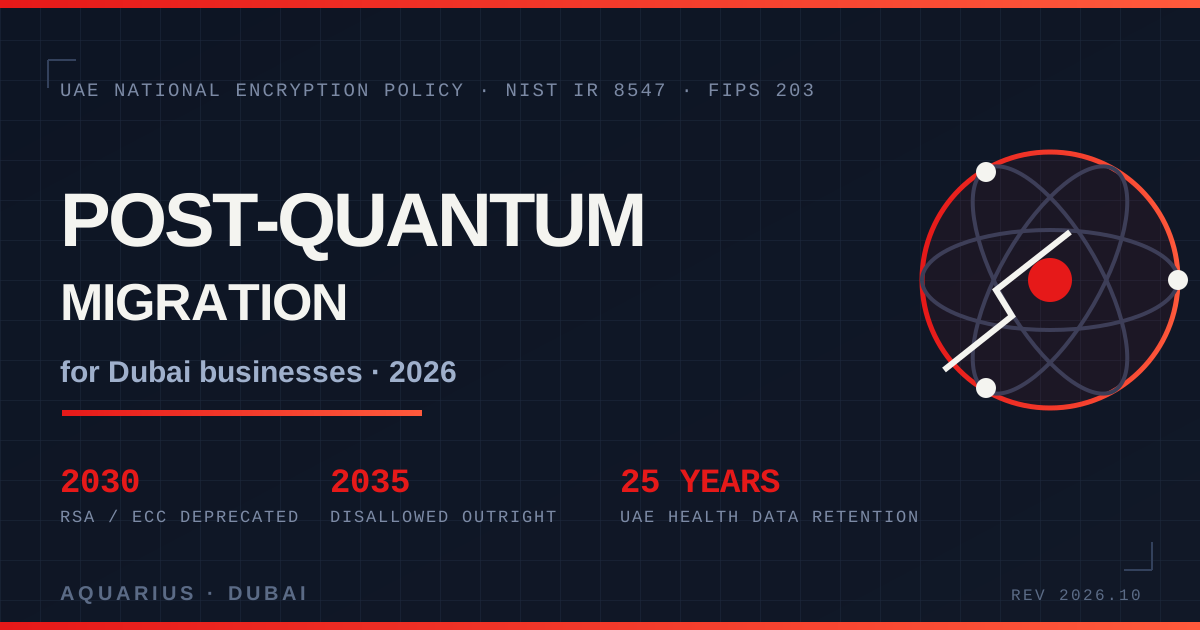
The UAE Cyber Security Council approved a National Encryption Policy on 27 November 2025 that requires officially approved transition plans from classical encryption to post-quantum cryptography — one of the first binding national PQC mandates anywhere. NIST’s roadmap deprecates RSA-2048 and ECC-256 after 2030 and disallows them after 2035. Dubai healthcare providers, meanwhile, must retain patient records for at least 25 years. Do that arithmetic once and the problem stops being theoretical: data you encrypt this afternoon has to stay secret well past the date its encryption stops working.
Dubai is ahead of the world on this, and most local businesses have not noticed
The UAE is not waiting for a quantum computer to appear. The National Encryption Policy obliges entities to hold formal, approved migration roadmaps away from RSA and ECC, maintain an automated cryptographic inventory rather than a spreadsheet, and build new systems so algorithms can be swapped without re-architecture. It explicitly names the harvest now, decrypt later threat model and prioritises data with 10–20 year confidentiality lifetimes.
Then came the tooling. In May 2026 the Council partnered with Abu Dhabi-built QuantumGate to launch a national Crypto Discovery Tool, customised to UAE National Cryptography Center requirements, as the operational layer of the National Post-Quantum Migration Programme — covering critical public and private sector entities, not just ministries. It also ran a Global Quantum Drill with the ITU at GISEC: the first post-quantum migration-failure exercise any regulator has staged.
The backdrop: daily cyberattack attempts against the UAE have risen from a pre-conflict baseline of 90,000–200,000 to 600,000–800,000 per day in 2026. Dubai’s GDP hit AED 473 billion in H1 2026, with information and communication adding roughly AED 24.7 billion. That is a lot of value riding on key exchanges nobody has inventoried.
Most Dubai businesses think post-quantum is a 2035 problem. It is a 2026 problem with a 2035 deadline — and the data stolen in between is the part you cannot fix later.
Harvest now, decrypt later: the only argument that matters
An attacker does not need a quantum computer today. They need your encrypted traffic today and a quantum computer later. Captured TLS sessions, backups and database exports sit in storage until a cryptographically relevant quantum computer (CRQC) can run Shor’s algorithm against the key exchange that protected them.
The Global Risk Institute Quantum Threat Timeline Report, published 9 March 2026 from a survey of 26 specialists, puts a CRQC at 28–49% likely within 10 years and 51–70% within 15 years — roughly one-in-four by 2030 and one-in-two by 2035. No CRQC exists in 2026. That is not reassurance; that is the window.
Now overlay UAE retention law, which is where this becomes specifically a Dubai problem:
- Health data: 25 years minimum from the patient’s last medical intervention, under DHA and federal health-data rules, stored inside the UAE. A record created in 2026 is still legally live in 2051.
- Banking, KYC and CDD records: 5 years minimum from the end of the relationship under CBUAE rules — longer for mortgages and trade finance.
- Government, defence, energy and legal archives routinely carry decade-plus confidentiality expectations with no expiry clause.
If your confidentiality obligation outlives 2035, RSA and ECC are already inadequate for that data. Everything else here is implementation detail.
What is actually standardised, and what your stack already supports
NIST published the replacement algorithms in August 2024: FIPS 203 (ML-KEM, formerly Kyber, for key exchange), FIPS 204 (ML-DSA, formerly Dilithium, for signatures) and FIPS 205 (SLH-DSA). The transition roadmap, NIST IR 8547, deprecates quantum-vulnerable public-key algorithms — RSA, finite-field and elliptic-curve Diffie-Hellman, ECDSA and EdDSA — after 2030 and disallows them after 2035.
Good news for anyone on a normal web or mobile stack: the key-exchange half is mostly configuration, and the internet has quietly done it already.
- The industry converged on the hybrid X25519MLKEM768 key agreement — classical X25519 plus ML-KEM-768, so it is no weaker than today even if ML-KEM were broken.
- Chrome 131 ships standardised X25519MLKEM768; Firefox 132+ enables it.
- OpenSSL 3.5 ships ML-KEM, ML-DSA and SLH-DSA, with X25519MLKEM768 in the default key share. Go 1.24 enables it by default in
crypto/tls. Node.js bundles OpenSSL 3.5 from 24.5.0 and 22.20.0 onward — Python’sssl, Ruby, PHP and curl inherit it once their runtime links 3.5+. - Cloudflare reported more than two-thirds of human-generated TLS traffic using hybrid ML-KEM as of 30 April 2026, up from roughly half in October 2025. Post-quantum origin connections jumped from about 25 billion to 45 billion per day.
And the gap: a 2026 measurement study found 49.3% of domains support hybrid post-quantum key exchange and 50.7% do not. Being in the second half is now a choice — usually an accidental one, made by a pinned curve list someone wrote in 2019.
The single most common Dubai finding
In code reviews the recurring blocker is a hardcoded curve: ecdhCurve or DEFAULT_ECDH_CURVE in Node, an explicit ssl_ecdh_curve in nginx, a pinned cipher list on a load balancer. Each silently opts you out of the post-quantum default your runtime already shipped. Removing the override is often a one-line change that moves a Dubai SME from 0% to 100% quantum-safe key exchange on public traffic.
Signatures are the hard half, and nobody has finished
Key exchange protects confidentiality now; signatures protect authenticity later, and they are tangled up in certificate authorities, code signing, firmware and payment hardware you do not control. As of mid-2026 no Tier-1 global bank had completed a production migration to FIPS 203 or FIPS 204; most expect to finish only the inventory by end-2026. If the largest banks on earth are still counting their keys, an honest Dubai roadmap starts there too.
The deadline that forces the issue first: 47-day certificates
Before any quantum computer arrives, a more mundane change breaks manual processes. CA/Browser Forum ballot SC-081v3 cuts the maximum lifetime of publicly trusted TLS certificates from 398 days:
| From | Max certificate lifetime | Domain validation reuse |
|---|---|---|
| Before 15 March 2026 | 398 days | 398 days |
| 15 March 2026 | 200 days | 200 days |
| 15 March 2027 | 100 days | 100 days |
| 15 March 2029 | 47 days | 10 days |
At 47 days, renewal by calendar reminder is not a policy, it is an outage schedule. Every certificate must be issued and deployed by automation — and that automation is exactly the crypto-agility muscle the UAE encryption policy asks for. An estate that can rotate every certificate unattended can also swap an algorithm unattended. One that cannot will fail at both.
What quantum-safe migration costs in Dubai in 2026 (AED)
International benchmarks are enterprise-sized and frighten SMEs out of starting: a Tier-1 global bank is projected to spend USD 35–50 million over four years; mid-market programmes USD 500,000–5 million over 12–24 months; discovery alone USD 2–5 million at large-enterprise scale. The US federal government has budgeted roughly USD 7.1 billion across 2025–2035.
A Dubai SME is not that — a typical estate is 3–25 applications, a CDN, some APIs, a mobile app and SaaS. At USD 1 = AED 3.6725, here is what the work costs at that scale:
| Workstream | 2026 range (AED) | Timeline / notes |
|---|---|---|
| Cryptographic inventory, SME estate | 18,000 – 55,000 | 2–4 weeks; TLS endpoints, libraries, keys, pinned curves, vendors |
| Edge and TLS quantum-safe enablement | 12,000 – 35,000 | 1–2 weeks; CDN, load balancers, API gateways, runtime upgrades |
| Certificate automation (47-day ready) | 15,000 – 45,000 | ACME issuance, renewal monitoring, staging rehearsal |
| Crypto-agility refactor in application code | 35,000 – 120,000 | 4–10 weeks; remove hardcoded algorithms, central crypto layer, KMS |
| Mobile app pinning and PQ-ready transport | 20,000 – 60,000 | Both platforms; pin rotation strategy, store release cycle |
| Vendor and SaaS supply-chain assessment | 15,000 – 40,000 | Questionnaires, contract clauses, roadmap evidence |
| Board / regulator-ready transition plan | 20,000 – 50,000 | Mapped to UAE National Encryption Policy and NIST IR 8547 |
| Full programme, mid-size UAE enterprise | 250,000 – 900,000 | 12–24 months, phased by data confidentiality lifetime |
| Ongoing crypto-posture monitoring | From ~3,500 / month | Drift detection, certificate expiry, new-dependency scanning |
The honest headline: for most Dubai SMEs, getting public traffic to hybrid post-quantum key exchange costs a few tens of thousands of dirhams and takes under a month. The expensive part is never the algorithm. It is discovering what you have.
A five-step migration that fits a Dubai SME
1. Inventory before anything else
Every TLS endpoint, library version, key and certificate, HSM and KMS holding, pinned curve or cipher list, and every third party that terminates your traffic. The UAE policy asks for this automated and continuously maintained, not a one-off audit.
2. Rank by confidentiality lifetime, not by system importance
Most roadmaps get this backwards. The question is not “which system matters most today” but “which data must still be secret in 2040”. Patient records, immigration files, M&A material, source code and biometric templates go first. A marketing site goes last.
3. Turn on hybrid key exchange where it is free
Upgrade runtimes to OpenSSL 3.5-linked versions, delete hardcoded curve overrides, enable post-quantum key agreement at the CDN and load balancer. On most Dubai stacks this is a pull request, not a project.
4. Automate certificates and prove you can rotate
Get to unattended issuance ahead of the March 2027 100-day limit, then rehearse an algorithm change in staging. The rehearsal is the deliverable.
5. Push the question down your supply chain
Your payment gateway, identity provider, EMR and hosting provider all hold cryptography you do not control. Ask each for a written PQC roadmap now, and put an algorithm-agility clause in the next renewal — the same discipline you already apply for DESC ISR compliance and ISO 27001 certification.
What it costs to skip this
IBM’s Cost of a Data Breach 2026 puts the Middle East average breach at USD 8 million — roughly AED 29.4 million — the costliest region tracked. The UAE PDPL adds fines up to AED 1,000,000 for inadequate technical security measures and AED 5,000,000 for the most serious violations. “We used the algorithms our framework shipped in 2019” reads as an inadequate-measures finding once a national policy, a NIST roadmap and your own runtime default all point the other way. The PDPL checklist covers the rest of that obligation.
There is a procurement dimension too. Once government entities operate approved PQC transition plans and the Crypto Discovery Tool maps critical private-sector infrastructure, suppliers get asked for their own roadmap. A two-page dated transition plan costs almost nothing today and will shortly be a tender attachment — the same way PCI DSS evidence became one.
How Aquarius handles quantum-safe migration
We start with the inventory, because every credible roadmap does and because clients consistently skip it. We enumerate TLS endpoints, runtime and library versions, key and certificate holdings, hardcoded curve overrides and third parties that terminate your traffic — then rank by how long each dataset must stay confidential, not by how visible the system is.
Quick wins ship first: runtime upgrades, removing pinned curves, hybrid X25519MLKEM768 at the edge, certificate automation that survives the 47-day rule. Then the slower work — a central crypto abstraction so the next algorithm change is a config value, KMS hygiene, a mobile pinning strategy, a vendor questionnaire pack. You get a dated transition plan written against the UAE National Encryption Policy and NIST IR 8547 that a board or regulator can read. Where authentication is in scope we pair it with passkeys and WebAuthn, and drift detection can run inside a managed monitoring arrangement. Fixed scope, fixed price — ranges are on our pricing page.
FAQ
Does the UAE actually require post-quantum migration in 2026?
The National Encryption Policy, approved on 27 November 2025, requires entities to hold officially approved transition plans from classical to post-quantum cryptography, maintain automated cryptographic inventories and design new systems for crypto-agility. It is binding rather than advisory, and the Crypto Discovery Tool launched in May 2026 extends the programme to critical private-sector entities.
Quantum computers cannot break RSA today, so why move now?
Because of harvest now, decrypt later. Traffic and backups captured in 2026 can be decrypted whenever a CRQC arrives — experts put that at 28–49% within ten years. Dubai health records must be kept 25 years, so data created today is still live long after RSA is disallowed in 2035.
What does a Dubai SME actually have to change?
Less than expected on the key-exchange side: upgrade runtimes to an OpenSSL 3.5-linked version, remove hardcoded curve overrides, enable hybrid X25519MLKEM768 at the CDN and load balancer, automate certificate renewal. Expect AED 12,000–55,000 and a few weeks for a typical estate. Signatures, code signing and vendor-controlled cryptography take longer.
Is hybrid key exchange risky if ML-KEM turns out to be flawed?
No — that is the point of hybrid. X25519MLKEM768 combines classical X25519 with ML-KEM-768, so an attacker must break both. If ML-KEM were weakened you are no worse off than classical TLS today. That is why browsers and OpenSSL shipped the hybrid rather than pure ML-KEM.
How long does full migration take?
Published modelling puts it at 5–7 years for small enterprises, 8–12 for medium and 12–15+ for large, with discovery alone running 12–18 months at enterprise scale. A Dubai SME compresses that — public traffic in weeks, application and vendor cryptography over 12–24 months — but the arithmetic assumes you start in 2026, not 2032.
Next step
Pick one dataset you must legally keep past 2035 and ask what algorithm protects it today, in transit and at rest. If nobody can answer in the meeting, that is the finding. Send us your stack and we will run the inventory against the UAE National Encryption Policy and NIST IR 8547 — and send the quantum-readiness checklist either way.
Figures and regulatory positions as of October 2026. NIST IR 8547 remains a draft roadmap; costs vary with scope and provider. Confirm compliance obligations with a UAE legal adviser before relying on them.