
The 24-Hour Recall Clock in Dubai (2026): Building Systems That Can Actually Pull a Product
Cabinet Decision No. 107 of 2026 gives UAE suppliers 24 hours to withdraw a product and 48 to announce it bilingually. Fines reach AED 2,000,000. What your systems must do.
- PUBLISHED
- 21 NOV 2026
- READ TIME
- 12 MIN
- AUTHOR
- AQUARIUS · DUBAI
- UNIT
- REV 2026.09
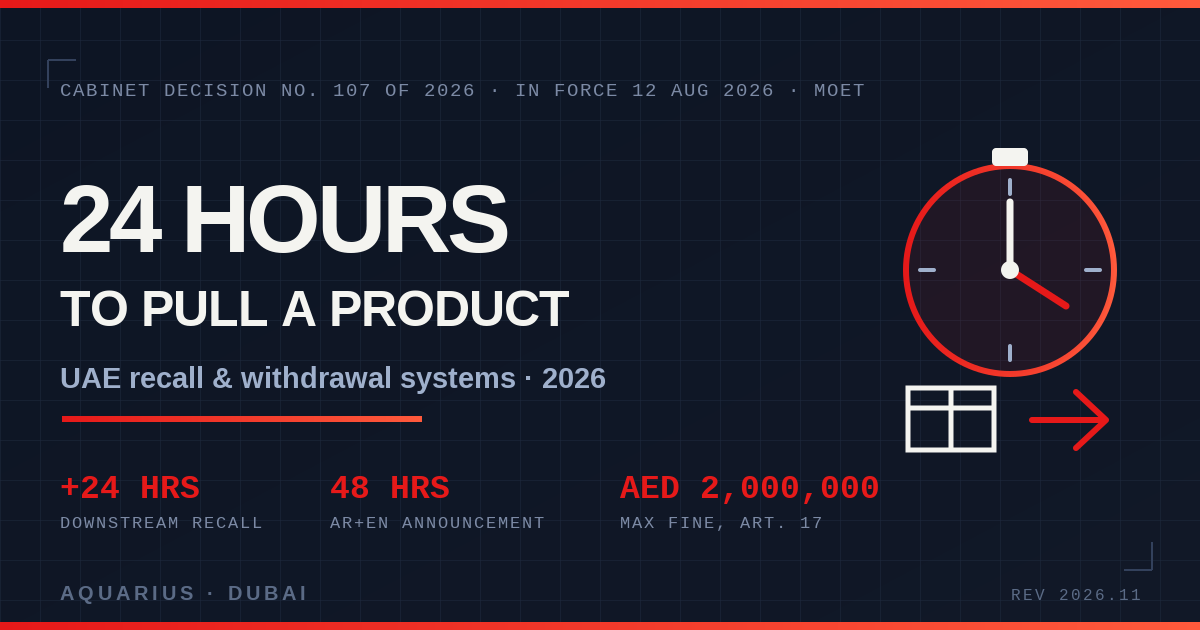
Since 12 August 2026, a supplier in the UAE that receives an official notification about a non-compliant product has 24 hours to stop selling it, pull it from every market and warehouse, and notify every point of sale it supplied — and those recipients then have a further 24 hours to recall their own stock. Cabinet Decision No. 107 of 2026 made that clock binding across the mainland and the free zones, with fines reaching AED 1,000,000, or AED 2,000,000 where health and safety are at stake.
Most Dubai retailers and distributors read that as a legal problem and send it to the compliance consultant. It is not. Twenty-four hours is an engineering specification. If your batch numbers live in a supplier email, your store list lives in someone's head and your customer contact data sits in three disconnected systems, the deadline is already missed on the day the notice lands. Below is what the regulation actually demands, hour by hour, and the systems work that makes the deadline survivable.
The stakes: a market that got large before it got traceable
Three numbers frame the problem:
- UAE e-commerce sales hit USD 11.5 billion in 2025, up from USD 4.8 billion in 2020 — a 19% compound growth rate over five years — and are forecast to reach USD 18.3 billion by 2030, per the sixth annual EZDubai and Euromonitor International report published in September 2026. At the 3.6725 peg that is roughly AED 42.2 billion growing to AED 67.2 billion.
- Online now accounts for 15.7% of total UAE retail sales, and the same report expects it to pass 20% by 2030. Apparel and footwear alone moved USD 3.10 billion online in 2025 — a category where sizing, materials and safety claims all trigger withdrawal risk.
- Penalties under Federal Decree-Law No. 42 of 2023 on Combating Commercial Fraud run to imprisonment of up to two years and fines of AED 5,000 to AED 1,000,000, rising to AED 2,000,000 for goods harmful to human or animal health, and for certain food, agricultural and pharmaceutical products.
Here is the part most teams get wrong. You will not learn about your recall from a public bulletin board. The Ministry of Economy and Tourism publishes a product-recall index, and as of November 2026 its automotive list holds 199 entries whose most recent is dated 25 August 2023, while the food-and-drugs list contains exactly one item — a frozen vegetable ball recall from February 2022. Real enforcement arrives as a private notice to the supplier. The clock starts the moment it is received, not the moment it is published.
What Cabinet Decision No. 107 of 2026 actually changed
Cabinet Decision No. 107 of 2026 was issued on 13 July 2026, published in Federal Official Gazette No. 827 on 14 July 2026, and took effect on 12 August 2026. It is the executive regulation to Federal Decree-Law No. 42 of 2023 and it repeals Cabinet Decision No. 11 of 2020.
Two structural points matter more than the fine print:
It applies in the free zones. There is no DMCC or JAFZA carve-out. A free-zone trading company holding stock in a Dubai South warehouse is inside scope.
"Supplier" is defined broadly. Importers, exporters, manufacturers, producers, marketers, sellers, holders, warehouse operators, transporters and exhibitors all qualify. If you only import and never meet an end customer, you still own the 24-hour duty.
And the inspection power reaches directly into your stack. Judicial enforcement officers may enter commercial premises, production facilities, warehouses and transport hubs without prior notice, and the power expressly extends to devices, networks, electronic media, information systems, computer programs, databases, e-commerce platforms, electronic communications and financial and inventory records. Your ERP is evidence.
The clock, deadline by deadline
This is the operational spine of the regulation. Every row is a system requirement disguised as a date.
| Deadline | What must happen | What the system has to produce |
|---|---|---|
| Immediately | Stop selling and stop displaying the goods | Kill switch by SKU and batch across POS, webstore, marketplace feeds and in-store screens |
| 24 hours from receiving notice | Withdraw from markets and warehouses; notify every point of sale and every entity supplied | Batch-level stock map plus a verified contact list of every downstream recipient |
| +24 hours | Those recipients recall their own stock | Acknowledgement tracking — you must evidence that they were told |
| 48 hours | Public recall announcement in Arabic and English through authority-specified channels | Bilingual notice template carrying supplier contact, trademark, product type and model, country of origin, refund procedure, withdrawal locations and deadlines |
| 48 hours after a missed deadline | The authority removes the goods itself, at the supplier's expense (Article 8) | Nothing — this is the failure state |
| 5 working days | Written withdrawal report | Quantities held, quantities distributed, quantities recovered, their value, and refunds paid to consumers |
| 15 working days | Laboratory testing concludes (shorter for perishables); supplier pays regardless of result | Batch and lot linkage to the tested sample |
| 30 days from seizure | Return to origin or re-export at the supplier's own cost, where no destruction order was issued | Export documentation tied to the seized consignment |
Read the 5-working-day report row again. It asks for quantities recovered and refunds made to consumers. That is a reconciliation between inventory, sales and payments, in a defined format, five days after the worst week of your year. Almost nobody can produce it from existing reports.
Why most Dubai stacks fail the 24-hour test
The failures are consistent and they are all data-model failures, not willpower failures.
1. You stock SKUs, not batches
Most mid-market systems in the UAE track inventory at SKU level. A notice names a batch, a lot or a production date range. If the SKU is your finest granularity, your only compliant response is to withdraw all of it — which is both commercially brutal and slower, because you now have to touch every location instead of four. Batch and lot fields at goods-receipt are the single highest-leverage change you can make.
2. You cannot list who you supplied
Article 5 requires notifying every point of sale and every entity supplied. For a distributor with 300 trade accounts, that list has to be derivable from delivery records, with current contact details, in minutes. Most of it is in invoices nobody has normalised and WhatsApp threads nobody can export.
3. Product attributes live in the webstore, not in a source of truth
The 48-hour announcement needs trademark, product type, model and country of origin — in Arabic and English. If your Arabic copy only exists as hand-edited CMS fields, the bilingual notice becomes a translation project at hour 30. A proper product information management layer is what turns that into a query.
4. Your channels do not share a stop list
Pulling a product from your own website is easy. Pulling it from Noon, Amazon.ae, your Talabat listing, your retail partners' feeds and the in-store catalogue tablet is five separate integrations, and each one has its own propagation delay. Measure that delay before you need it.
5. You cannot reach the buyers
A good-faith consumer is entitled to a refund or a replacement — at the consumer's preference, not yours — without prejudice to compensation. And their knowledge that goods were adulterated, counterfeit or spoiled does not exempt you. If order records do not join to batches, you cannot target the affected buyers and must mass-notify everyone, which converts a contained recall into a brand event.
What a recall-ready stack looks like
You do not need a specialist recall platform. You need five capabilities wired into what you already run:
- Batch and lot capture at receipt — mandatory fields on the goods-receipt note, printed on the internal label, carried into every stock movement. This is where 2D barcodes under GS1 Sunrise 2027 start paying for themselves, because a QR-style GS1 Digital Link can carry batch and expiry that an EAN-13 physically cannot.
- A downstream recipient register — one query returning every account, branch and marketplace that received a given batch, with a contact channel and a delivery timestamp.
- A channel kill switch — one admin action that sets a batch to blocked and propagates to POS, webstore, marketplace feeds and partner APIs, with a per-channel confirmation log.
- Bilingual notice generation — the nine mandated fields pulled from structured data into an Arabic and English notice, ready for web, email, SMS and press within the 48-hour window.
- An evidence pack — immutable logs of who was notified and when, quantities held, distributed and recovered, and refunds paid, exportable in the 5-working-day report format. The regulation specifically requires you to furnish proof that notification, recall and recovery were carried out.
Build order matters. Batch capture first, because every other capability reads from it. Evidence logging second, because it is cheap and it is the thing you will be judged on. The kill switch last, because it is the most integration-heavy and the least useful without the first two.
What this costs in Dubai, and what inaction costs
Indicative AED ranges for a mid-market Dubai retailer or distributor already running an ERP or a Shopify, WooCommerce or Magento storefront:
| Scope | Typical AED range | Timeline |
|---|---|---|
| Recall-readiness audit and gap report (data model, channels, evidence) | AED 9,000 – 18,000 | 1 – 2 weeks |
| Batch and lot tracking added to existing inventory and order flow | AED 22,000 – 55,000 | 3 – 6 weeks |
| Downstream recipient register plus notification and acknowledgement tracking | AED 18,000 – 40,000 | 2 – 4 weeks |
| Multi-channel kill switch (webstore, POS, 2 – 3 marketplaces) | AED 30,000 – 75,000 | 4 – 8 weeks |
| Bilingual notice generator and 5-day report export | AED 12,000 – 28,000 | 2 – 3 weeks |
| Full recall-ready build, phased | AED 75,000 – 190,000 | 8 – 14 weeks |
Set that against the downside. A single Article 17 penalty tops out at AED 1,000,000, or AED 2,000,000 for health-and-safety or food, agricultural and pharmaceutical goods. Miss the 24-hour window and the authority removes the goods itself within the following 48 hours at your expense. You pay for laboratory testing irrespective of the result, for re-export where ordered, and for destruction — including destruction outside the UAE.
Settlement exists but it is narrow: apply within 10 working days of notification, a decision follows within 15 working days, silence counts as rejection, and it is unavailable for bad faith — or if you were fined under the law in the preceding 12 months. One prior penalty removes the escape hatch. Full compliance costs less than one capped fine, and the asset you buy is batch-level traceability that improves margin forecasting and shrink control in the 51 weeks a year nothing goes wrong.
How Aquarius approaches it
We treat the 24-hour clock as an acceptance test. We start with a timed dry run against your live systems: pick a real batch, and measure how long it actually takes to produce the stock map, the recipient list and the bilingual notice. The number is usually days, not hours, and it is the only argument you need internally.
From there we fix the data model before touching the UI, because batch granularity is what every downstream feature depends on. We work with the systems you already own — no rip-and-replace — and we leave behind the evidence export, documented, so the 5-working-day report is a button and not a weekend. Scope and fixed-price bands are on our pricing page.
If you are also closing legal-page and consumer-notice gaps, read our walkthrough of UAE website legal pages and compliance in 2026 — the refund and withdrawal language in a recall notice has to match what your terms already promise.
FAQ
When did the 24-hour recall rule take effect in the UAE?
Cabinet Decision No. 107 of 2026 was published in Federal Official Gazette No. 827 on 14 July 2026 and came into force on 12 August 2026. It replaces Cabinet Decision No. 11 of 2020 and implements Federal Decree-Law No. 42 of 2023 on Combating Commercial Fraud.
Does the 24 hours mean the recall has to be finished?
No. The 24 hours is to begin and execute withdrawal from markets and warehouses and to notify every point of sale and entity you supplied — not to destroy the goods. Those downstream recipients then have a further 24 hours to recall their own stock. Destruction follows a court judgment or committee decision and has its own 15-working-day window.
Do free-zone companies in Dubai have to comply?
Yes. The regulation applies throughout the UAE including the free zones, and the definition of supplier covers importers, exporters, manufacturers, marketers, sellers, holders, warehouse operators, transporters and exhibitors.
Who enforces it — Dubai or the federal ministry?
The emirate-level competent authority has primary jurisdiction. The Ministry of Economy and Tourism can take over after 10 working days of local inaction, where goods are distributed across more than one emirate, where there is serious risk to human or animal health or the environment, or where state-level measures are needed.
What does the public recall announcement have to contain?
Within 48 hours, in Arabic and English, through channels the authority specifies: supplier contact details, the trademark, product type and model, country of origin, the refund procedure, withdrawal locations, and the recall deadlines.
What if we only sell through an e-commerce marketplace?
Consumer-protection rules under Federal Law No. 15 of 2020, as amended by Federal Decree-Law No. 5 of 2023, cover goods sold via e-commerce platforms registered in the UAE, alongside mainland and free-zone trade. Marketplace listings are a channel you have to be able to stop, not a shield.
The practical next step
Do the dry run. Pick one batch, start a stopwatch, and see whether you can produce a stock map, a complete downstream recipient list and a bilingual notice inside 24 hours. If you cannot — and most Dubai businesses cannot — talk to us and we will scope the smallest set of changes that gets you under the clock.