
Product Information Management (PIM) in Dubai 2026: Real AED Costs and the Catalogue Gaps That Sink UAE Listings
A PIM is the product-data layer behind noon, Amazon.ae and your own store. Real 2026 AED costs, Akeneo vs custom, Arabic attributes, and the returns it stops.
- PUBLISHED
- 18 OCT 2026
- READ TIME
- 12 MIN
- AUTHOR
- AQUARIUS · DUBAI
- UNIT
- REV 2026.09
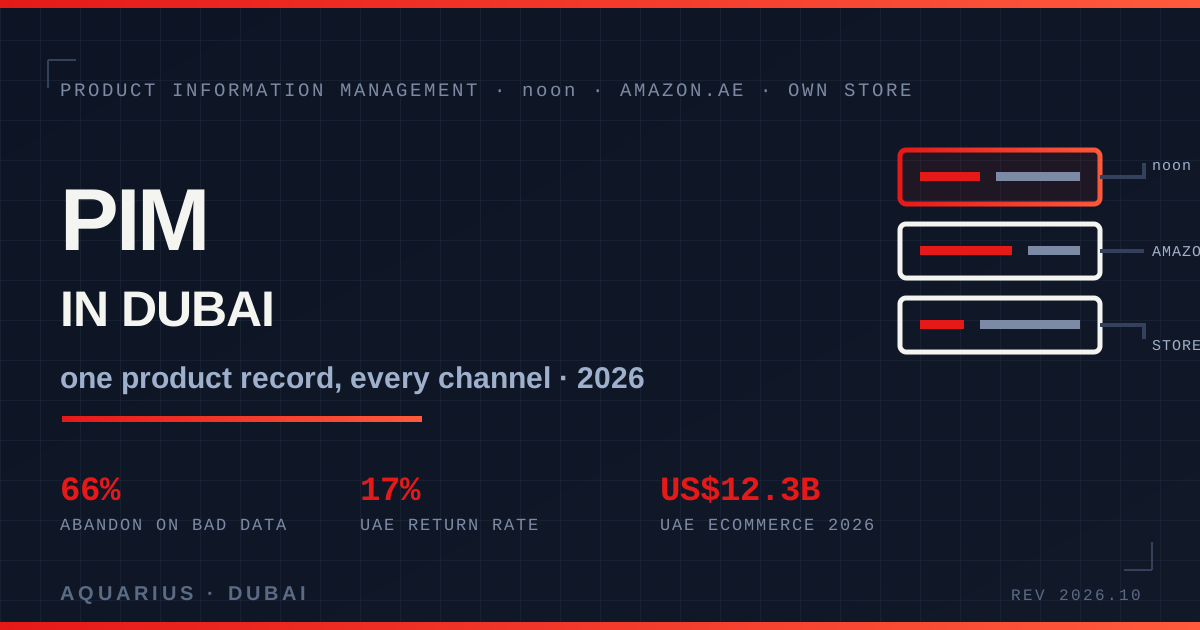
Short answer: A PIM (product information management system) is the single source of truth for every product attribute — titles, Arabic copy, images, dimensions, barcodes, tax codes, compliance claims — that your store, noon listing, Amazon.ae listing and WhatsApp catalogue all read from. In Dubai in 2026 a licensed platform runs from free (Akeneo Community, self-hosted) to roughly AED 165,000 a year for Akeneo Growth before implementation, while a custom catalogue-data layer built around an existing UAE stack typically lands at AED 35,000–180,000 one-off. The business case is not tidiness: 66% of shoppers abandon a purchase when product information is missing or inaccurate, and the UAE already returns about 17% of everything it buys online.
Most Dubai merchants do not have a product data problem they can see. They have three spreadsheets, one agency, a Shopify admin, a noon seller panel, an Amazon.ae Seller Central tab, and a WhatsApp catalogue someone built in a hurry. Every one of them holds a slightly different version of the same SKU. This guide covers what that costs in AED, what UAE-specific attributes nobody outside the region tracks, and when a PIM is worth it versus when it is over-engineering.
Key takeaways
- UAE ecommerce is worth about US$12.30bn in 2026, heading to US$21.01bn by 2031 at an 11.29% CAGR, across 11 million-plus online shoppers and 45,000-plus active stores.
- Amazon.ae, noon and Carrefour UAE jointly control 45–50% of GMV — so your product data has to satisfy someone else's validator, not just your own CMS.
- The average UAE return rate sits near 17% (apparel ~26%, footwear above 30%), each return costs US$10–65 to process, and only 48% of returned items resell at full price.
- 43% of consumers returned something in the past year because pre-purchase information was wrong, and 59% returned an item because the online description was misleading or inaccurate.
- Shoppers dissatisfied with product data completeness more than doubled from 13% to 30% since 2023 — while consumers say they will pay 25–30% more for clear, complete information.
Why Dubai catalogues break faster than most
The UAE market is the reason. UAE ecommerce is estimated at US$12.30bn in 2026 and forecast to reach US$21.01bn by 2031, an 11.29% CAGR, served by more than 45,000 active online stores and 11 million-plus shoppers. But the traffic is concentrated: Amazon.ae, noon and Carrefour UAE together hold 45–50% of GMV, with noon drawing 9.06 million monthly visits as of January 2026 and Amazon.ae 8.01 million.
That concentration is what turns a messy catalogue into lost revenue. A Dubai brand selling only through its own Next.js or Shopify store controls its own templates and can be sloppy. The moment it lists on noon and Amazon.ae, three things happen at once: a third-party validator starts rejecting assets, Arabic becomes a ranking and visibility variable rather than a nice-to-have, and the same SKU needs different titles, image sets and attribute names per channel. Multiply by 1,200 SKUs and two languages and the spreadsheet stops being a system.
Then the returns arrive. The UAE average return rate is around 17% across categories — roughly 18–20% by some category-weighted estimates, with apparel near 26%, footwear above 30% and electronics a far calmer 8–10%. Each one costs US$10–65 to process once reverse logistics, labour, restocking and write-downs are counted, and only 48% resell at full price. Cash on delivery makes it worse: in the Gulf, COD pushes fashion order-rejection rates to 12–18%, with the merchant paying freight both ways. Our guide to ecommerce returns and reverse logistics in Dubai covers the operational half of that problem; this article covers the cause nobody audits.
Because the cause is often the data itself. 66% of shoppers abandoned a purchase because product information was missing or inaccurate. 43% returned a product in the past year after pre-purchase information turned out to be incorrect — on average two products per consumer per year for that reason alone — and 59% returned an item because the online description was misleading or inaccurate. Meanwhile 87% of shoppers treat detailed product content as a key purchase factor, and consumers report willingness to pay 25–30% more where information is clear and complete.
What a PIM actually is (and is not)
A PIM holds product attributes and their lifecycle. It is not your ERP (which owns stock, cost and finance), not your OMS (which owns orders — see multichannel order management for Dubai retailers), and not your POS and inventory system. One job: every attribute of a SKU, enriched once, validated against rules, then syndicated out in whatever shape each channel demands.
Four things a real PIM does that a spreadsheet cannot:
- Completeness scoring. Each channel has a required-attribute set. The PIM tells you SKU 4412 is 71% ready for noon and 100% ready for your own store, before you upload and get rejected.
- Per-channel mapping. One master title, many derived titles. noon wants 5–200 characters with no brand name, no special characters, no all-caps and no promotional phrasing; your own product page wants the brand first for SEO. Same record, two outputs.
- Localisation as a first-class field. Arabic title, Arabic bullets, Arabic size and care instructions, RTL-safe copy — versioned, not pasted. See Arabic website localisation and RTL for why machine translation alone reads wrong to a Gulf shopper.
- Asset discipline. Images tied to the SKU with per-channel renditions, so the white-background primary that noon requires is generated from the same source as your lifestyle hero.
Globally this is a maturing category rather than a trend: the PIM market is put at roughly US$19.95bn in 2026 growing to US$37.39bn by 2031 (13.38% CAGR) by Mordor Intelligence, with other houses estimating US$17.2bn–22.36bn for 2026 and CAGRs from 13% to 21%.
The UAE attributes nobody outside the region tracks
Most Dubai merchants get this exactly wrong: they treat Arabic and compliance text as marketing output, so it lives in the agency's design files rather than in the product record. Then a regulator, a marketplace validator or a customs desk asks for it per SKU and nobody can produce a list.
Four UAE-specific field groups belong in the master record from day one:
- Arabic label and pack copy. Labelling requirements apply to all regulated products in the UAE, and labels must be in Arabic only or Arabic and English, under the Emirates Conformity Assessment Scheme (ECAS) now administered by the Ministry of Industry and Advanced Technology (MoIAT) — ESMA no longer exists as a separate body. Arabic stickers are accepted, production and expiry dates must be on the original installed label, and for medical devices Arabic text must carry equal or greater prominence than English, at a minimum 1.6mm text height.
- Registration references. Many consumer goods carry two layers: a federal ECAS conformity certificate (for example against GCC cosmetics standard GSO 1943) that authorises import, plus Dubai Municipality product registration through the Montaji portal that authorises retail sale in Dubai — typically 2–4 weeks with official fees of roughly AED 110–240 per product. Those certificate numbers and expiry dates are product attributes. Keep them in the PIM, not in an inbox.
- GTIN and barcode governance. GS1 UAE increased its licence fees effective 1 January 2026, with a fee structure based on annual turnover. Your GTIN allocation, barcode images and prefix ownership are catalogue data, and marketplaces check them.
- Tax and invoicing fields. The UAE's Peppol-based e-invoicing regime opens for voluntary use on 1 July 2026, requires in-scope businesses to appoint an Accredited Service Provider by the end of October 2026, and becomes mandatory on 1 January 2027 for businesses with annual revenue of AED 50 million or more, extending to the remaining in-scope VAT-registered businesses from 1 July 2027, in PINT AE format over a five-corner model. Invoice lines are generated from product master data: descriptions, units of measure, VAT treatment. Dirty product data becomes dirty structured invoices — see UAE e-invoicing and ERP integration.
What the marketplaces actually reject
These are the published rules that generate most Dubai listing failures, and all of them are attribute rules a PIM can enforce before upload:
| Rule | noon requirement | Fails when |
|---|---|---|
| Title | 5–200 characters, no brand name, no special characters, no all-caps, no promotional phrases, no repeated words | Titles copied from your own SEO-optimised product page |
| Primary image format | JPEG, at least 660px wide, aspect ratio 0.5 or more, under 10MB | WebP exports from a modern website build |
| Primary image background | Pure white (light grey for fashion), no packaging, no brand or price tags | Lifestyle or packshot-in-box photography reused as primary |
| Primary image framing | Whole product, uncropped, front view first | Square crops from an Instagram asset library |
| Image sequence | Front, back, side, other angles, details, usage | Random upload order |
| Language | English mandatory on noon UAE and KSA; Arabic optional | English-only listings can be hidden from the Arabic site |
Read that last row twice. Arabic is formally optional on noon, and an English-only listing can be hidden from the Arabic site entirely — which in practice makes it a visibility rule, not a preference. Amazon.ae publishes no Arabic mandate either, but it is a bilingual marketplace with English primary, and one reported beauty-brand case saw a 22% higher click-through rate for a listing with Arabic bullet points and six images versus its English-only version. Arabic keyword research is separate research: shoppers do not search dictionary translations of English terms. If you are still deciding how much to invest per channel, our comparison of selling on noon and Amazon versus your own store sets out the economics.
What it costs in AED: licence, build, or neither
Three honest routes, priced at AED 3.6725 to the US dollar and about AED 4.3 to the euro:
| Route | Published cost | Approx. AED | Best fit |
|---|---|---|---|
| Akeneo Community Edition | Free, self-hosted | AED 0 licence + hosting and setup | Teams with a developer and under ~2,000 SKUs |
| Akeneo Growth | From US$45,000/yr (EU entry around EUR 25,000) | From ~AED 165,000/yr | Multi-channel brands wanting vendor support |
| PIM implementation (any licensed platform) | Adds 50–200% of first-year licence | +AED 83,000–330,000 one-off on a Growth licence | Budget line most merchants forget |
| Salsify | Custom quotes, commonly cited EUR 75,000–300,000+/yr; Vendr median US$52,100/yr | ~AED 320,000–1,290,000/yr; median ~AED 191,000/yr | Enterprise syndication at scale |
| Custom catalogue-data layer (Aquarius) | Project-based | AED 35,000–180,000 one-off | UAE merchants with 500–20,000 SKUs and 2–4 channels |
The line that catches people is implementation: on a licensed platform it adds roughly 50% to 200% on top of the first-year licence, so an Akeneo Growth start is realistically an AED 250,000–500,000 first year, not AED 165,000. That is excellent value at 50,000 SKUs across six countries. It is poor value at 900 SKUs in two emirates.
The cost of doing nothing, in real dirhams
Take a mid-size Dubai store: 2,000 orders a month at AED 250 average order value, so AED 6m a year. At the UAE average 17% return rate that is 340 returns a month. At US$10–65 processing cost per return — AED 37–239 — call the mid-point AED 138: about AED 46,900 a month, or AED 563,000 a year, before the 52% of returned stock that does not resell at full price.
Now apply the research. 43% of consumers report returning something because pre-purchase information was wrong. Assume your catalogue is better than average and only a quarter of your returns are information-driven: that is still roughly AED 140,000 a year of pure data-quality cost. A custom catalogue layer at AED 35,000–180,000 pays for itself inside a year on returns alone — before counting the 66% abandonment on missing information, the listings hidden from noon's Arabic site, or the 25–30% price premium shoppers say complete information earns.
How Aquarius builds this in Dubai
We are a Dubai software team, so we start from the stack you already run instead of selling a platform. A typical engagement is four to six weeks:
- Week 1 — attribute audit. Export every SKU from every system. Diff them. Produce a per-channel completeness score and a ranked list of the attributes costing you the most listings and returns.
- Week 2 — model. One master schema with locale-aware fields (EN/AR), channel mapping rules, asset renditions, and the UAE compliance group: ECAS and Montaji references, GTIN, VAT treatment, unit of measure.
- Weeks 3–4 — build. Either an Akeneo Community deployment configured and hosted in-region, or a custom catalogue service on your existing database with an admin UI your merchandisers will actually use. Validation runs on save, not on upload.
- Weeks 4–6 — syndication and handover. Feeds to your store, noon and Amazon.ae, with rejection reasons surfaced back into the record. Arabic workflow with a human translator in the loop. Documentation and training in English and Arabic.
Indicative Dubai pricing: attribute audit and data model from AED 12,000; Akeneo Community deployment with UAE field groups and two channel feeds AED 45,000–120,000; a custom catalogue-data layer with admin UI and syndication AED 35,000–180,000 depending on SKU count, channels and how bad the existing data is. Data residency in-region where you need it, AED-first quotes, VAT handled. See our pricing and services.
When you should not buy a PIM
Under about 300 SKUs on a single channel, a disciplined spreadsheet plus a strict upload template is genuinely enough, and we will tell you so. The threshold is not SKU count alone — it is SKUs multiplied by channels multiplied by locales. One hundred products on one store in English is 100 records. One thousand products across your store, noon, Amazon.ae and a WhatsApp catalogue in two languages is 8,000 pieces of content to keep true. That is where the spreadsheet quietly starts lying to you.
FAQ
How much does a PIM cost in Dubai in 2026?
Akeneo Community Edition is free but self-hosted; Akeneo Growth starts around US$45,000 a year (roughly AED 165,000), and implementation typically adds 50–200% of the first-year licence on top. Salsify is quote-only, commonly cited at EUR 75,000–300,000+ a year with a reported median contract of US$52,100. A custom catalogue-data layer built around an existing UAE stack usually runs AED 35,000–180,000 one-off.
Do I need Arabic product content to sell on noon and Amazon.ae?
It is not formally mandatory on either. English content is mandatory on noon UAE and KSA and Arabic is optional — but an English-only listing can be hidden from the Arabic site, which makes Arabic a visibility issue in practice. Amazon.ae publishes no Arabic requirement, though it is a bilingual marketplace with English primary and Arabic content is a genuine competitive differentiator. Use a fluent translator and separate Arabic keyword research, not machine translation.
Is a PIM the same thing as an ERP or an OMS?
No. The ERP owns stock, cost and finance. The order management system owns orders, allocation and fulfilment across channels. The PIM owns product attributes, assets, localisation and channel-specific output. They integrate; they do not replace each other.
What UAE compliance data should sit in the product record?
Arabic label and pack copy (labels must be Arabic only, or Arabic and English, under the ECAS scheme administered by MoIAT), ECAS conformity certificate references, Dubai Municipality Montaji registration numbers and expiry dates where applicable, GTIN and barcode allocation, and VAT treatment plus unit of measure for invoicing. Keeping them per SKU is what makes an audit or a customs query a lookup instead of a project.
Will a PIM actually reduce my returns?
It addresses the information-driven share of them, which the research suggests is large: 43% of consumers returned something in the past year because pre-purchase information was incorrect, and 59% returned an item because the description was misleading or inaccurate. It will not fix a sizing or quality problem. On a store doing AED 6m a year at the UAE average 17% return rate, even a quarter of returns being information-driven is roughly AED 140,000 a year in processing cost alone.
Bottom line
UAE ecommerce is a US$12.30bn market in 2026 where half the GMV sits behind three validators that will reject your assets, 17% of what you ship comes back, and two thirds of shoppers walk when the information is thin. Product data is not a housekeeping task in that market — it is the layer every channel reads from. Want your catalogue audited against noon, Amazon.ae and your own store before the next peak season? Talk to Aquarius — we will score your actual SKUs and quote in AED against the gaps we find, not a generic rate card.