
RAG Accuracy in Dubai (2026): The Vector Database Choices That Actually Work Here
Your Dubai AI assistant gives wrong answers because of retrieval, not the model. Real 2026 vector database options, UAE residency limits and AED run-rates.
- PUBLISHED
- 25 OCT 2026
- READ TIME
- 12 MIN
- AUTHOR
- AQUARIUS · DUBAI
- UNIT
- REV 2026.09
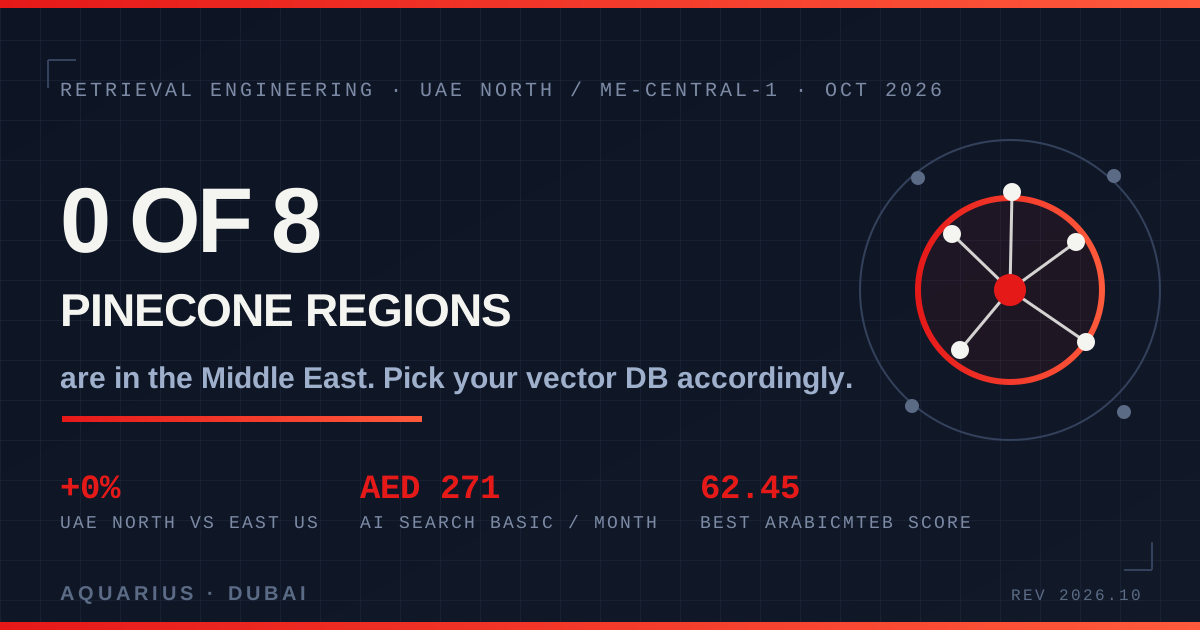
If your Dubai AI assistant gives confident wrong answers, the model is almost never the problem — retrieval is. The fix is a retrieval stack sized for the UAE: a vector store you can legally and practically host here, chunking that respects Arabic sentence structure, hybrid search, and a reranker. Done properly, that stack runs from roughly AED 271 a month (Azure AI Search Basic in UAE North) to AED 1,300 a month for a production pgvector cluster — and the in-region premium for keeping data in the UAE is, on Microsoft's own published rates, exactly zero.
Dubai's 2026 AI problem is a data-retrieval problem
UAE businesses are not short of AI ambition. Adoption among UAE organisations has climbed to 72% from 53% the year before, and 90% say they are increasing AI spend — yet only 16% report measurable revenue impact. KPMG's 2026 UAE tech survey found 97% of UAE tech leaders are embedding AI agents into workflows, against 87% globally.
So why so little revenue? Gartner's working estimate is that more than half of generative-AI projects are abandoned after proof-of-concept, and that through 2026 60% of AI projects will be abandoned because organisations lack AI-ready data. That is not a model-quality statement. It is a retrieval statement: the index is wrong, so the answer is wrong.
The stakes are local and expensive. IBM's 2026 cost-of-a-breach figures put the Middle East average at USD 8.0 million (about AED 29.4 million) per incident — which is why "just ship the data to a US vector database" stops being a shortcut and starts being a board-level decision. Meanwhile the UAE cloud market is tracking from USD 16.43 billion in 2026 to USD 56.26 billion by 2031, a 27.93% CAGR, so in-region capacity is getting better, not worse.
The myth that quietly kills UAE RAG projects
Here is the thing most Dubai teams discover three weeks into a build: you cannot host Pinecone in the Middle East.
Pinecone's own serverless index documentation lists eight regions — AWS us-east-1, us-west-2, eu-west-1, eu-central-1 and ap-southeast-1; GCP us-central1 and europe-west4; Azure eastus2. None of them is in the Middle East. Free Starter projects are restricted to us-east-1 only. Weaviate Cloud's managed offering is similarly narrow — five cloud regions, with the shared tier generally available on AWS us-east-1 and eu-central-1. Qdrant Cloud runs on all three hyperscalers but does not publish a region list you can plan a data-residency position around.
That matters because the vendor you were most likely to shortlist is the one you cannot use if your contract, your regulator, or your DIFC client says UAE-resident. And it cuts the other way too: shipping embeddings of customer records to us-east-1 is a cross-border transfer under Federal Decree-Law No. 45 of 2021, and embeddings of personal data are still personal data. Read our deeper breakdown of private LLM and AI data residency in Dubai before you commit an architecture.
Azure AI Search in UAE North: fully featured, frequently full
The best in-region managed retrieval engine today is Azure AI Search in UAE North. On Microsoft's region-support matrix (updated 24 October 2026) UAE North ticks essentially every premium box: AI enrichment, semantic ranker, agentic retrieval, query rewrite, serverless, availability zones and higher storage limits.
And then there is footnote 2, attached to UAE North in Microsoft's own documentation:
"This region is in high demand, which prevents the creation of new search services. Please choose a different region."
That single line reshapes a Dubai AI roadmap. The feature set is there; the capacity may not be on the day you provision. Two practical consequences: provision your search service early, well before the application is ready, and have a second in-region pattern designed so a capacity refusal is an inconvenience, not a replatform. Note also that UAE North appears on Azure's confidential-computing list for AI Search — and confidential compute disables or restricts several of the features you may have shortlisted it for, including agentic retrieval, semantic ranker, query rewrite and skillset execution.
In-region residency is free — we checked the live price list
A persistent assumption in Dubai procurement is that UAE-resident infrastructure carries a 20-40% premium. For Azure AI Search, it does not. We pulled the Azure Retail Prices API on 25 October 2026 for both uaenorth and eastus. The rates are identical to the cent.
| Azure AI Search tier | UAE North (USD/hr) | East US (USD/hr) | UAE North / month (AED, 730 hrs) |
|---|---|---|---|
| Basic | 0.101 | 0.101 | AED 271 |
| Standard S1 | 0.336 | 0.336 | AED 901 |
| Standard S2 | 1.344 | 1.344 | AED 3,603 |
| Standard S3 | 2.688 | 2.688 | AED 7,206 |
| Storage Optimized L1 | 3.839 | 3.839 | AED 10,292 |
| Storage Optimized L2 | 7.677 | 7.677 | AED 20,581 |
Converted at USD 1 = AED 3.6725. Confidential-compute variants of the same SKUs are a flat +10% (Basic CC USD 0.1111/hr, S1 CC USD 0.3696/hr). The semantic ranker in UAE North meters at USD 1 per 1,000 queries (AED 3.67), and agentic retrieval runs USD 0.000022 per 1,000 tokens at low or minimum reasoning, rising to USD 0.0001 per 1,000 tokens at medium reasoning.
The lesson: in the UAE, data residency is a capacity problem, not a cost problem. Budget for the engineering around availability, not for a residency surcharge that does not exist.
Four vector-store patterns that work for a Dubai deployment
1. pgvector on Azure Database for PostgreSQL, UAE North — the pragmatic default
For most Dubai businesses under roughly 5-10 million vectors, a Postgres instance with the pgvector extension and an HNSW index is the right answer. You get one database, one backup regime, one residency story, and SQL filters alongside vector search — which is how real queries actually look: documents for this tenant, in Arabic, after March 2026, nearest to this question.
Live UAE North rates for Flexible Server: General Purpose compute is USD 0.1085 per vCore/hr, so a 4-vCore D4ds_v5 is USD 0.434/hr (about AED 1,164/month) and an 8-vCore is USD 0.868/hr (about AED 2,327/month). Burstable B2ms sits at USD 0.158/hr (AED 424/month) for staging. Premium SSD v2 storage is USD 0.138 per GiB/month, so 256 GiB adds roughly AED 130. Memory-optimised E4ds_v5 is USD 0.60/hr if your working set has to stay in RAM. Confidential-compute DCasv5 is USD 0.098 per vCore/hr — cheaper per core than General Purpose, which surprises most people.
2. Azure AI Search UAE North — when you need the whole pipeline
Choose this when you want managed chunking, OCR-style document cracking, skillsets, hybrid search and a semantic reranker without building any of it. Document-cracking image extraction meters at USD 0.65-1.00 per 1,000 images; custom entity skills at USD 0.25-1.00 per 1,000 text records. Provision early because of the capacity footnote above.
3. Pinecone or Weaviate Cloud — only with an explicit cross-border position
Fast to adopt, genuinely good products, and the entry pricing is low: Pinecone Builder is USD 20/month flat, Standard starts at a USD 50/month minimum (AED 184), Enterprise at USD 500/month (AED 1,836), with read units at USD 16-18 per million and storage at USD 0.33/GB/month. Just be clear with your legal team that the index lives outside the UAE.
4. Self-hosted Qdrant or Milvus on AWS me-central-1 — when scale or sovereignty demands it
Running the open-source engine yourself in the UAE region gives you full residency control and no per-read metering. Qdrant's free managed tier (0.5 vCPU, 1 GB RAM, 4 GB disk) is fine for a prototype; its Premium plan adds SSO and a 99.9% SLA. Self-hosting costs you a DevOps owner — budget that honestly rather than discovering it in month four. Amazon Bedrock's runtime endpoint is available in me-central-1, with global cross-region inference for Claude models in the Middle East regions, so the generation half can stay close by.
| Pattern | UAE-resident? | Indicative monthly (AED) | Best for |
|---|---|---|---|
| pgvector on Azure PostgreSQL (UAE North) | Yes | AED 1,290 (4 vCore + 256 GiB) | Under ~10M vectors, SQL filters, one DB to run |
| Azure AI Search S1 (UAE North) | Yes | AED 901 + AED 3.67 / 1,000 ranked queries | Managed chunking, skillsets, semantic ranking |
| Pinecone Standard | No — 8 regions, none in the Middle East | From AED 184 usage minimum | Non-personal data, speed to prototype |
| Self-hosted Qdrant / Milvus on me-central-1 | Yes | AED 1,100-4,000 + DevOps time | 100M+ vectors, strict sovereignty |
Why your bilingual assistant gets Arabic questions wrong
This is the most under-diagnosed failure in Dubai AI builds. An assistant answers English questions well and Arabic questions badly, and the team blames the LLM. It is almost always the embedding model and the chunker.
ArabicMTEB — the Arabic massive text-embedding benchmark introduced with the Swan model family (ACL Findings, NAACL 2025) — spans 8 task categories across 94 datasets, covering dialect, cross-lingual and cultural retrieval. On its aggregate score Swan-Large averages 62.45 and Swan-Small 57.33, with Swan-Large outperforming Multilingual-E5-large on most Arabic tasks. If you embedded your Arabic corpus with a model tuned on English web text, you are losing recall before the LLM is ever called.
Three fixes, in order of payoff:
- Pick an Arabic-competent embedding model. Benchmark candidates such as BGE-M3, Multilingual-E5-large and Arabic-specialised models on your own documents, not on a leaderboard.
- Chunk on sentence boundaries, not character counts. Arabic sentence structure and diacritics make naive 512-character splits cut mid-clause, which destroys the semantics of the chunk.
- Add a reranker. Across published RAG evaluations, reranking a wide candidate set is consistently the single biggest accuracy lever on complex, multi-document questions — and it improves faithfulness, not just ranking.
If you are still choosing the generation model, our Arabic LLM comparison for UAE businesses covers that half of the stack.
The retrieval stack that actually lifts accuracy
A production UAE RAG system has six moving parts, and skipping any one of them is how you end up with a demo that never ships:
- Hybrid search. Vector similarity plus BM25 keyword matching. Keyword search catches Emirates ID formats, trade-licence numbers, SKUs and part codes that embeddings blur.
- Metadata filters at query time. Tenant, language, document type, effective date. Non-negotiable for multi-entity Dubai groups.
- HNSW index tuning. Build parameters trade index time and memory against recall. Measure recall at k on a labelled set — do not accept defaults.
- A reranker before the prompt. Retrieve wide, rerank narrow, send few.
- Groundedness evaluation in CI. A fixed question set with expected sources, run on every change. Published evaluations consistently find that nearly all wrong RAG answers still cite sources — so "it showed a citation" is not evidence of correctness.
- Query rewriting. Dubai users mix Arabic and English in one sentence and drop context across turns. Rewrite before you retrieve.
If you are building the assistant itself rather than just the index, our guide to AI chatbot development in Dubai covers the surrounding architecture.
What it costs in AED — and how Aquarius builds it
Embeddings are the cheapest part and people over-think them. OpenAI lists text-embedding-3-small at USD 0.02 per million tokens and text-embedding-3-large at USD 0.13 per million (ada-002 at USD 0.10). Embedding a 10-million-token corpus — roughly 7.5 million words, a very large Dubai document estate — costs AED 0.73 with 3-small or AED 4.78 with 3-large. One-off. Re-embedding your entire corpus when a better model appears is affordable, so do not let model lock-in frighten you.
The recurring costs are the index and the ranking. A realistic Dubai production retrieval layer:
- pgvector on Azure PostgreSQL, 4 vCore plus 256 GiB, UAE North: about AED 1,290/month
- Or Azure AI Search S1 in UAE North: AED 901/month
- Semantic reranking at 50,000 queries/month: about AED 184/month
- Agentic retrieval at medium reasoning: AED 0.37 per million tokens
- Corpus embedding refresh: under AED 5 per full pass
Call it AED 1,100-1,500 a month in infrastructure for a well-built, UAE-resident retrieval layer serving a mid-sized business — against an AED 29.4 million average regional breach cost and the opportunity cost of being one of the 84% of UAE adopters not yet seeing revenue from AI.
How we do it at Aquarius: we start with a labelled evaluation set from your own documents before choosing any vector store, because the store is the easiest thing to change and the eval set is the hardest to fake. We provision UAE North capacity on day one so the footnote never blocks us. We default to pgvector in-region until measured scale justifies something heavier. And we ship a groundedness dashboard with the assistant, so you can watch recall and faithfulness trending instead of waiting for a customer complaint. Fixed-scope figures are on our pricing page, and the full build sits under our services. If retrieval accuracy does not clear the targets we agree in writing at kickoff, we keep iterating at no extra cost — that is the deal.
FAQ
Can I host Pinecone in the UAE?
No. Pinecone's serverless documentation lists eight regions across AWS, GCP and Azure, and none of them is in the Middle East; free Starter projects are limited to AWS us-east-1. If your data must stay UAE-resident, use pgvector on Azure Database for PostgreSQL in UAE North, Azure AI Search in UAE North, or self-host Qdrant or Milvus on AWS me-central-1.
Does keeping a vector database in the UAE cost more?
Not on Azure AI Search. The Azure Retail Prices API on 25 October 2026 shows UAE North and East US at identical rates — Basic USD 0.101/hr, S1 USD 0.336/hr, S3 USD 2.688/hr. Confidential-compute variants add a flat 10%. The real UAE constraint is capacity, not price: Microsoft's own documentation flags UAE North as high-demand and may refuse new search services.
Do I need a dedicated vector database at all?
Usually not at first. Below roughly 5-10 million vectors, pgvector with an HNSW index inside your existing Postgres gives comparable recall with one less system to run, one backup regime and SQL filters in the same query. Move to a dedicated engine when you have measured a specific latency or scale ceiling, not in anticipation of one.
Why does my chatbot answer English well but Arabic badly?
Almost always the embedding model and the chunker, not the LLM. ArabicMTEB evaluates embeddings across 8 task types and 94 datasets, and Arabic-tuned models such as Swan-Large (62.45 average) beat general multilingual baselines on most of them. Combine an Arabic-competent embedding model with sentence-aware chunking and a reranker.
How long does a production RAG build take in Dubai?
Six to ten weeks for a single-domain assistant with UAE-resident retrieval, an evaluation harness and bilingual handling — assuming your documents exist in a usable form. The document-preparation stage, not the AI stage, is what moves that timeline.
Most Dubai AI assistants do not need a better model. They need a retrieval layer designed on purpose: in-region, with Arabic in scope, and accuracy measured in CI. If you want a second pair of eyes on yours — or a build that starts from the evaluation set — tell us what you are trying to answer.