
Real Estate Tokenization Platform Development in Dubai (2026): DLD & VARA Rules, Stack and AED Costs
Build a DLD-aligned property tokenization platform in Dubai: VARA fees, AED 1,000 tickets, secondary markets and real AED 250K-1.2M build costs.
- PUBLISHED
- 17 SEPT 2026
- READ TIME
- 11 MIN
- AUTHOR
- AQUARIUS · DUBAI
- UNIT
- REV 2026.09
Short answer: A real estate tokenization platform in Dubai lets investors buy fractions of a DLD-registered property as digital tokens, from as little as AED 1,000–2,000. In 2026 you can't just launch one on any blockchain. The token has to connect to Dubai Land Department title records, the activity usually needs VARA authorisation, and investor money has to sit in regulated accounts. The software itself (investor app, KYC, token ledger, secondary market, DLD integration) typically costs AED 250,000–1.2M to build, depending on scope.
Many Dubai developers and brokerages make the same mistake: they treat tokenization as a crypto project. In Dubai it's really a property-registration project with a blockchain inside it. This guide covers the market numbers, the approved routes, the platform you actually need, what it costs in AED, and where most first attempts get stuck.
Why tokenized property matters in Dubai right now
These are the numbers every developer, brokerage and proptech founder in Dubai should know:
- AED 917 billion. Dubai closed 2025 with more than 270,000 real estate transactions worth over AED 917 billion, up 20% year on year (Dubai Government / DLD). Q1 2026 alone reached AED 252 billion, up 31%.
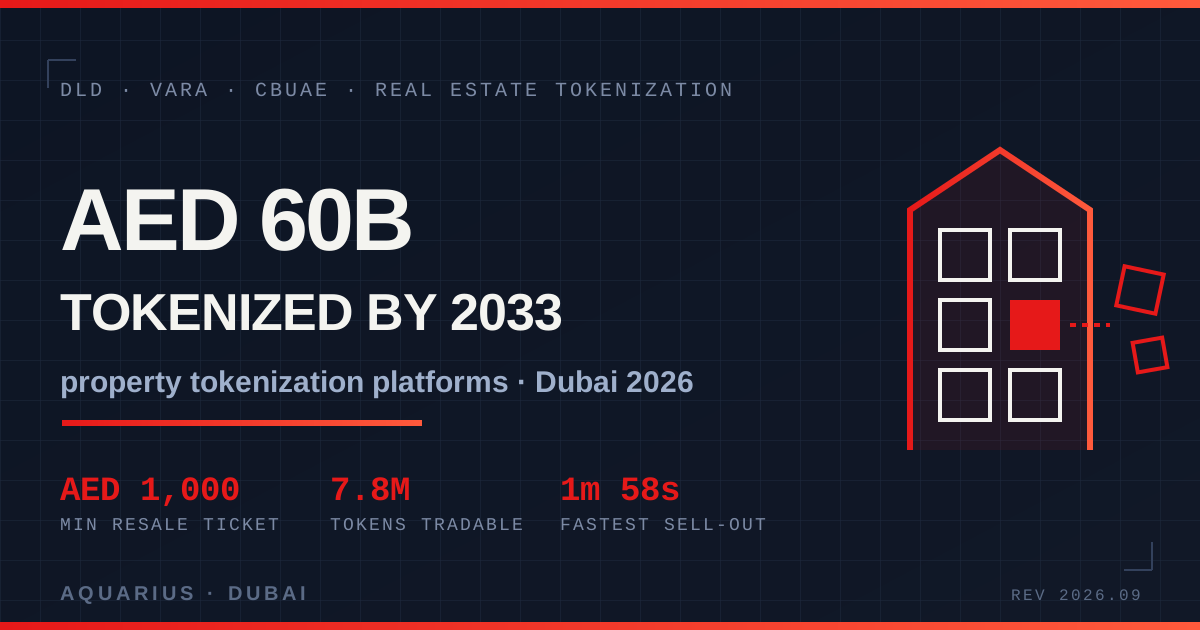
- AED 60 billion by 2033. DLD expects tokenized real estate to reach about AED 60 billion by 2033, roughly 7% of Dubai's property transactions.
- AED 18.5 million in the pilot. Between May 2025 and February 2026, investors from 50+ nationalities put more than AED 18.5 million into tokenized Dubai property through PRYPCO Mint. One listing sold out in 1 minute 58 seconds.
The part that should get attention is who bought. On the first tokenized project, 70% of the 224 investors had never invested in Dubai property before, and the average ticket was AED 10,714 (DLD). Tokenization isn't just a new way to sell units to existing investors. It brings in buyers who could never afford a whole apartment.
Myth: "Tokenization means putting property on a public blockchain and letting anyone trade it." Fact: in Dubai the token is tied to a DLD title record, investors are KYC-verified, funds sit in CBUAE-supervised accounts, and resale runs in a controlled market.
How Dubai's tokenization model actually works
The DLD Real Estate Tokenization Project launched in March 2025 through DLD's Real Estate Sandbox. It was built with VARA, the Dubai Future Foundation, the Central Bank of the UAE and Zand Digital Bank. Its first platform, PRYPCO Mint, runs on infrastructure from Ctrl Alt, which issues title-deed tokens on the XRP Ledger. Each regulator has a clear job:
- Dubai Land Department (DLD) verifies the property, reviews pricing before listing, keeps the title record, and issues a Property Token Ownership Certificate to investors.
- VARA regulates the virtual-asset side: issuing, holding and trading the tokens.
- CBUAE supervises investor funds in regulated client-money accounts. Money is released only after the title transfer.
Phase 2: the secondary market
On 20 February 2026, secondary trading opened for about 7.8 million tokens across ten Dubai properties. Sellers can list within ±15% of the current valuation shown in the app, and in July 2026 the secondary-market minimum dropped from AED 2,000 to AED 1,000. Investors also pay a 2% DLD fee instead of the usual 4%, and each investor is capped at 20% ownership of any one property.
That's the benchmark any new Dubai platform is judged against: low minimums, instant checkout, government-issued certificates, and a resale button. Your product has to match it or have a clear angle of its own, like a single developer's inventory, a commercial asset class, or a GCC investor base.
The routes to market: which one fits you?
How you're regulated decides your budget and timeline more than any technical choice. Here are the realistic options in 2026:
| Route | Best for | Regulator(s) | Typical time to market |
|---|---|---|---|
| Partner with an existing licensed platform | Developers wanting to tokenize units fast | Platform holds approvals; you list assets | 2–4 months |
| DLD Real Estate Sandbox | Proptechs with a new model | DLD + VARA | 6–9 months |
| Own VARA authorisation (Category 1 issuance / broker-dealer) | Funded platforms planning scale | VARA, DLD for title | 6–12+ months |
| ADGM / DIFC fund or SPV structure | Institutional and commercial assets | FSRA / DFSA | 6–12 months |
Legal advisers put the full journey, from feasibility and entity setup through licensing and technology, at around six to nine months when it's well prepared, and more than twelve months when it isn't. Licensing is the slowest part (3–6 months). The technology can be built in parallel.
What VARA licensing costs in AED
Under VARA's fee schedule, higher-tier activities such as broker-dealer, custody, exchange and Category 1 issuance carry a AED 100,000 application fee and a AED 200,000 annual supervision fee. Each additional activity adds an extension fee. On top of that you need paid-up capital: broker-dealer starts around AED 400,000–600,000, and an asset-referenced token issuer needs at least AED 1.5 million or 2% of reserve assets, whichever is higher, plus net liquid assets of 1.2× monthly operating costs. The licence fee isn't the real cost of a licence. The capital and compliance headcount are.
The platform stack you actually need to build
Whatever route you choose, investors see an app. The regulators see the back office. A Dubai-grade tokenization platform needs:
- Investor app (iOS, Android, web) in Arabic and English, with UAE PASS and passport-based onboarding for foreign investors.
- KYC/AML engine: identity checks, sanctions and PEP screening, source-of-funds checks and goAML reporting. See our AML/KYC compliance software guide.
- Asset onboarding workflow: title deed data, valuation reports, SPV documents and DLD pricing approval before a listing goes live.
- Token issuance and cap table: the ledger integration (XRP Ledger, an EVM chain or a permissioned chain) with a mirrored off-chain register. It must enforce transfer rules such as the 20% cap and KYC-only wallets.
- Payments and escrow: AED card and bank-transfer rails into regulated client-money accounts, with funds released only after title transfer.
- Secondary market: an order book or listing board with price bands (like the ±15% rule), settlement and fee logic.
- Rental distributions: automatic pro-rata payouts of net rental income to token holders, with statements.
- Admin and regulator reporting: audit trails, investor registers and exportable reports for DLD/VARA reviews, all built to meet UAE PDPL data rules.
Build vs white-label
| Option | Upfront (AED) | Timeline | Trade-off |
|---|---|---|---|
| White-label tokenization SaaS + branded front end | 60,000–200,000 + monthly licence | 6–10 weeks | Fast, but limited DLD-specific logic and vendor lock-in |
| Custom MVP (primary sale, KYC, escrow, distributions) | 250,000–550,000 | 4–6 months | You own the IP; secondary market comes later |
| Full platform (MVP + secondary market + admin/regulator suite) | 600,000–1,200,000+ | 6–9 months | Ready for scale and licensing reviews |
Build ranges are Aquarius quote bands for UAE projects in 2026. Regulatory fees and capital are separate.
Costs, risks and how to launch without burning a year
Here's why this is worth doing now: fractional buyers bring new money. On DLD's first project, 70% of investors were first-time Dubai property buyers, and they got in with an average of just over AED 10,000. For a developer, that's a new sales channel for units that would otherwise sit on the market. For a brokerage, it's recurring fee income from investors who top up every month.
The mistakes that cost Dubai teams the most
- Building the app before mapping the regulation. If your structure needs a broker-dealer licence you didn't plan for, much of the product gets rebuilt.
- Treating the blockchain as the register. In Dubai the DLD record is the legal truth. Your on-chain and off-chain registers must always reconcile with it.
- Skipping the resale story. Investors now expect liquidity. A platform with no secondary market or buyback path is a harder sell in 2026.
- Underbudgeting compliance. AED 200,000 a year in VARA supervision, plus a compliance officer, audits and insurance, often costs more than the yearly software maintenance.
How Aquarius builds tokenization platforms
We start with a two-week regulatory and product mapping sprint. It confirms your route (partner, sandbox, VARA or ADGM/DIFC) before any code is written, so you don't build the wrong product. Then we deliver in milestones: investor onboarding and KYC first, then issuance and escrow, then distributions and the secondary market. Each milestone is demo-ready for your legal team and regulator conversations. You own the code, the smart contracts and the data. See our services and pricing, or read our guide to custom software development costs in Dubai.
Waiting has a cost too. DLD's own forecast puts AED 60 billion of Dubai property on token rails by 2033. The platforms investors trust by then are being built now.
FAQ: real estate tokenization in Dubai
Is real estate tokenization legal in Dubai?
Yes. DLD launched its official Real Estate Tokenization Project in March 2025 with VARA, CBUAE and the Dubai Future Foundation. Tokenized ownership is recorded against DLD title data, and investors receive a Property Token Ownership Certificate.
What is the minimum investment in tokenized property in Dubai?
On PRYPCO Mint, primary listings start at AED 2,000. Since July 2026 the secondary-market minimum has been AED 1,000. Investors pay a 2% DLD fee instead of the standard 4%.
How much does it cost to build a real estate tokenization platform in Dubai?
Expect roughly AED 60,000–200,000 for a white-label launch, AED 250,000–550,000 for a custom MVP, and AED 600,000–1.2M+ for a full platform with a secondary market. VARA fees (for example, AED 100,000 to apply and AED 200,000 a year for higher-tier activities) and capital requirements are extra.
Do I need a VARA licence to tokenize property?
It depends on your structure. Listing through an existing approved platform may not require your own licence. Running issuance, brokerage or trading yourself usually does, or you can go through the DLD sandbox or an ADGM/DIFC regime. Get the route confirmed by legal counsel before you build.
Which blockchain does Dubai use for property tokens?
DLD's first platform, PRYPCO Mint, uses Ctrl Alt's infrastructure on the XRP Ledger. New platforms can choose other chains, but they must still reconcile with DLD title records and enforce KYC-only transfers.
Planning a tokenized property product in Dubai? Talk to Aquarius. We'll map your regulatory route and give you a fixed AED quote for the platform within a week.